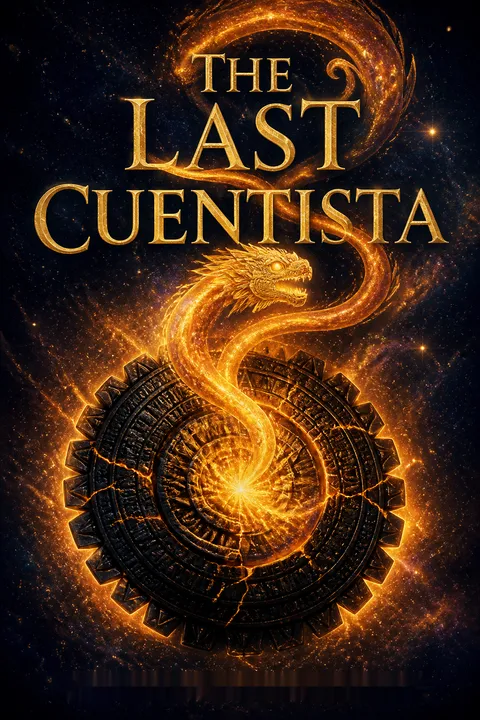


Plot Summary
Fire Snake Farewell
Thirteen-year-old Petra Peña sits beneath the New Mexico stars with her grandmother Lita, who gives her an obsidian sun pendant and tells of a blind fire snake forever seeking its mother. Halley’s Comet is now on course to strike Earth, and Petra’s family has been selected to flee aboard a colony ship bound for Sagan.
Petra cannot bear to leave Lita, her desert home, or her tortoise, Rápido. Her mother, Amy, and father, Robert, try to explain that the journey offers humanity a chance to survive, but Petra sees the people left outside the guarded launch site. Lita urges Petra to carry their family’s stories forward. The pendant becomes a promise that distance cannot erase their bond.
The opening makes inheritance an intimate act before it becomes a civilizational one. Lita’s story does not deny the comet or offer Petra a practical escape; instead, it gives the child a pattern for understanding separation and return. Petra’s resistance is not simple ingratitude. She recognizes the moral cost of being saved while others are abandoned, and her anger keeps the family’s survival from feeling like uncomplicated good fortune. The pendant condenses this tension: it is both a keepsake and a tool for imagining connection across impossible distance.
The Ship's Hidden Purpose
At the forest launch site, Petra sees desperate families held back by armed guards while her own family boards one of the last ships. Her parents have concealed the full mission: the passengers will sleep for 380 years while the Monitors maintain the vessel. Petra also overhears news of the Collective, a movement promising peace by erasing difference and history.
Inside the luxury liner, the children’s Monitor, Ben, reveals that Petra and her younger brother Javier will sleep apart from their parents. Javier panics when Petra tries to comfort him with Lita’s story, so she replaces it with a simple star-counting riddle. He enters stasis first. As Petra’s turn comes, the crowd outside attacks, and the ship begins closing its doors.
The departure turns rescue into a compromised privilege. The family’s passage depends on a selection system that leaves others outside, while the Collective’s rhetoric offers a seductive answer to the very conflicts that made the world so unequal. Petra’s failure to soothe Javier exposes how hard it is to inherit a story rather than merely repeat it: comfort can misfire when a child hears its images literally. Still, she learns to adapt, and the star riddle becomes a more careful act of care. The attack compresses private grief into public emergency.
Awake Inside Stasis
Ben cannot find the mythology elective Petra’s parents arranged, but promises to add stories from his own collection. Before he can finish, the ship’s attackers force an emergency launch.
Petra’s Cog immobilizes her body without putting her mind to sleep, leaving her conscious as gel fills the pod and her family disappears from the room. Ben reads ancient stories aloud, then secretly loads literature and mythology into her Cog, hoping it will survive. A later group of Monitors attacks him and orders Petra’s cultural files deleted.
Their leader calls for a new history without Earth’s memories. Petra cannot move or warn Ben. When the Cog’s program begins to take hold, she drifts toward sleep carrying Lita’s stories and the books Ben tried to preserve.
Petra’s paralysis gives the book’s central conflict a bodily form: her mind remains active while every means of acting or speaking is removed. Ben’s choice to preserve stories is therefore more than a kindness; it is an intervention against a system already converting people into useful, programmable assets. The stolen files also complicate the idea of memory as private property. Petra receives a cultural inheritance she did not choose, but unlike the Collective’s imposed sameness, it expands her possible identities rather than narrowing them.
Zeta One Awakens
In 2432, Petra wakes on Sagan to a ship stripped of its gardens and recreation spaces. The Collective has taken control, renamed the children Zetas, and programmed them to serve. Chancellor Nyla forces Suma back into stasis for reprogramming after Suma wakes frightened and confused. Petra repeats the required identity of Zeta-1 while privately clinging to her own name and departure date.
When Nyla’s staff examines her eyes, Petra expects her retinitis pigmentosa to make her disposable, but Nyla values her downloaded scientific knowledge instead. Petra learns that the adults and children are being assigned as tools, not welcomed as fellow settlers. She hides what she remembers, knowing that one wrong answer could send her back into a pod.
Petra survives by splitting outward compliance from inward identity. This is not a triumphant resistance yet; it is a psychologically costly form of concealment, grounded in her recognition that open refusal would give Nyla control over her body and memories. The Collective’s acceptance of Petra despite her eyesight is not genuine inclusion, since it values her only for what her mind can produce. The scene exposes a familiar institutional bargain: a person may be tolerated as exceptional so long as the exception remains useful.
A Garden Turned White
Nyla leads Petra and the other young Zetas through the ship’s empty central atrium, where the former park, theater, and cafeteria have vanished. At a Collective gathering, holograms show Halley’s Comet striking Earth; Nyla presents the extinction as a clean break from humanity’s troubled past.
She assigns Petra, Rubio, and the younger Zeta-4 to a planetary scouting mission with Len, a nervous Collective member who drinks tonic to steady himself. Petra sneaks away to search the adults’ quarters, but finds only honeycomb beds.
In the hold, she discovers her parents’ and Javier’s pods are empty. Their records say their attempts at reprogramming failed and they were purged, years apart. Petra collapses beside their names, with the family life she expected on Sagan gone.
The destruction of Earth is framed by Nyla as a cure, but Petra experiences it as the loss of specific people, places, and unfinished relationships. The barren atrium makes the Collective’s theory visible: life has been reduced to what can be maintained and measured. The empty pods then puncture its claim to protect humanity, showing that its survival plan has already discarded the people it promised to carry forward. Petra’s grief is sharpened by the dates, which imply not one shared catastrophe but years of isolated erasure.
Cuentos Against Forgetting
Back in the children’s quarters, Petra finds Zeta-4 crying from a dream about her mother, despite having no conscious memory of her. Petra sings Lita’s lullaby and retells a folktale, reshaping its heroine into a clever girl who outwits a tyrant.
Rubio listens too, and the children begin to respond to stories as more than assigned knowledge. Petra decides they deserve their memories, then plans an escape. On a later scouting trip, the group returns to Sagan and Petra confirms that the lake water can be filtered and a glowing cave might shelter them.
Len develops painful blisters after exposure to the planet’s environment. Petra uses the children’s water to cool him, but Nyla warns her not to risk a useful Zeta for someone she considers expendable.
Storytelling becomes a practical form of care before it becomes a strategy of resistance. Petra’s tale lets the younger girl feel grief without knowing its source, while the act of listening gives Rubio and the others a first experience of attention not organized by the Collective. Petra’s response to Len tests whether she will reproduce Nyla’s hierarchy of usefulness. By helping him despite the danger, she acts on an ethic in which vulnerability creates a claim on others rather than a reason for disposal.
The Last Emergency Stores
When Glish questions whether the Collective’s sacrifices benefit anyone, Nyla has her removed, and the others quickly fall silent. Voxy secretly slips extra bioloaf into Petra’s bag, giving her the food she needs for an escape.
Suma later wakes after a second reprogramming, and Petra folds her into the growing circle of listeners through another cuento. Searching the hold for emergency food and water filters, Petra finds the rations gone. An elderly, reprogrammed scientist called Epsilon-5 discovers her and brings her to the laboratory, where he administers the Collective’s mood tonics.
Petra recognizes that he has been kept working for decades, isolated from the world outside the lab. His curiosity about Sagan’s creatures makes her like him, even as she realizes she may have to leave him behind.
The Collective’s control is sustained not only by force but by routine: Glish disappears, meals continue, and the group learns to treat removal as ordinary. Voxy’s small act of generosity interrupts that routine and makes solidarity possible without requiring a speech or a fully formed rebellion. Epsilon-5 offers a more painful complication. He is neither a free ally nor a clear antagonist; his gentle curiosity persists inside a role designed to regulate others. Petra’s growing capacity for care now collides with the limits of what one child can rescue.
The Vault Behind Voxy
Voxy leads Petra to the Chancellor’s quarters, where a concealed door opens into a frozen seed vault. Earth’s solar system glows above drawers of preserved seeds, family photographs, certificates, and personal effects removed from the passengers.
Petra finds her own obsidian pendant and Javier’s picture book, Dreamers, but leaves them in place when Voxy urges caution. The vault also contains unused Cogs and a record of failed reprogrammings. Later, Nyla tells Voxy that relics must remain hidden because memories and possessions cause conflict.
Petra overhears her admit that the Collective is preparing a new batch of conditioned children. Nyla also reveals that nearby First Arrivers may be living on Sagan, but calls them hostile and says the Collective intends to prevent future conflict with them.
The vault makes the Collective’s abstract doctrine tangible: it has not merely forgotten Earth but deliberately stored its evidence out of view. Family photographs, children’s clothes, and seeds contradict the claim that the past consists only of greed and war. Voxy’s access to the room reveals how control depends on denying people the means to compare official history with material proof. The planned new batch also clarifies that the system is not a temporary emergency response. It is designed to reproduce itself across generations.
Epsilon Five Is Javier
While helping Epsilon-5 prepare a defoliant, Petra learns that the samples she collected are missing. The scientist explains that Nyla instead ordered him to extract a short-lived airborne toxin to eliminate a threat on Sagan. Petra realizes the target may be the First Arrivers. Then she sees the constellation of freckles on Epsilon-5’s thumb, the same birthmark she used to rub on Javier when they were children.
She recognizes her brother, now elderly after decades of service, though he has no memory of her. Petra hides the truth from Nyla and persuades her to let Javier join the next mission. She also claims she can improve the toxin, buying time to weaken it with stasis gel and oxygen before the Collective can use it.
Javier’s return does not undo the loss of their childhood; it makes the cost of that loss newly visible. Petra recognizes him through a small bodily detail, not through a stored narrative, because the Collective has stripped away the shared memories that would ordinarily confirm kinship. Her decision to manipulate Nyla marks a shift from survival through concealment toward purposeful deception. Yet the toxin makes resistance ethically difficult: Petra’s scientific skill, originally meant to help settlers, has been redirected toward mass killing.
Dreamers Comes Home
At Nyla’s public gathering, Petra learns the Collective will leave Sagan rather than risk living there, but plans to poison the First Arrivers before departing. She steals back her pendant and family keepsakes, including her father’s hand-polished jasper rosary and her mother’s wedding ring.
She also retrieves Suma’s baby book and unicorn sweatshirt, then carries Javier’s Dreamers to the laboratory. Reading the picture book rekindles his memories of Petra, their parents, and their life on Earth.
Javier agrees to help the other Zetas escape. Before they can leave, Nyla catches Petra with Voxy and orders her reprogrammed. Javier appears to side with the Chancellor, and Petra enters the pod believing her brother has chosen the Collective over her.
The book and keepsakes restore identity through sensory recognition rather than argument. Javier’s memory returns through a familiar story and the repeated physical act of touching its illustrations, while Petra’s father’s rosary carries a patient craft built from distinct stones. These objects resist the Collective’s premise that difference is a source of disorder. The apparent betrayal at the end of the section exploits Petra’s deepest fear: that recovering a relationship may not be enough to recover the person she lost.
Ben's Library Within
As an adult Cog begins to erase her memories, Petra enters a dreamlike library where a program modeled on Ben shows her the stories he managed to preserve. The library is damaged, but its surviving books make Petra understand that she is a storyteller, not merely the scientist her parents’ curriculum prescribed. She refuses to remain in the comforting vision.
Javier has secretly removed the Cog and loaded the Zetas into the shuttle. He cannot go with them: he stays aboard to lock Nyla out of remote controls and launch the shuttle, sacrificing his own escape. Petra wakes as the craft descends toward Sagan, grieving him again but carrying the others and the stolen belongings toward the landing site.
The library is both an interior refuge and a final test of agency. Petra could remain surrounded by stories and avoid further pain, but choosing to wake means choosing a damaged, uncertain life over perfect imaginative shelter. Ben’s preservation work pays off as a resource Petra can carry forward, not as an escape from history. Javier’s sacrifice reverses the apparent betrayal: his restored identity enables him to give the younger children a future, even though it costs him the chance to share it.
Five Against the Drones
Voxy follows Petra onto the planet, choosing life beyond the Collective. Petra leads him, Suma, Rubio, and Feathers through a windstorm to the cave, only to find that the stored bioloaf has been eaten.
They continue toward the First Arrivers’ settlement, and Suma recognizes herself through her baby book and her mothers’ images. A swarm of drones then releases the green toxin near the waterfall. Petra gets the group across a dangerous river and into shelter as the poison mist fades.
They find no people in the exposed field, only a woven wall of trees. The Collective ship approaches, then launches away instead of retrieving them. Smoke and distant music rise from the caves, suggesting survivors remain. Petra begins a new cuento for her improvised family.
The ending refuses an easy rescue. The five escape the ship’s control, but must face hunger, weather, and uncertainty without the infrastructure that kept them alive. The toxin attack shows that the Collective’s promise of peace still depends on treating other lives as obstacles. Yet the final signs of smoke and music leave room for contact and continuation rather than certainty. Petra’s cuento now includes loss instead of disguising it, allowing the group to inherit a past without being trapped by it.
Analysis
The novel makes the struggle over memory concrete through bodies, objects, and repeated acts of telling. Petra’s failing eyesight narrows her visual field, but the Collective’s deeper blindness is chosen: it refuses to see people except as useful units, and history except as a source of disorder. By contrast, Petra learns to recognize others through touch, remembered habits, and stories. Her brother’s birthmark, a familiar picture book, and a rosary assembled from unlike stones all carry knowledge that cannot be reduced to an official record.
The Collective’s appeal is not merely villainous rhetoric. It responds to genuine human failures: war, scarcity, ecological damage, and unequal access to safety. The book’s critique therefore turns on method. Nyla answers flawed history by eliminating difference and suppressing dissent, reproducing violence under the language of protection. Petra’s parents offer a less certain alternative: preserve memory, acknowledge mistakes, and build cooperation without demanding sameness. Their ideal does not spare them from loss, but it gives Petra a way to judge what survival is for.
Storytelling becomes both an emotional technology and a social practice. Lita’s cuentos help Petra endure fear, but they also change as Petra tells them to children whose inherited context has been stripped away. A story remains alive because the teller adapts it, not because it stays untouched. Petra’s final role emerges through that adaptation. She cannot restore Earth or recover the years stolen from Javier, and she cannot guarantee safety for the group. She can preserve names, share memories, and help others imagine choices. The closing possibility of smoke and music matters because it is neither proof of a perfect rescue nor a return to the old world. It is evidence that life may continue beyond the Collective’s account of history, with stories carried forward by people who remain different from one another.
Review Summary
The Last Cuentista receives praise for its engaging storytelling, powerful themes of cultural preservation, and compelling protagonist. Many reviewers appreciate its blend of science fiction and Mexican folklore, noting its appeal to both middle-grade and adult readers. The book's exploration of identity, memory, and the importance of stories resonates strongly. Some critics find the pacing slow at times and the ending unsatisfying. Overall, it's viewed as a thought-provoking, emotional read that deserves its Newbery Medal, though opinions on its kid appeal vary.
People Also Read





Characters
Petra Peña
Reluctant young storytellerPetra is a nearly thirteen-year-old girl with retinitis pigmentosa, a sharp sense of fairness, and an imagination more vivid than the scientific future her parents plan for her. She loves her family, especially her younger brother Javier, but resents being protected in ways that limit her independence. Lita’s cuentos give her a way to understand fear and inheritance, though Petra doubts she can ever tell them as well. Her practical intelligence and downloaded scientific knowledge coexist with a strong need to shape experience through stories. She is most compelling when those capacities conflict: a child who wants to protect everyone, yet must learn that responsibility means choosing what to do with limited power.
Lita
Keeper of family storiesPetra’s grandmother is a warm, sharp-witted storyteller whose tales mix inherited folklore with her own inventions. She comforts Petra without pretending danger is unreal, and urges her granddaughter to make old stories her own rather than imitate her. Lita’s obsidian pendant and recurring tales give Petra emotional tools for separation, grief, and choice. Her influence is not simply nostalgic: she treats storytelling as an active practice that changes with the teller and the needs of the listener. Through Lita, Petra learns that cultural memory can travel even when homes, languages, and familiar landscapes cannot.
Javier Peña
Petra's younger brotherJavier is affectionate, playful, and closely bonded to Petra, who often serves as his protector and companion. He shares private rituals with her, including the touch of a constellation-shaped birthmark on his thumb, and trusts her even when he is frightened. His childhood enthusiasms range from a favorite picture book to an overfed pet frog. Javier’s dependence on Petra is mutual: his reassurance gives her a steadiness she struggles to find in herself. Their relationship is shaped by ordinary sibling teasing as much as by tenderness, making their shared memories a potent measure of what the family stands to lose.
Amy Peña
Protective botanist motherPetra’s mother is a botanist whose work and convictions center on sustaining plant life. She tries to keep her children safe, sometimes by steering Petra toward a future Petra has not chosen. Her fear during the evacuation complicates Petra’s view of her as overprotective: Amy is also grieving the people and places she must leave behind. Her Hyperion sapling represents both scientific hope and a personal attempt to carry Earth’s resilience into a new home.
Robert Peña
Patient geologist fatherPetra’s father is a geologist who teaches through patient attention to land and materials. He values careful collecting over taking everything available, and sees beauty in differences that complement one another. His quiet humor makes learning feel shared rather than imposed. Robert’s example gives Petra a practical model of respect for the natural world and a family ethic grounded in effort, restraint, and kindness.
Ben
Story-minded MonitorBen is the children’s Monitor aboard the colony ship, a young man who takes his responsibility to the sleeping children seriously. He is gentle with Javier and attentive to Petra’s interest in stories. His love of books and his belief that readers should encounter many kinds of narratives distinguish him from officials who regard knowledge as something to control. Ben’s grief and loneliness remain visible even while he performs his duties, making his kindness feel like a deliberate practice rather than easy optimism.
Chancellor Nyla
Architect of samenessNyla leads the Collective with polished composure and an absolute belief that unity requires the removal of difference. She frames control as protection, and her calm manner makes coercive decisions sound administrative rather than violent. Nyla values people for their usefulness to the group and treats memory, family ties, and unregulated knowledge as threats. She is not portrayed as chaotic or impulsive; her danger lies in the disciplined logic with which she converts fear of conflict into permission to erase other people’s lives.
Suma Agarwal
Unicorn-hooded ZetaSuma is a perceptive girl whose hoodie bears a silver unicorn horn, and whose skepticism persists even under the Collective’s conditioning. She is cautious about unexplained orders and attentive to inconsistencies others overlook. Her wit and stubbornness reveal a lively personality beneath the Zeta designation. Suma’s connection to her mothers and her own history is central to what Petra hopes to recover for the children, while her scientific ability makes her an important member of the group.
Voxy
Curious Collective childVoxy is a young child raised inside the Collective’s closed world. He is curious about Petra’s skin, stories, and the forbidden artifacts hidden aboard the ship. Though he knows the rules and fears their consequences, he repeatedly follows his curiosity toward experiences the Collective cannot explain away. His longing for cuentos reveals a capacity for imagination that the system has not managed to erase. Voxy’s choices are shaped by a child’s need for wonder and belonging, not by an abstract political understanding.
Rubio
Freckled science specialistRubio is a lanky young Zeta with freckles and a strong appetite for scientific classification. He approaches new discoveries with questions about biology and astronomy, sometimes at inconvenient moments. His apparent obedience does not extinguish his curiosity or his capacity to enjoy a story. Rubio’s technical knowledge helps the group assess Sagan, while his willingness to listen allows a more personal self to show through.
Feathers
Young nanotechnology expertKnown as Zeta-4, Feathers is a young blonde girl assigned expertise in nanotechnology and surgical work. She is earnest, attentive to Petra’s stories, and gradually shows emotional responses that do not fit the Collective’s ideal of tranquil sameness. Her small size and youthful manner make her especially vulnerable to the system’s use of children, but she is also observant and eager to participate.
Crick
Nyla's careful lieutenantCrick works closely with Nyla and helps oversee the Zetas, their assignments, and the ship’s operations. He is dutiful, technically capable, and at times uneasy about the risks Nyla accepts on behalf of the Collective. His questions suggest an ability to notice moral and practical uncertainty, though he rarely challenges the authority above him. Crick represents how systems endure through people who see problems but continue carrying out the work.
Len
Anxious planetary scoutLen is a Collective member chosen to accompany the Zetas on their first expedition to Sagan. He relies on tonics to manage his fear and is visibly uncomfortable beyond the ship’s controlled environment. His assignment makes him another test subject in Nyla’s search for a safe world.
Glish
Dissenting Collective memberGlish is a member of the Collective who quietly questions whether its sacrifices will benefit the people making them. Her doubts are brief but consequential, exposing how little space the group allows for disagreement. She has a personal connection to Len and recognizes that planetary exploration was not part of their expected duties.
Tía Berta
Lita's longtime friendTía Berta is Lita’s friend and neighbor, remembered by Petra through shared coffee, family jokes, and the old pecan tree beside her home. She belongs to the network of everyday relationships Petra fears losing when Earth is evacuated.
Isaac
Ben's younger brotherIsaac is Ben’s younger brother, who travels aboard another colony ship. His fate weighs on Ben during the attack and launch, deepening the Monitor’s grief and his attachment to stories about friendship and loss.
Rápido
Petra's desert tortoiseRápido is Petra’s pet tortoise, whose slow, familiar presence ties her to the desert home she leaves behind. Petra imagines him surviving the comet by sheltering underground.
Plot Devices
Lita's cuentos
Memory passed by voiceLita’s oral tales give Petra ways to interpret fear, loss, courage, and cultural inheritance. Petra retells and alters them for Javier, Suma, Feathers, Rubio, and Voxy, turning private family practice into a shared form of resistance. The stories do not magically solve material problems, but they help listeners recognize feelings the Collective has tried to suppress and imagine lives beyond assigned roles.
Obsidian sun pendant
A portable family bondLita gives Petra a silver sun pendant set with obsidian before the evacuation. It represents the possibility of connection across distance and becomes one of the few physical links to Petra’s grandmother and Earth. Petra later finds it among the passengers’ stored belongings. Its meaning depends less on supernatural power than on the memories and promises Petra attaches to it.
En Cognito Cogs
Knowledge and identity controlCogs place travelers in stasis while downloading expertise into their brains. The Collective later uses upgraded versions to overwrite personal memory and condition the children to serve. The same technology therefore supports both education and coercion. Ben’s hidden story files complicate its purpose, preserving material that the Collective intends to delete, while Petra’s malfunctioning Cog leaves her conscious during the long journey.
Dreamers
A book that restores connectionJavier’s picture book is one of the few personal objects carried from Earth and stored in the seed vault. Its images and familiar pages hold emotional associations that survive where explicit memories have been erased. The book also represents the human capacity to make a home through stories, language, and shared attention. It becomes especially important when Petra uses it to reach her brother across the years and his altered identity.
Collective tonics
Emotion regulated as policyColored tonics help the Collective regulate mood and maintain a calm, compliant population. Their public use turns emotional management into a communal ritual, while Nyla’s members treat strong feelings as instability rather than meaningful responses. The tonics do not erase every impulse: fear, curiosity, grief, and empathy continue to surface among individuals, revealing the limits of a system that tries to govern inner life as thoroughly as outward behavior.
Download PDF
Download EPUB
.epub digital book format is ideal for reading ebooks on phones, tablets, and e-readers.








