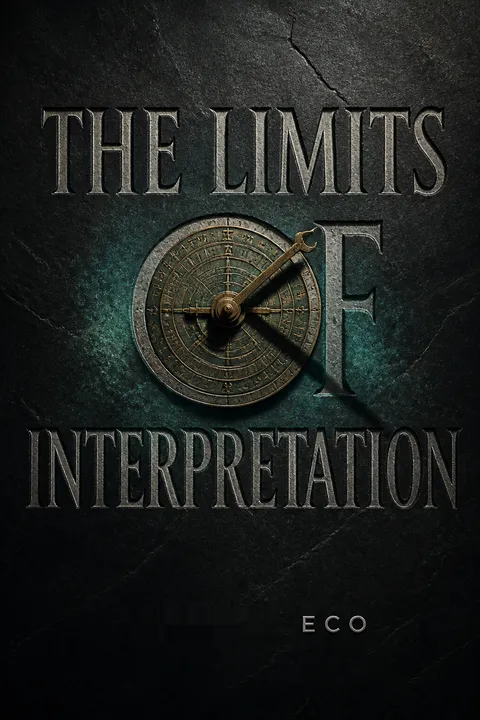


Key Takeaways
Read freely, but let the text veto interpretations it cannot support.
A text sets limits. Eco opens with a letter that says a basket contains thirty figs. The original basket and fruit disappear, and the letter passes to strangers, yet its words still point toward figs, not apples, Napoleon, or anything else an interpreter might fancy. The sender's identity and original circumstances may be lost, but ordinary language and the message's wording continue to constrain what it can plausibly mean.
Openness needs evidence. A reader may suspect a code, metaphor, or hidden historical setting, but each proposal must account for the text as a whole. The text does not have to yield one final, authorized meaning. It does rule out readings that cannot explain its language or context. Interpretation is active, but not sovereign.
What's valuable here is the distinction between uncertainty and arbitrariness. In scientific reasoning, a hypothesis earns attention by explaining evidence better than its rivals; a literary reading can be assessed similarly, even when no single answer wins outright. This standard protects both experimentation and shared discussion. A caution is that ordinary language is not perfectly stable: communities disagree over usage, irony, and historical meanings. Constraints therefore need argument and evidence too. They are not a license to treat today's dictionary as timeless authority.
Follow meaning forward, but do not let association erase its starting point.
Two kinds of infinity. Eco distinguishes Peirce's unlimited semiosis, the potentially unending interpretation of signs by further signs, from Hermetic drift, an associative habit that connects almost anything to anything through loose resemblance. In Peirce's account, each interpretant should clarify or add determination to the sign that began the process. In drift, a chain may wander from a word to a sound-alike, then to a remote image, until the original subject has vanished.
A test keeps the chain honest. Eco's example is an orchid root that resembles a body part. The resemblance may support a claim about shape, but it does not establish that the root has the same medical effect. A proposed connection must remain relevant to the question and withstand practical or contextual checks.
The distinction resembles the difference between productive model-building and overfitting. A powerful interpretive system can find patterns everywhere, especially when it can change its criteria after each objection. Requiring a reading to preserve contact with its initial evidence makes it possible to learn from ambiguity without treating every association as a discovery. Yet practical testing cannot govern every interpretation: a poem's meaning is not a laboratory prediction. Here, coherence and explanatory reach are more fitting tests than simple empirical verification.
Let context discipline symbols before turning every image into a secret.
Symbols need textual anchors. Eco traces a shift from medieval allegory to Renaissance Hermetic symbolism. Medieval readers could treat creatures and objects as signs of spiritual truths, but they sought rules for deciding which sense fit a particular passage. A lion might carry several conventional meanings in a bestiary, while its role in a specific text helped select among them.
A text narrows the field. Renaissance Hermetic thought, by contrast, emphasized universal correspondences and the idea that almost anything could resemble something else. Eco argues that symbols may invite many possible associations, but their placement in a story makes only some readings relevant. A myth or literary work is not an unshaped universe: its arrangement gives symbolic material a context that readers must respect.
This account offers a useful middle path between rigid decoding and interpretive free-for-all. Context functions like a selection mechanism: it does not always identify one meaning, but it changes which possibilities deserve attention. The approach also explains why symbols can travel across cultures while taking on different force in different works. A complication is that context itself can be contested. Genre expectations, translation, and historical distance all affect what counts as a plausible fit, so contextual judgments remain reasoned decisions, not automatic outputs.
Treat a text as evidence, not a mirror for your private agenda.
Three intentions, three questions. Eco separates the author's intention, the text's intention, and the reader's intention. An author may have meant one thing, the text may support more than the author consciously planned, and a reader may use it for a separate purpose. Eco distinguishes interpreting a work, which asks what its features support, from using it as a springboard for another project.
The Pliny letter shows the difference. Pliny the Younger presents his uncle's death during the Vesuvius eruption as a heroic scientific rescue. The facts he recounts also suggest that the elder Pliny misunderstood the danger and behaved rashly. By arranging time shifts and knowledge carefully, the letter guides readers toward a heroic portrait. Close analysis asks how the account produces that effect, rather than accepting its persuasion as neutral fact.
The distinction is especially useful wherever communication carries incentives: memoir, journalism, advocacy, and institutional reporting. A text can shape belief through selection and framing without stating anything plainly false. This is close to contemporary work on framing, where presentation changes what audiences notice and infer. Eco's standard does not require recovering a private authorial intention, which is often inaccessible. Still, separating interpretation from use can be difficult in practice: a reading motivated by present concerns may reveal a feature that earlier audiences overlooked.
Make bold interpretive guesses, then test what else they explain.
Abduction proposes a rule. Eco explains abduction through a familiar pattern: a person sees white beans beside a sack and conjectures that the beans came from a sack containing only white beans. The observation does not prove the explanation. It makes the explanation a promising hypothesis. Deduction then predicts what should follow if the hypothesis is right, and further evidence can strengthen or weaken it.
Reading works similarly. In Borges and Bioy's stories, the imprisoned detective Don Isidro Parodi solves cases from confused accounts by proposing a hidden rule, such as treating an apparently real sequence of events as a staged performance. That conjecture makes scattered details intelligible. The interpretive skill lies not only in noticing clues, but in choosing a rule that organizes them better than competing explanations.
Abduction names a central but often invisible part of reasoning: evidence rarely announces its own explanation. The same process appears in diagnosis, historical reconstruction, and everyday troubleshooting. Its strength is speed and creativity; its risk is confirmation bias, since a clever theory can make inconvenient details seem irrelevant. A disciplined interpreter therefore asks what evidence would count against the reading and whether it explains the whole pattern, not merely the detail that inspired it.
Read fiction as a small world with rules, gaps, and consequences.
Fiction supplies selective worlds. A fictional possible world is the state of affairs readers build from a text. It contains characters, properties, and events, but it is incomplete: a novel rarely tells everything that would be true about its imagined Paris or its inhabitants. Readers borrow ordinary knowledge unless the story signals a different rule. Eco calls attention to these limited constructions as small worlds.
Respect what the story establishes. In a detective story, readers forecast events from clues and can be deliberately misled. In Sophocles' Oedipus Rex, Oedipus acts from beliefs that do not match the story's underlying events; the gap creates tragedy. A fictional character's identity also depends on relationships established in that work. Change those defining relations, and the character belongs to a different fictional world.
The small-world idea clarifies how fiction can feel vivid without being exhaustive. Readers perform a kind of controlled completion, filling gaps with shared assumptions while staying alert to details that revise those assumptions. This resembles how people use mental models to navigate incomplete information. It also explains why contradictions matter: they may be errors, deliberate puzzles, or signals that the world is unstable. The interpretive task is to determine which function best fits the work, rather than automatically repairing every inconsistency.
Look for invention inside repetition, not only in novelty.
Repetition has several forms. Eco distinguishes stories that continue earlier adventures, retell a familiar plot, repeat a stable formula with changing details, follow a family across generations, or openly quote earlier works. In a formula series, familiar characters and patterns reassure viewers, while variation keeps the episode from being identical to the last. A story may be satisfying precisely because audiences know the shape of what is coming.
The audience changes the experience. Eco contrasts the naive viewer, absorbed in what happens, with a critical viewer who notices how the familiar pattern is being varied. A Columbo episode can disclose the murderer early, shifting suspense from guessing who did it to watching how the detective proves it. Repetition can therefore be commercial routine, skilled variation, or both.
This framework helps explain why audiences return to genres, sequels, and recurring characters without assuming they are simply being fooled. Familiar structures lower the cost of entry, leaving attention available for tone, performance, and small deviations. The same logic appears in musical variation and ritual: repetition can make difference more perceptible. Eco's account also warns against treating critical pleasure as the only sophisticated response. Emotional attachment to a familiar story is not necessarily naive; it can be part of what the form is designed to deliver.
A performance turns real bodies into signs through framing and convention.
The frame changes the body. Eco imagines a Salvation Army display featuring a visibly intoxicated man as a warning against drink. The person is physically real, but the staging makes him represent drunkenness and its consequences. His posture, clothing, and setting become meaningful because the audience knows how to read the scene. Put the same man under a different banner, and the display may suggest social failure rather than individual vice.
Performance depends on shared codes. Theater makes this process explicit: an actor's body is both a real body and a sign for a character. Words, gestures, objects, and spatial arrangement help establish what the audience should infer. Everyday interaction also carries intentional and unintentional signals, such as a performed limp or a nervous gesture that another person interprets as impatience.
This account connects theatrical semiotics to social interaction: people interpret not just statements, but posture, setting, and the roles others appear to occupy. A frame can make the same conduct look comic, threatening, or pitiable. That insight matters in media, politics, and public imagery, where presentation guides judgment before an argument begins. The caution is that audiences do not share one uniform code. A sign that seems obvious to one group may be opaque or offensive to another, making interpretation partly a question of cultural power.
Treat authenticity as a claim to test, not a property visible at a glance.
A fake requires an identification claim. Two objects can look alike without either being a forgery. Forgery arises when someone presents one object as identical to a distinct original, or falsely attributes a new work to an absent creator. The claimant may intend fraud, act in good faith, or simply care more about usefulness than provenance. A copy openly presented as a copy is not the same kind of deception.
The original needs evidence too. Experts compare materials, style, language, historical references, and provenance. Each test can expose a bad imitation, but no single test guarantees authenticity. Eco's thought experiment about a Picasso portrait copied through several artists shows how difficult it can be to establish which object, if any, is the original. Authenticity depends on a reasoned, revisable judgment.
The argument reaches beyond art markets. Documents, identities, and digital media all depend on chains of custody and shared standards for verification. Similarity is evidence, but it is not proof of origin. The chapter's strongest implication is that verification systems themselves deserve scrutiny: an institution that certifies an object can be mistaken or deceived. That does not make authenticity unknowable. It means confidence should reflect the convergence of independent evidence rather than the prestige of a label or the apparent authority of a single expert.
Track what a sentence makes you accept before you notice its argument.
Meaning depends on use. Eco resists separating semantics, the study of meaning, from pragmatics, the study of how signs function in communication. Words carry coded possibilities, but context, background knowledge, and social expectations help determine what a speaker is doing. His encyclopedia model treats a word's meaning as a network of linked information and instructions, not as a tiny dictionary definition sealed off from use.
Presuppositions quietly frame discussion. A presupposition is information packaged as background rather than foreground. Saying someone stopped an activity implies that the activity had been happening; accusing someone implies a negative judgment of the act. A listener can challenge these assumptions, but doing so takes explicit conversational work. The speaker's wording can thus shape what seems already settled before the main claim is debated.
This is a practical model for noticing how language distributes attention and responsibility. In public debate, presupposed claims can pass as common ground simply because they sit outside the sentence's apparent point. The idea also links to cognitive accounts of framing: people interpret new information against an active background model. Yet presuppositions are not irresistible. Listeners can reject the frame, ask for evidence, or restate the issue. The useful habit is to identify what a statement asks its audience to grant before evaluating what it explicitly asserts.
Analysis
The book's governing question is not whether interpretation can continue indefinitely. Eco accepts that it can. The harder question is how continued interpretation remains about something rather than becoming a chain of free associations. His answer is a practical account of constraint: language, textual structure, context, and shared habits make some readings more defensible than others. Meaning is neither a sealed package delivered intact by an author nor a blank surface on which readers may write anything.
That position becomes especially persuasive because the essays test it in different domains. The lost letter about figs shows that a text retains ordinary semantic direction after its sender and situation disappear. The Pliny letter demonstrates how narrative can shape judgment through timing and point of view while remaining compatible with its stated facts. Fictional worlds show readers filling gaps, but only within rules established by the story. Forgery analysis reveals that even apparently objective categories such as original and copy depend on evidence and communal standards. Together, these examples make interpretation less like decoding a secret and more like a disciplined inquiry.
Eco's account also has a productive tension. He relies on communal agreement and historically available conventions to restrain interpretation, yet communities can preserve mistaken assumptions or exclude minority readings. Textual coherence is a strong test, but works can be deliberately contradictory, culturally translated, or designed to frustrate stable judgment. His argument is strongest when treated as a demand for accountable readings, not as a promise that experts can always settle meaning conclusively.
The result is a theory of intellectual hospitality with boundaries. Readers should entertain unusual hypotheses, notice what a text enables beyond its author's awareness, and still explain how the reading fits the evidence. That discipline is useful well beyond literary criticism. It applies whenever people infer intentions, evaluate testimony, interpret images, or decide whether a claim deserves belief. Openness is valuable precisely because it is not the same as saying anything goes.
Review Summary
The Limits of Interpretation is a collection of essays exploring the boundaries of textual interpretation. Readers appreciate Eco's defense of the text's intentio operis and his rejection of unlimited interpretation. The book is praised for its intellectual depth and Eco's entertaining writing style. Some find it challenging due to its academic nature and specialized vocabulary. Reviewers note that Eco draws on various philosophical traditions and semiotics to develop his arguments. While some essays are more accessible than others, the overall work is considered significant in the field of hermeneutics and literary theory.
People Also Read







Glossary
Unlimited semiosis
Ongoing sign interpretationThe potentially unending process in which one sign is interpreted through another sign, which can itself be interpreted further. For Eco, this does not mean that every interpretation is acceptable. Interpretants should add determination to the starting sign, and the process remains answerable to context, practical consequences, and shared inquiry.
Hermetic drift
Uncontrolled associative readingAn interpretive habit associated with Renaissance Hermetic thought that links elements through flexible similarities, analogies, and correspondences. Because almost any item can be connected to another through some resemblance, the chain can wander far from its starting point. Eco contrasts this movement with interpretations that preserve and clarify the original sign.
intentio operis
The text's interpretive directionThe intention attributed to a work on the basis of its organization, language, and internal relations. It is not simply the author's private purpose, nor whatever a reader wishes to find. Since it is inferred rather than directly visible, interpreters propose it as a conjecture and test that conjecture against the work as a whole.
Model Reader
Reader anticipated by a textThe kind of reader a text's strategies invite or require. A Model Reader is not a particular person but a role defined by the knowledge, inferences, and interpretive cooperation needed to make the text work. Some works also support a more critical reader who notices how the text guides the first, more immediate response.
Abduction
Inference to an explanationA form of reasoning that proposes a possible rule to explain a surprising result. Unlike deduction, it does not guarantee its conclusion; unlike induction, it does not merely generalize from repeated observations. The proposed explanation must be tested against further evidence. Eco applies this logic to scientific discovery, detective fiction, and interpretation.
Small worlds
Limited constructed worldsThe incomplete, locally defined worlds readers construct from fictional texts. Such worlds contain enough characters, properties, and events to follow a story, but they omit much of what would be known about a complete world. Readers fill gaps using ordinary knowledge unless the text signals different rules or asks them to imagine an impossible world.
Encyclopedia
Network of cultural knowledgeEco's model of meaning as a network of information, conventions, contexts, and interpretive instructions associated with expressions. Unlike a compact dictionary entry, an encyclopedia can include scientific facts, stereotypes, historical associations, and procedures for using a word. Any actual interpretation activates only a relevant portion of this potentially vast network.
P-terms
Presupposition-carrying expressionsExpressions, especially certain verbs, whose coded meaning carries information treated as background when they are used. For example, a verb meaning to stop an activity implies that the activity was occurring beforehand. The assumption can be challenged, but doing so usually requires questioning the speaker's choice of wording, not merely negating the sentence's main assertion.
Positional power
Power to frame discourseThe capacity of an utterance to establish presupposed information as part of the conversational background. A presupposition-carrying expression can make an assumption seem settled even when the listener did not previously know or accept it. Positional power is activated in actual discourse, and listeners can resist it by challenging the frame the speaker has introduced.
FAQ
What's The Limits of Interpretation about?
- Exploration of Interpretation: Umberto Eco's The Limits of Interpretation examines the complexities of interpreting texts, particularly in literature and semiotics. It highlights the multiplicity of meanings that can be derived from a single text.
- Reader-Response Criticism: The book discusses how the meaning of a text is shaped not only by the author but also by the reader's interpretation, emphasizing the active role of the reader in meaning-making.
- Semiotic Framework: Eco uses a semiotic framework to analyze how signs and symbols function within texts, arguing that understanding these relationships is crucial for interpretation.
Why should I read The Limits of Interpretation?
- Insightful Analysis: The book offers a profound analysis of interpretation, challenging conventional views on meaning and authorship, making it essential for literature and philosophy enthusiasts.
- Interdisciplinary Approach: Eco bridges various fields, including linguistics and literary theory, providing a comprehensive understanding of how texts operate.
- Critical Thinking: It encourages readers to think critically about how they engage with texts and the implications of their interpretations.
What are the key takeaways of The Limits of Interpretation?
- Unlimited Semiosis: Eco introduces the concept of unlimited semiosis, suggesting that interpretation can continue indefinitely without reaching a final meaning.
- Constraints of Interpretation: Despite potential for unlimited interpretations, texts impose constraints based on structure, context, and authorial intent.
- Role of the Reader: The reader plays an active role in constructing meaning, but interpretations must remain grounded in the text.
What are the best quotes from The Limits of Interpretation and what do they mean?
- "Language always says more...": This quote highlights that texts carry layers of meaning beyond their surface interpretation, urging readers to engage deeply.
- "The limits of interpretation...": Eco emphasizes the balance between reader freedom and respecting the text's inherent constraints.
- "Even the most radical deconstructionists...": This quote underscores the necessity of grounding interpretations in the text itself, reminding that not all readings are valid.
How does Eco define "unlimited semiosis" in The Limits of Interpretation?
- Concept of Unlimited Semiosis: Eco defines it as the idea that interpretation can continue indefinitely, challenging traditional notions of fixed meanings.
- Implications for Interpretation: Every interpretation can lead to further interpretations, creating a chain of meanings that evolve over time.
- Textual Constraints: Despite potential for unlimited interpretations, texts impose constraints that guide understanding, maintaining connection to original intent.
What is Eco's view on reader-response criticism in The Limits of Interpretation?
- Active Reader Engagement: Eco acknowledges the reader's role in interpreting texts, arguing that readers actively construct meaning based on their experiences.
- Limits to Interpretation: While supporting reader involvement, Eco stresses that texts impose limits on interpretation through structure and context.
- Dialectical Relationship: He presents a dynamic relationship between text and reader, allowing for multiple readings while maintaining a connection to the text.
How does Eco address the relationship between authorial intent and interpretation?
- Authorial Intent: Eco acknowledges its significance in shaping a text's meaning but argues that once published, meaning is not solely determined by the author.
- Reader's Interpretation: Readers bring their interpretations, which can diverge from the author's original intent, highlighting the collaborative nature of meaning-making.
- Balancing Act: Eco advocates for balancing respect for authorial intent with allowing reader interpretations for a comprehensive understanding.
What is the significance of the "limits of interpretation" in Eco's work?
- Defining Boundaries: The "limits of interpretation" refer to boundaries that texts impose on understanding, ensuring interpretations remain grounded in the text.
- Respecting Textual Integrity: This concept emphasizes respecting the text's integrity while engaging in interpretation, reminding that not all readings are valid.
- Framework for Analysis: It provides a framework for analyzing texts, guiding readers to consider both the text's structure and their interpretive choices.
How does Eco's The Limits of Interpretation contribute to semiotics?
- Foundation for Semiotic Theory: Eco's work lays a foundation for understanding the relationship between signs and meanings within texts.
- Interdisciplinary Connections: The book connects semiotics with literary theory, linguistics, and philosophy, broadening the scope of semiotic studies.
- Influence on Future Research: Eco's insights have influenced subsequent research, prompting scholars to explore complexities of meaning-making in various contexts.
What is Eco's definition of a "Model Reader" in The Limits of Interpretation?
- Reader's Role: The Model Reader is an idealized reader who aligns with the author's intentions while bringing their own interpretations.
- Infinite Conjectures: This reader explores various interpretations within the bounds of what the text can convey, encouraging creativity while staying anchored in content.
- Cultural Context: The Model Reader's background and cultural context shape their understanding, making the reading experience unique.
How does Eco differentiate between "semantics" and "pragmatics" in The Limits of Interpretation?
- Semantics Defined: Eco describes semantics as the study of meaning within a sign system, focusing on how signs relate to what they denote.
- Pragmatics Defined: Pragmatics examines how context influences interpretation, including speaker intentions and situational factors.
- Interrelation: Eco argues that semantics and pragmatics are interdependent, requiring both for understanding a text.
What is the relationship between "text" and "context" in Eco's analysis?
- Textual Coherence: Eco argues that a text must be understood in relation to its context, which includes cultural, historical, and situational factors.
- Dynamic Interaction: The relationship is dynamic; while the text conveys meanings, context can alter or enhance them based on interpretation.
- Interpretive Strategies: Effective interpretation requires awareness of both the text's internal structure and external context, allowing meaningful engagement.
About the Author
Other books by Umberto Eco


Download PDF
Download EPUB
.epub digital book format is ideal for reading ebooks on phones, tablets, and e-readers.








