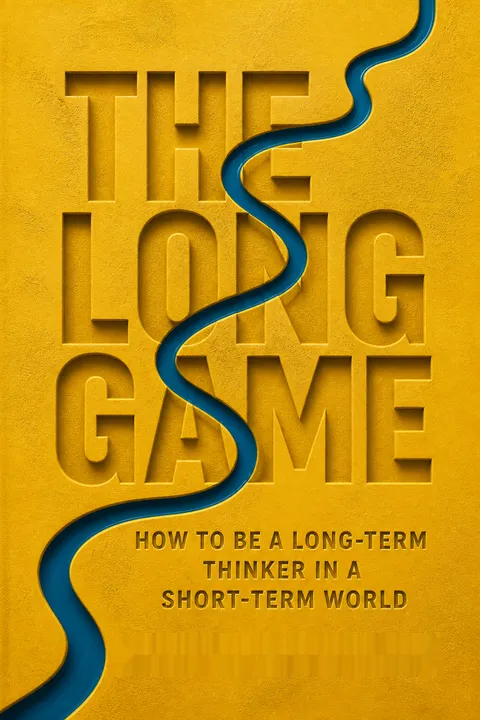


Key Takeaways
Build for the future you want while staying ready to change routes.
Think beyond the next quarter. Dorie Clark’s speaking career brought money and recognition, but constant travel made her wonder whether that pace could last. In 2014, she began testing online courses so her income would not depend entirely on being physically present. After years of experiments, she had a digital business ready to expand when the pandemic erased her speaking engagements. The crisis changed her immediate plan, but earlier long-term preparation gave her options.
Hold the aim, revise the route. The book’s central idea is that long-term thinking means steadily moving toward a worthwhile future, not predicting exactly what will happen. Clark could not foresee a pandemic; she could anticipate that travel might become unsustainable. A strategy creates direction and flexibility at once.
The distinction between a durable aim and a fixed plan is crucial. In decision theory, a good strategy often preserves options rather than betting everything on one forecast. Clark’s courses functioned as a hedge against a known vulnerability, even though the specific crisis was unpredictable. This is a practical alternative to both rigid planning and aimless improvisation. The caveat is that preparation takes resources, and not everyone can invest in a side business. Long-term thinking can still begin with smaller forms of resilience, such as transferable skills, savings, or relationships.
Make white space a priority, not a reward for finishing everything.
Busyness has hidden rewards. In one study of senior leaders, 97% called strategic thinking vital to organizational success, while 96% said they lacked time for it. Knowledge workers spend substantial time on email, and professionals average about 62 meetings a month. Yet overload is not only imposed from outside. Research cited by Clark suggests that busyness can signal status, while work can also numb grief or postpone uncomfortable questions about a career.
Protect thinking time deliberately. Dave Crenshaw built a business around limits, working about 30 hours a week and taking July and December off with his family. A fixed stopping time exposed waste and forced better choices. A calendar, unlike an endless task list, makes the trade-off visible: important work gets scheduled, lesser work moves, and some tasks disappear.
Busyness can become an identity, not just a workload. That makes calendar redesign a psychological intervention as much as a productivity tactic: it challenges the belief that constant demand proves personal worth. The chapter also points toward attention as a scarce resource, a concern that becomes sharper in an information-saturated workplace. Still, individual boundaries cannot repair every organizational problem. If a company rewards visible availability over useful outcomes, employees may need collective changes to expectations, not merely better personal scheduling.
Decline attractive opportunities when their hidden costs violate your north star.
Count the whole commitment. Clark found that a one-hour webinar could consume three or four hours once preparation and coordination were included. She recommends assessing a request by asking:
1. What is the full time commitment?
2. What worthwhile alternative would that time displace?
3. What are the physical and emotional costs?
4. Would declining still bother me in a year?
Choose by values, not applause. Consultant Terry Rice turned down a $20,000 monthly retainer because the commute would have kept him from his daughter and crowded out work he cared about. Tom Waterhouse declined a coveted Singapore job because he wanted a family life that the role might make harder to build. Both choices made sense only in light of their own priorities, not the opportunity’s prestige or pay.
Opportunity cost is powerful because it reveals that saying yes is never simply adding one more thing. It is also choosing what will not happen. Behavioral economics helps explain why the costs of accepting are easy to miss: the offer is vivid, while the forgone alternative remains abstract. A written checklist can make those invisible costs concrete. Yet a personal north star should not become an excuse for reflexive refusal. Some opportunities are valuable precisely because they challenge existing preferences, so the questions should clarify a decision rather than automate it.
Follow curiosity through small bets instead of waiting for a calling.
Interest can come before purpose. Clark argues that people need not identify one lifelong passion before acting. She directed a documentary after meeting environmental activist Marion Stoddart during a political campaign. The project began with curiosity, not a career plan, and taught Clark that unexpected interests can reveal new abilities and connections. Looking at how time is already spent, revisiting original motivations, and trying low-risk activities can help distinguish lasting curiosity from a passing fascination.
Explore before committing. Google popularized 20% time, a practice that gave employees room to explore projects beyond their main assignments. Google News and Gmail emerged from such experiments, though the work often added to employees’ regular duties. Clark’s own weekly New York outings led her to musical theater and, eventually, formal training. Exploration is not a promise of success; it is a way to gather evidence before making a larger bet.
This approach replaces the pressure to discover a hidden, singular vocation with a more testable process. Curiosity generates contact with new skills and people, while small experiments limit the cost of being wrong. That resembles exploratory learning in science: a preliminary trial can reveal whether a question deserves deeper investment. The important qualification is that free time is unequally distributed. The ideal of a fifth of one’s time for experimentation may be unrealistic for workers with little schedule control, so even modest, occasional experiments can serve the same purpose.
Change work modes as your career shifts from learning to influence.
The right work changes over time. Clark’s Career Waves describe a sequence: first learn a field, then create and share ideas, build relationships, and benefit from the resulting expertise. Each phase develops something needed by the next. Endless training can become a way to avoid putting work into the world; relentless networking can crowd out creating; and early success can distract from developing new ideas.
Alternate exploration and execution. Entrepreneur Jared Kleinert distinguishes heads-up periods, when someone scouts possibilities, from heads-down periods, when they commit to what is working. Clark sets aside blocks of roughly three to six months for each mode. This reduces the urge to chase every new idea while also preventing a promising career from becoming a routine that never gets reconsidered.
The framework is useful because it treats careers as changing systems rather than ladders with one permanent task. It also captures a real tension between exploration and exploitation: too much exploration prevents accumulated skill, while too much exploitation can lock someone into a shrinking opportunity. The phases should not be mistaken for a universal timetable. People may revisit learning after success, or create and connect simultaneously. The value lies in diagnosing which activity is currently neglected, not in forcing a neat sequence onto a complicated career.
Make each hour serve several goals without splitting your attention.
Look for compatible overlaps. Clark tracked her time for a month and noticed that some activities could serve two purposes at once, such as cooking while talking with her mother or exercising while listening to an audiobook. By counting only combinations she could genuinely do well, she calculated that these overlaps gave her 29% more usable time than she had expected. This is different from trying to write an email while listening to a complicated meeting.
Extend the value of effort. After attending a London business conference, executive coach Nihar Chhaya wrote an article about it, strengthened new connections by sharing the piece, and clarified what he had learned. Clark also describes professional visibility as a mix of useful ideas, credible proof, and relationships. An activity can produce more than one of these assets when planned with intention.
The key distinction is not between multitasking and single-tasking, but between compatible and competing demands. Combining a routine task with audio learning may be efficient; pairing two attention-intensive tasks usually degrades both. The deeper principle is leverage: make a single effort produce several kinds of value. This resembles portfolio thinking, where an investment is judged by its total return rather than one immediate payoff. The 29% figure is Clark’s accounting method, not a universal increase in time, and it depends on honestly judging whether both activities received adequate attention.
Build relationships before you need favors, and give without keeping score.
Make connection less transactional. Clark separates urgent, favor-seeking contact from long-term relationship building and what she calls infinite horizon networking: getting to know people without assuming their future usefulness. A University of Kansas study cited in the book estimates that moving from acquaintance to casual friend takes about 50 hours, and becoming close friends can take more than 200. Even lighter connections can matter; sociologist Mark Granovetter’s work describes how weaker ties can carry information beyond a person’s immediate circle.
Create reasons to meet. After moving to New York without close friends, Clark began hosting dinners where guests answered questions and met one another. One connection eventually led to a Grammy-winning jazz album: a chain of introductions brought her to producer and musician Kabir Sehgal, who later invited her to join an album project. The result was unpredictable, not a dependable networking formula.
Relationship building works partly because trust and information travel through networks that no individual can fully map. The Grammy story illustrates possibility, not typical probability. Its more durable lesson is that generosity and repeated contact can create social value without turning every interaction into a transaction. A useful boundary is reciprocity: generosity does not require accepting exploitation or endlessly giving to people who never return effort. Ethical networking respects consent, including asking before making introductions that create obligations for others.
Stay with a sound strategy long enough for quiet effort to compound.
Early progress can be hard to see. Clark calls strategic patience active persistence: understanding what work is required, continuing through periods of weak feedback, and checking whether the approach still makes sense. She advises people building public expertise to expect two to three years before small signs of recognition, and around five years for a stronger reputation. These are her practical observations, not guarantees. Writer Anne Sugar spent years publishing with little response before her work began reaching much larger audiences.
Use a longer horizon. Clark’s own path to publishing a first book took years of proposals, rejection, blogging, and building a body of work. The book also cites Jeff Bezos’s argument that a seven-year horizon can reduce competition because fewer people are willing to wait that long. Patience is not passive: compare timelines with credible role models, consult trusted advisers, and reconnect with the reason for the work.
The account gives readers a better model than the myth of overnight success: early effort can build skills, reputation, and relationships before public results become visible. Those assets may reinforce one another, producing a compounding effect. But exponential growth is a metaphor, not a promise that every project will take off if pursued long enough. Strategic patience needs review points. If evidence repeatedly contradicts the underlying assumptions, adaptation is wiser than treating sunk costs as proof of commitment.
Treat rejection as evidence to interpret, not a verdict to obey.
Test ideas before betting everything. The lean startup approach begins with a modest version of an idea, then uses real responses to decide whether to improve, change, or stop it. Clark applies that logic to careers: experiments can produce useful information even when they do not produce the hoped-for result. When an initial mastermind group failed to attract enough members, she redesigned it as a tailored experience for two people, which informed a larger program the following year.
Keep more than one route open. In 2019, four of Clark’s five ambitious goals failed, including a book collaboration, a musical, a newspaper column, and a conference talk. She was still named to the Thinkers50 list that year. Dayna Del Val’s acting career also took a different route from her original Hollywood plan, leading to regional work and arts leadership. A failed path does not settle the value of the underlying goal.
Separating an outcome from a person’s worth is essential, but so is extracting information from the outcome. A rejection may reflect fit, timing, competition, or a genuine weakness in the work; treating every refusal as irrelevant would be as unhelpful as treating one as final. Small pilots and multiple routes help distinguish those possibilities. The examples also resist a narrow success narrative: a changed destination can satisfy the original motive more fully than the first imagined route.
Shrink intimidating goals until beginning requires almost no courage.
Make the first action small. Stanford psychologist BJ Fogg’s tiny habits approach starts with a behavior so manageable that motivation is barely needed. When Fogg wanted to floss regularly, he began with one tooth. Clark applies the same logic to ambitious work: begin with one paragraph, one email, or one small piece of practice rather than demanding a finished book or a transformed career from the outset.
Build capacity gradually. Clark also uses Dave Crenshaw’s idea of distance to empty: how long a business or professional routine can operate when its owner steps away. Instead of jumping directly to months off, set a firm stopping time, improve systems, and expand breaks in stages. Jeff Bezos shared the example of a handstand coach who said mastery requires about six months of daily practice, not two weeks. Accurate expectations make persistence more realistic.
Small starts reduce the psychological cost of initiation, while gradual limits expose fragile systems before a crisis does. Together, these ideas connect behavior design with operational resilience: make progress easier to begin and make work less dependent on constant personal availability. A tiny action is not sufficient for every goal, and repeating it without progression can become symbolic rather than useful. The small start should open a path toward meaningful practice, while the stopping boundary should trigger real choices about priorities and process.
Define success by your own life, and notice the progress already made.
Make the reward personal. Clark accepted an invitation to speak at Mary Baldwin University, where she had studied decades earlier, and later joined its board. The honor mattered because of her history there; another prestigious invitation might have meant less. Her point is that the same achievement can feel liberating to one person and irrelevant to another. Money and status are possible measures, but they cannot substitute for deciding what a satisfying life actually contains.
Do not move the finish line silently. Clark describes how people become accustomed to achievements that once seemed extraordinary, then immediately compare themselves with someone further ahead. She connects this to shifting baseline syndrome, the tendency to forget earlier conditions as the present becomes normal. Revisiting past milestones makes progress visible and restores perspective. Celebration is not a reason to stop striving; it helps prevent an entire career from feeling like an endless waiting room.
Personal definitions of success guard against the social comparison trap, especially when public metrics make other people’s milestones unusually visible. The idea also has a connection to hedonic adaptation: gains often lose their emotional force as they become routine. Deliberately recording what has changed can counter that drift. The challenge is to distinguish genuine satisfaction from complacency. A meaningful life can include ambition and gratitude at once, with progress acknowledged without pretending that every constraint or unmet need has disappeared.
Analysis
The book’s most useful contribution is not simply an argument for patience. It offers a practical architecture for using patience well: clear space, choose goals that fit personal values, run limited experiments, build relationships, and review progress across a longer horizon. The recurring stories make this architecture vivid because they show that long-term strategy is rarely a straight line. Clark’s speaking business prepared her for a crisis she did not predict; a rejected musical application led her toward coaching; a career detour gave Dayna Del Val a different route into acting and arts leadership.
The argument is strongest when it treats the future as uncertain rather than controllable. Experimentation, multiple routes, and transferable assets are forms of resilience, not prophecy. The emphasis on options also connects the book to portfolio logic: keep a stable base while making limited investments in uncertain possibilities. That approach is more robust than either reckless all-in commitment or indefinite safety.
Its main limitation is that personal strategy cannot erase structural constraints. A worker with little schedule control, caregiving responsibilities, or precarious income may not be able to reserve a fifth of their time for exploration or reject an attractive offer. The book’s advice remains useful, but its implementation depends on resources and bargaining power that are unevenly distributed. Similarly, a long horizon can become an excuse to persist in a failing plan. The necessary counterweight is explicit feedback: define what progress would look like, consult people with relevant experience, and set points at which assumptions can be revised.
Taken together, the strongest version of the message is neither hustle nor passive waiting. It is deliberate allocation under uncertainty. A person cannot guarantee that effort will pay off, but can improve the odds by investing in skills, relationships, and projects that create future choices, while making today’s life compatible with the effort required.
Review Summary
The Long Game receives mixed reviews. Many praise its insights on long-term thinking, strategic patience, and networking. Readers appreciate Clark's practical advice and personal anecdotes. Critics argue the book lacks depth, repeats common ideas, and contains too much self-promotion. Some find it motivational and actionable, while others see it as fluffy and obvious. The book's focus on optimizing for interesting opportunities and balancing short-term needs with long-term goals resonates with many readers. Overall, it's viewed as a quick read with valuable concepts for professional development.
People Also Read








Glossary
20% time
Protected exploratory project timeA practice of reserving a portion of working time for projects beyond a person’s regular responsibilities. Google helped popularize the idea, and the book cites Google News and Gmail as products associated with experimentation. Clark adapts it for individuals as a way to test interests, build skills, and discover opportunities without immediately abandoning dependable work.
Career Waves
Stages of professional developmentClark’s model for shifting emphasis across a career: first build knowledge, then develop and share original work, strengthen relevant relationships, and benefit from accumulated expertise. These are changing priorities rather than permanent job categories. The model warns that overusing one strength, such as constant learning or networking, can stall progress in other important areas.
Heads-up mode
Exploring emerging opportunitiesA period devoted to looking outward, meeting people, and scouting possible directions before committing to one. Clark contrasts this with heads-down mode, when attention shifts to executing a selected project. Alternating between the modes can reduce both premature commitment and endless distraction by new possibilities.
Strategic patience
Active persistence over timeThe practice of continuing purposeful work despite slow feedback, while understanding what the process requires and remaining willing to revise the approach. It differs from passive waiting: practitioners keep building skills, sharing work, and seeking informed advice. The term captures the capacity to endure a long period in which effort is real but visible rewards are limited.
Distance to empty
Capacity to operate without youDave Crenshaw’s metaphor for how long a person’s work or business can continue functioning when they step away. A short distance suggests dependence on constant personal availability. Increasing it means setting boundaries, improving systems, and making deliberate choices about low-value work, delegation, and processes.
Infinite horizon networking
Connection without an immediate agendaClark’s term for building relationships because someone is interesting, without expecting a specific favor or professional payoff. The connection may never become directly useful, but people’s interests and circumstances change in unpredictable ways. The practice emphasizes genuine curiosity, mutual value, and patience rather than treating contacts as instruments.
Lean startup methodology
Test before full investmentAn approach to developing a product or idea by first creating a modest, testable version and learning from real responses. If people show interest, the creator can improve it; if they do not, the creator can change direction before investing heavily. Clark applies this experimental logic to career projects and professional goals.
Tiny habits
Very small repeatable behaviorsBJ Fogg’s term for behaviors made so small and manageable that they require little motivation to begin. The book gives Fogg’s decision to start a flossing routine with one tooth as an example. The principle is to lower the starting barrier, establish action, and allow a small beginning to support continued practice.
Deception phase
Early growth hard to perceiveA stage of exponential growth in which increases are real but initially too small to look impressive. The book uses the idea, discussed by Peter Diamandis and Steven Kotler, to explain why early progress in technology or a career can resemble stagnation. Its usefulness is cautionary: weak early visibility does not by itself prove that nothing is developing.
FAQ
What's "The Long Game" about?
- Focus on Long-Term Thinking: "The Long Game" by Dorie Clark emphasizes the importance of long-term thinking in a world that often prioritizes short-term gains.
- Practical Strategies: The book provides practical strategies to help individuals achieve their higher ambitions by focusing on what truly matters over time.
- Personal and Professional Growth: It guides readers on how to redefine success on their own terms and build a meaningful life and career.
- Overcoming Short-Term Pressures: Clark addresses the challenges of a short-term-focused world and offers insights on how to break free from the cycle of constant busyness.
Why should I read "The Long Game"?
- Gain Strategic Insight: The book offers valuable insights into becoming a strategic thinker, which is crucial for long-term success.
- Actionable Advice: It is filled with actionable advice that can be immediately applied to both personal and professional life.
- Inspiration from Real Stories: The book includes inspiring examples and stories from successful individuals who have mastered long-term thinking.
- Overcome Modern Challenges: It helps readers navigate the pressures of modern life, such as busyness and short-term distractions, to focus on what truly matters.
What are the key takeaways of "The Long Game"?
- Strategic Patience: Success often requires patience and perseverance, as significant achievements take time to materialize.
- Optimize for Interesting: Instead of solely focusing on money or meaning, consider pursuing what genuinely interests you to find fulfillment.
- Think in Waves: Approach your career and goals in phases, focusing on learning, creating, connecting, and reaping rewards at different times.
- Leverage Your Time: Use strategic leverage to maximize your efforts and make the most of your time and resources.
What is the "Optimize for Interesting" concept in "The Long Game"?
- Follow Your Curiosity: Clark suggests that when you're unsure of your passion, optimizing for what interests you can lead to meaningful opportunities.
- Incremental Exploration: Start by exploring your interests incrementally, such as through informational interviews or reading, to see if they sustain over time.
- Avoid Pressure of Passion: This approach alleviates the pressure of finding a singular passion and allows for a more flexible and exploratory path.
- Potential for Growth: Pursuing interesting paths can lead to unexpected personal and professional growth, opening doors to new opportunities.
How does "The Long Game" suggest dealing with busyness?
- Reframe Busyness: Clark encourages readers to view busyness not as a status symbol but as a potential distraction from meaningful work.
- Create White Space: The book emphasizes the importance of creating white space in your calendar to allow for strategic thinking and reflection.
- Say No More Often: Learning to say no, even to good opportunities, is crucial to maintaining focus on long-term goals.
- Plan Around Priorities: Prioritize tasks that align with your long-term objectives and set boundaries to protect your time.
What is the "Think in Waves" strategy in "The Long Game"?
- Sequential Focus: Clark advises focusing on different aspects of your career in waves: Learning, Creating, Connecting, and Reaping.
- Avoid Stagnation: By shifting focus periodically, you prevent stagnation and ensure continuous growth and development.
- Strategic Overindexing: At times, it may be beneficial to overinvest in one area to maximize returns before moving to the next wave.
- Adaptability: This approach allows for flexibility and adaptability, enabling you to respond to changing circumstances and opportunities.
How does "The Long Game" address failure?
- Rethink Failure: Clark encourages viewing failure as a form of experimentation rather than a definitive end.
- Multiple Paths: There are often multiple paths to achieving your goals, and failure in one area can lead to success in another.
- Learn from Setbacks: Use setbacks as learning opportunities to refine your approach and strategy.
- Precommitment and Community: Setting deadlines and involving others can help maintain commitment and overcome obstacles.
What are some of the best quotes from "The Long Game" and what do they mean?
- "Success is not a question of how much stuff you get done." This quote emphasizes that true success is about knowing your purpose and fulfilling your potential, not just completing tasks.
- "Playing the long game today means building the kind of long-term career success that enables you to look back with satisfaction and joy." It highlights the importance of long-term thinking in creating a fulfilling career and life.
- "You have to place your bets, make your move, and wait." This underscores the need for strategic patience and the willingness to take calculated risks.
- "If you’re methodical, if you’re persistent, and if you take small, deliberate steps, we can arrive there." It encourages a disciplined approach to achieving long-term goals.
How does "The Long Game" suggest leveraging your time?
- Multitasking Wisely: Clark distinguishes between bad multitasking and strategic multitasking, where complementary tasks are combined effectively.
- Maximize Efforts: Look for ways to make one activity count multiple times, such as repurposing content across different platforms.
- Identify High-Impact Activities: Focus on the 20% of activities that yield 80% of the results, and eliminate or delegate the rest.
- Leverage Relationships: Use your network strategically to amplify your efforts and achieve your goals more efficiently.
What is the "No Asks for a Year" strategy in "The Long Game"?
- Build Genuine Relationships: Clark advises against making significant requests from new connections for at least a year to build authentic relationships.
- Avoid Transactional Networking: This strategy helps avoid the pitfalls of transactional networking, which can feel inauthentic and self-serving.
- Focus on Giving: Concentrate on offering value and support to others without expecting immediate returns.
- Long-Term Benefits: By building trust and rapport over time, you create a foundation for mutually beneficial relationships.
How does "The Long Game" suggest setting goals?
- Optimize for Interesting: Focus on what genuinely interests you rather than solely on money or meaning.
- Set Extreme Goals: Consider setting ambitious goals that challenge you and provide motivation, even if they seem unattainable at first.
- Evaluate Current Activities: Look at how you currently spend your time to identify areas of genuine interest and potential growth.
- Think Big: Don't limit yourself to what's possible now; consider where you'd like to be in the future and plan accordingly.
What role do trusted advisers play in "The Long Game"?
- Provide Perspective: Trusted advisers offer valuable insights and feedback, helping you evaluate your goals and strategies.
- Support During Setbacks: They can provide encouragement and guidance when you face challenges or self-doubt.
- Objective Assessment: Advisers can help you determine if your timeline and expectations are realistic based on their experience.
- Community and Accountability: Having a network of trusted advisers creates a supportive community that holds you accountable to your long-term goals.

Download PDF
Download EPUB
.epub digital book format is ideal for reading ebooks on phones, tablets, and e-readers.








