

Key Takeaways
Every person on the sidewalk was once somebody's cherished child
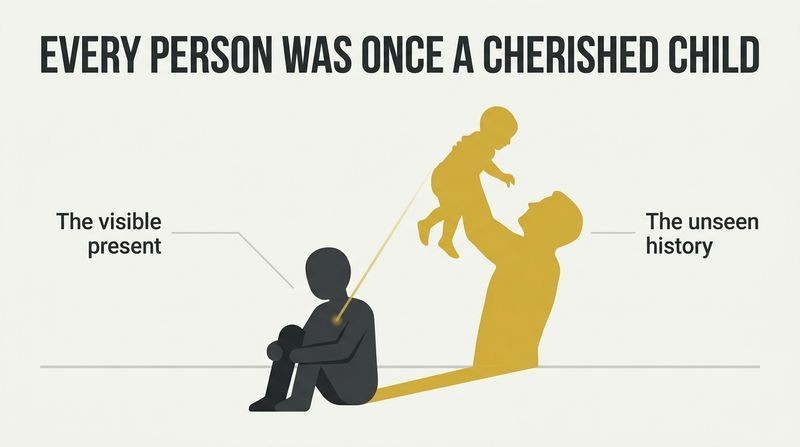
Veteran San Francisco Chronicle reporter Kevin Fagan builds his entire book around a single reframe: the disheveled figure passed out on the pavement, whom most pedestrians step around or glance at with pity, had a full life before the gutter. He tells the true stories of two people who fell into homelessness. Rita Grant was a Florida surfer girl, a near-Olympic gymnast, and a high school homecoming runner-up. Tyson Feilzer grew up in Danville, one of America's wealthiest suburbs, a witty football player raised by an accountant father.
Both ended up addicted and sleeping on concrete. Fagan's argument is that homelessness is not a separate species of human but a destination reachable from surfboards and suburban koi ponds alike.
What's striking is how Fagan weaponizes contrast against the psychological defense researchers call dehumanization by category. Studies by Princeton's Susan Fiske show the brain processes images of homeless people in regions associated with disgust rather than the regions used for other humans, literally short-circuiting empathy. By excavating Rita's beehive hairdo and Tyson's Cub Scout years, Fagan forces the reader's mind back into the person-perceiving mode. The device is old (Dickens used it), but its deployment through immersive, decades-long reporting rather than sentiment gives it unusual authority. The risk: two charismatic, photogenic subjects may not represent the harder majority, a caveat Fagan himself acknowledges.
You cannot force help on addicts; they must hit bottom first

Fagan reports a consistent finding from street counselors in San Francisco, Philadelphia, and New York: it takes roughly two years of repeated visits to persuade a hard-core homeless person to accept help. You cannot legally compel it unless someone is a danger to themselves or others, a very high bar. City health specialist Dr. Josh Bamberger frames the counterintuitive truth: jail just makes people trust you less. You have to convince them life indoors beats life outside.
Rita's family learned this the hard way. Her daughters flew out twice and briefly got her into methadone and housing, but she always drifted back to the street and her boyfriend Tommy. Only after Tommy died and she had a near-death vision did she say a single word: "Okay."
This aligns with the transtheoretical model of behavior change developed by Prochaska and DiClemente, which holds that people move through stages (precontemplation, contemplation, preparation, action) and that intervention mistimed to the wrong stage backfires. The book's tension, though, sits uneasily against the recent policy turn toward conservatorship and mandated treatment in California. Fagan's evidence suggests coercion rarely sticks, yet critics note that waiting for rock bottom can mean waiting for death. The honest reading is that readiness cannot be manufactured, but the surrounding scaffolding (family showing up repeatedly, a bed available the instant someone says yes) can be prepared in advance so the window is not missed.
House people first, then treat the addiction, not the reverse

After six months living on the street in 2003 for his "Shame of the City" series, Fagan concluded that the only thing that reliably worked was supportive housing: welfare apartments with rehab and counseling staff on-site, offered before demanding sobriety. Everyone he watched try to kick drugs while still outside failed, even after brief jail-induced sobriety.
The idea drew bipartisan appeal. Conservatives liked that housing the chronically homeless saves money (emergency rooms and jails cost more). Liberals liked that it was humane. President George W. Bush's homelessness czar circulated Fagan's series and pushed federal agencies to prioritize permanent supportive housing. Climbing out, Fagan stresses, is not a bootstraps hand-up but the construction of an entirely new life, requiring massive assistance.
Fagan is describing Housing First, the model pioneered by psychologist Sam Tsemberis in the 1990s, which inverted the old "treatment readiness" staircase. Randomized studies (notably the Canadian At Home/Chez Soi trial) confirmed high housing retention. Yet the model faces a scaling problem the book documents vividly: San Francisco would need billions and a tripling of construction to house everyone, and for every person housed, four more appear. Housing First works at the individual level but drowns without upstream supply. The deeper lesson is that a clinically proven intervention can still fail as public policy when the underlying housing market itself manufactures homelessness faster than programs cure it.
For every homeless person housed in San Francisco, four more replace them
Fagan lays out the arithmetic of futility. San Francisco spends more than $600 million a year on homelessness, more per capita than nearly any American city, and has housed tens of thousands over two decades. Yet the one-night count stays stuck between roughly 6,000 and 8,000, doubling to 20,000-plus over a full year. The city's own department estimates a four-to-one replacement rate.
The cause is upstream: persistent poverty keeps refreshing the ranks. More than a third of Americans are impoverished or living paycheck to paycheck. Fagan traces the crisis to the 1980s dismantling of mental institutions and the slashing of federal housing aid. HUD's budget was cut from $83 billion to $18 billion between 1978 and 1983 (in 2004 dollars) and never recovered.
The replacement dynamic exposes why local heroics feel like shoveling sand against the tide, Fagan's own phrase. Economists Gregg Colburn and Clayton Page Aldern, in Homelessness Is a Housing Problem, show that regional homelessness rates correlate far more with rent and vacancy rates than with poverty, addiction, or weather. This reframes the moral debate: individual stories of addiction, however true, are symptoms downstream of a structural shortage. Fagan's international comparison sharpens the point. England, with 56 million people, counts around 4,000 sleeping rough nightly; San Francisco alone, with 800,000 people, has more than 4,000. The difference is not character but the presence of a welfare floor.
Chronic street dwellers are only 30% of the homeless but define the image
Fagan draws a crucial distinction most people miss. The "chronically homeless," defined as anyone outside for a year or more with a disabling condition like mental illness or addiction, make up roughly 30% of the total. More than 75% of them battle mental illness, substance abuse, or both. They are the visible ones, camped on sidewalks, shooting up in the open.
The other 70% are largely invisible: in shelters, couch-surfing, or in jail and rehab. Most became homeless episodically through a job loss or fleeing domestic violence, then "self-resolve" by finding work or moving in with family. The chronic population cannot pull itself up by bootstraps. Rita's Homeless Island crew, a dozen entrenched addicts living on a traffic median near City Hall, were the hardest of the hard core.
This 30/70 split is the single most useful mental correction the book offers, because public policy and public rage both fixate on the visible minority while the churning majority passes unseen. The framing echoes epidemiology's distinction between prevalence (who is homeless right now) and incidence (who flows through over a year). Confusing the two produces bad policy: solutions aimed at the entrenched chronic population (intensive supportive housing) differ entirely from what the transient majority needs (rapid rehousing, one-time rent assistance). Fagan's clarity here is a public service. The nuance worth adding: the two groups are not sealed off, and prolonged episodic homelessness can graduate someone into the chronic category.
Advantage is no armor; Danville privilege ended on a Tenderloin sidewalk
Tyson Feilzer had every buffer Rita lacked: an accountant father, a real estate agent mother, a top-100 high school, summer fishing trips to the Sierra. He was a brainiac who aced classes on memory alone. Yet he chased a shortcut to a big life, refused to pay dues, drifted through cocaine and alcohol, and after his grandmother died and his mother sold the family home, he hit San Francisco's streets in 2012.
The hidden accelerant was an undiagnosed bipolar condition. Tyson had been self-medicating with narcotics for a mental illness nobody, including himself, knew he had until a late-summer diagnosis at age 40. His brother Baron, raised in the same house, built a stable career and family. Same launch pad, opposite trajectories.
The brothers function as a natural experiment that undercuts pure environmental determinism. Behavioral genetics offers a partial key: twin and adoption studies attribute roughly 50% of addiction vulnerability to heritable factors, and bipolar disorder carries high heritability. Tyson's story illustrates "dual diagnosis," the toxic interaction of mental illness and substance abuse that Fagan flags as especially lethal and hard to catch early. The uncomfortable implication is that comfortable childhoods reduce but do not eliminate risk, and that untreated mental illness can override every advantage. What looks like a character flaw (chasing get-rich-quick schemes, restlessness) may itself be a symptom of undiagnosed mania.
Homeless encampments are chosen communities, not just heaps of despair
Rita's Homeless Island, a 40-by-75-foot concrete triangle between Mission and South Van Ness, was selected with a homeowner's eye for location by her boyfriend Tommy: two leafy shade trees, a streetlamp, stopped traffic for panhandling, no residents to complain, and a central spot on the drug-trade route. The dozen regulars arranged their shopping carts in a circle like a wagon train, watching each other's backs.
Fagan insists the "I just love the outdoor life" claim is usually a lie. What people really mean is they have a survival routine, and changing it terrifies them. When Tommy died of flesh-eating disease from dirty needles, the Islanders screamed and wailed for an hour, then went back to panhandling and scoring. The bonds were real, the mutual protection genuine, the misery constant.
Anthropologists Philippe Bourgois and Jeff Schonberg, in Righteous Dopefiend, documented this same "moral economy" among heroin users, sharing needles, food, and shelter through a code of reciprocity they called "the moral economy of sharing." Fagan's Island confirms that even the most degraded settings generate social structure, hierarchy, and loyalty. This matters practically: outreach that ignores these bonds fails, because leaving the camp means leaving one's only protective network. The counterintuitive policy takeaway is that nav centers succeeded partly by letting people bring partners and pets, preserving the social unit. Community is not the opposite of homelessness; it is often what makes the street survivable and, tragically, sticky.
A bed available the instant someone says yes is everything
When Baron finally found his brother on Larkin Street at 10:36 p.m., the interventionist Vicki's rule was absolute: when they say yes, you go immediately. Wait, and they are gone. They had a hotel room, a shower, food, a rehab bed in the Sierra foothills, and a plane ticket to Ohio already lined up. Tyson got clean and gained weight at a resort-like Mississippi rehab with horse therapy and a lake.
Rita's rescue followed the same logic. Her sister Pam and daughter Joy flew out, took her straight to a wound clinic (doctors said the abscesses would have killed her in two weeks), then methadone, then AIDS meds, then a flight to Florida. The infrastructure of the catch mattered as much as the moment of willingness.
This is the operational counterpart to the readiness insight. Behavioral economists would call it exploiting a narrow "window of low resistance" before hyperbolic discounting reasserts itself and the immediate craving overwhelms the distant goal. Addiction medicine confirms that treatment access delayed even by days sharply reduces entry. The sobering coda is that access is not destiny: Tyson relapsed and died four months later, alone, from a fentanyl-laced dose, because his tolerance had dropped and he stopped his bipolar medication. Fagan's honesty here refuses the tidy redemption arc. The relapse rate for addicts hovers near 60%, and lowered tolerance after rehab makes relapse overdoses especially deadly.
Getting clean can quietly kill the body that survived the street
Fagan describes a grim pattern he has witnessed repeatedly: people come indoors, clean up, relax, and then die. "Little Bit," the four-foot Homeless Island woman who turned tricks and missed her four children, achieved a complete turnaround through supportive housing, methadone, and a good boyfriend. She lasted one year before dying of kidney failure at 40. The survival-mode defenses that kept her alive outside relaxed, and a long-brewing illness swooped in.
The street ages and destroys bodies invisibly. Rita's teeth all 28 rotted from "meth mouth," the combination of drug-dried saliva and sugar cravings. Abscesses from dirty needles cost "One-Leg" Mike his leg and killed Tommy. Rita herself contracted HIV, hepatitis C, and later survived where nearly all her friends did not.
This observation, that recovery can precede rapid physical collapse, is underappreciated even in medicine. It parallels documented phenomena like "give-up-itis" and the paradox where chronic stress-hormone flooding (allostatic load) masks underlying organ damage until the stress lifts. Fagan is not arguing against getting clean; he is puncturing the fantasy that sobriety instantly reverses years of accumulated harm. The public tends to imagine rescue as a finish line. In reality, decades of malnutrition, exposure, and untreated disease leave a debt the body eventually collects. It reframes success stories as fragile and reminds readers that survival on the street is itself a physiological achievement extracting a hidden toll.
Fentanyl turned relapse from a setback into a death sentence
Fagan charts the escalating lethality of America's drug supply across decades: crack in the 1980s, meth in the 1990s, and now fentanyl, a synthetic opioid up to 50 times more powerful than heroin that dealers spike into everything. Tiny grains kill. Nearly 70% of America's 100,000-plus annual overdose deaths involve fentanyl. In San Francisco, opioid overdose deaths jumped from 177 in 2018 to 811 in 2023.
Tyson died in September 2019 from acute mixed-drug intoxication, fentanyl, heroin, and methamphetamine, on the same block where his brother had rescued him five months earlier. Rita's son Doug Jr. and his friend both overdosed and died instantly after casually trying fentanyl once, after years of sobriety. Her other son, Scooter, died of a heroin overdose at 21.
The fentanyl era has statistically decoupled relapse from recovery. Where a heroin-era relapse might mean weeks of renewed use before crisis, a fentanyl-era relapse can be fatal on the first dose, especially for someone whose tolerance dropped during treatment. This transforms the moral math of harm reduction: naloxone (Narcan) distribution, drug-checking strips, and supervised consumption sites become life-or-death rather than nice-to-have. Fagan captures the cruel irony that Tyson himself carried Narcan and had saved several lives with it before dying without anyone nearby to save him. The policy debate over safe-injection sites, still legally fraught, is fundamentally a debate about whether a relapse should be survivable.
Judge a society by whether it manufactures its own underclass
Fagan ends with a structural indictment. Homelessness, he argues, is not primarily a personal failing but the predictable output of policy choices: gutted federal housing funds, no national health care, inadequate low-income wages, oppressive rent practices, and a mental-health system dismantled in the 1970s. The crisis mirrors inequality's ugliest edges. In San Francisco's 2022 count, Black residents were 35% of the homeless but only 6% of the population. Nationally, 40% of homeless youth identify as LGBTQ.
He contrasts America with England and Australia, which maintain national health systems, guaranteed housing for the poor, and living-wage rules, and consequently keep far fewer people sleeping rough. Housing, activist Paul Boden tells him, fixes homelessness. Not more ten-year plans.
Fagan invokes the maxim, often attributed to Gandhi or Humphrey, that a society is measured by how it treats its most vulnerable. The racial disparities he cites point to homelessness as a downstream reservoir of redlining, mass incarceration, and wage suppression, a view supported by Matthew Desmond's Evicted and Poverty, By America. The comparative international data is the strongest part of the argument: nations that treat housing and healthcare as rights simply produce fewer rough sleepers, suggesting the American level is a policy choice rather than an inevitability. The steelman for skeptics is that generous welfare states also face rising homelessness lately, meaning supply and immigration pressures complicate the pure policy story.
Never stop showing up; a family that refuses to quit is the rescue
The engine of both rescues was not a government program but relatives who would not give up. Rita's sister Pam and daughters tried repeatedly over years, absorbing failure after failure, until the moment Rita was ready. Baron flew from Ohio, hired an interventionist, raised nearly $44,000 from 90 friends, and walked the streets showing his brother's photo to hundreds of strangers. Even street people cheered them on, telling Baron, "He needs you."
Rita got nearly 20 restored years: dentures, a massage career, dancing at family gigs, reconnection with her mother before she died. Tyson got roughly six good months, meeting his niece, feeding horses, feeling healthy. Both were worth saving. Fagan's closing conviction is that a younger, hopeful self survives inside even the most ruined person, waiting to be relit.
The book resists the sentimentality it flirts with by refusing a happy ending for Tyson, and this is its ethical strength. Persistence is presented not as a guarantee but as a necessary condition with uncertain payoff. This mirrors research on "natural recovery" and social support: family involvement is among the strongest predictors of sustained sobriety, yet no amount of love overrides untreated bipolar disorder plus fentanyl. Baron's haunting question, whether getting Tyson clean actually caused the fatal overdose by lowering his tolerance, captures the tragic knot. The takeaway is not that love conquers addiction, but that showing up is the only lever ordinary people control, and its value survives even failure.
Analysis
Kevin Fagan's The Lost and the Found is best understood as immersion journalism wearing the clothes of memoir. A San Francisco Chronicle reporter who spent six months living on the streets for his 2003 "Shame of the City" series, Fagan braids two decades-long true stories, Rita Grant and Tyson Feilzer, into a single meditation on why some people fall, why some rise, and why society keeps producing the fall.
Structurally, the book is a diptych. Rita descends from Florida surfer girl to Homeless Island heroin addict and, rescued by her family, achieves twenty restored years. Tyson descends from Danville privilege to a Tenderloin sidewalk and, rescued with even greater resources, dies four months later. The parallel construction is the argument: outcome is not proportional to effort or advantage. Fagan deliberately withholds a formula, insisting the determinants (genetics, mental illness, luck, peer influence, timing) resist reduction.
The book's intellectual contribution is not theoretical but perceptual. Fagan is trying to repair the reader's broken empathy circuit toward the visibly homeless, and he does it through granular biography rather than argument. Where the book earns authority is its reportorial patience: he tracks subjects across twenty years, interviews dozens of family members, and refuses tidy resolution.
Its limitations are worth naming. Two exceptionally charismatic, photogenic subjects risk skewing the reader toward the redeemable. Fagan's policy prescriptions (Housing First, supportive housing, national welfare floor) are sound and evidence-backed but treated more as moral conclusion than contested terrain. The recent research consensus that homelessness tracks housing markets more than personal pathology actually strengthens his case, though he foregrounds individual stories that can inadvertently reinforce the pathology narrative he opposes.
What lingers is Fagan's dark-humored humanity and his structural honesty: he lets Tyson die on the page, refusing the redemption the genre craves. That refusal is the book's integrity. The lesson is neither optimism nor despair but obligation, to see, to show up, and to keep trying without the comfort of guaranteed results.
People Also Read





Glossary
Chronically homeless
Long-term disabled street populationThe government category for anyone who has lived outside for a year or more and has a disabling condition such as mental illness or substance abuse. They make up roughly 30% of the total homeless population but are the most visible, the most entrenched, and the least able to exit without intensive help. More than 75% struggle with mental illness, addiction, or both.
Homeless Island
Traffic-median encampment near City HallFagan's name for a 40-by-75-foot concrete traffic triangle at Mission and South Van Ness in San Francisco where Rita Grant and about a dozen chronically homeless addicts lived in the early 2000s. Chosen for its shade trees, streetlamp, and panhandling access to stopped traffic, it functioned as a tight, self-protective community of the city's hardest-core street dwellers.
Supportive housing
Welfare apartments with on-site rehabPermanent subsidized housing that places formerly homeless people indoors first and provides counseling, addiction treatment, and health services within the building, rather than requiring sobriety before housing. Fagan identifies it as the only intervention he saw reliably work for chronically homeless people, and his reporting helped push it to federal priority under the George W. Bush administration.
Self-resolve
Exiting homelessness without interventionCaseworker term for the roughly 70% of homeless people who slide into homelessness episodically because of an emergency (job loss, domestic violence) and then find their own way out by getting a job, moving in with family, or similar means, without needing intensive services. Distinguished from the chronically homeless, who cannot exit unaided.
Navigation center (nav center)
Low-barrier enhanced homeless shelterA San Francisco shelter model conceived in 2015 with fewer restrictions than typical shelters: no curfews, pets and partners allowed, more personal space, and on-site counselors for housing, rehab, and health. Entry requires selection by a roving outreach counselor. Designed to entice chronically homeless people who normally refuse conventional shelters.
Homeward Bound
Bus-home family reunification programA San Francisco program created under Mayor Gavin Newsom, partly inspired by Fagan's reporting on Rita, that pays to reconnect homeless people with committed friends or family elsewhere. By 2022 it had sent 10,800 people home at an average $180 per trip, with just over half staying, and has been replicated in cities nationwide.
Meth mouth
Severe drug-induced tooth decayThe catastrophic dental deterioration common among street addicts, caused by methamphetamine and other drugs drying up protective saliva combined with intense sugar cravings, often compounded by beatings and falls. Rita lost all 28 of her teeth to it. Because dentures cost thousands, the disfigurement blocks employment and crushes self-esteem.
Dual diagnosis
Co-occurring addiction and mental illnessThe combination of substance abuse and an underlying mental illness, such as Tyson Feilzer's undiagnosed bipolar disorder for which he was unknowingly self-medicating with narcotics. Fagan flags it as an especially toxic and lethal condition that is difficult to detect early and that dramatically complicates recovery.
Download PDF
Download EPUB
.epub digital book format is ideal for reading ebooks on phones, tablets, and e-readers.








