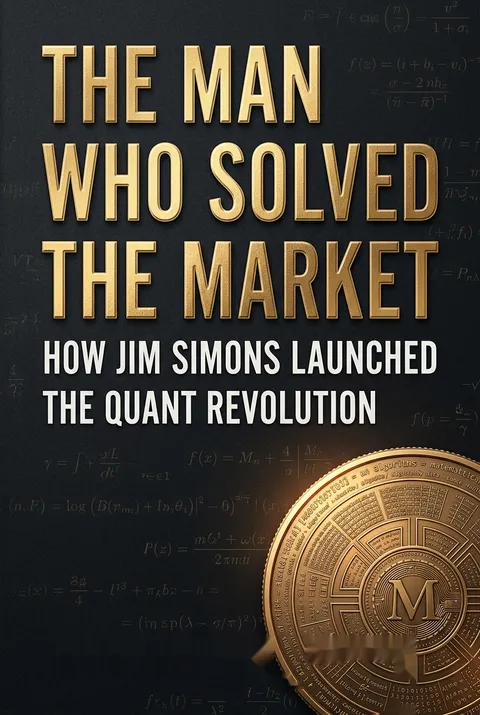


Key Takeaways
He did not solve markets; he built a machine for harvesting small edges.
The result was historic. Jim Simons moved from theoretical mathematics and Cold War code-breaking into trading, despite having little finance experience. By the book’s 2019 account, Medallion had averaged 66.1 percent annually before fees and 39.1 percent after fees from 1988 through 2018, generating an estimated $104.5 billion in trading profits. The achievement was not a single brilliant forecast. It was a repeatable system that found patterns, placed many trades, and kept adapting.
A difficult transition. Simons’s early attempts to trade by instinct brought losses and anxiety. He gradually shifted toward computers, data, and mathematical models, recruiting researchers rather than conventional market experts. His success helped make quantitative trading influential across finance. Yet Medallion’s exceptional record was not typical: the book notes that average quant funds earned far less.
The central achievement is better understood as an engineered process than as a claim to have decoded the entire market. That distinction matters: systems can exploit a narrow, recurring advantage without explaining every force that shapes prices. The results also show how an organization can turn intellectual work into compounding commercial returns. But Medallion is an extreme outlier, operating with unusual talent, data, infrastructure, and secrecy. Its performance cannot establish that quantitative methods reliably outperform for ordinary investors or in every market.
Treat prices as evidence, not as stories that must be explained.
Infer the hidden state. Simons’s early work with fellow code-breakers proposed that markets might move through underlying conditions that cannot be observed directly. A hidden Markov model is a statistical method for inferring unseen states from observable sequences. In markets, the model might infer a rising, falling, or unusually volatile condition from price movements, without needing to explain why that condition arose.
Prediction before explanation. This approach differed from investors who began with company news or economic theory and then forecast prices. Simons’s team asked whether a pattern in the data predicted what came next. The method echoed code-breaking: the visible message may look chaotic, but its structure can reveal information about the unseen process producing it.
This is a useful distinction between explanation and prediction. A weather model can forecast rain without explaining every atmospheric interaction, just as a trading model can detect a recurring relationship without a satisfying economic story. Yet predictive success is not proof that the model has found a stable cause. When the underlying process changes, a once-useful pattern can vanish. Treating prices as evidence encourages disciplined testing, but it also demands humility about what the evidence actually establishes.
Build the data plumbing before trusting the elegant model.
Raw data misleads. Renaissance’s early research relied on scattered, error-filled price records. Sandor Straus took on the unglamorous work of collecting intraday prices, checking gaps, and correcting suspicious figures. Those detailed records later helped the team detect patterns that were invisible in daily opening and closing prices alone.
A model can be confidently wrong. An early system, nicknamed the Piggy Basket, began directing large sums into potato futures. The team could see the recommendation but could not explain it, and regulators eventually forced the firm to close its positions at a loss. Another strategy appeared to lose money in Canadian dollar futures because a small group of traders exploited the firm’s orders. Better data and analysis could reveal opportunity, but only careful validation and attention to market mechanics could prevent avoidable mistakes.
Data quality is not clerical housekeeping. It is part of the theory: a model trained on faulty records learns the flaws in its inputs as if they were features of the world. This insight applies to medicine, public policy, and machine learning, where biased or incomplete data can produce precise-looking errors. The potato episode also highlights interpretability’s practical value. A system need not explain every decision, but unexplained recommendations deserve especially strong checks before they control large sums.
Harvest many modest signals instead of demanding one brilliant prediction.
Small patterns can add up. After the fund’s early losses, Elwyn Berlekamp pushed the team toward frequent, short-term trades. Researchers searched historical data for repeatable effects, including patterns around weekdays, economic announcements, and consecutive price movements. Henry Laufer later divided trading sessions into five-minute intervals, giving the team a finer view of market behavior.
A slight edge can compound. The researchers combined numerous signals rather than betting everything on one forecast. Their trades often earned only small gains, and the system was right only a little more than half the time. That could still work when the signals were tested, traded frequently, and balanced across investments. The firm also looked for relationships between assets, not just whether one stock would rise or fall.
The power here lies in aggregation. In statistics, repeated observations can make a weak but genuine effect measurable; in casinos, a small advantage across many independent wagers can produce reliable outcomes. Renaissance applied a related logic to markets. However, a large number of tests also makes accidental patterns easier to find. The more combinations researchers search, the more important it becomes to test signals on fresh data and account for the many chances that a coincidence will look persuasive.
Automate decisions, but retain authority to stop a model under stress.
Machines resist ordinary impulses. Simons wanted a system that could trade without humans reacting to every price swing. This helped prevent fear, overconfidence, and attachment to losing positions from repeatedly distorting decisions. In 2000, however, Medallion’s automated strategies kept buying stocks that had been rising just as the technology bubble collapsed. Researchers identified the failing momentum signal and removed it, helping end the losses.
Automation is not infallibility. During the 2007 quant sell-off, Simons reduced positions because he feared the fund might run short of collateral, even as researchers argued for trusting the system. The choice limited some potential gains, but prioritized survival. The book contrasts this restraint with Long-Term Capital Management, whose confidence in its models and leveraged positions proved disastrous when markets behaved in unexpected ways.
Automation can make a decision process more consistent, but consistency is not the same as correctness. A model may execute a flawed assumption faster and at greater scale than a person could. The strongest design therefore separates routine discipline from emergency governance: clear conditions for intervention, authority to reduce exposure, and a process for reviewing failures. Human judgment can reintroduce bias, but removing it entirely also removes a source of adaptation when the model’s world no longer resembles reality.
Build a team that shares code, credit, and the fund’s outcomes.
Talent needed a system. Simons had learned to recruit strong minds while building a leading mathematics department and working with code-breakers. At Renaissance, he assembled mathematicians, physicists, computer scientists, and specialists in other fields, many without Wall Street backgrounds. Rather than let researchers work in isolated silos, he promoted a shared trading system and broad access to its code, so employees could test ideas and improve one another’s work.
Incentives reinforced cooperation. Bonuses and ownership were linked to the firm’s performance, rewarding contributions ranging from discovering signals to fixing software. The approach helped turn individual expertise into a collective research engine. It also carried risks: secrecy, relentless pressure, and internal disputes could damage the collaborative culture. Departures and conflict showed that financial rewards alone could not guarantee trust or a shared sense of purpose.
Renaissance’s advantage was organizational as much as mathematical. A diverse team can combine perspectives that no single expert possesses, while shared tools make it easier for discoveries to build on one another. Incentives tied to overall results can reduce competition for individual credit. Still, openness has limits in a firm whose code is its competitive asset, and high-powered incentives can make colleagues rivals for status and compensation. Collaboration requires norms of respect, not merely shared files and bonuses.
Measure capacity and hidden costs; paper profits disappear in execution.
A good forecast is not a completed trade. Renaissance tracked slippage, the difference between the price its model expected and the price it actually received after trading costs and market impact. It developed tools to estimate this gap and spread orders across exchanges and times, making trades less visible and less disruptive. The firm also learned that some markets could not absorb unlimited activity without eroding returns.
Scale adds risk. Basket options let Medallion control far more stock exposure than its cash alone would permit. That leverage amplified gains, but it also increased what could go wrong. The arrangements drew criticism from a Senate subcommittee and an IRS dispute over the fund’s tax treatment. The episode shows that financial engineering can improve a strategy’s economics while creating legal, ethical, and systemic questions beyond the model itself.
Execution is where abstract predictions meet other people, rules, and limited market capacity. In operations research, an optimal plan that ignores constraints is not optimal in practice; trading follows the same principle. Leverage complicates the picture because it magnifies both the apparent quality of a signal and the consequences of being wrong. The basket-option controversy adds a further lesson: technical ingenuity does not settle whether a structure is fair or sustainable. Those judgments require legal and public scrutiny, not just risk calculations.
A private fortune can become political infrastructure, whether intended or not.
Money travels beyond markets. Renaissance co-CEO Robert Mercer used part of his wealth to support conservative causes, Breitbart News, and political organizations connected to the 2016 Trump campaign. His daughter Rebekah helped bring Steve Bannon and Kellyanne Conway into the campaign during a period of disarray. Their influence drew intense scrutiny and protests, eventually contributing to Mercer stepping down as Renaissance co-CEO in 2017.
Influence has consequences. Simons, a major Democratic donor, disagreed with Mercer’s politics but initially treated them as separate from his performance at the firm. As employees and clients raised concerns about morale and reputation, he changed course. The story links private wealth to public power and shows how decisions made outside a company can still reshape its internal culture and its future.
The story exposes a governance problem: formal authority and real influence do not always sit in the same place. A wealthy executive’s political activity may be personal, yet it can affect employees, clients, and the organization’s ability to attract talent. The same concern applies across political parties, since concentrated private funding can amplify a narrow set of priorities. Defending individual political freedom remains important; so does asking who bears the reputational and institutional costs of that freedom.
Use wealth to fund problems whose payoffs markets cannot measure.
The next challenge changed shape. After stepping back from daily leadership at Renaissance, Simons devoted substantial resources to scientific research and education. The Simons Foundation supported autism research, including a genetic repository designed to help researchers study the condition. Math for America provided annual stipends to strong mathematics and science teachers in New York City, aiming to help keep skilled educators in public schools.
Money did not erase uncertainty. Simons also backed research into the origins of the universe and life, questions with no guaranteed answer or quick commercial return. His philanthropy followed the same appetite for difficult problems that had drawn him to mathematics and markets. Yet the book leaves a tension unresolved: private giving can support valuable work, while also giving one person unusual influence over which public problems receive attention.
Basic research and teacher development often produce diffuse benefits over long periods, making them difficult to fund through ordinary markets. Patient philanthropy can support work that conventional investors would avoid, especially when results are uncertain and broadly shared. But generosity does not remove the question of accountability. When a donor sets priorities at a scale usually associated with public institutions, transparency and independent evaluation become essential. Good intentions can open doors; they should not be mistaken for proof that a program works.
Analysis
The book’s deepest story is not simply that a mathematician became a spectacular investor. It is how Simons assembled an institution capable of converting imperfect evidence into repeated decisions. His route ran through code-breaking, where patterns had to be inferred from obscure messages; university leadership, where talent had to be recruited and coordinated; and trading, where a prediction had value only if it survived data errors, execution costs, and competition. Renaissance’s advantage emerged from these parts working together, not from a single formula.
That distinction also clarifies the book’s portrayal of scientific thinking. The firm tested patterns and accepted some that lacked an intuitive explanation, while guarding against statistical flukes and refining its models. Yet the process was never purely mechanical. People chose the data, designed tests, set exposure, judged market capacity, and decided when survival outweighed faith in a model. The celebrated machine depended on human decisions about where to point it and when to intervene.
The biography resists a neat triumph narrative. Simons’s career shows how curiosity and persistence can carry expertise across fields, but his personal losses expose the limits of prediction. The firm’s extraordinary returns coexist with trading failures, a leveraged crisis, tax controversy, workplace conflict, and the political influence of its wealth. These are not footnotes to the model. They are consequences of building a powerful institution around it.
The book’s most portable lesson is therefore methodological, not financial: make claims testable, build reliable measurement, and distinguish a useful model from reality itself. Its least portable lesson is the implication that data abundance alone produces an edge. Renaissance’s results depended on rare people, costly infrastructure, unusual secrecy, and circumstances that may not recur. The story celebrates quantitative ambition while showing why no model, however successful, can make markets or life fully predictable.
Review Summary
The Man Who Solved the Market received mixed reviews. Many readers found it an engaging account of Renaissance Technologies and its founder, Jim Simons, praising the insights into quantitative trading and the firm's success. Some appreciated the human stories and political aspects, while others felt these detracted from the financial focus. Critics noted a lack of technical depth and mathematical explanations. Overall, readers valued the book's exploration of Renaissance's history and impact on financial markets, despite some finding it lacking in certain areas or containing extraneous details.
People Also Read








Glossary
hidden Markov model
Infers unseen statesA statistical model for sequences in which observable events are generated by underlying states that cannot be seen directly. Researchers estimate those hidden states from the observed data and use them to assess what may happen next. In the book, this provides a way to infer market conditions from price movements without requiring a conventional economic explanation.
Baum-Welch algorithm
Estimates hidden probabilitiesAn algorithm developed by mathematicians Leonard Baum and Lloyd Welch to estimate probabilities and hidden states in a sequence. It can learn underlying structure from observed outputs even when the rules generating those outputs are not directly visible. The method became important in machine learning and speech recognition, and it informed Simons’s early thinking about markets.
statistical arbitrage
Trades statistical anomaliesA trading approach that uses statistical analysis to identify relationships or irregularities among securities and places multiple trades intended to profit if those patterns persist or return toward normal. It often seeks to limit exposure to broad market direction. Renaissance used related methods to trade stocks, while managing the practical constraints of cost, risk, and execution.
kernel methods
Find nonlinear data patternsA family of statistical and machine-learning techniques that can identify complex, nonlinear relationships in data. Rather than relying only on a simple straight-line relationship, these methods compare patterns across observations and help generate predictions. In the book, researchers proposed using kernel methods to detect market situations resembling earlier ones, even when the similarities were not obvious to people.
slippage
Cost of market impactThe difference between the price a trading model assumes it can obtain and the price actually achieved when orders are executed. Slippage can result from brokerage charges, limited liquidity, or a fund’s own trading moving the market. Renaissance built tools to measure this cost because a forecast can appear profitable in a simulation yet fail after real-world execution.
Sharpe ratio
Return adjusted for volatilityA measure comparing an investment’s returns with the volatility involved in achieving them. A higher ratio indicates more return relative to observed fluctuations, though it does not prove that losses are impossible or that risk has been fully captured. The book uses it to compare Medallion’s unusually strong performance with that of other funds and market benchmarks.
basket options
Options tied to stock groupsFinancial contracts whose value is linked to a group of stocks rather than a single security. Renaissance used basket options arranged through banks to gain substantial exposure to stock portfolios while the banks technically held the underlying shares. The structure increased leverage and changed the fund’s risk and tax treatment, which later became the subject of government scrutiny.
data overfitting
Mistakes noise for patternA modeling error in which a system appears to explain historical data because it has been tuned too closely to accidental details in that sample. The apparent relationship may not repeat in new data. The risk grows when researchers test many possible signals, since some will look successful by chance. Renaissance sought to test signals for stability and statistical strength.
The Devil
Execution cost gapRenaissance’s name for the gap between the trades its model ideally wanted and the results achieved after real-world trading costs and market impact. Tracking this difference helped the firm understand how much theoretical profit was being lost during execution. It also guided decisions about when, where, and how quickly to place orders.
FAQ
What's The Man Who Solved the Market about?
- Focus on Jim Simons: The book chronicles the life and career of Jim Simons, a mathematician who founded Renaissance Technologies, a hedge fund that revolutionized quantitative trading.
- Quantitative Revolution: It explores how Simons and his team used mathematical models and algorithms to predict market movements, leading to the creation of the Medallion Fund with extraordinary returns.
- Impact on Finance: The narrative examines the broader implications of Simons's methods on the finance industry, including the rise of quantitative investing and its influence on various sectors.
Why should I read The Man Who Solved the Market?
- Insight into Quantitative Trading: The book provides a deep dive into the world of quantitative finance, making complex concepts accessible to general readers.
- Inspiring Story: It tells an inspiring story of how a mathematician with no formal finance training became one of the most successful investors in history.
- Lessons on Risk and Morality: The book raises important questions about the ethics of wealth accumulation and the impact of financial practices on society.
What are the key takeaways of The Man Who Solved the Market?
- Data-Driven Success: The book emphasizes the power of data and algorithms in making investment decisions, showcasing how Simons's methods changed the landscape of finance.
- Collaboration and Innovation: Simons fostered a culture of collaboration among his researchers, leading to innovative trading strategies and success in complex fields.
- Adaptability in Trading: The narrative illustrates the need for adaptability in trading strategies, especially in response to market changes.
What are the best quotes from The Man Who Solved the Market and what do they mean?
- “If we have enough data, I know we can make predictions.”: This quote encapsulates Simons's belief in the power of data analysis to drive investment success.
- “All models are wrong, but some are useful.”: It underscores the idea that while no model can perfectly predict market behavior, they can still provide valuable insights.
- “Trust the model.”: This phrase emphasizes the importance of relying on data-driven strategies rather than emotional decision-making in trading.
What is the Medallion Fund, and why is it significant?
- Exceptional Performance: The Medallion Fund is renowned for its extraordinary returns, averaging around 39.1% net annually since its inception.
- Quantitative Approach: It employs sophisticated mathematical models and algorithms to execute trades, setting a benchmark for quantitative investing.
- Limited Access: The fund is exclusive to Renaissance employees, adding to its mystique and reputation as a highly secretive and successful investment vehicle.
How did Jim Simons transition from academia to finance?
- Mathematical Background: Simons's strong foundation in mathematics and his work in code-breaking during the Cold War equipped him with unique analytical skills.
- Founding Renaissance Technologies: After leaving academia, Simons founded Renaissance Technologies, applying his mathematical expertise to develop trading algorithms.
- Innovative Trading Strategies: His approach to trading was revolutionary, integrating scientific methods into finance and creating a successful hedge fund.
What challenges did Renaissance Technologies face?
- Market Volatility: Renaissance encountered significant challenges during periods of market volatility, testing the effectiveness of its trading models.
- Internal Conflicts: Dynamics between key figures, such as Bob Mercer and Peter Brown, created tensions within the firm, impacting decision-making.
- Public Scrutiny: As Renaissance gained prominence, it faced increased scrutiny regarding its political affiliations and the ethical implications of its trading practices.
How did Renaissance Technologies adapt to changing market conditions?
- Continuous Improvement: The firm constantly refined its trading models to adapt to new market realities, maintaining its competitive edge.
- Embracing New Data: Renaissance began incorporating alternative data sources and machine learning techniques to enhance its trading strategies.
- Risk Management: The firm developed robust risk management practices to navigate periods of market turbulence, protecting its assets and profits.
What role did data play in Simons's trading strategies?
- Data as a Foundation: Simons believed that extensive data analysis was crucial for making informed trading decisions.
- Historical Patterns: The team used historical pricing data to identify patterns and anomalies that could predict future market movements.
- Continuous Improvement: Simons's approach involved constantly refining their data collection and analysis methods to enhance trading performance.
What role did Bob Mercer play at Renaissance Technologies?
- Key Contributor: Bob Mercer was instrumental in developing the quantitative models that drove Renaissance's trading strategies.
- Political Involvement: Mercer became a prominent political donor, supporting conservative causes, which later drew criticism and affected the firm's public image.
- Leadership Transition: After Simons stepped down, Mercer took on a more significant leadership role, co-managing the firm alongside Peter Brown.
How does The Man Who Solved the Market address the ethical implications of quantitative trading?
- Wealth Disparity: The book raises questions about the impact of hedge funds like Renaissance on wealth inequality.
- Market Manipulation Concerns: It discusses the potential for quantitative trading to manipulate markets, particularly during periods of high volatility.
- Philanthropic Efforts: Simons's philanthropic initiatives are presented as a counterbalance to the wealth generated by Renaissance, suggesting that giving back can help mitigate negative perceptions.
What is the significance of machine learning in Renaissance's trading strategies?
- Enhanced Predictive Power: Machine learning allows Renaissance to analyze vast amounts of data and identify complex patterns that traditional methods might miss.
- Automated Decision-Making: The integration of machine learning enables Renaissance to automate many aspects of its trading process, increasing efficiency.
- Continuous Learning: Renaissance's machine learning models are designed to adapt and improve over time, helping the firm stay ahead of competitors.
About the Author
Other books by Gregory Zuckerman

Download PDF
Download EPUB
.epub digital book format is ideal for reading ebooks on phones, tablets, and e-readers.








