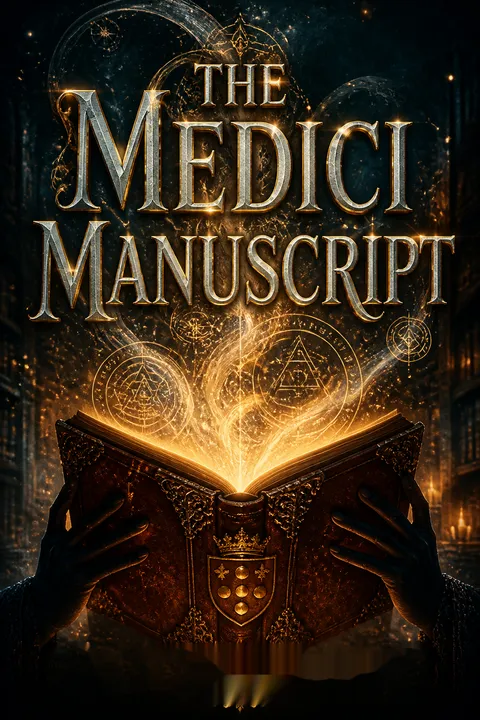


Plot Summary
The Attic’s Silver Clasp
In spring 1920, Sylvia Ashe is building a new life as assistant librarian after losing her mother and brother, while still wondering about the family history her mother concealed. Professor Nash leads Sylvia and her lively friend Daisy into the neglected attic of the Glass Library, searching for a book marked by his late companion Oscar Barratt.
Sylvia finds wooden covers secured by shining silver clasps, with Oscar’s note tucked inside. Its first page bears the Medici emblem; the rest is filled with unfamiliar letters and symbols.
Oscar had written a second name beside the manuscript’s title: Folgate, with a question mark. The discovery turns Sylvia’s abandoned curiosity about her ancestry into a new investigation, since Marianne Folgate was a silver magician who might connect the book to Sylvia’s unknown roots.
The book gives Sylvia’s grief a direction without pretending to cure it. Her instinct is not simply to inherit Professor Nash’s enthusiasm: she has already made a habit of finding shelter in books, and the manuscript offers a way to turn that inward refuge into action. Its two markings create distinct kinds of uncertainty, one historical and one personal. The Medici crest invites public scholarship, while Folgate’s tentative name touches the private silence surrounding Sylvia’s family. The attic discovery therefore launches both a material mystery and a search for belonging, with Sylvia’s professional skill providing the bridge between them.
Names Beneath Faded Ink
Professor Nash explains that the manuscript came through an Italian dealer, and that Oscar sensed magic in its clasps but never decoded its writing. Sylvia spots faint letters on a page; war photographer Carl Trevelyan enlarges them with specialist camera equipment, revealing the name Sir Andrew Sidwell.
Nash finds Sidwell in an old reference book as a sixteenth-century English collector of occult and scientific works. Ink magician Huon Barratt dates the name to that century, the Medici page to the fifteenth, and the main text to the fourteenth.
A mathematician, Francis Stray, cannot break its code. Huon recognizes one symbol from Catalonia, while Gabe’s repeated kidnapping attempts and a journalist’s interest add danger around the investigation. Daisy, who knows Wiltshire, points Sylvia and Gabe toward Sidwell’s descendants.
Each expert can identify a different layer, but none can yet explain the whole object. This makes the investigation collaborative by necessity: photography recovers what the eye cannot see, magical knowledge dates the ink, and historical research places an owner without revealing an author. The manuscript’s age also resists a simple provenance story, since its pages and Medici emblem belong to separate periods. Meanwhile, Gabe’s public reputation intrudes on Sylvia’s private inquiry. His unexplained escapes attract the press and kidnappers, giving the book’s trail an uneasy parallel: both the manuscript and Gabe contain something others want to possess or expose.
A House Full of Ledgers
Sylvia and Gabe drive to Sidwell House, a once-grand manor now falling into disrepair, where Lazarus Sidwell lives among the books collected by his ancestor. Lazarus welcomes them after learning Sylvia knows Daisy, his friend and neighbor, and shows them a library containing rare volumes and old medical instruments.
An account ledger records that Sir Andrew acquired 185 books from Dr. Thomas Adams in exchange for a debt, but it does not name Sylvia’s manuscript. Lazarus offers to search further.
On a later visit, he finds a list hidden in an old book: the manuscript was bought in Florence in 1563 from Dr. Niccolo di Mario, physician to the Medicis. The record traces its ownership, but gives no key to its coded contents or the clasps’ maker.
Lazarus’s crumbling home makes preservation feel costly rather than romantic. He loves the collection as a family inheritance, even though he has not read most of its books; possession stands in for a history he fears losing. His records let Sylvia and Gabe distinguish the manuscript’s actual chain of custody from attractive guesses, especially the assumption that Sidwell authored or decoded it. Yet documentary proof has limits: the ledger can tell them who transferred the object, not what its symbols mean. The distinction matters to Sylvia, whose research is increasingly driven by the mystery itself, not only by the possibility that it will explain her ancestry.
The Engagement Comes Apart
After dancing with Daisy and sharing a quiet picnic with Gabe in the Wiltshire countryside, Sylvia hears him describe feeling stranded in the aftermath of war. She tells him that meaningful work and new friendships helped her emerge from grief; he admits her part in his recovery.
The intimacy unsettles them both, since Gabe is engaged to Ivy Hobson. He later decides to end the engagement, but Ivy initially refuses to accept the separation and asks him to reconsider.
His cousin Willie blames Sylvia, believing Gabe has acted impulsively, while Sylvia insists she urged him only to speak honestly with Ivy. Professor Nash argues that Gabe would not make such a decision lightly. The disagreement exposes how much his friends want to protect him, even when they mistake protection for choosing his future.
The romance develops through a shared recognition of postwar disorientation, not through a sudden escape from it. Sylvia offers Gabe a language for the emotional fog he cannot yet name, but his decision about Ivy remains his responsibility. Willie’s accusation reveals a protective bond mixed with a wish to preserve a familiar version of Gabe, the man who seemed steadier after becoming engaged. Sylvia’s discomfort is equally revealing: she wants closeness but refuses to claim authority over his choice. The engagement’s fracture therefore changes the group’s emotional balance before it offers Sylvia any romantic certainty.
The Empty Display Cabinet
Professor Nash decides the Medici Manuscript may draw researchers and support to the Glass Library, so he arranges a public display behind magically reinforced glass. The protection is overdue for renewal. One morning, Sylvia finds a broken window, shattered cabinet glass, and the manuscript gone.
The thief has checked the card catalog before going directly to the display, suggesting preparation rather than a random burglary. Scotland Yard’s Cyclops investigates, while Gabe joins the case as a consultant and Alex assists him.
The theft hits Nash personally because the book belonged to the collection he built with Oscar. For Sylvia, losing the manuscript interrupts both her research and a rare feeling of forward momentum. The few outsiders who knew of it immediately become suspects.
The cabinet’s failure is more than a mechanical lapse. The library’s security depends on magical labor that must be renewed, and neglect turns a protective spell into false reassurance. The thief exploits that gap, while the book’s public display, intended to invite knowledge, also makes it vulnerable to greed. Nash experiences the theft as a loss of his friend’s work, showing how objects can become vessels for relationships. Sylvia’s distress is different: the book had given her a task that joined competence to curiosity. Its disappearance removes both the physical evidence and the structure that had helped her imagine a life beyond bereavement.
The Suspects Take Shape
Gabe lists everyone who knew about the manuscript: Trevelyan, Huon, Lazarus, Francis, and Daisy. He questions Trevelyan, whose account of a late female visitor is initially suspicious, then meets Madge Dowd, an aspiring actress who confirms she came for photographs and describes Trevelyan as a fair, careful photographer.
Francis has no alibi, but reveals that a former Military Intelligence commander has been asking about Gabe’s survival and supposed luck. Gabe’s wartime friends Juan Martinez and Stanley Greville identify several manuscript symbols: a Catalonian knot associated with power, regional signs, and the medical Rod of Asclepius.
Meanwhile, journalist Albert Scarrow has vanished from work. These fragments provide a first method for reading the book, even as the group still lacks the stolen original.
The suspect interviews test the difference between suspicious appearances and evidence. Trevelyan’s secrecy has a personal explanation, while Francis’s lack of an alibi is counterweighted by his candid awareness that he must remain under suspicion. This methodical fairness contrasts with the press’s appetite for a sensational account of Gabe. The symbols also begin to shift the manuscript from an artifact into a system: regional knowledge can identify images that a general cipher method could not. The chapter’s two investigations now converge around interpretation. Sylvia’s team tries to read coded signs, while Military Intelligence and journalists try to read Gabe’s improbable history.
Ivy Refuses the Easy Story
Lazarus tells Sylvia and Gabe that he never leaves his estate, and records in Dr. Adams’s papers show the manuscript passed through Niccolo di Mario, a physician connected to the Medici family. The discovery clarifies its route but not the thief’s identity.
Back in London, Ivy seeks Gabe after a newspaper reports that soldiers protested defective boots made by her family’s company. She asks for his public support. Gabe tells her their engagement is truly over, explaining that he chose marriage hastily and no longer wants to resume it.
Ivy still hopes he will return, while Gabe waits until she has left before departing himself. Her father’s business troubles deepen Gabe’s guilt, and Sylvia resists stepping into the emotional space between them.
Ivy and Gabe are not simply mismatched characters; they hold different accounts of what their engagement means. Ivy treats the separation as a pause caused by his postwar uncertainty, while Gabe recognizes it as a correction to a decision he no longer endorses. The boot scandal makes the break morally harder for him, since he does not want his choice to compound her family’s public troubles. Sylvia’s restraint is not passivity here. She understands that comforting Gabe could become a way of benefiting from Ivy’s distress, so she protects the boundary even while wishing to be closer.
Time Breaks the Kidnappers
Two former soldiers seize Gabe outside the Glass Library, but one suddenly loses his gun and Willie and Alex overpower the pair. The captors say a hooded man hired them by telephone and in shadowed meetings, without explaining why he wanted Gabe.
Under pressure from Willie, Gabe reveals that danger can alter his perception of time: in battle, the world slowed enough for him to evade bullets and explosions, while underwater during a rescue, time seemed to speed up.
He used the same ability during earlier kidnapping attempts and to save Sylvia from an attacker. The episodes leave him breathless and exhausted. Willie recalls that a burst of magic affected Gabe’s mother while she was pregnant, possibly shaping his strange power, though its limits remain unknown.
The revelation converts a public mystery about luck into a bodily experience Gabe has endured alone. His ability is not a clean superpower: it is involuntary, triggered by danger, and costly enough to leave him gasping. That cost reframes his wartime survival as prolonged isolation inside altered time, not merely a series of lucky escapes. Willie’s anger at being excluded gives way to tenderness once she understands the burden. Sylvia’s capacity to reconstruct the mechanics helps Gabe name what happened, but neither her explanation nor Willie’s family history resolves the larger threat. Someone has sought to take him, not merely observe him.
A Letter to John Smith
A rare-book dealer shows Gabe and Sylvia an inquiry from a supposed John Smith offering a Medici-owned book. Its return address leads to an abandoned shop used to collect mail, where Gabe finds the dealer’s reply waiting unopened.
The anonymous seller has no obvious channel into the rare-book trade, suggesting a hurried attempt to make money. Another dealer denies receiving an approach, but Gabe distrusts him and assigns Murray to watch both shops. The nearby location revives suspicion of Trevelyan, who works close to the vacant shop.
When Gabe searches Trevelyan’s studio, the photographer attacks rather than allow his satchel to be examined. Sylvia finds revealing nude photographs inside, but no manuscript. Their discovery complicates her judgment of Trevelyan without proving he stole the book; the search then turns toward Huon.
The abandoned shop is a useful image of anonymity made practical: the thief has hidden behind a false name and a mailbox, but the very clumsiness of the arrangement narrows the field. The book’s value attracts dealers, yet the thief’s ignorance of specialist channels exposes inexperience. Trevelyan’s violent resistance produces a moral distraction, because Sylvia must assess the photographs separately from the theft. The story refuses to make one revelation settle another. His work may be troubling or consensual, but neither conclusion identifies the thief. Sylvia’s growing discernment depends on keeping those judgments distinct.
Scarrow’s Homburg Gives Him Away
Murray traces the anonymous seller to a boarding house in Spitalfields and describes a medium-built man in a homburg. Sylvia recognizes the detail as a match for Scarrow, who stopped appearing at his newspaper just after learning about the manuscript.
She draws the journalist downstairs by pretending to offer information about Gabe’s secret. When Scarrow demands proof and reaches for an umbrella, Gabe rushes in and restrains him; Alex blocks the back exit.
Sylvia searches Scarrow’s room and finds the manuscript wrapped in a blanket atop a wardrobe. Scarrow admits he saw the book at Trevelyan’s studio, recognized the Medici crest, and stole it hoping to sell it. His failed attempt to contact dealers gave the investigators the trail they needed.
Sylvia wins this encounter through inference and performance, not force. She uses Scarrow’s desire for an exclusive story to bring him within reach, but her plan remains risky because he can still grab a weapon. That risk marks her growth from a researcher drawn into events to an active investigator willing to act under pressure. Scarrow’s motive is deliberately smaller than the mystery he disturbed: he wanted money and mistook the crest for a quick route to it. His arrest resolves the theft while leaving the deeper questions intact, separating the criminal solution from the manuscript’s historical meaning.
The Book Finds Sylvia
After the manuscript returns to the library, Gabe notices Sylvia went directly to it while searching Scarrow’s room, even though it was hidden above her reach. He wonders whether the silver clasps drew her. To test the idea, Huon tries locating the book among the library’s many magical objects.
He succeeds only after struggling to distinguish its silver magic from the surrounding spells. Sylvia, however, had already sensed which aisle held it. She describes the knowledge as a quiet certainty rather than a physical pull, and Gabe concludes she may be a magician, though not necessarily a silver magician.
Sylvia had spent her life unaware of any talent; her brother James’s diary had been the first hint that their family might carry magic. Gabe promises to help her investigate what her awareness means.
The mystery turns inward at precisely the moment the external case is solved. Sylvia has been competent because of trained attention, but her discovery suggests another source of knowing that cannot be reduced to cataloging or deduction. The distinction between a felt compulsion and quiet awareness matters: she does not experience the clasps as an object of desire, yet their location registers within her. Gabe’s hypothesis opens possibility without forcing an identity onto her. His offer of help also reverses their earlier dynamic: he is no longer simply the person who gave Sylvia work, but a partner in her attempt to understand herself.
Pulci Writes in Fleas
With the manuscript restored, Sylvia gathers Francis, Juan, Stanley, Professor Nash, and Gabe’s other allies to decode it. A sequence linking the symbol for the pope with a woman points to Pope Joan, while tiny drawings of fleas identify the author as Luigi Pulci, a Florentine wit whose name resembles the Italian word for fleas.
The group recognizes the text as Italian and uses the clues to translate it. Pulci records scandals he claims to have verified, including a female pope, and says that a Medici ancestor smuggled a silver magician out of the Ottoman Empire and forced him to improve silver objects for profit.
The book’s charge implicates Giovanni de’ Medici, founder of the family’s banking power. Because Lazarus’s collection holds its earlier companions, Gabe and Sylvia agree it belongs at Sidwell House.
The solution comes from combining kinds of intelligence rather than applying a single master key. Symbols, languages, historical context, and knowledge of Pulci’s personality all cooperate; the author’s joke about his own name becomes a signature disguised as an image. The decoded text also changes the Medici emblem from evidence of ownership into an accusation. The family that preserved the manuscript may have been implicated in the exploitation it describes. Returning the book to Sidwell House acknowledges that provenance is not just a sequence of owners: it is a history of power, coercion, and the institutions that decide which stories survive.
The Story Gabe Never Gave
A newspaper reports that Gabe publicly defended the quality of Hobson and Son’s army boots, though he never made the statement. Ivy’s father confirms he gave the press his own version of Gabe’s view, then asks him not to correct it because the scandal could damage Ivy’s prospects.
Gabe refuses to accept responsibility for words he did not say, but the visit revives his guilt over ending the engagement. At a family lunch, Sylvia openly objects to Mr. Hobson’s attempt to trade on Gabe’s reputation. Gabe thanks her for defending him, then retreats from the intimacy between them.
He invites Sylvia to help investigate Marianne Folgate, the only known recent silver magician connected to her family’s questions. Daisy and Alex show signs of growing affection, while Sylvia’s magic and Gabe’s feelings remain unresolved.
The ending offers a next step rather than a tidy emotional settlement. Gabe must separate compassion from submission: he can regret hurting Ivy without allowing her father to rewrite his public character. Sylvia’s defense marks a new willingness to take up space, though her closeness to Gabe remains constrained by his unresolved guilt. Their renewed investigation gives intimacy a legitimate shared purpose, but it does not disguise the uncertainty between them. The book’s central pattern continues: recovering an object or fact does not settle what it means. Sylvia has learned that she may be a magician, yet Marianne’s history and her own lineage remain open questions.
Analysis
The novel’s mysteries are built around the difference between possession and understanding. The Medicis, Sir Andrew Sidwell, Dr. Adams, and the Glass Library all hold the manuscript at different points, but ownership does not guarantee that anyone can read it. Lazarus loves his family’s collection without mastering its contents; the thief recognizes the Medici crest but not the book’s history; Sylvia’s library skills take her closer to the text, yet the final solution requires a community of historians, magicians, soldiers, and a mathematician. Knowledge is distributed, not hoarded.
That structure also complicates inheritance. Sylvia begins by hoping the silver clasps will explain who she is, then becomes invested in the manuscript for its own sake. When she discovers an unfamiliar magical sensitivity, the revelation expands her identity without completing it. Her ancestry remains unresolved, and the book cannot supply a ready-made family. The story treats belonging as something made through trusted relationships as much as something received by blood.
Gabe’s temporal ability offers a physical metaphor for the unevenness of survival, but the narrative makes its cost concrete. He has lived through danger by experiencing time outside the pace shared by others, and his postwar restlessness suggests that survival did not restore ordinary life. His friends’ vigilance can protect him, but it can also reduce him to the problem they are trying to solve. Sylvia’s willingness to ask what he feels, while allowing him to make his own choices, gives their relationship a more reciprocal foundation.
The book’s historical accusation adds an ethical edge to its archival pleasures. A celebrated banking family may owe its rise to the coercion of a magician, and a preserved manuscript can carry evidence against the institution that once owned it. Returning the book to Sidwell House respects its provenance, but does not erase the violence it records. The ending therefore favors careful continuation over closure: the theft is solved, the code is read, and the questions of Sylvia’s origins, Gabe’s power, and their future remain active.
Review Summary
The Medici Manuscript receives mixed reviews averaging 4.01/5 stars. Readers appreciate the historical setting post-WWI, engaging mystery elements, and character development, particularly of protagonist Sylvia and love interest Gabe. Many praise the clean, cozy nature of the story and slow-burn romance. Common criticisms include repetitive character dynamics similar to the author's previous series, excessive focus on unrequited romance over mystery elements, slow pacing, and one-dimensional characters, especially Willie. Several readers note the plot's similarity to earlier works and express frustration with drawn-out revelations about magical abilities.
People Also Read
Characters
Sylvia Ashe
The searching librarianSylvia is a careful reader and former journalist who has found steadier ground in the Glass Library after her mother and brother died. She trusts research more readily than people, partly because her family moved often and left her without answers about her father or ancestry. Her attention to physical details makes her valuable to the manuscript investigation, while her reserve can make her underestimate her own courage. She values useful work and honest judgment, but she is also learning to accept companionship without surrendering independence. Her feelings for Gabe unsettle her because he is engaged, and she tries to respect that boundary even when their friendship deepens.
Gabriel Glass
The guarded heirGabe is the only child of a prominent magical family, a former officer, and a capable investigator who moves easily between social worlds. His charm and apparent fearlessness conceal a man still adjusting to what the war took from him and what survival asks of him. He values loyalty, privacy, and keeping his word, sometimes so strongly that he hides distress from people trying to protect him. His long engagement to Ivy reflects an earlier attempt to find stability, while his growing trust in Sylvia gives him room to speak more honestly. Others notice his improbable escapes, but Gabe is reluctant to make himself the center of attention.
Daisy Carmichael
Sylvia’s bright companionDaisy is a warm, restless friend who moves from painting to acting with more enthusiasm than planning. Her humor and generosity help Sylvia re-enter ordinary pleasures after grief, though Daisy’s carefree manner can hide painful memories of the war and the people who did not return. An inheritance gives her independence, but she is still discovering what she wants to do with it. She is socially bold, especially around new people, yet not as worldly as she likes to appear. Her friendship with Sylvia is affectionate and teasing, and her attraction to Alex complicates their circle without diminishing that bond.
Alex Bailey
Gabe’s steadfast protectorAlex is Gabe’s closest friend, a former policeman and Scotland Yard consultant whose size and directness make him a natural shield. He is observant beneath his blunt manner, and his loyalty often takes the form of challenging Gabe when concern is being dismissed as interference. His own wartime injury has not erased his capacity for humor or practical care. He dislikes being mistaken for a fool and initially judges Daisy by her apparent frivolity, but his attention to her reveals a gentler side. His friendship with Gabe is intimate without sentimentality: he knows when to argue, when to stand guard, and when to let Gabe decide.
Willie Farnsworth
The armed family guardianWillie is Gabe’s cousin, a fearless, unconventional woman who dresses for action, carries a gun, and refuses to be managed by polite society. Her rough humor and volatile temper make her seem careless, but her loyalty to Gabe is deep and often anxious. She fears that his new attachments and dangerous investigations will put him beyond her reach, so her protectiveness can become controlling. Willie is also generous toward people others overlook, including vulnerable former soldiers and Daisy. Beneath the swagger is a person still negotiating grief, habit, and the possibility that Gabe’s life is changing beyond her influence.
Professor Nash
The library’s patient scholarProfessor Nash runs the Glass Library and treats Sylvia as a colleague rather than a subordinate. His scholarship is expansive, but his attachment to the collection is personal because he built it with his late friend Oscar Barratt. He is gentle with visitors and curious about ideas, yet the manuscript’s theft exposes how strongly he associates books with memory and companionship. He provides historical context and encourages Sylvia’s independent work.
Ivy Hobson
Gabe’s long-standing fiancéeIvy is poised, intelligent, and accustomed to navigating a wealthy magical family’s social obligations. Her public composure can make her feelings difficult to read, but she is not indifferent to Gabe; she believes their relationship can survive his uncertainty. Her family’s boot business is a source of status and pressure, and her father’s ambitions complicate her personal life. She is often more accommodating in company than she is when her future is at stake.
Carl Trevelyan
The war photographerTrevelyan is a reserved photographer whose work at the front left him wary and unsentimental. He is tenacious, private, and uncomfortable with being treated as an open book. His studio serves aspiring actresses who want professional photographs, and he has a reputation for dealing fairly with them. His guarded manner makes him difficult to assess, while his connection to Scarrow draws him into the manuscript investigation.
Albert Scarrow
The hungry newspapermanScarrow is an ambitious journalist who believes a sensational story can advance his career. He pursues Gabe’s unexplained survival and is willing to pressure the people around him for access. His confidence depends on assuming that others can be manipulated by money or publicity. Unlike Sylvia, he approaches mysteries chiefly as opportunities to sell.
Huon Barratt
The restless ink magicianHuon is Oscar Barratt’s nephew and an exceptionally perceptive ink magician, though he resists the family business and drifts through London’s nightlife. His flamboyance and flirtation conceal grief for his uncle and an intelligence he does not always put to work. He enjoys provoking others, but his technical knowledge proves valuable when the manuscript’s age and magical properties need testing.
Lazarus Sidwell
The reclusive family custodianLazarus lives in the deteriorating home of his ancestors and takes pride in preserving its library and history. He is socially isolated and eccentric, but his attachment to the estate is sincere rather than merely possessive. Daisy’s friendship offers him a rare connection to life beyond the house. He knows that family objects can carry a past even when their owners no longer understand them.
Francis Stray
The literal codebreakerFrancis is Gabe’s former schoolmate and a mathematician who served as a codebreaker during the war. He is exceptionally intelligent and precise, but often misses implication, tone, and social cues. His unusual literalness can make conversation awkward, yet it also makes him unusually candid and methodical. He approaches a puzzle with seriousness even when he has to admit that his tools are insufficient.
Cyclops
The Scotland Yard detectiveCyclops is Alex’s father and a senior detective who investigates crimes with magical connections. He is imposing, practical, and suspicious of unnecessary risks, especially when Gabe’s safety is involved. His dry exchanges with Willie reveal a long familiarity beneath their friction. He expects evidence and procedure, even when he knows that magic can complicate both.
Juan Martinez
The Catalonian witnessJuan is one of Gabe’s former military companions, a Catalonian whose knowledge of regional history helps the group recognize symbols in the manuscript. He is sociable and quick to encourage Stanley, though the war has left its mark on the men around him. His knowledge turns a decorative knot and other images into useful historical evidence.
Stanley Greville
The war-scarred veteranStanley served alongside Gabe and Juan and remains visibly anxious in civilian life. He is quiet and physically tense, but his knowledge of medicine helps identify a crucial emblem in the manuscript. His presence shows that returning from war does not mean returning unchanged, and that recovery may require more than the passage of time.
Mr. Hobson
Ivy’s forceful fatherIvy’s father is a successful businessman whose leather magic and boot factory have made the family wealthy. He is protective of his company’s standing and his daughter’s prospects, but his concern can become coercive when he expects others to bear the cost of his decisions. He treats reputation as a family asset that must be defended.
Lady Stanhope
The socially ambitious patronLady Stanhope is a wealthy, influential collector who cultivates relationships with magical families and values access to their creations. She is polished and persistent, able to cloak self-interest in concern for others. Her earlier dealings with Sylvia and Gabe have taught them to question what she wants from their attention.
Mrs. Ling
Gabe’s gifted cookMrs. Ling is a quiet, skilled cook whose food brings warmth to Gabe’s household. She helps Sylvia’s landlady translate recipes and shares practical advice about ingredients. Her courtesy and generosity create a small bridge between the household’s staff and Sylvia’s new life.
Murray
The resourceful footmanMurray is a former constable and disabled veteran who works in Gabe’s household after the police force offers him no suitable role. He is direct, funny, and eager for meaningful tasks rather than pity. His practical help becomes important to the investigation.
Marianne Folgate
The missing silver magicianMarianne is a silver magician last seen in London in 1891, known to Gabe’s parents and possibly connected to Sylvia’s family history. She remains absent from the records Sylvia has searched, making her a name that carries more questions than answers.
James Ashe
Sylvia’s lost brotherJames died in the war, leaving a diary in which he wondered whether he and Sylvia descended from silver magicians. His notes become Sylvia’s first reason to investigate her family, and his absence remains part of the grief she is learning to carry.
Plot Devices
The Medici Manuscript
A mystery in old paperThe manuscript connects several strands of the story: Sylvia’s search for family origins, the Glass Library’s history, and a theft that draws Gabe into danger. Its wooden covers conceal a fourteenth-century coded text, later additions, and a trail through Medici and Sidwell collections. The changing dates and owners make provenance part of the puzzle rather than a simple label. Its eventual translation reveals that the book preserves allegations about the Medici family and a stolen silver magician.
The Silver Clasps
A magical family signalThe manuscript’s bright clasps are identified as magically worked silver, making them the first possible link between the book and Sylvia’s unknown ancestry. They remain visually plain enough to be overlooked as decoration, but their magic attracts scholarly and criminal attention. Their effect on Sylvia is not a clear physical compulsion; it emerges as an unexplained awareness of the manuscript’s location. The clasps therefore operate both as evidence of a rare craft and as a subtle test of Sylvia’s own capacities.
The Coded Symbols
A history hidden in imagesThe text mixes letters with regional emblems, animals, and abstract signs, making ordinary cipher methods inadequate. Each symbol requires a different kind of knowledge: Juan recognizes Catalonian imagery, Stanley identifies a medical emblem, and historical research connects other signs to the pope and the Medicis. The flea drawings conceal the author’s name through a visual pun. The code’s layered design turns the group’s varied expertise into the means of solving it.
Gabe’s Time Anomaly
Survival with a hidden costGabe experiences time differently when danger threatens him. In battle, events slow enough for him to avoid bullets and explosions; during a rescue, time seems to accelerate around him. The same phenomenon helps him escape repeated kidnappings and protect Sylvia, but he cannot summon it at will and is left breathless afterward. This ability explains the rumors around his improbable survival while giving the unknown kidnapper a reason to target him.
The False Seller’s Letter
A careless trail to ScarrowThe supposed John Smith uses a vacant shop as a temporary mailing address to contact antique book dealers. The arrangement hides his residence but reveals his inexperience: rather than using established black-market contacts, he approaches shops directly and risks leaving correspondence behind. Murray’s surveillance connects the false identity to a boarding house, and Sylvia recognizes Scarrow through the description of his hat. The device turns an attempted sale into the path that exposes the thief.
Glass Library Series


About the Author
Download PDF
Download EPUB
.epub digital book format is ideal for reading ebooks on phones, tablets, and e-readers.








