

Key Takeaways
Treat gut, brain, and immunity as one communicating system
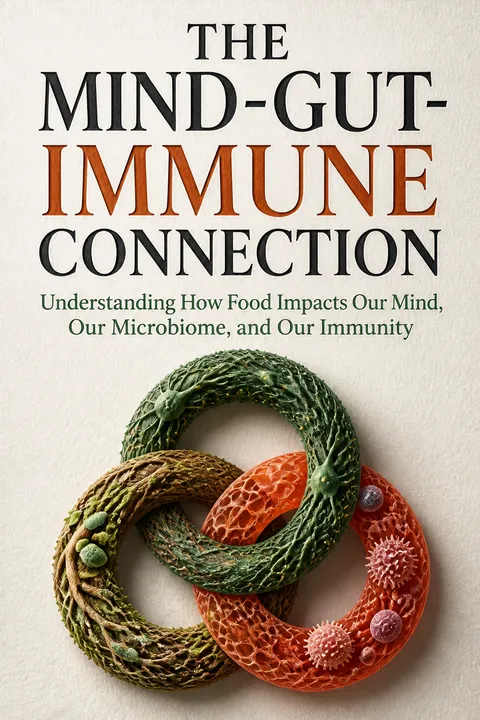
Health travels through networks. Mayer’s central claim is that the gut, brain, immune system, and microbiome constantly exchange signals. The gut is more than a digestive tube: its nerve and hormone cells regulate digestion and appetite, while about 70 percent of immune cells are located in its wall. Microbes alter the signals sent through this system, and those signals can affect organs throughout the body. Chronic immune activation is one proposed link between changes in diet and rising rates of metabolic, autoimmune, and brain disorders.
A problem with many causes. The book traces today’s chronic disease burden to interacting pressures, including ultraprocessed food, stress, inactivity, poor sleep, and environmental change. Its systems view challenges treatment strategies that address each illness in isolation, but it does not establish the microbiome as the single cause of these diseases.
The network model is useful because it shifts attention from isolated organs to feedback: a signal can affect the gut, the brain, and immune activity in a loop. That is a stronger explanation than assuming every symptom has one simple cause. It also encourages prevention across several parts of daily life. Still, a central hub is not automatically the original source of a problem. Calling the gut important should not turn it into a universal explanation for chronic illness, which also reflects genetics, social conditions, and many other exposures.
Judge a microbiome by what it does, not a perfect bacteria list
There is no ideal roster. A person’s gut microbiome changes with food, time of day, season, geography, and lifestyle. In industrialized societies, healthy people may share as few as 10 percent of microbial strains. Rather than look for one universal set of species, researchers consider a microbiome’s functional core: the range of useful molecules different microbial communities can produce, even when their members differ.
Diversity supports recovery. Richness means how many types are present; diversity also considers how evenly they are represented. The book describes resistance as withstanding disruption, and resilience as recovering afterward. Both matter because a varied ecosystem may better withstand infection, antibiotics, or dietary disruption. A changing microbiome is not automatically unhealthy, and a species list alone cannot diagnose disease.
This ecological framing replaces the tempting idea of a single “good bacteria” checklist with a more realistic question: can the community perform needed functions and recover from disturbance? That distinction also makes sense beyond biology, since different teams can solve the same problem using different members and methods. The caution is practical as well as scientific: diversity is not a direct score of personal health, and associations between particular microbes and disease do not establish that those microbes caused the illness.
Send varied plant fiber and polyphenols to feed your gut microbes
Feed the organisms downstream. Microbiota-accessible carbohydrates, or MACs, are complex plant carbohydrates that resist digestion in the small intestine and reach gut microbes, especially in the large intestine. There, microbes turn them into short-chain fatty acids and other signaling molecules that can support the gut lining and influence immune activity. Polyphenols, found in foods such as berries, tea, spices, and olive oil, also often require microbial processing before their compounds can be absorbed.
Variety matters more than a magic ingredient. The Hadza, a hunter-gatherer group in Tanzania, were reported to eat about ten times as much fiber as the average American, and their microbiome changed with seasonal diets. A study of immigrants to the United States found an approximately 15 percent loss of microbiome diversity associated with life in the US. These findings fit the book’s argument, but diet is not the only difference between these populations.
The most practical shift here is to consider what food reaches the colon, not only what nutrients the body absorbs earlier in digestion. Beans, whole grains, vegetables, fruit, nuts, and seeds deliver a range of substrates rather than one fashionable supplement. This also explains why variety is a sensible general strategy when individual microbial needs are poorly understood. Cross-population comparisons are suggestive, not controlled experiments: migration changes food, stress, sanitation, medicine, and many other conditions at once.
Protect the gut from chronic stress, disrupted sleep, and extreme training
Lifestyle changes the habitat. Stress signals can alter gut movement, microbial conditions, and intestinal permeability. Sleep and meal timing matter too: the microbiome has daily rhythms shaped by eating patterns and the body’s internal clock. The book describes jet lag as one disruption that can temporarily alter microbial composition. These pathways help explain why gut symptoms may worsen during stressful periods even when a person’s diet has not changed.
More exercise is not always better. Regular moderate activity is associated with improved gut microbial diversity and increased short-chain fatty acids. But in a study of soldiers completing a strenuous four-day ski march, average intestinal permeability rose by 60 percent. The author’s clinical example of a runner with recurring race-day diarrhea illustrates the difference between sustainable exercise and extreme exertion that overwhelms an individual’s resilience.
This takeaway widens the meaning of a gut-friendly routine: eating well is not a substitute for sleep, movement, or relief from relentless stress. The shared pathway is exposure and recovery. Exercise can be beneficial while still functioning as a physical stressor when intensity exceeds a person’s capacity. That nuance helps avoid turning health advice into another contest of discipline. The research described supports biological plausibility, but it does not yield one precise exercise prescription for every body or schedule.
Take gut links to brain disease seriously, without treating them as proof
Communication is plausible; diagnosis is harder. The gut and brain exchange information through nerves, immune signals, hormones, and microbial metabolites. The gut produces most of the body’s serotonin, but gut-derived serotonin does not simply travel into the brain; it can influence brain activity through pathways such as the vagus nerve. In Parkinson’s disease, constipation can precede movement symptoms by years, and gut microbes can affect how much levodopa reaches the brain.
Evidence has limits. Experiments transferring microbes from people with depression or Parkinson’s to animals can change animal behavior, but mice do not reproduce the complexity of human illness. Human studies have not found one universal microbial signature for depression. In the SMILES trial, 32 percent of participants receiving dietary support for a Mediterranean-style diet reached clinical remission, compared with 8 percent in a social-support control group. The result supports diet as a possible treatment component, not a replacement for care.
The book’s strongest contribution is to make gut-brain biology credible without reducing mood or neurological disease to a stool test. Its examples show why symptoms in one organ can offer clues about another, and why drug responses may vary among people. The distinction between a mechanism and a treatment is essential: a pathway can be biologically interesting without yet providing a proven intervention. Depression and neurodegenerative disease require individualized clinical assessment, not confident conclusions from microbial associations.
Try time-restricted eating only if its rhythm fits your life
Timing is part of the diet. Time-restricted eating means limiting daily food consumption to a set window, rather than necessarily cutting total calories. The book connects this approach to circadian rhythms: eating and fasting periods may help synchronize daily changes in the microbiome and metabolism. In mouse studies, a feeding window under 12 hours improved several metabolic measures, even when the animals ate the same amount of food.
Feasibility matters. Mayer describes gradually narrowing his family’s eating period to eight hours, then allowing a less restricted routine on weekends. He reports weight loss, but acknowledges that this was a personal experiment without biological measurements or a control group. Human findings are less decisive than animal findings, and intermittent fasting studies have not consistently outperformed ordinary calorie-restricted diets. The book’s practical point is to find a sustainable schedule, not to treat fasting as a cure.
The appeal of this approach is that it focuses on when eating occurs without demanding a special menu or calorie count. That can make it easier for some people to test than a highly restrictive diet. Yet a schedule that suits one household may conflict with shift work, caregiving, school, culture, or medical needs. A personally successful experiment is useful as a story, not proof of a general effect. The book’s more careful message is to prioritize consistency and fit over heroic restriction.
Choose food with the health of its soil and producers in mind
The ecosystem extends beyond the body. The book compares the gut microbiome with the microbial community around plant roots, where microbes help plants access nutrients and resist threats. It argues that chemical-intensive agriculture can damage soil ecosystems and reduce the diversity and resilience of food systems. Mayer recalls returning to his uncle’s Bavarian farm to find family farming replaced by corn and barley monocultures, chemical fertilizer, and machinery. He connects that change with changes in local diets and health, while recognizing the story is an illustration, not proof of cause.
One Health connects the scales. The One-Health concept links human, animal, plant, soil, and environmental health. The EAT-Lancet Commission described food production as responsible for up to 30 percent of greenhouse gas emissions. The book favors predominantly plant-based diets and regenerative farming, while noting that organic labeling alone does not guarantee restored soil health.
This planetary perspective changes the grocery question from “Is this food healthy for me?” to “What system produced it, and who bears the costs?” That wider frame matters because individual choices are shaped by price, access, labor, and agricultural policy. Regenerative practices offer a model for treating farms as living systems rather than production machines. Still, food labels and farming methods vary, and the book’s analogy between soil and gut ecosystems should invite investigation, not imply that the two systems work identically.
Build a durable food pattern before buying a microbial shortcut
Start with repeatable meals. The book’s practical foundation is a varied, largely plant-based diet, with plenty of fiber-rich foods and sources of polyphenols, plus naturally fermented foods if tolerated. It also emphasizes regular moderate activity, sleep, and stress management. Recipes range from lentil and chickpea stew to bowls built from grains, seeds, and berries, making variety a cooking principle rather than a supplement label.
Be skeptical of personalized promises. Sarah, a patient with bloating and weight gain, brought commercial stool analyses hoping for a diagnosis. Mayer explains that such tests can describe microbial patterns, but they are not yet equivalent to a validated blood test for cholesterol or glucose, and some personalized food and supplement recommendations lack published clinical support. His Healthy-food index compares microbiome-targeted foods with calories and easily absorbed carbohydrates, but it is a dietary heuristic, not a clinical outcome measure.
This practical hierarchy is persuasive: change the overall pattern before searching for a precise microbial fix. It also reduces the risk of spending money on tests that produce more certainty than the evidence allows. At the same time, dietary change is not equally easy for everyone; cost, time, disability, culture, and food availability shape what is realistic. A useful plan should be flexible and clinically appropriate, especially for people with persistent symptoms, rather than treating plant foods or commercial scores as universal prescriptions.
Analysis
The book’s organizing move is to connect three scales that are often discussed separately: signals inside the body, daily choices about food and routine, and the agricultural systems that produce food. Its most memorable claim is not simply that microbes matter, but that their effects are relational. A microbial community responds to its food and environment; its products influence gut and immune activity; those signals interact with brain and bodily functions. This feedback model makes a strong case for prevention that reaches beyond a single nutrient or organ.
The evidence, however, sits at different levels. Mechanistic studies explain plausible pathways. Animal experiments can test causality under controlled conditions. Human observational studies show associations, while dietary trials offer stronger but still bounded evidence. These forms of evidence should not be flattened into one certainty. The book itself notes contradictory findings, small samples, and uncontrolled interventions. Its confidence is most persuasive when discussing broad dietary patterns and least secure when linking specific microbes to complex disorders or implying that a particular lifestyle shift prevents them.
The ecological analogy between gut and soil is fruitful because both systems depend on interactions, diversity, and resources. But analogy is not identity. A soil intervention cannot be assumed to produce a predictable clinical effect, and a healthier microbial profile is not itself proof of reduced disease. The book’s wider political argument also complicates any purely personal solution: food choices depend on affordability, agricultural incentives, working hours, and access to care. Advice to eat differently can empower readers, but can also obscure the structures that constrain those choices.
The most defensible practical conclusion is therefore modest and substantial at once: favor diverse, minimally processed plant foods; protect sleep and regular movement; treat stress as biologically relevant; and regard microbiome tests and supplements cautiously. These steps are not guaranteed cures. They are a coherent way to improve several interconnected conditions while the science continues to clarify which mechanisms matter most for whom.
Review Summary
Reviews of The Mind-Gut-Immune Connection are mixed, averaging 3.74/5. Many readers appreciate the holistic approach connecting gut health, brain function, and immunity, praising the inclusion of patient anecdotes and recipes. However, several note the writing becomes overly technical and scientific midway through, losing less science-oriented readers. Common takeaways include eating plant-based, exercising moderately, and prioritizing fiber. Critics argue the science is too anecdotal and hypothetical, while supporters value its research-heavy, comprehensive perspective on how diet and lifestyle impact overall health.
Glossary
BGM network
gut-brain-microbe communicationThe brain-gut-microbiome network is the two-way communication system linking the brain, the gut, and its resident microbes. Signals travel through nerves, hormones, immune molecules, and microbial metabolites. The network is embedded in the larger brain-body system, so changes in diet, stress, sleep, or microbial activity can influence more than digestion alone.
gut connectome
gut regulatory networkThe gut connectome is the interacting network of nerve cells, hormone-producing cells, immune cells, and related pathways in the gut. It regulates movement of food, secretion and absorption, appetite-related signaling, and defenses against pathogens. In the book, the term refers to the gut’s connected regulatory systems, not to the microbes living in the gut.
functional core
shared microbial capabilitiesA functional core describes the useful functions that different people’s microbiomes can share despite substantial differences in their microbial species and strains. Rather than defining a healthy microbiome by a fixed list of organisms, this approach looks at the metabolites and signaling molecules microbial communities can produce and how those products interact with the host.
microbiota-accessible carbohydrates
fiber that feeds gut microbesMicrobiota-accessible carbohydrates, abbreviated MACs, are complex carbohydrates that human digestive enzymes do not fully break down in the small intestine. They reach microbes farther along the gut, where microbial enzymes ferment or otherwise process them into metabolites, including short-chain fatty acids. Many fruits, vegetables, legumes, seeds, and whole grains provide these carbohydrates.
metabolic endotoxemia
low-grade systemic immune activationMetabolic endotoxemia is a chronic, low-level activation of the immune system associated in the book with an unhealthy diet and a compromised intestinal barrier. In this account, inflammatory signals and microbial components can enter circulation and affect organs beyond the gut. It is presented as a proposed contributor to metabolic and other chronic diseases, not as a stand-alone diagnosis.
time-restricted eating
eating within set daily hoursTime-restricted eating limits food consumption to a consistent daily window, leaving a regular period without food. Unlike many fasting plans, it does not necessarily require reducing total calories. The book connects the practice to circadian rhythms and daily changes in microbial and metabolic activity, while noting that evidence in humans is less conclusive than animal research.
One-Health concept
connected human and planetary healthThe One-Health concept treats human health as connected to animal health and the environment. Mayer broadens it to include food production, plants, soil, and microbial ecosystems. The framework argues that decisions about farming and food affect health across these linked systems, so public health and ecological sustainability should be considered together.
healthy-food index
microbe-targeted food scoreThe healthy-food index, or HFI, is Mayer’s way of comparing foods according to microbiota-accessible carbohydrates, polyphenols, omega-3 fatty acids, calories, and absorbable carbohydrates. A higher score favors foods that deliver more material for microbial processing relative to readily absorbed energy. It is a dietary comparison tool in the book, not a validated medical test or measure of disease risk.
About the Author
Other books by Emeran Mayer


Download PDF
Download EPUB
.epub digital book format is ideal for reading ebooks on phones, tablets, and e-readers.








