

Key Takeaways
Pair minimalism with veganism to make every purchase an ethical choice
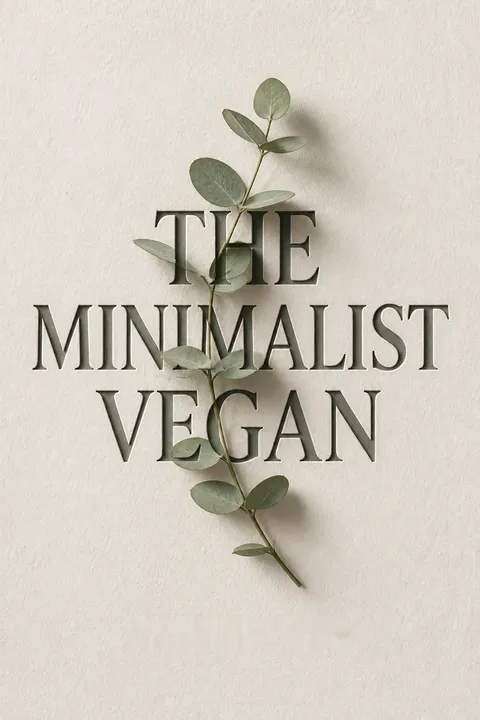
Two questions for consumption. The authors define minimalism as identifying what matters and removing what does not. They define veganism as a way of living that seeks to reduce harm to animals, the planet, and human health. Together, the ideas ask not only how much to consume, but also how goods are made and who bears their costs. A minimalist might buy fewer items; a minimalist vegan also considers whether an item depends on animal exploitation or harmful production.
An ideal, not a purity test. The authors acknowledge that their lifestyle is imperfect, but argue that everyday choices can still shift demand. Their goal is not an empty home or a flawless consumer record. It is to make room for relationships and meaningful activities while directing purchases toward less harmful alternatives.
The pairing gives minimalism a moral dimension that tidy interiors alone cannot supply. It also gives compassion a practical outlet: consumption becomes a repeated decision, not merely a private feeling. The strongest version of this argument treats purchasing as one form of participation, alongside civic action and support for better institutions. Its limit is that ethical options are not equally available to everyone, and no individual can inspect every supply chain. The useful standard is therefore deliberate progress, rather than the impossible demand to make every choice perfectly.
Treat desire as a sales signal, not proof that you need something
Wanting has a context. The book calls consumer culture's pressure to accumulate the “More Virus.” Advertising associates products with belonging, attractiveness, comfort, or success, so the urge to buy may be about an emotional need rather than the item's practical use. The authors cite a claim that 95% of purchasing decisions are subconscious, using it to underline how easily desire can precede a rational explanation.
Interrupt the automatic yes. Examine where the pressure appears: work, clothes, household goods, subscriptions, hobbies, social commitments, or digital clutter. Before buying, ask whether the item solves a real need, whether something similar is already owned, and whether it is durable and responsibly made. The point is not to distrust every desire, but to understand what it is asking for.
This reframing turns a shopping impulse into information. Instead of treating self-control as a battle against wanting, it asks what the want represents, such as rest, recognition, or connection. That pause can reveal less costly ways to meet the underlying need. The book's subconscious-decision statistic should be read as a cited claim, not a universal law; buying behavior varies by person and circumstance. Its more durable insight is that advertising shapes the setting in which choices are made, so awareness begins by noticing the setting.
Keep what serves your life, not what guilt, scarcity, or habit preserves
Clutter has a backstory. People keep things because they were gifts, belonged to someone who died, were free, might be useful someday, or seem too valuable to waste. The authors answer that memories do not reside inside objects, and suggest photographing meaningful belongings or limiting keepsakes to a small sentimental box. A free teapot that duplicates a better one is not truly free if it occupies space and attention.
Make clearing manageable. The book proposes removing one item a day rather than attempting an overwhelming purge. For tools or equipment used rarely, borrowing, sharing, or renting can meet the need without permanent ownership. The deeper practice is preventive: choose carefully what enters the home, so decluttering does not become a recurring project.
The examples expose how possessions can carry emotional obligations, not just practical value. A gift may feel like a contract, and a sentimental object can become a proxy for the person remembered. Separating affection from ownership makes letting go less like erasure. The book's strategies work best when adapted to real circumstances: a small sentimental box may not fit every family or culture, and retaining useful emergency supplies can be sensible. Minimalism is most persuasive as a question of purpose, not as a contest to own the least.
Build your schedule around what matters, then decline its competitors
Start with the life desired. The authors recommend identifying meaningful priorities before listing what to eliminate. If exercise, creative work, or time with a partner matters, a packed calendar may be blocking the very life it is supposed to support. Work, hobbies, social plans, and constant busyness can all become security blankets: familiar commitments that make life feel full while crowding out chosen priorities.
Say no with a reason. Review the week and ask whether each commitment adds value or pulls attention away from what matters. The authors connect fear of missing out, or FOMO, with anxiety about deals, events, and staying informed. They offer joy of missing out, or JOMO, as a shift toward enjoying what is already present. Simplicity, in this account, is not a prescribed number of possessions or an austere home. It is a life arranged intentionally.
The order matters: choosing a positive priority gives refusal a purpose. Without that purpose, saying no can feel like deprivation; with it, a full calendar becomes negotiable. This is also a useful correction to the tendency to treat busyness as evidence of importance. Still, not every obligation is freely chosen. Care work, financial pressure, and limited control over working hours constrain many schedules. The framework is most humane when it distinguishes commitments that can be redesigned from responsibilities that require support, rather than blaming people for lacking time.
Follow compassion through the supply chain, beyond what reaches your plate
A product has a history. The book presents veganism as broader than avoiding meat, dairy, and eggs. It asks readers to consider how clothing, cosmetics, household products, entertainment, and other goods are made, and whether animals or workers are harmed along the way. The authors describe meatpacking as dangerous work and fast fashion as a system that can rely on low-paid labor and weak oversight. They argue that neatly packaged products often conceal those conditions.
Turn concern into a choice. The authors suggest checking whether brands test on animals, choosing cruelty-free alternatives, and looking for clothing made with greater care for workers and the environment. Their account of leather challenges the familiar idea that it is merely a leftover from meat production, presenting it instead as a product tied to the economics of animal use. Compassion becomes a way to examine the whole transaction.
Supply-chain thinking expands the moral field from the visible object to the relationships that produce it. That is a powerful habit because labels and packaging tend to make production disappear. It also avoids treating a vegan diet as the whole of ethical living. The challenge is practical: supply chains are complex, and labels can offer incomplete information. A useful response is not to demand perfect knowledge before acting, but to prioritize the clearest harms and favor credible alternatives where they exist.
Animals' capacity to suffer makes species an inadequate moral boundary
Look past familiar categories. The authors use the term speciesism for assuming human superiority in a way that justifies exploiting other animals. They ask why people protect cats and dogs from cruelty while accepting similar treatment of pigs, cows, or hens. The book points to evidence that many nonhuman animals feel pain and show emotional and social behaviors, and cites the Cambridge Declaration on Consciousness in support of the claim that consciousness is not uniquely human.
Notice where exploitation hides. The argument covers food, circuses, zoos, racing, and animal testing, not just farming. The authors urge readers to question the idea that animals are harmless objects for human use, especially when their behavior or captivity serves entertainment or product development. Their ethical test is whether a being's capacity to suffer should matter even when it looks or communicates differently.
The argument shifts attention from whether animals resemble humans to whether their interests deserve consideration. That move challenges a familiar bias: compassion often follows affection and familiarity, not a consistent account of suffering. It also makes the question concrete by asking what human benefit justifies a particular harm. The evidence for animal experience is not identical across species or situations, so broad claims need care. But uncertainty about another creature's inner life is not, by itself, a strong reason to assume that its suffering is irrelevant.
Count the resource costs hidden in both food and fashion
Consumption uses land and water. The book connects animal agriculture with water use, habitat loss, pollution, and greenhouse-gas emissions. It cites an estimate of 2,500 gallons of water to produce a pound of beef, and argues that replacing intensive livestock with grass-fed systems would require much more land. These figures come from sources cited in the 2017 book, so they describe its case rather than a current accounting.
Clothing carries costs too. The authors report that producing one pair of jeans can use nearly 4,400 gallons of water. They also describe fast fashion's short trend cycles, waste, chemical-intensive cotton production, and labor abuses. Their proposed response is to buy fewer, longer-lasting items and consider how materials were sourced. The common principle is to judge a product by more than its price or appearance.
The book's distinctive move is to connect a familiar personal choice, what to eat or wear, with resource use and working conditions. That makes environmental impact less abstract and harder to assign solely to distant governments or industries. The numbers are vivid, but estimates can vary with production methods and assumptions, so they are best used to identify scale and direction, not as timeless exact measures. The broader question remains sturdy: which habits create substantial demand, and which changes would reduce that demand without simply shifting harm elsewhere?
Prevent disposable plastic from entering your routine in the first place
Plastic outlasts its brief use. The authors describe how discarded plastics reach oceans, where animals can mistake fragments for food or become tangled in abandoned fishing gear. Their 2017 book cites estimates of about eight million tons entering oceans each year and reports that plastic had been found in 90% of seabirds. These are historical figures from the book, not a current measurement.
Reduce the stream at home. The authors favor preventing new single-use plastic rather than throwing away every plastic object already owned. They suggest carrying reusable bags, cutlery, or a straw, and keeping a container available for takeout leftovers. They also urge readers to check for microbeads in personal-care products. The point is to make lower-waste choices ordinary and visible, so businesses receive a signal that disposable packaging is not the only acceptable option.
This section links personal convenience to harms that are easy to overlook because they occur far from the moment of use. Its most useful distinction is between reducing future waste and discarding functional possessions simply because they are plastic. That avoids turning environmental concern into another cycle of replacement shopping. Individual habits cannot solve packaging systems alone, but repeated choices can make demand legible to businesses. Pairing personal prevention with expectations of manufacturers keeps responsibility from landing entirely on consumers.
Adopt animals rather than supporting a market built on disposable pets
Demand has consequences. The book describes puppy and kitten mills as breeding operations that prioritize sales over animals' care. It says breeding animals may spend their lives confined and that puppies can be separated from their mothers too early. When demand for new pets exceeds adoption, animals may end up in shelters with limited space and resources. The authors cite an estimate that 1.5 million shelter dogs and cats were euthanized in the United States each year, based on figures available to the book in 2017.
Choose adoption first. For people seeking a companion animal, the authors recommend starting at a shelter rather than a pet store. They note that shelter dogs are not necessarily old or mixed-breed, and that an adult animal's established temperament may be easier to assess. They also warn against buying exotic animals, whose needs may be difficult to meet in a home.
The adoption recommendation makes the book's compassion ethic concrete: the question is not only how a pet is treated after purchase, but what kind of market the purchase sustains. It also challenges the assumption that companionship requires a particular breed or a young animal. Shelter systems vary, and adoption does not erase the responsibilities of care, training, and veterinary support. The strongest version of the advice therefore pairs adoption with a careful assessment of whether a household can meet an animal's needs for its entire life.
Use gratitude to keep compassionate choices steady under social pressure
Change can feel isolating. The authors describe common friction: family questioning a new lifestyle, friends choosing restaurants without vegan options, and the work of clearing possessions or changing routines. They advise returning attention to small, present sources of gratitude, such as a meal at home, time with a loved one, or a moment outdoors. In their view, contentment weakens the promise that the next purchase or future achievement will finally deliver happiness.
Make participation practical. The authors suggest planning around social situations rather than withdrawing from them: call a restaurant in advance, ask whether it can prepare an alternative, or choose activities not centered on eating. They frame ordinary decisions and the brands people support as daily forms of activism. The aim is not to win every argument, but to live in a way that reflects compassion and simplicity consistently.
Gratitude is presented here as a stabilizer, not as a denial of real problems. It can reduce the feeling that change means losing every pleasure, while practical planning keeps values from colliding unnecessarily with social life. The approach also avoids making activism synonymous with confrontation. Its boundary is important: gratitude should not be used to silence anger about injustice or excuse avoidable harm. It works best as a source of steadiness, allowing concern to become sustained action rather than a brief burst of guilt.
Analysis
The book's central contribution is the merger of two questions that are often kept apart: how much a person consumes, and what that consumption does to other beings. Minimalism without an ethical lens can become a matter of taste, efficiency, or attractive rooms. Veganism without attention to broader consumption can leave clothing, entertainment, and household purchases unexamined. The combined approach treats daily choices as a coherent moral practice.
Its most persuasive narrative strategy is to move from the intimate to the systemic. A crowded cupboard, an impulse buy, or a restaurant plan becomes an entry point to advertising, labor, animal welfare, resource use, and waste. This scale shift helps readers see that ordinary purchases are not isolated events. The book also gives agency a low threshold: change need not begin with public protest or a perfect lifestyle, but with decisions about what enters a home and what receives support.
There are limits. The book is a manifesto, not a balanced review of every environmental or nutritional claim it cites. Many of its numbers are tied to sources available in 2017, and some claims depend on definitions, production methods, and measurement choices. They should not be treated as current universal constants. The ethical case for reducing avoidable harm is distinct from any single disputed statistic, and readers can retain the former while checking the latter.
The book's individual-choice emphasis is both its strength and its vulnerability. Personal decisions can express values and shift demand, but they cannot by themselves repair exploitative supply chains or make ethical options affordable and accessible. A fuller application combines personal restraint with community sharing, institutional pressure, and support for better production. Its enduring lesson is not that every purchase can be made pure. It is that attention can interrupt automatic consumption, and that a simpler life can be measured by what it makes possible: more time, less waste, and a wider circle of concern.
Review Summary
The Minimalist Vegan receives mixed reviews, with an average rating of 3.70. Many readers find it a good introduction to veganism and minimalism, praising its concise approach and thought-provoking content. Some appreciate the connection drawn between the two lifestyles and find inspiration to make changes. However, experienced vegans and minimalists note a lack of new information. Critics point out the book's reliance on website citations rather than peer-reviewed sources. Overall, readers recommend it as a starting point for those new to these concepts.
People Also Read









Glossary
The More Virus
pressure to keep acquiringThe authors' name for the recurring cultural pressure to want more possessions, experiences, status, and commitments. Advertising and consumer habits attach products to feelings such as belonging or happiness, encouraging people to buy or accumulate beyond practical need. The term describes both external marketing and the internal habit of treating more as a route to contentment.
Minimalism
keeping what is essentialThe authors define minimalism as identifying what is essential in a person's life and eliminating the rest. It is not a fixed limit on possessions or a requirement for bare rooms. It is a mindful practice of choosing what to keep, buy, and prioritize so that material and mental clutter do not crowd out valued relationships and activities.
Veganism
living to reduce harmIn this book, veganism means choosing a lifestyle intended to do the least harm to animals, the planet, and human health. It extends beyond avoiding animal-derived food to considering clothing, products, entertainment, and the conditions under which goods are made. The authors frame it as a practice of compassion and attention to the effects of consumption.
Speciesism
human superiority used to justify exploitationSpeciesism is the assumption that humans are superior to other animals in a way that permits their exploitation. The authors use the term to question why people protect some animals, especially companion animals, while accepting harm to farmed or captive animals. Their argument emphasizes that differences between species do not automatically make suffering morally unimportant.
JOMO
joy in choosing what to missJOMO means joy of missing out. The authors present it as a response to FOMO, the fear of missing out on a bargain, event, or information. Rather than chasing every opportunity, a person can notice what they fear losing and choose to value the present activity or relationship already in front of them.
The Cambridge Declaration on Consciousness
statement on animal consciousnessThe book cites the 2012 Cambridge Declaration on Consciousness, a statement by neuroscientists arguing that humans are not the only animals with neurological substrates associated with conscious states. It identifies evidence in mammals, birds, and some other animals. The authors use it to support their claim that nonhuman animals can have experiences relevant to questions of suffering and moral consideration.
Download PDF
Download EPUB
.epub digital book format is ideal for reading ebooks on phones, tablets, and e-readers.








