

Key Takeaways
Beat consensus only by being both different and more right.
Think beyond the obvious. First-level thinking spots a promising company and buys. Second-level thinking asks what everyone already believes, what is reflected in the price, and where a better judgment might differ. A good company can be a poor investment when investors expect too much; disappointing news can create an opportunity if the outcome is less bad than the market expects. The goal is not to be unusual for its own sake. It is to find a view that is both nonconsensus and more accurate than the consensus.
Ask the awkward questions. What range of outcomes is plausible? Which seems most likely? What does the price assume, and what happens if either the market or the investor is wrong? Marks warns that widely shared opinions cannot, by themselves, deliver above-average results: collectively, investors are the market.
The useful shift is from asking whether an asset is attractive to asking whether it is more attractive than its price implies. That resembles scientific reasoning: evidence matters, but so does the competing explanation and the standard against which a claim is judged. In markets, however, a contrarian view is not automatically insightful. Consensus can be right, and resisting it can become a costly identity. The discipline is to state the evidence that would prove the unconventional thesis wrong, not merely to celebrate being different.
A great business becomes a bad investment when its price assumes perfection.
Estimate worth first. Intrinsic value is an estimate of what an asset is worth based on its underlying business, assets, and capacity to generate cash. The practical aim is to buy below that estimate, not simply to own admired companies. Marks recalls the Nifty Fifty, a group of celebrated growth stocks that investors treated as nearly flawless. Many traded at price-to-earnings ratios around 80 or 90, far above the postwar market average in the mid-teens. When valuations later contracted, some lost about 90 percent of their value. The companies’ reputations did not protect buyers who had paid too much.
Price sets the terms. A weak business can be a sound purchase at a low enough price, while a strong business can be a poor one at an excessive price. Growth and value both require judgments about the future; they differ more in emphasis than in kind.
This principle counters the halo effect, the tendency to let a company’s reputation substitute for analysis of its price. It also helps explain why a compelling story can be dangerous without being false: the Internet did change business, but that fact alone could not make every Internet share worth its peak price. Intrinsic value is not a hidden, perfectly measurable number, though. It depends on uncertain forecasts, so responsible valuation is better treated as a range of plausible values than as a precise answer.
Treat risk as possible permanent loss, not merely a bumpy price chart.
Separate danger from movement. Marks disputes the common use of volatility as the whole meaning of investment risk. A fluctuating price may be uncomfortable, but the central danger is losing capital or earning too little to meet a real obligation. Risk also varies by investor: an illiquid asset may be acceptable to someone with a long horizon and dangerous to someone who needs cash soon. Riskier investments have a wider range of possible outcomes, including severe losses, even when their expected returns look higher.
Watch the price and the mood. When investors feel safe, they may bid prices up and accept thin compensation for risk. Marks calls this the perversity of risk: confidence can create danger, while widespread fear can push prices low enough to reduce the risk of buying. A popular asset can therefore be more perilous than an unpopular one.
The distinction is valuable because a smooth ride is not the same as a safe destination. Safety engineering makes a similar distinction between routine performance and failure under stress: a system can look stable until a rare shock exposes its weak points. Yet volatility should not be dismissed altogether. It matters when an investor faces withdrawals, borrowing requirements, or a short time horizon. The sharper question is whether price movement signals temporary uncertainty, a permanent impairment, or a cash need that could force a sale.
Read the market's temperature instead of pretending to schedule its turns.
Cycles are built in. Economies, credit, investor confidence, and asset prices move through expansions and contractions. In a credit boom, lenders prosper, become less worried, loosen terms, and compete to lend. Capital then reaches weaker borrowers and riskier projects. When losses arrive, lenders retreat, refinancing becomes difficult, and that retreat can deepen the downturn. The process helped explain the financial crisis of 2007-2008, without requiring a precise prediction of its timing.
Infer the present. Marks argues that investors rarely know when a cycle will turn, but can assess the conditions around them. Records of unusually risky lending, easy credit, and rising leverage can indicate an overheated environment. The response is not a forecast of a particular date. It is to adjust risk to the evidence available now and avoid assuming that recent conditions will continue indefinitely.
Cycles are not just recurring patterns imposed on people; behavior helps produce them. In a boom, lending and spending reinforce confidence, while later defaults and retrenchment reinforce fear. This feedback perspective is more useful than treating crises as freak interruptions to an otherwise stable system. Still, diagnosing an overheated market does not reveal when it will cool. A sound risk assessment can remain early for years, so exposure, liquidity, and the ability to withstand being early matter as much as the diagnosis.
Distrust both the crowd's euphoria and its despair at market extremes.
The pendulum overshoots. Investor attitudes swing between greed and fear, optimism and pessimism, and willingness and refusal to take risk. Near a boom’s end, buyers can act as if improvement will last forever. In a crash, sellers can act as if decline has no limit. Both extremes distort prices and encourage the same mistake: treating the mood of the moment as a dependable guide to value.
Skepticism cuts both ways. Marks describes investors buying depressed debt during the 2008 crisis, when dire predictions dominated. Many such purchases returned 50 to 100 percent or more over the following eighteen months. That did not make every distressed asset a bargain. The opportunity came from questioning an extreme consensus and comparing price with an independent estimate of value, not from reflexively doing the opposite of the crowd.
The symmetry is important. Skepticism is often mistaken for pessimism, but genuine skepticism tests both a rosy story and a frightening one. That stance resembles Bayesian updating: confidence should change with evidence rather than with the emotional volume of the room. One limitation is that crowds can stay euphoric or fearful longer than a contrarian can stay solvent. A useful check is to separate the claim that prices are extreme from the much stronger claim that they must reverse immediately.
Judge investment decisions by probabilities, not by one lucky outcome.
One result proves little. Investing involves uncertainty, so a good decision can lose and a reckless one can win. Marks draws on the idea of alternative histories: the plausible outcomes that could have happened but did not. A manager who earns a large return after taking a poorly considered bet may have benefited from luck rather than skill. Conversely, a careful decision can be punished by an unlikely event.
Look at the process. Warren Buffett’s coin-flipping illustration imagines millions of people making daily guesses. After enough rounds, a small group will appear astonishingly prescient purely by chance. Their winning streak is real, but it does not demonstrate a repeatable method. Investors should examine how a record was produced, the risks taken, and whether the reasoning can work across many outcomes. Short-term performance alone cannot distinguish skill from randomness.
This is a direct challenge to outcome bias, the common habit of judging a decision by what happened rather than by what was knowable when it was made. The same problem appears in medicine and public policy, where one successful or failed case can mislead if the underlying probabilities are ignored. A useful extension is to record predictions and reasons before results arrive; hindsight otherwise edits the memory of what seemed likely. Even a sound process cannot guarantee success, and long records can still reflect changing conditions rather than permanent skill.
Keep capital and patience ready for sellers who cannot wait.
Wait for a real bargain. Patient opportunism means holding back until attractive prices appear rather than buying simply to stay busy. In a crisis, some investors must sell because of withdrawals, borrowing terms, or investment rules. These forced sellers may accept prices far below an asset’s estimated value. During the 2008 credit crisis, leveraged holders of senior loans faced margin calls as prices fell. Some portfolios were liquidated through competitive auctions, and loan prices eventually reached the 60s, creating opportunities for buyers able to commit cash.
Stay able to act. The patient buyer needs a strong grasp of value, limited reliance on debt, available capital, and enough emotional steadiness to buy when headlines are frightening. Waiting is not a promise that bargains will appear on schedule. It is a way to avoid paying ordinary prices merely because action feels productive.
The advantage here is partly analytical and partly structural. Cash and low leverage do not merely reduce exposure; they preserve the option to act when others lose theirs. This resembles resilience planning, where spare capacity looks inefficient during calm periods but becomes valuable when a system is stressed. The tension is that waiting has an opportunity cost, and excessive caution can leave an investor permanently underexposed. Patience works best when paired with explicit standards for what qualifies as a bargain, rather than an endlessly moving threshold.
Build portfolios to survive bad scenarios, not merely shine in good ones.
Favor staying power. Marks compares ordinary investing to a game in which avoiding mistakes can matter more than producing spectacular wins. A portfolio can seek high returns through concentration or leverage, but those choices also magnify damage when assumptions fail. Defense means using careful analysis, diversification, limited leverage, and a margin for error: room for an investment to disappoint without causing ruin. Buying an asset estimated at 70 rather than 90, when both estimates place its value near 100, gives more room for error.
Accept the trade-off. A defensive investor may lag during a strong bull market. The payoff is smaller losses when conditions turn, which protects both capital and the ability to buy during a downturn. Avoiding all risk is not the goal; taking risks only when they are understood and adequately rewarded is.
This is a form of robustness: designing for tolerable performance across several plausible futures instead of maximizing results in one forecast. The distinction matters because losses compound asymmetrically; a deep decline requires a disproportionately large gain just to recover. But defense is not free. Too much cash, diversification, or caution can dilute returns and miss valuable opportunities. The relevant question is not whether a portfolio is conservative in the abstract, but whether its safeguards match the investor’s horizon, obligations, and ability to endure losses.
Demand plausible returns; suspicious smoothness can be a warning, not a gift.
Set a credible target. Marks says ordinary investing should not be expected to produce extraordinary returns without some unusual advantage, such as exceptional skill, unusually low prices, substantial risk, leverage, or luck. Each has a cost or limitation. Investors who insist on high returns in a low-return environment may reach for risk without recognizing how much they have taken on.
Question the perfect record. Bernard Madoff reported returns around 10 percent a year with remarkably few down months. Stocks had historically averaged roughly that annual return, but with substantial volatility and losing years; Treasury bills offered steadier returns at much lower rates. The combination should have prompted questions about how such smooth results were possible. Marks’s practical tests are to ask whether the claim is too good to be true and why an apparently exceptional opportunity is being offered to the investor.
Reasonable expectations function like a fraud filter and a risk-control device at once. They force a return claim to be connected to a mechanism: what assets, what risks, and what conditions could plausibly produce it? This is especially useful when a product’s complexity makes its promise hard to inspect. Still, a return target should not be treated as a universal benchmark; liabilities and time horizons differ. The key warning is not that high returns are impossible, but that high, dependable returns require an explanation strong enough to survive scrutiny.
Call it skill only when gains survive a full market cycle.
Separate skill from exposure. Beta describes how strongly a portfolio tends to move with the market; alpha is the value attributed to investment skill beyond that market exposure. A high return in a rising market may simply reflect an aggressive portfolio. A lower loss in a falling market may simply reflect a defensive one. Neither result alone proves superior judgment.
Look for asymmetry. Marks considers skill more credible when an investor captures a substantial share of gains but gives back less during declines than the portfolio’s style would predict. Oaktree’s stated ambition is to keep pace in good markets and lose less in bad ones. That is difficult to establish from a brief record. Evaluation should include the investment process, the risks taken, and performance in conditions unfavorable to the manager’s style.
The distinction between raw return and value added resembles risk-adjusted evaluation in other fields: a surgeon’s outcomes depend partly on the difficulty of the cases, just as a manager’s returns depend partly on market exposure. Style-adjustment prevents a lucky bull-market bet from being mistaken for durable skill. Yet alpha is not directly observable, and even decades of results cannot eliminate uncertainty about regime changes or luck. Process evidence matters, but it should not become an excuse to ignore disappointing outcomes indefinitely.
Analysis
Marks’s central argument is not that value investing supplies a formula, but that investment judgment must hold several truths together: prices can be wrong, correcting them is difficult, and no investor can reliably know the future. That combination explains the book’s emphasis on value, psychology, cycles, and risk control. Valuation supplies an anchor; market psychology explains why price can stray from it; a sense of the cycle guides posture; and defense keeps the investor alive long enough for a judgment to be tested.
The deepest tension is between conviction and humility. Investors need sufficiently firm estimates of value to withstand a falling price, yet those estimates rest on uncertain assumptions. Conviction without revisability becomes dogma; humility without conviction becomes paralysis. A practical interpretation is to make assumptions explicit, consider a range of outcomes, and define what evidence would change the estimate. The book insists on judgment rather than mechanical rules, but that makes the discipline of documenting judgment especially important.
The framework is also selective in its ambition. It describes how an active investor might seek an edge, not why every investor should attempt to beat the market. Marks recognizes that markets with many informed participants are difficult to outperform. For many readers, passive investing may therefore be the sensible baseline, with active risk justified only where a genuine informational, analytical, or behavioral advantage exists. Even then, the strongest claim is not that contrarians always win. It is that avoiding forced selling, overpayment, and ruin can matter more than finding a spectacular winner. The philosophy is most persuasive when treated as a way to improve decisions under uncertainty, not as a promise of market-beating returns.
Review Summary
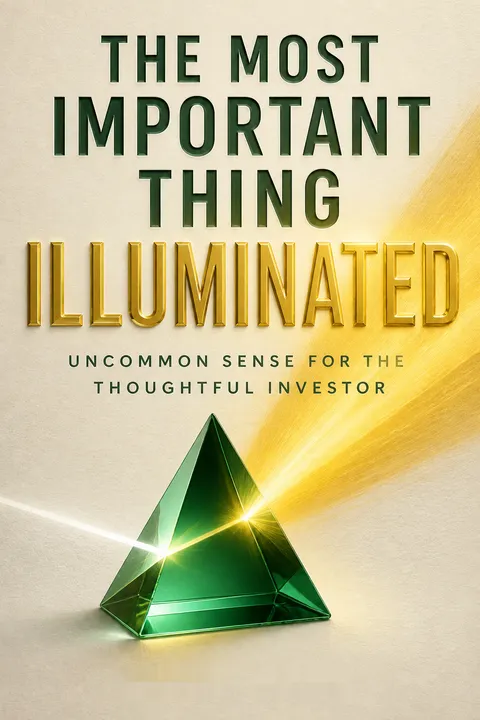
The Most Important Thing Illuminated receives mostly positive reviews for its insightful investment philosophy, emphasizing risk management, market cycles, and value investing. Readers appreciate Marks' clear writing style and focus on fundamental principles. Some find the book repetitive and more theoretical than practical. Many consider it essential reading for both novice and experienced investors, praising its emphasis on defensive investing and avoiding pitfalls. Critics note that it may be less useful for those already familiar with value investing concepts.
People Also Read






Glossary
Second-level thinking
Thinking beyond consensusA way of analyzing investments that considers not only an asset’s prospects, but also what other investors expect, what those expectations have already put into the price, and how outcomes would differ if either view proves wrong. It seeks a judgment that is both different from the consensus and more accurate.
Intrinsic value
Estimated underlying worthAn estimate of what an investment is worth based on the underlying business or asset, including its financial resources, ability to generate cash, and future prospects. The estimate is not directly observable and depends on judgments about the future. Marks uses it as the reference point for deciding whether an asset’s market price is attractive.
Perversity of risk
Confidence can create dangerMarks’s description of how investor behavior can reverse the apparent relationship between confidence and safety. When investors believe risk is low, they may bid prices higher and accept smaller risk premiums, making investments more dangerous. When they fear risk broadly, prices may fall enough to improve the terms available to a cautious buyer.
Patient opportunism
Wait for attractive pricesAn investment posture that resists buying merely to remain active and instead waits for opportunities offered at compelling prices. It depends on being prepared to act when sellers are under pressure, while keeping enough capital, liquidity, and patience to withstand uncertainty. It is not an attempt to predict exact market bottoms.
Alternative histories
Outcomes that could have occurredThe plausible outcomes that might have unfolded under the same decision but did not. Marks uses this idea, associated with Nassim Nicholas Taleb, to show why a profitable result does not prove a decision was wise and a loss does not prove it was foolish. Decision quality must be judged using the information and probabilities available at the time.
Margin for error
Room for being wrongA cushion that makes an investment’s outcome tolerable if assumptions prove too optimistic or conditions deteriorate. It can come from buying substantially below estimated value, limiting leverage, diversifying, and relying on durable assets or cash flows. It reduces dependence on a precise forecast, though it cannot eliminate loss.
Beta
Sensitivity to market movementsA measure of how much a portfolio tends to move in response to movements in a reference market. A portfolio with a beta above one is expected to move more than that market, while one below one is expected to move less. Marks distinguishes this market exposure from investment skill and from broader forms of risk.
Alpha
Value attributed to skillThe portion of an investment result attributed to a manager’s skill rather than to general market movement or exposure. Marks treats alpha as the ability to add value after considering risk, not simply the achievement of a high return. It is difficult to establish from short-term results because market conditions and luck can dominate.
FAQ
What's The Most Important Thing Illuminated about?
- Investment Philosophy: The book distills Howard Marks's investment philosophy, focusing on understanding risk, market cycles, and investor psychology.
- Human Side of Investing: Marks emphasizes that successful investing involves managing emotions and psychology alongside financial analysis.
- Practical Insights: It combines Marks's memos with annotations from other investors, offering a comprehensive view of value investing principles.
Why should I read The Most Important Thing Illuminated?
- Expert Guidance: Howard Marks is a renowned investor with decades of experience, making his insights valuable for both novice and seasoned investors.
- Comprehensive Understanding: The book covers essential concepts like risk management and second-level thinking, crucial for informed investment decisions.
- Real-World Applications: Readers can apply the lessons to navigate market fluctuations and improve their investment strategies effectively.
What are the key takeaways of The Most Important Thing Illuminated?
- Understanding Risk: Marks highlights the necessity of recognizing and managing risk, stating that "risk means more things can happen than will happen."
- Market Cycles Awareness: The book stresses the cyclical nature of markets, urging investors to prepare for potential downturns.
- Second-Level Thinking: Marks introduces deeper analysis beyond surface-level observations to gain a competitive edge in investing.
What is second-level thinking as described in The Most Important Thing Illuminated?
- Deeper Analysis Required: Second-level thinking involves considering the consensus view and analyzing how one's expectations differ from it.
- Example of Second-Level Thinking: It questions if a stock is overpriced due to the consensus view, rather than just buying because it's a good company.
- Competitive Edge: This thinking is essential for outperforming the market by identifying mispriced assets.
How does The Most Important Thing Illuminated define risk?
- Risk as Uncertainty: Marks defines risk as uncertainty about outcomes and the possibility of loss when unfavorable ones occur.
- Types of Risk: The book discusses market risk, credit risk, and the risk of permanent loss, emphasizing their importance in investing.
- Risk Management Importance: Effective risk management is crucial for long-term success, helping investors avoid significant losses.
What is the concept of "margin of safety" in The Most Important Thing Illuminated?
- Definition of Margin of Safety: It refers to the difference between an asset's intrinsic value and its market price, providing a buffer against errors.
- Importance in Investing: Ensuring a margin of safety protects investors from significant losses during market volatility.
- Practical Application: Investors should buy assets at prices significantly lower than their intrinsic value to mitigate risks.
How does Howard Marks define "contrarianism" in The Most Important Thing Illuminated?
- Contrarian Mindset: Contrarianism involves buying when others are selling and selling when others are buying, requiring courage and independence.
- Market Psychology: Recognizing when the herd is overly optimistic or pessimistic is key to successful contrarian investing.
- Long-Term Success: Successful contrarian investors capitalize on market extremes to achieve superior returns.
What role does psychology play in investing according to The Most Important Thing Illuminated?
- Emotional Influences: Marks emphasizes that emotions like greed and fear can lead to irrational investment decisions.
- Cyclical Nature of Psychology: Investor sentiment swings between optimism and pessimism, affecting market prices and creating opportunities.
- Combating Negative Influences: Investors should be aware of psychological biases and maintain a disciplined approach, especially during volatility.
What is the significance of cycles in The Most Important Thing Illuminated?
- Cyclical Patterns: Marks asserts that understanding cycles is crucial for informed investment decisions, as "most things will prove to be cyclical."
- Investment Opportunities: Recognizing cycles allows investors to identify undervalued assets and capitalize on downturns.
- Self-Correcting Mechanism: Cycles are self-correcting, with excesses leading to corrections, providing a framework for anticipating market movements.
How does The Most Important Thing Illuminated address market efficiency?
- Market Efficiency Concept: Marks discusses the efficient market hypothesis, which suggests asset prices reflect all available information.
- Limitations of Efficiency: He argues that markets are not always correct, and opportunities arise from mispricings and inefficiencies.
- Importance of Nonconsensus Views: To beat the market, investors must hold nonconsensus views that differ from the majority.
How does Howard Marks suggest investors should approach risk in The Most Important Thing Illuminated?
- Intelligent Risk Bearing: Marks advocates for accepting risk only when adequately compensated with potential returns.
- Risk Control Strategies: Strategies include diversification, thorough analysis, and maintaining a long-term perspective.
- Avoiding Overconfidence: He warns against overconfidence and stresses the importance of being prepared for adverse outcomes.
What are the best quotes from The Most Important Thing Illuminated and what do they mean?
- "The most important thing is understanding risk.": This quote highlights the book's core message that managing risk is fundamental to investing.
- "Cycles always prevail eventually.": Marks reminds readers that market conditions are temporary, and understanding cycles aids decision-making.
- "Fear of looking wrong": This phrase underscores psychological barriers that can lead to poor decisions during market extremes.
Download PDF
Download EPUB
.epub digital book format is ideal for reading ebooks on phones, tablets, and e-readers.








