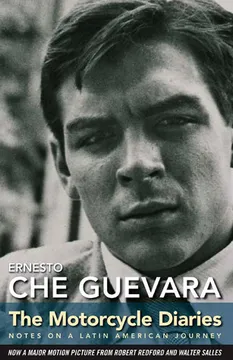


Key Takeaways
Let firsthand encounters enlarge your identity beyond inherited borders
A trip becomes a turning point. In December 1951, Ernesto Guevara and his friend Alberto Granado set out from Argentina on a motorcycle, aiming north and expecting adventure. Their battered bike, La Poderosa II, broke down in Chile. They continued by truck, on foot, by boat, and on a homemade raft, reaching Venezuela nine months later. The route brought landscapes, mishaps, hunger, illness, and strangers into the young medical student’s life.
The traveler changes, too. At the start, Guevara imagines heroic exploits and escape from routine. Encounters with workers, Indigenous communities, and patients gradually shift his attention from his own ambitions toward the shared conditions shaping people’s lives. The diaries tell a story of travel, but also of a person’s widening sense of who belongs in the word “us.”
What's striking is that the book treats travel not as a collection of destinations, but as repeated encounters that unsettle a traveler’s assumptions. That resembles the idea of moral imagination: distant lives become harder to dismiss once they are seen in ordinary detail. Yet exposure does not guarantee understanding. A traveler can mistake a brief meeting for a complete explanation of a community. The journey’s value lies less in producing an authoritative portrait of Latin America than in showing how contact can make a previously private conscience answerable to other people.
Follow the mine and the meal to see who pays for prosperity
Work leaves a human cost. At Chuquicamata, a vast Chilean copper mine, Guevara sees how industrial wealth depends on dangerous labor. The mine employed about 3,000 people, and the diary describes workers exposed to cave-ins, silica, and harsh conditions. Guevara notes that Chile produced roughly one-fifth of the world’s copper, while workers’ families faced poor compensation and insecurity. The mineral’s value is visible; the human losses are easier to overlook.
A couple makes the system personal. In the desert, Guevara and Granado meet a communist worker and his wife, who describe prison, unemployment, hunger, and missing comrades. They share their single blanket with them. The encounter connects political repression to material need: the worker’s political hopes grow from the struggle to find food and work, not from abstract doctrine alone.
The account makes political economy legible by moving between scale and intimacy. A copper statistic explains why the mine matters to a nation; a cold couple sharing a candlelit room shows what economic conflict means in daily life. This resembles labor history that reads production through workers’ bodies, households, and risks, rather than treating output as the whole story. The diary’s analysis can be sweeping, and its observations are not a complete investigation of Chilean industry. Still, its insistence that prosperity has a distribution, with beneficiaries and people who bear the danger, remains a useful question for examining any extractive economy.
Read Indigenous history as present reality, not scenery
The past is built into place. In Peru, Guevara visits Tarata, Cuzco, and Machu Picchu. He describes Inca stonework and the colonial churches erected over Indigenous temples, making conquest visible in the architecture. In Tarata, he sees Aymara communities living amid terraced fields and irrigation works, but also encounters poverty and social exclusion. The landscape is not an empty backdrop: it holds the marks of older societies and the consequences of their defeat.
Living people complicate the ruins. A teacher explains how education designed around white and mestizo expectations can shame Indigenous students instead of helping them serve their communities. Guevara also observes that visitors can admire ancient monuments while overlooking the people who live nearby. His account recognizes this divide, even as some of his own descriptions reduce Indigenous people to symbols of defeat or tradition.
The contrast between archaeological admiration and contemporary neglect is a sharp one. It anticipates a common problem in heritage tourism: a society may celebrate Indigenous civilizations as monumental pasts while treating Indigenous people as obstacles to modernization in the present. The teacher’s account adds a subtler point: education can open opportunity, but it can also demand that students disown their own communities to gain status. The diary is valuable as a record of an outsider noticing this tension, not as a final authority on Indigenous life. Its own sweeping characterizations show how easily sympathy can coexist with a gaze that generalizes.
Treat patients as equals before treating them as cases
Respect changes the encounter. Guevara and Granado visit leprosy facilities during the journey. In Lima, they shake patients’ hands, talk with them, and play football without the gloves and overalls patients expect others to wear. The patients later give them money and a camping stove, and some weep at their departure. Guevara understands these gestures as signs that patients value being treated as ordinary people, not as objects of fear.
Dignity needs resources, too. At Huambo, the travelers see a small, isolated colony where 31 patients live in poor conditions, with little medical equipment and inadequate surgical support. One patient breaks down while describing her confinement. Personal kindness cannot repair an underfunded institution, but institutional treatment without respect can deepen isolation. The diaries hold both needs in view.
This is a practical account of stigma: a handshake or shared game can challenge the social distance imposed on people with a feared disease. In modern care ethics, respect is not decorative bedside manner; it supports trust, agency, and a patient’s sense of belonging. The episode also guards against making humane contact sound like a cure for structural neglect. Patients need competent treatment, safe facilities, and the ability to shape their own care. The strongest reading joins these dimensions: equal regard should inform medical practice, while public resources address what individual warmth cannot.
Build continental solidarity without flattening local differences
Borders feel less final on the road. Traveling through Argentina, Chile, Peru, Colombia, and Venezuela, the friends encounter related histories of conquest, poverty, and dependence on outside powers. In a birthday toast at the San Pablo leper colony, Guevara argues that Latin Americans share a broad identity that reaches beyond national borders. His idea of Our America names a continent understood as connected, rather than as a set of isolated national stories.
Connection is not sameness. The journey also reveals different languages, customs, political conditions, and Indigenous identities. In Peru, the travelers struggle to communicate with Aymara and Quechua speakers; in Chile, they observe distinct labor struggles and regional conditions. A shared political horizon can help people recognize common interests, but it cannot substitute for listening to the particular communities whose lives that horizon claims to represent.
The appeal of continental solidarity is clear: shared problems can be harder for powerful interests to isolate when people recognize their connections. The risk is equally clear. A single identity can erase differences of language, ethnicity, region, and political priority, especially when articulated by a visitor with greater mobility and privilege. Social movements face this design problem repeatedly: they need common goals without forcing every group into one story. The diary’s strongest contribution is not proof that Latin America forms one uniform community, but a prompt to ask how cooperation can respect differences rather than treating them as inconveniences.
Judge health by the conditions that prevent illness, not clinics alone
Medicine begins before the hospital. In a 1960 speech included with the diaries, Guevara argues that health depends on more than doctors treating individual bodies. Hunger, poverty, poor housing, and limited education shape who becomes ill and who can recover. He calls the work of improving these conditions a form of social medicine: organizing society to reduce disease, rather than relying only on treatment after people are sick.
The journey gives this claim a face. At the Huambo colony, patients live with inadequate facilities and isolation; in the mining regions, workers face hazards tied to earning a living. Guevara’s conclusion is that medical professionals should understand people’s circumstances and use their expertise in service of public well-being. A clinic matters, but it cannot by itself undo the conditions that keep sending people through its doors.
This argument aligns with contemporary public health, which distinguishes clinical care from the social conditions that shape exposure to illness. Medical treatment can save lives, while sanitation, nutrition, labor protections, and education influence how many people need treatment in the first place. The diary’s broad social diagnosis is compelling, but it leaves a hard implementation question: how should scarce resources be divided between urgent care and prevention? The answer depends on context, and both are necessary. The durable insight is that health systems should be evaluated not only by what they do for patients in clinics, but also by what they help prevent outside them.
Turn private compassion into shared power when systems block care
Good intentions meet limits. In the appendix, Guevara looks back on his earlier ambition to help people through his own medical work. He says that individual effort, however sincere, cannot overcome hostile political and social conditions on its own. By 1960, he believes doctors must join a collective project capable of changing those conditions, and must put professional knowledge at the service of the population.
The role changes with the setting. The speech describes doctors not only as clinicians, but also as participants in public education and community life. Guevara argues that professionals should learn from the people they serve rather than approaching them only as recipients of expertise. This is a political conclusion, not a neutral prescription: it places medical work inside a revolutionary program and asks professionals to reconsider whose needs their careers serve.
The move from individual charity to collective action is a serious challenge to the comforting idea that good professionals can solve structural problems one case at a time. Collective institutions can coordinate prevention and redistribute resources at a scale personal benevolence cannot reach. But collective purpose does not automatically guarantee accountability or protect dissent; a political program can also claim to speak for people without giving them meaningful control. The useful question is therefore twofold: what structures make care broadly available, and how can those structures remain answerable to the communities they affect? The speech raises the first question forcefully; the second remains essential.
Read the diarist as a witness, not an authority on everyone
The record admits its limits. Guevara warns that the diary captures only what his eyes could see, from a passing and incomplete point of view. The text shows those limits in action: he and Granado call themselves leprosy experts in newspapers despite exaggerating their credentials, and they use stories of hardship to secure food, lodging, and rides. Their humor and resourcefulness make the journey lively, but they also shape what other people disclose and what the travelers notice.
The account has blind spots. Guevara sometimes describes people through stereotypes or sweeping judgments, even while criticizing the systems that harm them. That contradiction matters. The diaries offer vivid scenes of poverty, work, and illness, but the traveler’s interpretations are not equivalent to the voices of everyone he meets. Read the observations carefully, and keep the observer’s privilege and errors in frame.
A memoir becomes more trustworthy, not less, when readers distinguish observed events from the meanings a narrator attaches to them. Guevara’s self-awareness about partial vision offers a useful opening, while the diary’s caricatures demonstrate that acknowledging bias does not eliminate it. This is a problem of positionality: who is looking, who can leave, and whose interpretation survives in print? The text can document encounters and reveal how one traveler’s politics develop. It cannot stand in for the testimony of Indigenous communities, workers, or patients themselves. Reading it critically preserves its value without confusing vividness with completeness.
Analysis
The Motorcycle Diaries is a travel memoir shaped as a story of political formation. Its first movement is comic and bodily: a failing motorcycle, dangerous roads, sickness, hunger, borrowed beds, and two friends repeatedly relying on strangers. These episodes matter because the political argument grows out of ordinary dependency. The travelers cannot sustain their romantic adventure without laborers, hosts, patients, and officials who assist them, often despite their poverty. The book’s developing concern with solidarity is therefore enacted in the travel plot before it becomes explicit in Guevara’s reflections.
The account also has a retrospective structure. The journey occurred in 1951 and 1952, while the appended 1960 speech presents a later political interpretation of the young traveler’s experiences. That pairing gives readers unusual access to a developing worldview, but it also risks making the journey seem destined to produce the revolutionary it later helped create. The youthful diary contains uncertainty, appetite, vanity, improvisation, and ethical inconsistency. Those features resist a simple conversion story and make the account more human, while also complicating its political authority.
Its strongest insight is that suffering becomes politically legible when connected to institutions: mine ownership, labor conditions, medical infrastructure, colonial history, and access to education. Its weaker tendency is to move quickly from encounters to large claims about whole peoples or a unified continent. The narrator sometimes recognizes the limits of his view, yet the people he describes rarely control the interpretation. This tension is not a reason to dismiss the memoir. It is a reason to read it in two registers: as a record of a privileged traveler learning to see structural inequality, and as a document that still carries the assumptions of its observer.
The book’s lasting value lies in that unfinished process. It shows how contact can redirect ambition, but not how contact alone guarantees sound judgment or just politics. The reader receives both a compelling account of moral expansion and an invitation to test its conclusions against the voices and experiences the diary cannot fully contain.
Review Summary
Reviews of The Motorcycle Diaries are largely positive, averaging 3.8 stars. Readers appreciate the intimate glimpse into young Ernesto's transformation from a carefree medical student into a socially conscious revolutionary. Many find his compassion, humor, and vivid descriptions of Latin America compelling, noting how the journey planted seeds of his later ideology. Some criticize the writing as disjointed or unremarkable in isolation, acknowledging its value lies primarily in Che's iconic status. The racist passage about Black people is frequently addressed, with readers contextualizing it within his later evolved views.
People Also Read




Glossary
La Poderosa II
Guevara and Granado's motorcycleThe name Guevara and Alberto Granado give their Norton 500 motorcycle, the vehicle that begins their 1951 journey across South America. Its repeated breakdowns force them to travel by other means and become part of the memoir’s comic, practical texture. The motorcycle represents their early confidence in the adventure, but its failure also pushes them into closer contact with the people and conditions along the way.
Our America
A shared Latin American identityGuevara uses Our America to express the idea that Latin American peoples share histories and conditions that cross national borders. In the diaries, the phrase supports his growing sense of continental belonging and his criticism of narrow national divisions. It is a political vision of connection, not proof that the region’s different cultures, languages, and communities are interchangeable.
social medicine
Health shaped by social conditionsIn the appended speech, social medicine means addressing the collective conditions that shape health, not limiting medicine to diagnosing and treating individual illness. Guevara links health to poverty, nutrition, education, and broader social organization. In this view, medical workers have responsibilities both in clinical care and in helping create conditions that prevent disease.
revolutionary doctor
A doctor serving collective changeGuevara defines a revolutionary doctor as a medical professional who places technical knowledge in the service of the people and a wider political transformation. The role extends beyond treating individual patients to understanding the social causes of illness and participating in community welfare. The term reflects the political commitments of the 1960 speech, rather than a standard clinical job title.
About the Author
Other books by Ernesto Che Guevara

Download PDF
Download EPUB
.epub digital book format is ideal for reading ebooks on phones, tablets, and e-readers.








