

Key Takeaways
A second journey turns curiosity into a commitment to Latin America's politics
The traveler returns changed. In July 1953, newly qualified doctor Ernesto Guevara sets out from Argentina with his friend Carlos Ferrer, known as Calica. The trip begins as another roaming adventure through familiar parts of the continent, but the traveler is no longer simply collecting landscapes and amusing mishaps. In Bolivia, Peru, and Central America, he pays closer attention to who owns wealth, who does the labor, and how political power is exercised.
The route becomes a turning point. He crosses from Bolivia through Peru, Ecuador, Panama, Costa Rica, Nicaragua, El Salvador, and Guatemala, then reaches Mexico. Guatemala's 1954 coup against President Jacobo Árbenz makes the consequences of political conflict immediate. In Mexico, Guevara meets Fidel Castro and agrees to join the Cuban struggle. The diary ends before that expedition leaves in 1956, capturing a decision in formation rather than a completed revolutionary legend.
What's striking is that the political transformation is recorded as a change in attention. The same traveler who once sought adventure increasingly asks what structures produce poverty and who benefits from them. That gives the diary a useful model of political learning: experience does not automatically produce insight, but repeated encounters can change the questions a person brings to the next place. The transformation is not perfectly linear. Guevara remains preoccupied with money, health, romance, and travel plans. Those ordinary concerns make the shift more credible, while cautioning against reading every early observation as proof that his later identity was inevitable.
Judge reform by whether workers gain power, not by its public spectacle
The mine tells two stories. In Bolivia, Guevara visits the Bolsa Negra tungsten mine, where engineers describe production and plans to expand it. The galleries are quiet during his visit because the miners are in La Paz taking part in a demonstration connected to the revolution and agrarian reform. The contrast makes labor visible through its absence: the mine's machinery and output mean little without the workers who operate it.
Reform is contested, not settled. Bolivia's 1952 revolution had brought land reform and the nationalization of major tin mines, but Guevara sees disagreements among political factions and continuing tension over who will control the changes. He is unimpressed by a formal procession that seems weary and staged, while the miners' political presence carries greater force. A policy announcement matters, but its consequences depend on who can organize and defend it.
The mine scene offers a material test for political language: follow the labor, ownership, and decision-making rather than stopping at speeches or ceremonies. This approach is especially valuable because visible state action can coexist with unequal control of production. The diary also shows the limits of a visitor's snapshot. Guevara sees one mine and one demonstration, not the full range of workers' views or the long-term effects of nationalization. The episode is strongest as a question to carry forward, not as a complete verdict: who actually gains the capacity to shape the economy?
Trace foreign ownership through workers' housing, hospitals, and wages
Power appears in daily arrangements. In Costa Rica, Guevara visits Golfito, a port organized around the United Fruit Company and its banana operations. Company employees live in distinct zones, with the American staff housed in the most comfortable area. Hospital care also varies according to a person's position in the company. The landscape is beautiful, but its divisions show how corporate authority can structure ordinary life, from where people live to the care they receive.
Work makes the hierarchy personal. After leaving Guatemala, Guevara takes exhausting night work unloading tar barrels near Puerto Barrios. He works twelve-hour shifts, sleeps in an abandoned house by the sea, and damages his hands in the process. Earlier, he and his companions struggle to pay for transport and visas, sometimes selling possessions or accepting help. These episodes connect political claims about exploitation to wages, housing, safety, and insecurity.
The diary's most persuasive political observations often begin with concrete arrangements rather than abstract labels. A company town, a stratified hospital, and a dangerous shift reveal how power is embedded in routines. This is a form of social observation that avoids treating inequality as a distant statistic. At the same time, one port or workplace cannot stand in for an entire country, and Guevara's judgments are shaped by his own political commitments. The details are most useful when they prompt investigation: who sets the rules, who bears the risks, and whose comfort depends on whose labor?
Guatemala showed him that popular reforms can fall without organized protection
A reform government faces attack. Guevara arrives in Guatemala in late 1953, while Jacobo Árbenz leads an elected government pursuing social change, including land reform. In June 1954, forces led by Carlos Castillo Armas invade with support from the United States. Guevara joins emergency medical and youth brigades and asks to be sent toward the front. He watches the crisis from inside the capital as bombing, political pressure, and army defections weaken the government.
He draws a severe lesson. Árbenz resigns rather than arm the population, and the coup brings repression, arrests, and the reversal of reforms. In his account, Guevara argues that the government could not rely on legal appeals or military loyalty when its opponents controlled force. His later essay, The Dilemma of Guatemala, also blames divisions among the government's supporters. This is his interpretation of a defeat he witnessed, not a neutral or exhaustive history of every cause.
The episode turns institutional vulnerability into a practical question: what protects reform when opponents can use coercion? Guevara's emphasis on popular organization captures a real tension between legal legitimacy and the capacity to withstand force. Yet his own account can make the choice seem simpler than it was. Arming civilians might have changed the conflict, or intensified its costs; the diary cannot establish the counterfactual. Its enduring value lies less in proving one tactical answer than in showing that a reform program's survival depends on institutions, alliances, and the balance of power around it.
Test political leaders against their labor record and their loyalties
Conversation becomes political evidence. Across Central America, Guevara meets exiles, union figures, and politicians, including Costa Rican communist leader Manuel Mora and Dominican writer Juan Bosch. He listens to competing accounts of alliances, elections, and conflicts over labor laws. Mora describes political coalitions that shift as parties and landowners pursue power. Guevara also forms a sharply critical impression of Venezuelan leader Rómulo Betancourt, whom he sees as accommodating to US interests.
Promises need a practical measure. In Mexico, after Perón is overthrown in Argentina, Guevara challenges exiles who want to endorse the new government before it has delivered meaningful union democracy or economic change. For him, a leader's declared principles matter less than what happens to workers' organizations and control of the economy. His judgments are sometimes confident despite limited evidence, but the method is clear: compare public claims with decisions that affect power.
The diary treats politics as a record of choices under pressure, not simply a contest of declared ideals. That makes labor rights and economic control useful measures for evaluating leaders, especially when alliances shift. The method also guards against being impressed by charisma or access. Its weakness is that Guevara often turns a conversation into a verdict about a person's character or future direction. A disciplined reader can separate the test from the conclusion: ask what policies were enacted, who gained influence, and what evidence supports the judgment before deciding what a leader represents.
Let experience change your vocation, even when the safer path remains open
Medicine remains a real possibility. In Mexico, Guevara works in hospitals, conducts allergy research, publishes a medical paper, and earns money through photography and journalism. His scientific interests are serious, not a disguise: he studies patients and experiments, while repeatedly considering how to build a medical career. Yet he is also frustrated by unstable work and the limited time available for research.
The competing life grows clearer. Before Guatemala, he imagines combining travel, medicine, and scientific study. After witnessing the coup and its aftermath, he increasingly describes Latin America's political struggle as his central concern. He still pursues research, supports friends, and worries about rent, but no longer sees a conventional medical career as the whole answer to his questions. The choice is costly and uncertain. His letters show a person trying to decide what knowledge is for, not someone who has neatly resolved every doubt.
This is not a simple story of abandoning science for politics. It is a question about vocation: which work feels adequate to the problems a person has encountered? Guevara's medical training gives him practical skills, while his research shows patience and technical ambition. His political commitment expands the scale of the problems he wants to address. The tension is instructive, but the diary does not establish that one calling must displace another. Its more durable insight is that a career can be re-evaluated when experience changes the perceived stakes, while the costs of that choice deserve honest accounting.
Build solidarity through shared risk, not slogans alone
Friendship becomes practical support. The journey is full of small acts of dependence: borrowed money, shared food, introductions, and places to sleep. Guevara helps a Guatemalan friend with money despite his own precarious finances. During the coup, he works with emergency services and youth brigades. Later, while seeking asylum in the Argentine embassy, he lives among people fleeing the new regime and records their different temperaments, loyalties, and political convictions.
The self widens into a group. In a 1956 letter from prison, Guevara describes how closely he identifies with his fellow detainees and values a sense of collective purpose over private comfort. The idea is not merely that comradeship feels noble. Shared danger makes dependence visible and turns individual action into a group problem. Yet his portraits of political companions also reveal how readily solidarity can coexist with harsh judgments about those who disagree or fall short.
Solidarity here is credible because it has material form: money passed along, food shared, risk accepted, and time spent with people in danger. That makes collective identity more than a slogan. The diary also preserves a tension worth keeping in view. A strong sense of common purpose can sustain people under pressure, but it can encourage suspicion of dissent and overly confident sorting of allies from liabilities. The healthiest version of solidarity holds both commitments together: responsibility to others and continued scrutiny of the group’s assumptions.
Read ancient ruins as history with present-day political stakes
Sites are more than scenery. Guevara revisits Machu-Picchu and explores Maya ruins in Guatemala and Mexico, describing their stonework, layout, and setting. In an essay on Machu-Picchu, he recounts the city's uncertain historical meaning and the removal of archaeological objects to museums in the United States. He treats the ruins as evidence of Indigenous achievement, but also asks who controls their interpretation and where their material history is kept.
The past shapes political imagination. His travels to Quiriguá, Palenque, Uxmal, and Chichén-Itzá deepen his interest in the cultures that existed before European conquest. The ruins prompt him to question stories that treat Latin American history as secondary or finished. His comparisons between civilizations are sometimes speculative, and the archaeological arguments should not be mistaken for established conclusions. Still, he sees preservation and interpretation as matters tied to identity, power, and cultural ownership.
The archaeological passages widen the book beyond immediate politics. They show how historical memory can shape what people believe a society is capable of, and who is entitled to tell its story. The point is not that ancient civilizations provide direct instructions for modern government. Rather, they unsettle assumptions that Indigenous societies were marginal or culturally empty. Guevara's own archaeological claims are not always reliable, and his sweeping comparisons need caution. The strongest contribution is his insistence that ruins belong to living debates about representation and access, not only to tourism.
The diary ends at the threshold of Cuba, before the legend begins
Mexico brings the strands together. In 1955, Guevara meets Fidel Castro, a Cuban revolutionary preparing to challenge the Batista dictatorship. Guevara agrees to join the planned expedition. He is still working, studying, climbing volcanoes, and supporting a family; political commitment does not erase the ordinary pressures around him. In 1956, Mexican authorities arrest him with Cuban revolutionaries. After his release, he remains underground while the group prepares to leave for Cuba.
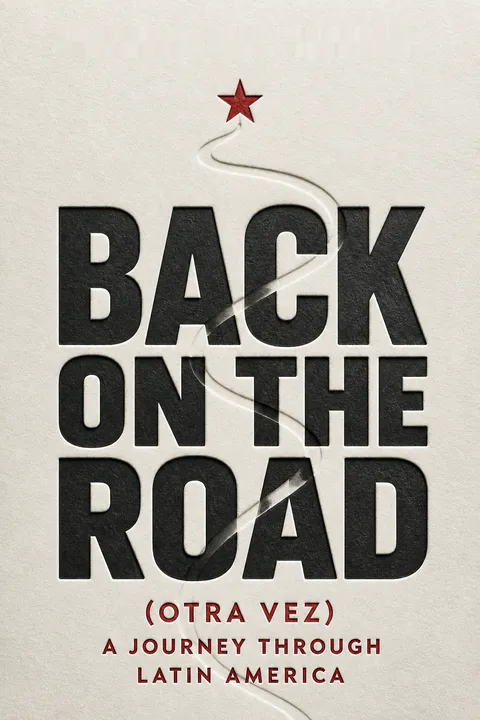
The record stops before the outcome. The diary itself ends earlier, in Mexico, and the included letters help explain the period that follows. The boat trip to Cuba and the guerrilla war belong to another account. This boundary matters: Back on the Road is not a complete story of the revolution or a polished account written from hindsight. It captures a young doctor moving toward a decision, with uncertainty and unfinished plans still visible.
Ending before the Cuban campaign preserves the difference between a decision and its later historical meaning. Readers see how a commitment takes shape without having every earlier event arranged as destiny. That is a strength of the diary form, which records hesitations and mundane details that retrospective biography often compresses. It also demands caution: Guevara's own record is selective, and the edition combines diary entries with letters, editorial notes, and later context. Those layers illuminate one another, but they are not the same kind of evidence.
Analysis
The book's central achievement is to make political conversion visible as a process of attention. Its narrator does not begin as a fully formed revolutionary. He begins with a traveler's appetite for landscapes, ruins, work, women, food, and stories, then repeatedly encounters the distribution of power behind those experiences. The transition is uneven. Asthma, unpaid wages, broken travel plans, and uncertain employment occupy much of the diary alongside national crises. This mixture resists a simple heroic narrative and makes the eventual commitment more intelligible.
The diary's unevenness is also its evidentiary limit. Guevara observes real events and speaks with politically engaged participants, but he often turns partial encounters into confident conclusions about leaders, classes, or national trajectories. The text is therefore strongest as testimony to what he saw, felt, and believed, and weaker as a comprehensive history. The editorial apparatus itself signals this distinction: a note corrects his mistaken report that a Guatemalan judge was executed. His errors do not invalidate his account, but they warn against treating conviction as verification.
The narrative's most consequential episode is Guatemala. The coup transforms political argument into immediate experience, while Guevara's interpretation emphasizes the vulnerability of reform without organized force and the danger of division among supporters. That reading explains his radicalization, but it also narrows the field of possible explanations and solutions. The reader gains most by holding both levels together: the diary documents a formative shock, while its proposed lessons remain political judgments open to scrutiny.
The title's second journey is thus not merely a repeat itinerary. It is a return to Latin America with a changed question: not only what is here, but who controls it, and what obligations follow from seeing it. The book ends before the answer becomes a military campaign. Its lasting value lies in that unfinished threshold, where curiosity, professional ambition, solidarity, and political resolve are still in tension.
Review Summary
Back on the Road receives mixed reviews, with an average rating of 3.72/5. Some readers find it less engaging than Guevara's previous work, noting its more political focus and disjointed structure. Others appreciate the insight into Guevara's developing revolutionary ideology and his experiences in Latin America. The book covers Guevara's travels from 1953-1956, including his time in Guatemala during a military takeover and his meeting with Fidel Castro. Readers note the frequent mentions of Guevara's asthma attacks and his evolving political views.
People Also Read



Glossary
Otra Vez
Once againThe Spanish title of Guevara's second Latin American travel diary, meaning "once again." It refers to his return to countries that had already shaped his earlier journey, but the repeated route brings a changed perspective. In this account, travel increasingly becomes a way to examine social inequality, political conflict, and his own future role.
Our America
Latin American political communityA political and cultural idea associated in the book with Cuban writer José Martí. It names Latin America as a connected community with shared histories and interests, rather than merely a collection of separate countries. Guevara's use of the idea frames his travels as an encounter with a wider continental reality and with struggles that cross national borders.
MNR
Bolivia's nationalist movementThe Movimiento Nacionalista Revolucionario, or Nationalist Revolutionary Movement, which led Bolivia's 1952 revolution. In the diary and accompanying correspondence, Guevara describes it as a coalition containing competing political tendencies. Its government pursued major changes, including land reform and the nationalization of important mines, while facing internal disputes over the direction of the revolution.
Decree No. 900
Guatemala's land-reform lawA land-reform measure enacted under Guatemala's elected government of Jacobo Árbenz. It became a central point of conflict between the government and its opponents. After the 1954 coup, the decree was declared unconstitutional. In Guevara's account, the reversal represents the defeat of a reform project and the wider political struggle surrounding land and power.
About the Author
Other books by Ernesto Che Guevara
Download PDF
Download EPUB
.epub digital book format is ideal for reading ebooks on phones, tablets, and e-readers.








