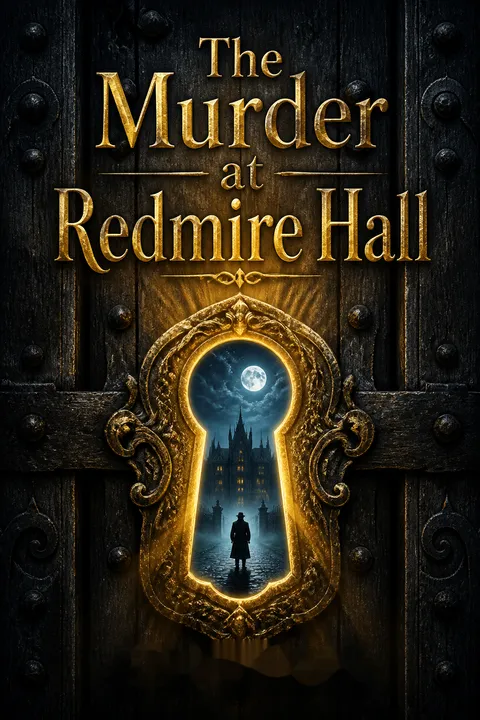


Plot Summary
Prologue
In 1980, eccentric Lord Vivian Carstairs dazzles his guests at Redmire Hall with a locked-room illusion. They inspect the study, bolt Vivian inside, and watch him vanish, return, then disappear again and reappear behind them.
His glamorous assistant, Esmeralda, helps conduct the show, while the guests leave baffled and Vivian refuses to reveal how it worked. The room is locked away, its key lost, and the trick becomes a fading legend. Decades later, the secret that once made the room a source of wonder will offer someone a way to turn it into a murder weapon.
The prologue establishes the story’s central bargain: an audience agrees to trust what it sees, while the illusion depends on what it cannot see. Vivian’s refusal to explain the trick preserves his social power and turns secrecy into part of the performance. The room then outlives its creator as an unattended mechanism, detached from the original context of amusement. That transformation matters: the book makes spectacle morally unstable. The same carefully staged disappearance can entertain a privileged audience or conceal violence, depending on who controls the machinery and what the witnesses have been trained to believe.
Redmire Goes Live
Nearly forty years after Vivian’s performance, his son Frederick Carstairs, the current Lord Redmire, announces a live television recreation of the illusion. He has rediscovered the room and its secret, and hopes the broadcast will draw paying visitors to an estate strained by his gambling debts.
He assembles family and old associates, each carrying private grievances: his brother Dominic resents the inheritance, his daughter Poppy wants help with her boyfriend’s debts, and former lover Alex arrives with James Forsyth, Frederick’s former business partner.
Frederick’s son Alistair worries about the estate’s future, while his mother objects to the spectacle. Detective Chief Inspector Jim Oldroyd and Sergeant Stephanie Johnson attend as official witnesses, unaware they are walking into a crime scene.
Frederick’s public performance is an economic decision dressed as entertainment. He wants the audience’s amazement converted into visitor revenue, while his family sees the gathering through their own ledgers of grievance, inheritance, and dependence. That collision makes the Hall feel less like a home than a stage on which every relationship has an audience. Oldroyd and Steph’s presence adds an especially sharp irony: Frederick borrows police authority to validate the illusion, unknowingly placing investigators inside the spectacle that will require them to distinguish evidence from misdirection.
The Returned Body
Oldroyd and Steph inspect the study with the cameras following them. They find no exit, only the small floor cavity Vivian had once shown his guests, and Oldroyd locks Frederick inside. Music covers the brief wait. The room is empty when they reopen it; after the process repeats, Frederick is back in his chair.
For a beat the audience applauds, then his body tips sideways and exposes a knife wound. The broadcast captures the killing before the picture cuts away. Oldroyd secures the room, Steph checks the body, and the family’s shock gives way to panic. Because every invited relative and guest stood outside watching, the impossible murder seems to offer the killer an alibi as complete as the illusion.
The murder converts the audience from spectators into involuntary witnesses, but witnessing does not mean understanding. The television broadcast multiplies the event without making it clearer: thousands see the result, while the crucial action remains hidden. Frederick’s theatrical confidence also collapses into a body that cannot control its own presentation. For Oldroyd, the case begins with two linked problems, identity and method. The locked room is not merely a puzzle to solve after the murder; it is the condition that makes the murder appear impossible and allows the conspirators to exploit the crowd’s certainty.
Robinson Is Silenced
As Oldroyd tries to contain the guests and summon help, the estate’s retired mechanic, Harold Robinson, is strangled in his cottage. His neighbour finds him the next morning, with no sign of a break-in or ordinary theft.
The second killing makes the connection to the locked room difficult to ignore: Robinson helped maintain the Hall’s machinery for decades and may have known how Vivian’s trick worked. Oldroyd concludes the first murder required more than one person, since the relatives were all beside him during the broadcast and could not have entered the study openly.
He keeps the family and close associates at the Hall for questioning. Their grief is mixed with suspicion, while the estate staff and television crew wait for police instructions.
Robinson’s death changes the investigation from a closed-room puzzle into a campaign to control knowledge. The absence of theft suggests that the victim’s value lay not in what he owned but in what he could reveal. Oldroyd’s early theory of multiple participants follows from the practical problem of the alibis: the crowd could not act as a single killer, but it could conceal a coordinated plan. The family’s detention intensifies the novel’s social pressure. In the Hall, everyone is both a witness and a possible source of information, and silence becomes increasingly dangerous.
Grievances Fill the Hall
Oldroyd and Steph question Frederick’s circle and uncover a crowded field of plausible motives. Alex still feels attached to Frederick despite his infidelity, while James remains angry about their failed car business.
Antonia, Frederick’s former wife, resents years of betrayal; Dominic admits his bitterness about being passed over for the estate. Poppy had recently sought money to help Tristram, a gambler, and Frederick refused. Alistair and his wife Katherine feared his father’s secret plans for Redmire, though they claim not to know their details.
The dowager is unusually unsentimental about her son. Meanwhile, estate manager Richard Wilkins reveals a strained workplace, and Oldroyd learns that an earlier nighttime break-in at the estate office yielded no reported theft.
The suspects’ abundance of motives is not simply a mystery convention; it reflects a family system in which money substitutes for direct emotional repair. Frederick’s generosity has kept some relationships close while making dependence another source of resentment. Oldroyd must resist treating visible anger as proof, particularly when the family’s polished manners conceal different forms of injury. The unexplained office break-in introduces a second layer of secrecy beyond the locked room. The investigation’s challenge becomes one of proportion: many people have reason to dislike Frederick, but the method requires specialized access and cooperation.
A Shot Across the Fields
At the village pub, Robinson’s longtime friends confirm he helped with the original illusion and had been paid well, though he never disclosed its workings. A local man, Scott Handley, tells Oldroyd he saw an old red Volkswagen Polo hidden near the estate on the murder night, with signs that the spot had been used before.
Walking back alone, Oldroyd is shot at from across a field and narrowly escapes behind a hedge. The attack confirms that the killers are willing to eliminate anyone who gets close. The detectives also learn that Frederick and Tristram had argued over gambling debts, while the search for the missing estate-development papers begins to suggest that the murder may involve more than personal revenge.
The shot at Oldroyd is a structural escalation: the detective is no longer studying a completed crime from a position of safety but has become a possible next victim. At the same time, Robinson’s friends complicate the moral picture. His silence may have protected a secret, but his pension suggests that keeping it was a paid obligation, not merely loyalty. The concealed car provides a physical trace without yet identifying its purpose. Together, these details shift the case from a family feud toward an organized operation whose members understand both the estate and the value of information.
The Estate Was for Sale
Frederick’s solicitor reads a will that leaves the estate to Alistair but warns that gambling debts may consume much of Poppy’s inheritance. The financial strain becomes concrete when Oldroyd tracks down the developers Frederick had consulted: he planned to sell a farm for a golf course and other land for housing.
The proposals would have altered Redmire permanently, giving Alistair, Katherine, and the dowager a possible motive to stop him. A copy has vanished from Wilkins’s office safe, where an unexplained break-in occurred months earlier.
Oldroyd also finds old photographs and a Christmas letter from a woman named Jane, evidence that Frederick concealed part of his past. The case now contains both a threatened estate and an unacknowledged family history.
The development plan turns inheritance from a vague motive into a conflict over what the estate is for. Frederick treats land as a financial asset; those attached to Redmire regard it as a continuity that must be preserved. Neither position is emotionally neutral, especially when the costs of maintaining tradition fall on others. The missing documents imply deliberate preparation, yet the investigators cannot assume that the heir was responsible for their disappearance. Jane’s letter opens a different line of inquiry: the public family tree may omit someone whose exclusion has consequences beyond inheritance.
The Missing Marble
Oldroyd and Steph visit Olivia Pendleton, who attended Vivian’s original performance as a child. She remembers little of the adults’ examination, but she recalls a marble rolling into the study after Vivian vanished. When he reappeared, the marble was gone, though she searched for it.
Oldroyd initially has no answer, but the detail joins two other clues: a Russian nesting doll his daughter gave him, and Robinson’s old remark that people never actually left the room. Meanwhile, Oldroyd’s private life falters when his wife, Julia, tells him she may seek a divorce. Their daughter Louise urges him to stop living in the past. Her new job at a pub called the Orphan Girl gives Oldroyd an unexpected association with Frederick’s hidden history.
Olivia’s memory matters because it is precise where adult recollection is vague. The marble is a small, physical contradiction that resists the grand story of disappearance: if the room were unchanged, the object should still be there. Oldroyd’s deduction emerges through a combination of evidence and personal association, not sudden brilliance. The parallel with his marriage is quieter but important. He has spent years hoping to restore an earlier arrangement, while the case asks him to abandon the first explanation that seems emotionally satisfying and examine what is actually present.
The Railway Killing
After the estate reopens and the detained guests are released, Ian Barden continues his amateur inquiries, telling workers he has noticed things but withholding specifics. Someone ambushes him at the miniature railway, ties him to a bridge support, and sends the model Duchess of Hamilton engine down the track at full speed.
The engine kills him and plunges into the pond. Oldroyd closes the grounds again and learns that Barden had hinted at blackmail, though no one knows what he actually discovered.
Forensics find unusual plant residue on the knife from Frederick’s murder, and fertilizer traces on Robinson’s garrote. These details point toward the gardens and their tools. The third death suggests that the killer is removing possible threats, whether or not they truly know anything.
Barden’s killing is both an escalation and a warning about the danger of performing knowledge. He may have been a genuine witness or merely a self-dramatizing meddler, but his captors act as though uncertainty itself must be eliminated. The method also turns his beloved railway into an instrument of execution, collapsing the boundary between a worker’s identity and the violence imposed on him. For Oldroyd, the forensic traces are more useful than Barden’s claims: soil and fertilizer connect the apparently sealed crime to the living, laboring world of the gardens.
Two Rooms, One Illusion
A police operation briefly mistakes Scott Handley, poaching with a rifle, for the person stalking Redmire, but the false alarm sends Oldroyd back to the evidence. Robinson’s friend Bill Mason recalls that Robinson once said people in the trick did not leave the room.
Oldroyd reconsiders the floor, then orders a focused search. The study is one of two identical rooms mounted on a hidden track; music masks the motor as one slides away and the other replaces it. When the floor shifts, the trapdoor no longer sits over concrete, allowing someone beneath the room to climb up through a concealed passage.
Forensic traces connect the murder weapons to garden work. A private investigator also supplies information about James’s blackmail of Frederick, but the evidence points beyond the obvious suspects.
The solution depends on revising the question. Everyone has asked how a person escaped a room, but Robinson’s phrase suggests that the room itself may be the thing that moves. The mechanism makes the audience’s assumptions part of its engineering: music covers sound, a curtain blocks sight, and the apparent solidity of the floor discourages further thought. Oldroyd’s method is strongest when he treats each clue as a constraint rather than a confirmation. The false alarm with Scott also underlines how fear can make ordinary behavior look criminal, a danger the detective must avoid.
Esmeralda’s Daughter
At a final gathering in the Hall, Oldroyd demonstrates the two-room mechanism and explains how a killer could enter beneath the shifted study, stab Frederick, and leave before it returned. He then identifies Frederick’s PA Andrea Jenkinson and head gardener David Morton as the conspirators.
Andrea is Jane Dawson’s daughter, born after Frederick abandoned Jane, the assistant known at the 1980 performance as Esmeralda. Andrea joined his staff to exact revenge; Morton joined after seeing plans to sell the old kitchen garden and destroy plants his family had tended for generations.
They recruited Robinson by threatening his pension, then killed him after Frederick’s murder. Morton also shot at Oldroyd and killed Barden, whom he feared might expose them. Andrea’s hidden photographs and Morton’s forensic traces complete the case. Police arrest them, while both insist their actions were justified.
The revelation binds private abandonment to institutional inheritance. Andrea’s revenge is not reducible to a single grievance: she has spent years organizing her life around a father who never acknowledged her, and the murder gives that history a grotesque public answer. Morton’s devotion to the garden likewise turns care into possession. He protects living things by treating a human life as expendable. Their motives are distinct, but both convert a cherished past into permission for violence. The locked room’s elegance therefore has a moral counterpart: the conspirators’ reasoning is carefully arranged, yet its apparent coherence cannot make it just.
The Detective Comes Home
With Andrea and Morton in custody, the Hall’s family and staff are left to reckon with the damage. Alistair takes responsibility for Redmire and rejects the sale of the estate, while planning practical changes to keep it solvent and help Poppy.
Poppy, in turn, hires private detectives to keep Tristram away from gambling, taking control of a pattern that once defined her father. Oldroyd admits to Steph that his theatrical accusation of every relative was cruel and partly driven by his dislike of the rich.
He also accepts that his marriage may be over after Julia’s decision to move on. Louise’s presence and new pub job draw him out of his solitary flat. He returns to ordinary life with no romantic resolution, but with a clearer sense that work cannot be his only refuge.
The resolution does not make the family whole; it redistributes responsibility. Alistair inherits not just a title but the practical work of preserving an estate damaged by Frederick’s spending. Poppy’s effort to restrain Tristram suggests a possible interruption of inherited behavior, though control alone cannot guarantee change. Oldroyd’s apology to Steph is equally significant: professional authority does not excuse his misuse of power, even when his performance produces the right answer. His marriage remains unresolved, but he begins to recognize the difference between loyalty and refusal to accept change.
Analysis
The novel’s central formal idea is that attention can be engineered. Vivian’s trick works because witnesses are invited to inspect the room yet guided away from the room’s actual structure. The television broadcast appears to increase transparency, but it only expands the audience for a carefully controlled deception. Oldroyd solves the crime by refusing the framing of the spectacle: he stops asking how Frederick escaped and considers whether the room itself changed. The mystery therefore treats skepticism not as cynicism but as disciplined attention to what an explanation excludes.
Redmire Hall is also a conflict between property as capital and place as inherited labor. Frederick sees land as a way to pay debts; Alistair sees a responsibility to preserve the estate; Morton understands the gardens through decades of care. Yet the novel refuses to make preservation automatically virtuous. Morton’s devotion becomes murderous when he values plants above people, while the old aristocratic order is itself sustained by workers whose contributions the owners often ignore. Andrea’s revenge likewise begins in an injustice that deserves recognition but ends in violence against people who did not cause it. Grievance explains action without absolving it.
The family’s many motives create an atmosphere in which nearly everyone can be suspected, but Oldroyd’s conduct shows that solving a case is not the same as behaving justly. His staged accusation gives him control over the relatives and lets him indulge his theatrical instincts. Steph’s rebuke makes accountability part of the resolution. Meanwhile, his failing marriage echoes the investigation’s demand to abandon a preferred story: he cannot restore the past by waiting, any more than the detectives can solve the room by accepting its appearance. The book’s final movement asks whether people can interrupt inherited habits of dependence, secrecy, and self-justification before those habits become another kind of trap.
Review Summary
The Murder at Redmire Hall receives mostly positive reviews (4.28/5) for its locked-room mystery reminiscent of Agatha Christie's Golden Age detective fiction. Readers enjoyed the Yorkshire setting, DCI Oldroyd's character, and the clever plot involving Lord Redmire's death during a televised magic trick. Common praise includes the traditional mystery structure and Poirot-style denouement. Criticisms focused on dated police procedures, clichéd characters, undisclosed forensic evidence, and predictable solutions. Some found it too long or melodramatic, while others appreciated the cozy mystery atmosphere and Yorkshire atmosphere.
Characters
Jim Oldroyd
The patient investigatorA seasoned detective chief inspector in the West Riding Police, Oldroyd approaches crime as a puzzle whose answer must be earned through patient observation. His fondness for music, local history, and theatrical flourishes makes him genial, but his humor can shade into self-indulgence. He works closely with Stephanie Johnson and values her judgment, even when she challenges him. Away from the case, he is separated from Julia and misses his children; years of putting work first have left him uncertain how to build a life outside the job. His intelligence is real, but so are his blind spots, especially when personal loyalties and class prejudice affect his conduct.
Stephanie Johnson
Oldroyd’s clear-eyed partnerA detective sergeant and Oldroyd’s longtime colleague, Steph is perceptive, practical, and willing to say what others leave unsaid. Their professional partnership carries the ease of a family bond, but she is not merely an assistant: she tests his assumptions and handles difficult interviews with composure. Her relationship with fellow detective Andy Carter gives her a steadier private life than her boss’s, though she faces harassment from a superior officer and must decide how to protect herself. Steph’s instincts are balanced by a strong sense of evidence and fairness, qualities that keep Oldroyd’s more theatrical impulses in check.
Frederick Carstairs
The spendthrift lordThe latest Lord Redmire, Frederick is charming, self-indulgent, and skilled at making other people accommodate his enthusiasms. He grew up amid privilege and inherited a historic estate, but treats it chiefly as a resource for his pleasures and financial schemes. Gambling, affairs, and a history of failed business dealings strain his relationships with his former wife, children, brother, and associates. His recreation of his father’s locked-room illusion shows that he understands the value of spectacle, though he underestimates the dangers surrounding it. Frederick’s charisma helps explain why people remain attached to him even after he has repeatedly disappointed or harmed them.
Andrea Jenkinson
The efficient private secretaryFrederick’s capable personal assistant, Andrea is organized, discreet, and accustomed to managing a demanding employer without appearing rattled. She came to Redmire after working in London finance and presents herself as professionally detached from the estate’s family conflicts. Her work puts her near schedules, correspondence, and sensitive information, while her reserved manner makes it difficult for others to know what she thinks. Andrea is also involved with estate manager Richard Wilkins, a relationship that complicates the boundary between her private life and her position at the Hall. Her ambition is directed toward a future beyond the estate, though the past remains an important pressure in her life.
David Morton
The devoted head gardenerMorton has spent most of his life tending Redmire’s gardens, following his father and grandfather in work that has become both vocation and inheritance. He knows the plants, walls, and paths intimately, and takes pride in the rare specimens and carefully composed garden spaces under his care. His loyalty is directed less toward the aristocratic owners than toward the living landscape and the generations of labor invested in it. Blunt, weather-beaten, and sparing with sentiment, he can seem reassuringly grounded beside the Hall’s more volatile personalities. The depth of his attachment is easy for others to underestimate.
Alistair Carstairs
The careful heirFrederick’s son and heir, Alistair is a cautious, earnest man who has lived on the estate with his wife and daughters. Unlike his father, he is attached to Redmire as a responsibility rather than a stage for personal pleasure. He worries about the family’s finances and the future of the property, but hesitates to confront Frederick directly while his father remains in control. Alistair’s steadiness can look dull beside Frederick’s charm, yet it gives him a practical understanding of what the estate requires. He is also a devoted husband and father, conscious that decisions made at Redmire will shape his children’s lives.
Poppy Carstairs
The dependent daughterFrederick’s daughter, Poppy has expensive tastes, an unfinished photography career, and a history of relying on her father’s financial help. She is affectionate toward him despite his treatment of her mother, and she wants to believe he supports her ambitions. Her relationship with Tristram is passionate but troubled by his gambling and her own fear of repeating her father’s patterns. Poppy can seem frivolous to relatives who value duty and restraint, yet she is more forceful about money and independence than they assume. Her struggle is to separate loyalty to family from the right to shape her own future.
Dominic Carstairs
The resentful younger brotherFrederick’s younger brother, Dominic is a practical businessman whose resentment of the inheritance has hardened into habitual complaint. He believes his elder brother squandered what should have been handled responsibly, while also feeling that birth order denied him a life of ease. Financial pressure at his recruitment company increases his dependence on the family he criticizes. His rigid ideas about class and propriety make him defensive when challenged, but beneath the bluster lies a genuine sense of exclusion.
Mary Carstairs
Dominic’s observant wifeMary is socially graceful and more emotionally perceptive than her husband. She often smooths over Dominic’s irritability, but her composure does not mean she is content with the life she has built around him. She notices the tensions in Frederick’s circle and understands that affection, money, and status are entangled at Redmire. Her attraction to lively, unconventional people contrasts with Dominic’s conventional outlook, leaving her caught between comfort and frustration.
Antonia Ramsay
The dignified former wifeFrederick’s former wife and mother of Alistair and Poppy, Antonia endured years of infidelity before leaving the marriage. She is composed in public, but her return to Redmire stirs memories of betrayal and the long work of protecting her children from their father’s unreliability. Her second marriage to Douglas offers the steadiness she lacked before. Antonia values family connection, though she has little patience for the damage Frederick’s choices have caused.
James Forsyth
The former business partnerJames once entered the vintage-car business with Frederick and believes he was left carrying the work when his partner lost interest. He has since built a more successful sports-car business, but old anger and the history of his relationship with Alex remain close to the surface. James enjoys the status and leisure his work affords him, while insisting that he earned them through effort. His confidence can conceal a capacity for secrecy, making him difficult for Oldroyd to read.
Alex Davis
The enduring former loverAlex was Frederick’s longtime lover before becoming James’s partner. Glamorous and socially assured, she is frank about the pain Frederick caused her but admits that her feelings for him never entirely vanished. She is not easily reduced to the role of a spurned woman: she has chosen her own relationships and can distinguish affection from the willingness to return to a damaging one. Her history links two of the men closest to the case.
Tristram Benington
The gambling boyfriendPoppy’s boyfriend, Tristram is a successful male model whose earnings are undercut by his gambling. He understands the code that players must honor their own debts, even when Poppy hopes Frederick will intervene. Attractive and self-possessed, he can also be evasive when a difficult truth might make him look suspicious. He cares for Poppy, but his habit places their future under continual strain.
Lady Redmire
The unsparing dowagerFrederick’s elderly mother, Lady Redmire has watched successive generations spend freely while others maintained the house and gardens. She is sharp, opinionated, and unwilling to disguise her disappointment in her son. Her sympathy for Antonia and confidence in Alistair reveal where her loyalties lie. Though she can be severe, she is not indifferent to the family’s history or to the estate’s future.
Richard Wilkins
The burdened estate managerWilkins manages Redmire’s staff and daily operations, carrying responsibilities that were never fully acknowledged by his employer. He is hardworking but harried, and resents Frederick’s indifference to the practical labor that keeps the estate functioning. His private relationship with Andrea makes their professional connection more complicated. He hopes Alistair will become a more engaged and considerate employer.
Katherine Carstairs
Alistair’s steady partnerAlistair’s wife, Katherine is a pragmatic partner who encourages him to protect the interests of their daughters and the estate. She notices details others overlook, including an unexplained nighttime presence in the estate office. Her practical intelligence complements Alistair’s conscientiousness, and she helps him face the prospect of inheriting a troubled property without romanticizing the burden.
Olivia Pendleton
The childhood witnessA London fashion designer and niece of Lady Redmire, Olivia attended Vivian’s original illusion as a child. She remembers herself as more interested in playing marbles than watching the adults, but her recollection preserves a small detail that the grown-ups overlooked. Creative and observant, she offers Oldroyd a perspective shaped by childhood attention rather than adult assumptions.
Ian Barden
The railway enthusiastBarden maintains and operates Redmire’s miniature steam railway. He is technically skilled and deeply attached to his engines, but socially awkward and prone to elaborate theories. After the murders, he appoints himself an investigator and warns others that danger remains. His need to feel useful makes him vulnerable to being dismissed, even when he may have noticed something important.
Harold Robinson
The retired estate mechanicKnown as Harry, Robinson spent decades repairing cars and equipment at Redmire. He was a quiet, loyal worker who remained close to the estate after retirement. His technical knowledge and long service connect him to the Hall’s older history, while his friends remember him as a decent man who guarded confidences.
Louise Oldroyd
The candid daughterOldroyd’s university-aged daughter is politically engaged, independent, and willing to challenge her father’s self-deceptions. She understands how his devotion to police work has affected his marriage and urges him to imagine a future beyond it. Her return home provides him with companionship and perspective, while her new bar job gives him a small but meaningful reason to re-enter ordinary social life.
Julia Oldroyd
The estranged wifeOldroyd’s separated wife, Julia, remains concerned about their family but has begun to build a life independent of him. Her care is real, yet she is no longer willing to let concern stand in for a functioning partnership. Her decision forces Oldroyd to confront the cost of years spent making work his first commitment.
Andy Carter
Steph’s trusted partnerAndy is a fellow detective and Steph’s romantic partner. A London native who has embraced Yorkshire life, he is affectionate, humorous, and at ease with Steph’s directness. Even while on leave, he helps her locate Olivia through his police contacts. Their relationship gives Steph a source of mutual support outside the pressures of the investigation.
Tom Walker
Oldroyd’s protective superiorA senior officer who values Oldroyd’s experience, Walker shields him from political fallout when the televised murder draws scrutiny. He shares Oldroyd’s Yorkshire loyalties and uses humor to manage the pressures of police hierarchy.
Scott Handley
The observant local poacherA young local who knows the fields and tracks around Redmire, Handley reports seeing a suspicious car near the estate. His poaching brings him into conflict with police security, but his attention to the landscape gives Oldroyd a useful lead.
Esmeralda
The forgotten assistantThe stage name used by Jane Dawson, the young assistant in Vivian Carstairs’s 1980 illusion. She hoped for a career in entertainment and was hired for her appearance and performance. Her brief presence at the original show becomes part of Redmire’s hidden family history.
Plot Devices
The locked-room illusion
Conceals murder in plain sightThe celebrated trick appears to make a person vanish from a sealed study and later reappear. In fact, two identical rooms move along a concealed track behind a curtain, with music covering the motor. When one room shifts away, a person can climb through the floor trap into a hidden passage and reach the other side. The device supplies the central murder method and creates the apparent alibis that confound the investigation. Its solution depends on recognizing that the room, not the person, is moving.
The marble and the remark
Turns overlooked details into proofOlivia’s childhood marble disappears from the room between performances, while Robinson once suggested that people did not leave the room. Each clue seems confusing alone. Together they challenge the assumption that the study is a single fixed space. Oldroyd combines these memories with the nesting doll his daughter gives him and tests the floor until the hidden movement becomes detectable. The device illustrates how minor observations can become decisive when an investigator asks a different question.
The stolen development plans
Makes inheritance a concrete motiveFrederick’s confidential proposals to sell a farm and estate land for development give the family and staff a tangible reason to fear his plans. Their disappearance from the estate office links an earlier break-in to the present murders and prompts Oldroyd to investigate the property developers. The documents also clarify the conflict between treating Redmire as a source of money and preserving it as a historic landscape. They widen the investigation beyond debts and romantic grudges.
The three staged deaths
Raises the cost of knowingFrederick is stabbed through the illusion, Robinson is strangled in his cottage, and Barden is killed with the miniature railway engine. The distinct methods make the crimes feel disconnected, but each death reduces the chance that someone will reveal what happened. The murders also escalate the threat from a concealed killing to an attack on the investigator and then a public warning to the estate. Their variety distracts from the shared motive of controlling information.
Jane’s photographs
Connects an old wound to the presentA letter and photographs hidden among Frederick’s possessions point Oldroyd toward Jane Dawson and the child she raised without Frederick’s support. The photographs provide a physical link to the past, while Andrea’s birthmark helps confirm her identity. This evidence turns an apparently marginal family secret into the key to understanding why someone joined the murder plot. It also exposes the lasting consequences of Frederick’s private conduct beyond the household that officially recognized him.
Yorkshire Murder Mysteries Series

Download PDF
Download EPUB
.epub digital book format is ideal for reading ebooks on phones, tablets, and e-readers.








