

Plot Summary
Prologue
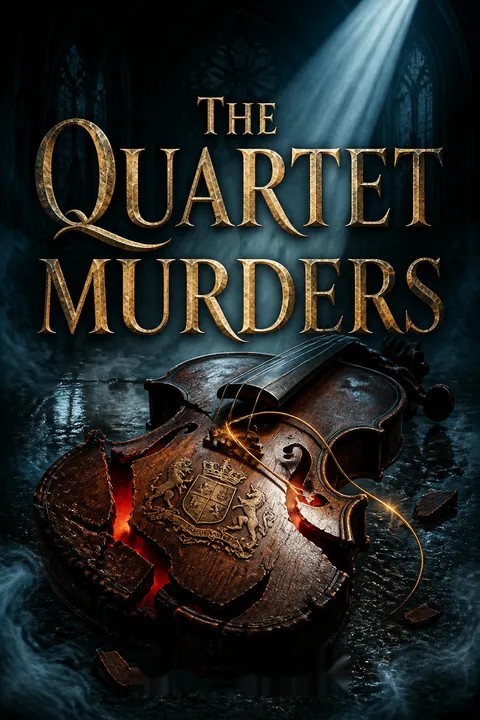
In 1709, Count Munsterhaven commissioned Antonio Stradivari to make nine string instruments for his private chamber orchestra. He asked for his family crest to be painted on each one, marking them as a matched set unlike any other.
Three centuries later, the surviving instruments are coveted by musicians and collectors, their craftsmanship magnified by rarity and the histories of those who owned them. One of the violins will bring a murder investigation to a concert hall in Halifax.
The commission establishes the violin as both a work of art and an object marked by ownership. The count wants his crest to make the instruments permanently answerable to his name; later collectors inherit that impulse, treating possession as a way to claim a piece of history. Yet the instruments were made to be played, not merely guarded. That tension between use and ownership runs through the mystery, while the lost histories attached to the set complicate any easy distinction between a legitimate collection and a stolen inheritance.
Schubert Ends in Blood
Delayed by his superior's long complaint about police management, Detective Chief Inspector Jim Oldroyd reaches Halifax just in time for the Schubert Quartet's concert at the Red Chapel. He has loved chamber music since his father first brought him to the venue, and the quartet's final work, Schubert's Death and the Maiden, absorbs him completely.
The German-born leader, Hans Muller, plays a priceless Stradivarius bearing Count Munsterhaven's crest. At the end of the slow movement, Muller places the violin on a small table while he rests his injured arm. A faint sound breaks the silence. A bullet strikes his forehead, and he falls beside his scattered score as the audience realizes the music has ended in murder.
The opening makes Oldroyd's love of music more than a personal flourish: it places him inside the event before he can become its investigator. His attention is trained on Schubert's meditation on death, then the performance is violently interrupted by a real death that seems to echo its subject. The timing also gives the violin immediate narrative force. Muller is killed only after setting it down, encouraging everyone to read the murder through the object's value. The scene begins the novel's central problem: whether the most visible motive is also the true one.
The Empty Gantry
Oldroyd steps between the audience and the body, calming the frightened concertgoers while committee member Frank Dancek runs downstairs to search for the shooter. When Halifax detective Sam Armitage arrives, officers find a silenced rifle on the lighting gantry, but no one can explain how its user left the building.
The exits appear watched, and the only visible way down is the ladder. The other musicians retreat to the artists' room, where Anna Robson, Michael Stringer, and Martin Hamilton are too shocked to notice the violin's absence.
A search confirms it has vanished from the table. Oldroyd, unsettled by the crime unfolding at a concert he cherished, agrees to help Armitage investigate and brings his sergeant, Andy Carter, into the case.
The crime scene turns a public murder into a puzzle of perception. The police can locate the weapon but not the person who used it, while the missing violin offers a clean, tempting explanation for both acts. Oldroyd's presence gives him a witness's intimacy with the scene and a detective's obligation to resist what it seems to mean. His decision to join Armitage also shifts him from startled spectator to active participant. The mystery now has two disappearances to explain, and the inability to account for either makes the investigators feel conspicuously outmatched.
Four Players, Three Stories
The next morning, Armitage produces a threatening note, assembled from cut-out letters, that was found in Muller's coat. Anna admits that Muller and Stringer had argued over whether the quartet should retire its traditional repertoire and find a replacement leader for Muller's failing arm.
She also remembers Muller once making an oddly phrased threat during an argument. Stringer confirms the professional dispute, then reports that Muller recently quarrelled with Patrick Jefferson, principal of the Bloomsbury School of Music.
Hamilton, outwardly composed, reveals that he deals in valuable instruments and had spoken with a wealthy London collector about a lute. Each musician denies knowing who wanted Muller dead. Their separate admissions give Oldroyd leads, but Anna's defensiveness and Hamilton's business interests leave him wary.
The interviews offer plausible motives that emerge from ordinary pressures: a career approaching its end, a colleague pressing for change, and access to valuable instruments. These details matter because none alone quite fits a public, carefully staged killing. Anna's guardedness suggests that the musicians' shared professional life has concealed private histories, while Stringer's report redirects attention from rivalry inside the quartet to the institution that employed Muller. Hamilton's trading work introduces a more commercial world beneath the concert's cultivated surface. The detectives gain information, but every answer multiplies the number of stories they must test.
Hamilton Behind the Table
Oldroyd and Carter question Dancek, who recalls seeing Hamilton leave a closed instrument shop in Halifax's Piece Hall before the concert. Dancek also identifies Edward Shaw, the Music Society's wealthy patron, as a collector of stringed instruments.
At the shabby shop, owner Paul Taylor denies Hamilton visited and dismisses his own dealings with collectors. Oldroyd suspects the business is a front but has no proof. Then Gertrude Dobson, an elderly concert patron, supplies a sharper observation: after Muller fell, she saw Hamilton block the table with his back, and the violin was gone when he moved.
The timing transforms Hamilton from a merely interested dealer into a serious suspect. Armitage releases the musicians, but the detectives head to London to investigate.
Dobson's account changes the direction of the case because it connects a visible action to a concrete loss. Until then, the violin's disappearance could have been hidden in the general confusion; now a person stood between the table and a witness at precisely the necessary moment. The clue is not forensic but social, dependent on what an older patron noticed while others were overwhelmed. At the same time, the Piece Hall shop and Shaw's collection suggest a local network of buyers. The investigation's focus narrows around Hamilton, though it has not yet established whether his theft connects to Muller's murder.
The Cellist's Hidden Compartment
As Oldroyd and Carter travel toward London to question Hamilton, news arrives that someone has shot him at his Notting Hill apartment. The cellist's rooms have been ransacked, but his cello remains untouched.
Oldroyd examines its case and discovers a concealed, padded compartment large enough for a violin. Dobson was right: Hamilton took Muller's instrument from the Red Chapel and hid it there. The compartment suggests that his discreet dealing involved more than legitimate brokerage, and the killer knew where to search.
The two murders now appear connected through the Strad, although Oldroyd cannot tell whether Hamilton stole it for himself or was trying to sell it. The missing instrument has drawn the investigation into a more dangerous world.
Hamilton's death appears to confirm the investigators' first theory, but it does not resolve it. The secret compartment proves he stole the violin and implies practiced concealment, yet the ransacked apartment cannot establish who killed him or why. A simple motive, possession, has become a chain of competing claims: Hamilton's theft, the killer's search, and a potential buyer's desire. Oldroyd's discovery also shows how methodical observation can recover evidence missed in a routine search. The instrument remains central, but the question has shifted from who took it to who controls the market surrounding it.
A Will, A Nazi Past
In London, collector Elizabeth Knott shows Oldroyd and Carter her guarded museum of stringed instruments and admits she has long wanted a Munsterhaven violin. Searching Muller's apartment afterward, Oldroyd finds another cut-out threat accusing him of holding stolen property, alongside a photograph of a young woman.
He learns that Muller left the Strad to the Bloomsbury School. Jefferson's recent argument with Muller was about the school's plan to end his contract; later, Carter discovers Jefferson knew about the bequest and stood to benefit from it.
Instrument historian Neville Adamson traces the violin to the Jewish Lerner family in Berlin, whose property was seized under Nazi rule. These discoveries make restitution, institutional prestige, and private collecting competing explanations for the threats and murders.
The violin's history changes the moral terms of the investigation. It may be not simply a valuable object but property separated from a family through state violence, giving the demand for its return a different weight from a collector's appetite. Yet the Bloomsbury School's inheritance complicates any clean moral position: an institution devoted to music also stands to gain prestige and wealth. Knott's admiration for the instruments is inseparable from her desire to possess them. Oldroyd must distinguish restoration from acquisition, while recognizing that both can be used to justify control over an object whose earlier owners were dispossessed.
The Restitution Campaign
The threatening notes lead Oldroyd to Ruth Greenfield, a Music Society committee member involved with Return Nazi Art Thefts Now. Greenfield explains that the group believes Muller's violin was taken from the Lerners and says she placed one warning in his coat before the Halifax concert.
She hoped pressure would make him acknowledge its history or surrender it, not provoke a shooting. Her family has its own history of persecution, and she has pursued restitution through protests rather than violence. The police find no evidence linking her organization to either murder.
Its London branch nevertheless has contacts among illicit dealers and offers intelligence about the Strad's movement. Greenfield's admission explains the warnings, but it does not explain the rifle, the vanished gunman, or Muller's death.
Greenfield's activism introduces a distinction between the legitimacy of a cause and the legitimacy of its tactics. She believes the violin was stolen from its rightful owners, but anonymous threats blur the difference between public pressure and coercion. Her own family history makes the campaign emotionally grounded rather than merely ideological; it also risks turning inherited injury into a license to intimidate. The investigation cannot treat her conviction as proof of murder, nor can it dismiss the pressure she applied as harmless. Her group's information network will become useful, showing that institutions outside the police may possess knowledge without sharing the same methods or priorities.
The Quartet's Private Wounds
As Carter revisits the quartet's circle, he learns Anna once had a long affair with Muller and that her husband, journalist Christopher Downton, had confronted him in anger. Stringer admits he and Anna agreed not to mention Downton because they feared worsening her marriage, and he reveals his own unspoken affection for her.
These omissions make the musicians' accounts less secure, though Downton is verified to have been in America when Muller was shot. Carter also establishes that Muller had threatened to withdraw the violin from the school after Jefferson's dismissal plan.
Meanwhile, Oldroyd's separation from Julia and his worry over daughter Louise's quarrels at home deepen his sense of isolation. The case's suspects have motives, but none yet explains the impossible escape.
The quartet's history shows how loyalty can become a form of concealment. Anna and Stringer withhold information to protect her from suspicion and from a volatile husband, but their silence makes the police reasonably distrust them. Stringer's feelings further complicate his claim to neutrality: affection need not mean guilt, yet it shapes what he chooses to defend. Oldroyd's own family strain gives him an emotional counterpoint to the musicians' fractured bonds. He understands the pull of attachment, but cannot let sympathy substitute for evidence. The section expands the human stakes without supplying the mechanism that would make any of these private conflicts fit the crime.
A Music Shop Front
Oldroyd's suspicion of Shaw and Taylor grows when Shaw cannot produce the instrument collection he claimed to own and police surveillance places him meeting a Dutch drug dealer. Shaw admits that his antiques business and collector persona conceal drug smuggling; Taylor, whose student record includes drug dealing, serves as a local distributor.
When officers move in at the Piece Hall, Taylor tries to flee through the Christmas market but is caught, and police find the drugs Shaw brought from Amsterdam.
Their criminal operation explains their secrecy and money, yet neither man has been tied to the murders. The bust clears a misleading strand of the investigation rather than solving it. Oldroyd remains caught between multiple plausible motives and the unanswered question of how the shooter vanished.
The drug operation exposes how easily a convincing cultural identity can function as camouflage. Shaw's inherited respectability and Taylor's music shop appear to connect them to the violin trade, but their actual business is unrelated to classical instruments. The revelation is both a genuine criminal discovery and a false solution to the murders. It warns the detectives that proximity to the Strad does not prove participation in its theft or the killings. Oldroyd's willingness to follow the evidence despite his suspicion prevents the case from collapsing into a neat but unsupported theory. The investigation gains clarity about these men while its central puzzle remains untouched.
Knott's Hidden Ambition
At her annual Mayfair gathering, Knott courts wealthy collectors and the Serbian dealer Novak Djaic, while a musician close to the murdered Hamilton grieves the cellist's involvement with illicit dealers.
Knott presses Djaic to find the Munsterhaven violin, insisting she will pay for it and avoid questions about its source. Soon afterward, a gunman enters her home disguised as a delivery worker and kills the real courier. Knott refuses to be cowed: she uses a concealed Taser to incapacitate the intruder and alerts the police.
The attack confirms that the search for the violin has become a contest among criminal networks, not merely a dispute among legitimate collectors. Knott's own appetite, however, remains shielded behind her cultivated public image.
Knott's social world turns connoisseurship into competition. Her guests admire the collection, but the private bargaining around it treats rare instruments as trophies whose history matters chiefly when it affects their price or availability. Her effort to recruit Djaic crosses a boundary she had denied crossing with the police. The disguised attack then reverses her usual position: the woman who secures objects behind steel doors becomes a target inside her own home. Her ability to defend herself complicates any assumption that age or refinement makes her powerless. Yet competence under attack does not erase her willingness to benefit from illicit acquisition.
Gunfire at King's Cross
A tip from Greenfield's organization leads Carter and the Metropolitan Police to a planned handover at King's Cross. Their surveillance identifies Terry Nash, a violent criminal carrying a bag suited to the violin.
Before officers can intervene, another gunman shoots Nash, grabs the bag, and turns his weapon on the police. Officers shoot him; Jefferson, waiting to buy the Strad for the Bloomsbury School, is arrested with the violin and a case full of money.
The investigation traces the attack to Djaic and then to Knott, whose home search reveals a second, long-missing Munsterhaven violin concealed behind a wall panel. She wanted the newly stolen instrument to make her the only collector with two. The Strad is recovered, but the first murder remains unsolved.
The station ambush is the point at which the separate criminal schemes collide in public. Jefferson's attempt to retrieve the violin for the school is not innocent, but neither is it the same motive as Knott's collecting ambition: he fears the instrument will disappear permanently, while she wants it as a private distinction. The concealed second violin proves that her collection hides a history she publicly disavows. In both cases, people justify unlawful action by claiming stewardship of something valuable. The recovery closes the international theft plot, yet the unsolved Halifax murder demonstrates that the most dramatic explanation was never necessarily the right one.
The Second Dancek
With London crimes contained, Oldroyd returns to the Red Chapel's escape puzzle. Carter's observation that Stradivarius made visually identical instruments makes him reconsider the assumption that one person must have both left and remained in the building.
A detail from the doorman's testimony clicks into place: Dancek's accent had sounded unusually strong. Immigration records reveal another man of the same age who arrived in Britain with him.
Oldroyd finds two matching sets of clothes in Dancek's flat and realizes the committee member has an identical twin. The brothers are arrested on a train to London and explain that Frank's twin, Helmut, fired the shot from the gantry; their resemblance enabled one to leave while the other returned unseen.
The solution depends on revising the basic unit of observation. The witnesses were not necessarily mistaken about seeing Dancek; they were mistaken in assuming that a recognizable person must be a single individual. Oldroyd's insight turns the locked-room problem from an architectural puzzle into a social one, exposing how trust in familiar faces can defeat careful surveillance. The violin comparison provides the associative spark, while the stronger accent and duplicate clothes convert intuition into evidence. The revelation also shows the limits of the detectives' earlier theories: they searched the building for a passage because they assumed there was only one body capable of moving through it.
Vengeance, Then Christmas
The brothers confess that Muller had once been Reinhard Meyer, a brilliant East German violinist who betrayed their sister Helga and her lover, Gerd, to the Stasi when they tried to escape to the West.
Helmut, serving as a border guard, unknowingly shot the couple on orders; years later, the brothers recognized Meyer in the Schubert Quartet and planned revenge. They chose the slow movement's end as a deliberate echo of Helga's death, while the stolen violin and Hamilton's opportunistic theft helped disguise their motive.
Oldroyd recognizes that the case was about a murdered young couple, not a Strad. At Christmas with Alison and Louise, he reflects on greed, loyalty, and family, then returns to music with the weight of Schubert's quartet changed.
The ending resolves both the practical mystery and Oldroyd's emotional movement without pretending that the consequences are simple. The brothers' confession explains the timing, the escape, and the false trail, while the recovered instrument can return to an institution where musicians will play it. Knott, Jefferson, and the gang members face legal consequences, though the novel does not supply their final sentences. Oldroyd's reflections on family arise from the case's contrasts: the brothers' loyalty, Helga's lost life, and the detective's imperfect ties to Julia and Louise. The last return to music is not a restoration of innocence; Schubert's quartet remains beautiful, but now carries the memory of the crime.
Analysis
The novel builds a murder mystery around a powerful but misleading equation: rare object, enormous price, therefore murder for possession. The Munsterhaven Strad makes that equation plausible because it is beautiful, scarce, and visibly marked by its history. Its value attracts legitimate institutions, private collectors, dealers, and criminals, but those groups do not want it for the same reasons. Some seek prestige, some profit, and some restitution. The investigation's task is not simply to identify who wanted the violin, but to separate these motives before they collapse into one convenient explanation.
The crime's mechanics mirror this problem of interpretation. The witnesses accurately report what they saw, yet the police cannot reconcile their reports because they assume a familiar face belongs to one person. Oldroyd solves the case by questioning that assumption, not by finding a hidden passage. His method is therefore ethical as well as deductive: he resists the glamour of the Strad and the apparent consensus that it must explain everything. The novel repeatedly warns that a compelling story can be wrong even when every clue seems to support it.
The histories of the objects also complicate the idea of rightful possession. The violin's connection to the Lerner family makes collecting inseparable from political theft, while Greenfield's campaign shows how the pursuit of justice can become coercive without becoming murder. Knott's collection and the school's proposed inheritance reveal different versions of institutional care that still center possession. The brothers' revenge, meanwhile, is rooted in genuine state violence but cannot restore the dead. Their response transforms an inherited injury into a new crime.
Oldroyd's private life gives this argument emotional consequence. He recognizes the cost of loyalty and the damage caused by neglect, but the case cannot repair his marriage or settle his daughter's conflicts. The Christmas ending offers no simple cure. Instead, family, music, and shared attention emerge as forms of value that cannot be stored behind glass or transferred by will. The Strad can be recovered; the lives and relationships damaged by possession, power, and vengeance cannot be returned to their earlier state.
Review Summary
The Quartet Murders receives generally positive reviews, averaging 4.19 stars. Readers praise the atmospheric Yorkshire setting, educational content about Stradivarius violins, and the old-fashioned police procedural style reminiscent of Agatha Christie. Main character DCI Oldroyd is well-liked, though some find the pacing slow with exhaustive interviews. The impossible crime setup—a violinist shot during a concert with both killer and stolen Stradivarius vanishing—intrigues readers. Common criticisms include a predictable or clichéd solution, slow middle sections, and lack of modern forensics. Most agree it's well-written with likeable characters, though opinions split on whether it matches the first book's quality.
Characters
Jim Oldroyd
The music-loving detectiveA thoughtful West Riding detective chief inspector whose affection for chamber music is rooted in concerts shared with his late father. He is observant, patient, and willing to question the obvious explanation, though his stubborn independence can leave him isolated from colleagues and family. His separation from Julia weighs on him, as does the sense that work has repeatedly taken precedence over home. He approaches people with curiosity rather than force, often noticing what their silences reveal. In this case, his emotional investment in the Red Chapel makes the murder personal, but his discipline requires him to see past the violin's glamour and follow the evidence.
Andy Carter
Oldroyd's quick-thinking sergeantA London-born detective sergeant working with Oldroyd, Carter brings metropolitan experience, energy, and a willingness to propose unconventional possibilities. He is eager to prove himself, but not merely ambitious: he watches how Oldroyd reasons and gradually becomes more confident in his own judgment. His relationship with Stephanie Johnson gives him a stable private life that contrasts with his mentor's loneliness. Carter is practical and sociable, able to move between police procedure and the unfamiliar worlds of collectors, musicians, and criminal dealers. His observations help the investigation, while his readiness to learn makes him more than a junior partner.
Sam Armitage
The dogged Halifax inspectorA Halifax detective chief inspector and Oldroyd's longtime colleague. Armitage is genial, persistent, and grounded in the local community, with an unpretentious manner that suits routine police work better than the rarefied musical world surrounding this case. He trusts Oldroyd's instincts and makes room for Carter's ideas, even when a theory sounds unlikely. His patience with witnesses and pressure from senior officers reveal the burden of keeping an investigation moving when leads repeatedly collapse. He is not as drawn to the Strad's artistic history as Oldroyd is, but his loyalty and practical steadiness make him an essential counterweight.
Hans Muller
The guarded quartet leaderThe German-born first violinist of the Schubert Quartet, Muller is a celebrated musician whose authority has helped shape the ensemble's reputation. He is private about his life before arriving in Britain and fiercely protective of his artistic independence. Age and a problem with his bowing arm have begun to raise questions about the quartet's future, but he resists being pushed aside or told what to play. His remarkable Munsterhaven Strad draws attention that he finds burdensome even as it deepens the power of his performances. To his colleagues, he is at once an admired artist and a difficult man to know.
Anna Robson
The divided violistThe Schubert Quartet's violist is an accomplished musician whose sensitive nature makes her acutely aware of tension among her colleagues. She admires Muller but carries complicated feelings about their past, while her marriage to journalist Christopher Downton has been strained by jealousy and secrecy. Anna tends to avoid confrontation until pressure forces her to speak, and her guardedness is partly an effort to protect people she loves. The death of a colleague unsettles both her professional identity and her sense of safety. She is not simply a witness to the quartet's conflicts; she is emotionally entangled in them.
Michael Stringer
The ambitious second violinistStringer has spent decades playing second violin beside Muller and wants the quartet to broaden its repertoire and plan for the future. His disagreements with the leader are professional, but his loyalty to Anna and his concealed affection for her complicate his choices about what to tell the police. He is intelligent, guarded, and quick to resent questioning that treats musicians as suspects. His discipline as a performer contrasts with the emotional restraint he maintains in private, making him difficult for Oldroyd and Carter to read.
Martin Hamilton
The cellist and dealerThe quartet's cellist is genial and professionally successful, with a second life as an agent who buys and sells musical instruments for wealthy clients. He is comfortable moving among musicians, collectors, and dealers, and values discretion in business. His interest in rare instruments brings him close to the investigation's central object, while his relaxed manner makes it hard to know how much he is revealing. Hamilton's double role illustrates the uneasy boundary between artistic appreciation and commercial appetite.
Frank Dancek
The committee regularA long-serving member of the Halifax Chamber Music Society, Dancek is an avid concertgoer with a strong attachment to the Red Chapel and its musical life. He has lived in Yorkshire for decades, retaining traces of a Central European background in his accent and manner. He is observant, eager to help, and respected by other committee members. His knowledge of the venue and his emotional investment in the quartet place him close to the investigation. Dancek presents himself as an ordinary, dependable fixture of the local music community, a man shaped by a past he rarely discusses.
Elizabeth Knott
The formidable collectorA wealthy Mayfair collector who has devoted much of her life to building an extraordinary assembly of stringed instruments. Knott is theatrical, sharp-witted, and highly protective of her privacy and possessions. She understands both the history and market value of rare instruments, but her language of guardianship can conceal a deeply personal desire to own what others can only admire. She is accustomed to controlling the rooms and conversations around her, and she does not welcome being treated as a harmless eccentric. Her collection reveals how cultural devotion and possessiveness can occupy the same mind.
Ruth Greenfield
The restitution campaignerA cellist and Music Society committee member, Greenfield is committed to recovering artworks and instruments seized from Jewish families under Nazi rule. Her activism is shaped by her family's history and by her belief that stolen cultural property should not remain with later owners simply because time has passed. She lives with her partner, Jo, and is forthright about her values and identity. Greenfield's determination can make her tactics confrontational, but she distinguishes public pressure from physical violence. She brings an ethical argument into a case where many others speak mainly in terms of prestige and price.
Patrick Jefferson
The school principalThe formal principal of the Bloomsbury School of Music, Jefferson is a polished institutional figure who worries about the school's reputation and finances. He respects Muller's musical contribution but participates in decisions that threaten Muller's position, illustrating how administrative pressures can injure people while being presented as reasonable policy. Jefferson is careful in interviews and accustomed to managing difficult conversations. His devotion to the school is real, though his judgment about how to protect it is shaped by status, institutional loyalty, and a willingness to take risks.
Gerald Watson
The society secretaryWatson organizes concerts for the Halifax Chamber Music Society and works as a skilled engineer. A self-described practical Yorkshireman, he is generous to the society and personally devoted to music, though his manner can be blunt. He knows the performers, the committee, and the Red Chapel's routines, making him an important source of local knowledge. His interest in firearms is another side of a life that does not fit neatly into the stereotype of a concert organizer.
Edward Shaw
The wealthy local patronA wealthy Halifax patron who supports the chamber society and presents himself as an antiques dealer and musical-instrument collector. Shaw enjoys the security and status of inherited money, but is less drawn to music than his family history might suggest. His imposing country house and guarded manner make him an early figure of suspicion.
Paul Taylor
The dubious shopkeeperTaylor runs a small stringed-instrument shop in the Piece Hall and presents himself as a modest local trader. His casual manner and rough surroundings sit uneasily beside the value of the objects at the center of the case. He has a history connected to music study, but his interests extend beyond the shop's advertised business.
Julia Oldroyd
The estranged wifeJulia is Oldroyd's separated wife and the mother of their two grown children. She has spent years carrying much of the practical responsibility for family life while her husband immersed himself in demanding cases. Her frustration with their daughter Louise's disorder and financial dependence can sound stern, but it comes from the burden of being the parent who must set limits. She and Oldroyd still care about each other, though trust has been worn down by his repeated absences.
Alison Oldroyd
The perceptive sisterOldroyd's older sister is a village vicar whose independent mind and human attentiveness make her a trusted confidante. She understands his loneliness because she has also lived through bereavement, and she offers insight without pretending to solve his cases for him. Alison's faith is thoughtful rather than rigid, and her concern for social justice connects her to Louise's activism. She offers Oldroyd both intellectual perspective and the promise of a family home at Christmas.
Louise Oldroyd
The idealistic daughterOldroyd's daughter is an Oxford student who spends her energy on political causes and struggles to manage her money. She is affectionate toward her father but often clashes with her mother over ordinary responsibilities and independence. Louise's arguments reflect a genuine social conscience, though her impatience with practical limits can leave others to absorb the consequences. Her presence reminds Oldroyd that family bonds need attention, not only affection.
Christopher Downton
Anna's volatile husbandA journalist married to Anna, Downton is intelligent and engaging but has a history of jealousy and a quick temper. His past conflict with Muller gives the police a plausible line of inquiry, while Anna's fear of his reaction shows how earlier secrecy continues to shape their marriage.
Plot Devices
The Munsterhaven Strads
Objects of contested ownershipThe nine instruments commissioned by Count Munsterhaven give the plot a tangible prize and a history that predates every modern claimant. Their painted family crest makes each instrument identifiable, while their rarity magnifies both cultural value and market value. Muller's violin appears to explain his murder, Hamilton's theft, and the collectors' interest, encouraging the police to connect crimes that do not share the same motive. The instruments also complicate ownership: one may have been taken from a Jewish family by the Nazis, while another has remained hidden after an earlier theft. They embody the gap between preserving an object and respecting the people from whom it was taken.
The Warning Notes
A false trail with moral weightTwo anonymous messages made from cut-out letters accuse Muller of holding stolen property and warn him of consequences. Their threatening form initially makes them look like a murderer's advance notice, but they come from a campaign seeking the return of Nazi-looted art. The notes connect the violin to the Lerner family's dispossession and draw the police toward Ruth Greenfield and her organization. They are not irrelevant red herrings: they reveal a real historical claim and a real act of intimidation, even though they do not explain who fired the shot. The device forces the investigators to distinguish moral grievance, coercive protest, and lethal violence.
The Impossible Exit
A locked-room misdirectionThe shooter fires from the lighting gantry, but no witness sees anyone leave the Red Chapel except Dancek, who was also observed inside after the attack. Searches find no passage, trapdoor, or route from the roof, driving Oldroyd and Armitage to examine the building repeatedly. The apparent contradiction is not solved by discovering a secret architectural feature. Instead, the witnesses' assumption that one familiar face represents one person proves false. The puzzle turns the mechanics of looking into the central clue: everyone sees accurately, but they interpret what they see through an untested belief about identity.
The Cello Case
A concealed route for the violinHamilton's cello case has a hidden padded compartment sized for a violin. It explains how he removed Muller's Strad from the concert hall and why a search of the visible case initially found nothing. The compartment also suggests that Hamilton has experience moving small instruments discreetly, strengthening suspicion that his trading business extends beyond ordinary brokerage. After his murder, Oldroyd notices the mismatch between the case's exterior width and its interior space, then finds the concealed panel. The device provides a concrete answer to the theft while deepening, rather than resolving, questions about the buyers and criminals around Hamilton.
The Lookalike Brothers
Identity used as an escapeThe final explanation depends on two identical brothers, one known to the concert committee and the other absent from local knowledge. Their matching appearance and clothes let one appear to leave the Chapel while the other remains, defeating the assumption that the gunman must have escaped by a hidden route. A difference in accent and duplicate outfits provide the evidence Oldroyd needs to test the possibility. The device is both a fair-play mystery mechanism and an expression of shared trauma: the brothers have concealed their identities for years, and that secrecy gives them the means to act together. Their plan is effective only because the witnesses trust what familiarity seems to guarantee.
Yorkshire Murder Mysteries Series

Download PDF
Download EPUB
.epub digital book format is ideal for reading ebooks on phones, tablets, and e-readers.








