

Key Takeaways
Refuse to surrender judgment just because Europe feels guilty about its past.
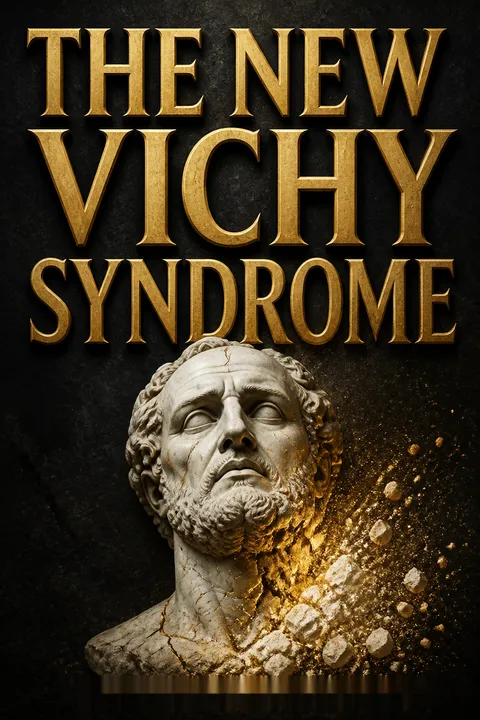
The central diagnosis. Dalrymple uses the “New Vichy Syndrome” as a metaphor for a modern European habit: historical guilt and fear of appearing intolerant can weaken the willingness to defend shared principles. His examples include the response to the Danish cartoons of Muhammad and the threats against novelist Salman Rushdie. In his account, authorities and intellectuals often prefer quiet to openly defending free expression, teaching would-be intimidators that pressure can work.
Guilt is not a verdict. The analogy does not claim that contemporary Europe is occupied France. It describes what Dalrymple sees as a recurring surrender of judgment, born of self-doubt. His larger argument is that a society cannot preserve freedoms it is unwilling to say are worth defending.
The argument usefully separates tolerance from the refusal to draw any boundary: a plural society still needs rules that protect speech, safety, and equal standing. Political theory often treats rights as constraints on majorities and minorities alike, not as prizes granted to whoever feels most offended. The harder question is how to defend those rules without turning firmness into a license for collective suspicion. Dalrymple's examples make the cost of intimidation vivid, but they do not establish that every accommodation is capitulation. Good judgment requires distinguishing coercion from ordinary disagreement.
Treat demographic projections as warnings, not scripts for Europe's collapse.
Numbers are not destiny. In 2004, every Western European fertility rate listed in the book was below the commonly used replacement level of 2.1; Ireland was highest at 1.99, while Italy was 1.33. Dalrymple accepts that low birth rates and longer lives create real pressures, but challenges the leap from those trends to inevitable economic or civilizational collapse.
Adaptation changes outcomes. He points to Singapore and Hong Kong as prosperous places without large, rapidly growing populations, and to Nigeria as a counterexample where a large population has not guaranteed economic success. He also argues that longer lives can include more years of health and productive work. A projection extends current conditions; a prediction must account for change, adaptation, and surprises.
The distinction between projection and prediction is a sound safeguard against demographic fatalism. Forecasts are conditional: their results depend on fertility, migration, productivity, health, and policy continuing in particular ways. But flexibility should not become an excuse to ignore the arithmetic of pensions, care, or shrinking workforces. A small population can support high productivity, yet institutions still have to adjust when the ratio of workers to retirees changes. The strongest use of Dalrymple's argument is therefore not reassurance that decline cannot happen, but a demand to examine mechanisms rather than treating a graph as fate.
Judge integration by lived institutions, not birth-rate arithmetic.
Populations are not blocs. Dalrymple disputes the idea that Muslim immigration must make Europe Muslim by sheer demographic momentum. He cites Dutch data: in 2005, fertility was 1.7 among Netherlands-born women and 2.9 among Moroccan-born women living there, down from 4.9 in 1990. He also notes a French survey in which more than half of Muslim respondents described their primary identity as French.
Practice matters more than labels. The book also recounts coercion faced by some Muslim women, including forced marriage and pressure to wear the niqab. These examples lead Dalrymple to argue that the central issue is whether European institutions protect individual rights, not whether all Muslims share one identity or political aim. The anecdotes are evidence of real cases, not a portrait of every community.
This insight resists a common error in debates about migration: converting a diverse population into a single forecasted actor. Identity research often finds that people hold several affiliations at once, and which one matters can depend on context. The book's attention to women's constrained choices also shifts the question from cultural symbolism to concrete protections. Yet its clinical and anecdotal evidence cannot establish how widespread particular practices are. Careful analysis needs both the moral clarity to oppose coercion and the empirical discipline to avoid treating visible cases as representative of an entire religion.
Pluralism needs standards of evidence, or every claim becomes equally weightless.
Doubt has a limit. Dalrymple argues that strong epistemological relativism, the view that no claim has a more secure basis than another, undermines itself: asserting that truth is inaccessible presents that assertion as true. He responds to readings of philosopher Thomas Kuhn that portray scientific change as mainly a matter of fashion or power. Scientific theories can be revised, he says, without becoming equivalent to guesswork; the discovery that blood circulates remains knowledge despite the possibility of future refinement.
Difference becomes everyday. In diverse cities, people see incompatible customs and moral assumptions side by side. Dalrymple argues that this can make inherited ways feel like arbitrary choices. His concern is not exposure to difference itself, but the conclusion that no judgment can be made among competing claims.
Fallibilism and relativism are not the same thing. Fallibilism says that beliefs can be mistaken and should remain open to correction; relativism, in its strongest form, denies any shared basis for deciding between them. Science works precisely by combining provisional theories with public tests, criticism, and replication. The same distinction can help with cultural debate: humility about one's own customs need not imply indifference to evidence or harm. Dalrymple's defense of standards is persuasive, though standards gain legitimacy when they are applied consistently, including to the powerful and to one's own tradition.
Treat commitment as the price of meaningful freedom, not its enemy.
Options have consequences. Dalrymple criticizes the idea that a good life means keeping every future possibility open. He invokes the old story of a donkey unable to choose between two equal piles of food, which starves rather than begin. Human choices are not always so absurd, but refusing to commit can still produce paralysis and resentment when reality blocks incompatible desires.
Rules can enlarge choice. The book compares social rules to grammar: learning a shared standard may constrain some forms of expression, while making many more forms available. It applies the point to relationships and marriage. A commitment closes some doors, but that does not prove it is oppression; freedom often depends on promises and institutions that make cooperation possible.
The distinction between having options and being able to act on them is central to contemporary debates about choice. Behavioral research on choice overload suggests that more alternatives can increase hesitation, though the effect depends on the stakes and the chooser's needs. Commitments can also protect people from short-term impulses and make long-term cooperation credible. The caution is that commitment should not be romanticized: a promise made under coercion is not liberating, and some exits must remain available. The useful principle is not to choose fewer things automatically, but to recognize that meaningful choices shape what follows.
Give life a purpose larger than consumption or the pursuit of power.
Comfort cannot carry everything. Dalrymple links declining religious belief to a thinner sense of purpose. If life is treated as all that exists, he argues, people may try to fill it with purchases and intense experiences, which soon lose their novelty. In the book's account, political causes can also supply a larger meaning: Marxism once promised a final historical resolution, while environmentalism, nationalism, and other movements can offer a sense of participation in something beyond private life.
Purpose can distort. A cause may give ordinary lives direction, but it can also make its adherents feel entitled to impose their vision on everyone else. Dalrymple's point is not that secular causes are inherently false or harmful. It is that the need for transcendence can turn a worthy concern into a totalizing project.
The connection between purpose and well-being has a useful counterpart in psychology: people often distinguish meaningful goals from short-lived pleasure, even when both matter to a good life. Shared projects can build trust and agency, not merely satisfy a hunger for importance. The danger lies in treating a cause as beyond criticism, since moral certainty can excuse coercion. Dalrymple's account is strongest when it asks what a cause gives its followers and what it asks them to sacrifice. It is less convincing if it treats secular commitment mainly as a substitute for lost religion rather than as a source of genuine ethical insight.
Build European cooperation on shared consent, not fear of inevitable war.
Identity is layered. Dalrymple accepts that national identities can be deliberately formed, pointing to Italy and to newer African states whose citizens have developed shared attachments over time. But he argues that people usually retain several identities, with national loyalty often more emotionally powerful than abstract European belonging.
Institutions have interests. The European Union is often defended as a guarantee of peace, especially between France and Germany. Dalrymple questions whether that peace would otherwise have failed, and suggests that politicians and bureaucrats also benefit from the institution. He warns that monetary union can constrain weaker economies: Greece, for example, could not easily devalue its currency during a crisis. In his view, cooperation is valuable, but it cannot erase national interests by decree.
The argument usefully distinguishes institutional peacekeeping from the emotional solidarity that makes political decisions feel legitimate. Durable cooperation requires both: rules can prevent conflict, while shared identity can make burdens easier to accept. The book is right that a monetary union without common fiscal capacity can create severe tensions, but its account of the European project leans heavily on conjectures about elite motives. Institutions can serve members imperfectly and still prevent costly coordination failures. The key test is whether citizens can understand, influence, and revise the arrangements that govern them.
Read national history whole, without turning catastrophe into the whole story.
The past resists simplification. Dalrymple traces the changing memory of the First World War through plays written in the late 1920s and early 1930s. Works such as Journey's End and For Services Rendered presented war as futile and devastating, helping replace earlier accounts centered on sacrifice and national purpose. He argues that later interpretations should be acknowledged as reinterpretations, not passed off as the only view people ever held.
No country is a single verdict. France's history under occupation includes collaboration, resistance, survival, and revenge after liberation. Dalrymple also lists European colonial crimes and wartime complicity, while rejecting the claim that these exhaust the meaning of European history. His target is “nothing-but-ism”: reducing a complex past to one recurring moral judgment.
Historical memory is never a transparent replay. Later events, new evidence, and moral change alter what societies notice and how they interpret it. Dalrymple's warning against hindsight is valuable because it asks readers to separate what people knew at the time from what became clear afterward. The same method must apply to his own counter-narrative: cultural achievements do not cancel atrocities, and cataloguing crimes does not prove that a civilization has no achievements. A balanced history is not a midpoint between praise and blame. It is an account that explains both, without making either one disappear.
Preserve inheritance while reforming it, or comfort becomes Europe's only ambition.
Destruction can masquerade as progress. Dalrymple sees postwar architecture and urban planning as signs of contempt for inherited culture. He describes proposals to demolish historic parts of Paris, Amsterdam, and Bath in favor of modern schemes; in Bath, protest helped prevent wholesale redevelopment. He argues that replacing old buildings with conspicuously modern ones cannot, by itself, produce social or economic renewal.
Security can narrow the future. In the book's final argument, Europeans increasingly treat material comfort and social protection as life's central goals. Children can appear as costs, and cultural inheritance as an embarrassment rather than a responsibility. Dalrymple warns that a society focused only on protecting what it has may lose both the confidence to preserve what matters and the energy to create what comes next.
The strongest version of this argument is not that old forms are automatically good, but that demolition can erase accumulated knowledge before a replacement proves its worth. Urban planning benefits from treating buildings as social infrastructure, not merely visual objects. At the same time, preservation can become exclusionary if it prevents housing, access, or adaptation. The book's proposed balance, conserving while changing, is more demanding than either nostalgia or novelty. Its final warning also invites a practical question: which inherited practices deserve investment because they help future generations live well, rather than merely resemble the past?
Analysis
The book's governing claim is that Europe's postwar loss of power became an inward crisis of legitimacy. Its people, in Dalrymple's account, inherit prosperity but distrust the history and institutions that produced it. That distrust weakens confidence in public standards, encourages a politics of permanent apology, and leaves consumer comfort as the safest shared ambition. The “Vichy” metaphor names the most political consequence: when intellectuals treat firmness as evidence of historical guilt, they may yield ground to those willing to use intimidation.
The argument is strongest as a connected interpretation, not as a demonstrated causal model. It links secularization, low fertility, relativism, immigration, European integration, and architectural modernism through a common loss of purpose. That synthesis is memorable, but the links are not equally supported. The fertility figures are historical snapshots, the anecdotes about Muslim communities cannot establish population-wide patterns, and claims about the motives of European institutions are explicitly speculative. A reader should therefore distinguish the book's documented examples from its larger diagnosis.
Dalrymple's method also contains a productive tension. He attacks one-sided histories that portray Europe as nothing but crime, yet he sometimes generalizes sharply about Europeans, intellectuals, Muslims, and political elites. This does not erase his central warning, but it makes his demand for historical balance apply to his own rhetoric as well. A serious account of civilization must include both achievement and brutality, and it must ask how institutional habits distribute power, rather than explain every outcome through a society's character.
The lasting value is a question rather than a verdict: can a society criticize its inheritance without treating inheritance itself as shameful? The answer matters beyond Europe. Institutions need confidence to defend rights, but confidence is most credible when paired with self-criticism and equal standards. Cultural continuity is not a demand for sameness; it is the capacity to decide what should be carried forward, what should be repaired, and what should be abandoned.
Review Summary
The New Vichy Syndrome receives mixed reviews, with an average rating of 3.90 out of 5. Readers appreciate Dalrymple's erudition and thought-provoking analysis of Europe's cultural decline, exploring topics such as demographic shifts, loss of national identity, and moral relativism. Some praise his writing style and insights, while others find the book disjointed or lacking coherence. Critics note the author's tendency to make vague historical references and his sometimes pessimistic outlook. Overall, readers find the book informative but occasionally challenging to follow.
People Also Read






Glossary
The New Vichy Syndrome
Self-doubt leading to surrenderDalrymple's metaphor for what he sees as European intellectual and political weakness in the face of threats to shared principles. Historical guilt and fear of seeming intolerant, in this account, can make people retreat from defending free expression and civic norms. The phrase does not mean that contemporary Europe is literally equivalent to occupied France.
historical miserabilism
History reduced to failureA way of interpreting the past that foregrounds wrongdoing and catastrophe while treating achievements as insignificant or irrelevant. Dalrymple argues that this is not simply a neutral reading of evidence: it can reflect present-day grievances and political interests. He sees it as especially damaging when a country's entire history is presented as a prelude to its worst crimes.
nothing-but-ism
Reducing history to one themeDalrymple's label for accounts that make a complex history into nothing but one kind of event, usually crime, folly, or oppression. The label does not deny that the selected events occurred. It challenges the claim that they are the whole story, and asks what has been omitted when a country's past is reduced to a single moral verdict.
demographic transition
Declining birth rates with developmentThe broad pattern, discussed by Dalrymple, in which fertility rates decline as societies change. He notes that Muslim-majority countries and Muslim populations in Europe have also shown falling fertility in the data he cites. He treats continued decline as a plausible trend, not a guaranteed forecast, and argues against assuming that current rates will continue unchanged.
transcendence
Purpose beyond private lifeIn Dalrymple's usage, a source of meaning that connects an individual to something larger or longer-lasting than personal comfort. Religion can provide it, as can scholarship, national identity, or political movements. Such commitments can give life direction, but the book warns that a cause promising ultimate purpose may also become dogmatic or coercive.
About the Author

Download PDF
Download EPUB
.epub digital book format is ideal for reading ebooks on phones, tablets, and e-readers.








