

Key Takeaways
Your workload grows when you mistake helping for taking ownership.
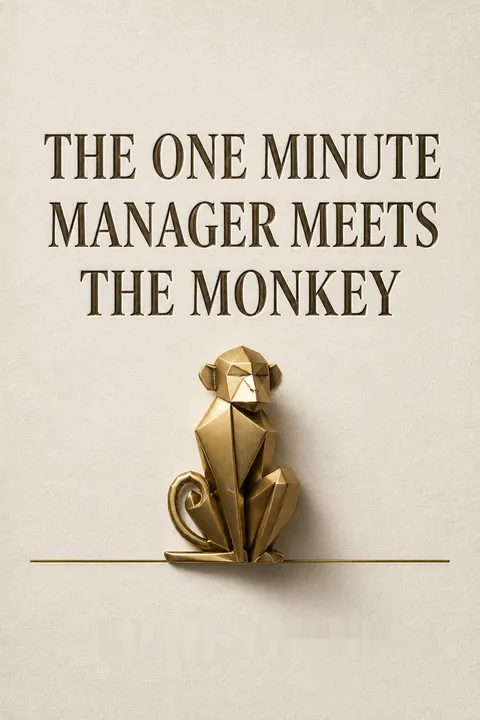
A manager becomes the bottleneck. The book follows a newly promoted manager whose department loses momentum even as he works late, weekends, and family time. His staff bring him problems, and he takes them away to solve. The metaphor for each transferred responsibility is a monkey: not the whole project, but the next action needed to move it forward. When the manager agrees to think about a staff member's issue and report back, that next action has quietly become his job.
Effort hides the real problem. The department's mission and staff have not changed, but its manager has. Working harder treats the symptom, not the cause: he is doing work his team could own. His growing pile of unresolved tasks leaves him less time to manage, while staff wait for decisions they could have made.
What's striking is how the book reframes overload as a problem of responsibility design, not simply poor scheduling. In organizational psychology, role clarity matters because people need to know who is expected to act, decide, and follow through. The monkey metaphor makes that transfer visible in ordinary conversations. Yet not every handoff is a manager's mistake: employees may lack authority, information, or time. Before returning a task, a manager should check whether the organization has equipped its owner to do it.
An unresolved next move can quietly transfer ownership to the boss.
Watch the handoff happen. A staff member stops a manager in the hallway and describes a work problem. The manager listens, gets involved, then says he will consider it and come back with an answer. The discussion began with the employee holding the issue, but the manager leaves carrying the next action. The employee can now check for updates rather than make progress.
Ambiguity has a cost. The book calls the next action the monkey, so a problem is not automatically the manager's responsibility just because the manager knows about it. If the conversation ends without agreement on who does what, the issue can sit between them. The manager may procrastinate, the employee may wait, and other teams may be blocked. A promise to follow up can turn a brief conversation into a recurring obligation.
This is a compact account of how organizations create hidden queues. Queueing theory, which studies how work accumulates when requests arrive faster than they are processed, helps explain why a manager can become a bottleneck even without intending to. Each accepted follow-up adds another item to the queue. The metaphor also exposes a social trap: employees may reasonably seek clarity, while managers may confuse being consulted with being accountable. The practical question is not who raised the issue, but who has the authority and capability to move it forward.
End every problem-solving conversation with a named action, owner, and deadline.
Make the handoff explicit. The book's four-part method for managing monkeys can be expressed simply: identify the next action, name the person responsible, agree on how much approval is needed, and set a time to review progress. These steps matter because vague endings invite delay. A team might discuss a proposal and leave with everyone assuming someone else will prepare it. Naming one person and a due date turns discussion into work.
Do not assign a mystery. The manager should ask what action comes next, rather than accepting a general description of the problem. When there is no sensible next step yet, the owner can take time to investigate and return with options. Some tasks are not worth doing at all; checking why a process exists can prevent the team from becoming more efficient at pointless work.
The method resembles implementation intentions, a planning approach in which people specify what they will do and when. Such specificity reduces the gap between intention and action by turning a broad goal into an observable commitment. The book's distinctive contribution is to add ownership and oversight to that logic. A deadline alone is not enough if no one has authority to act, and ownership without a review can still let work disappear. The process works best when the agreed action is small enough to start and meaningful enough to matter.
Keep each task with the lowest capable owner, not automatically the boss.
Put work near the knowledge. Staff members are often closer to the work, have more relevant information, and collectively have more time than their manager. Keeping a task at the lowest organizational level that can handle it protects the manager's time and lets the person responsible act without waiting. This is not a license to dump work downward: the task must remain with someone able to care for it.
Responsibility builds capacity. The manager in the story initially believes his staff are not ready for more responsibility. His boss points out that preparing them is part of his job. Managers can still step in when an employee is untrained, unavailable, or facing an emergency. But repeatedly taking over because it feels faster teaches the team to bring more work upward and gives them fewer chances to develop judgment.
This principle aligns with the idea of subsidiarity: decisions should be made as close as possible to the people affected, unless a higher level can demonstrably handle them better. It can improve speed and make local knowledge useful. The caveat is crucial, because delegation without resources or decision rights is merely responsibility without power. A manager should test capability, remove barriers, and offer support rather than assume either incompetence or readiness. The aim is not to minimize managerial involvement at all costs, but to place it where it adds value.
Match autonomy to the cost of mistakes, not to habit.
Choose the right guardrails. The book describes two ways to insure a task. In one, the employee proposes a plan and waits for approval before acting. In the other, the employee acts independently and informs the manager afterward. The first protects against costly errors but takes more supervisory time and limits freedom. The second encourages initiative and saves time, but the manager may learn about a bad decision too late to prevent it.
Adjust as conditions change. An employee who has earned broad independence on routine work may need closer review on a high-stakes project. In the story, a manager gives an employee more freedom, then realizes the possible consequences are much larger than expected and asks to see the plan first. As the risk falls and confidence grows, the employee can regain room to act.
This is a useful model of bounded autonomy. Research on psychological safety emphasizes that people learn and speak up more readily when they have room to act without fear of disproportionate punishment. Risk-sensitive approval can preserve that freedom while protecting the organization from preventable damage. However, managerial anxiety can masquerade as risk management. Clear criteria help distinguish genuine exposure from a preference for control. The decision should account for reversibility, potential harm, and the employee's demonstrated skill, not just how comfortable the manager feels.
Review work early enough to catch drift before it becomes crisis.
Set a check-in while assigning. The book treats follow-up as part of ownership: before a task leaves the manager's office, the two people agree when and where they will review it. A check-in is not a demand to supervise every move. It is a chance to spot trouble, offer help, and recognize progress while there is still time to respond.
Do not wait for a rescue. One highly self-reliant employee tries to repair a failing project alone and tells his manager only when it is nearly a crisis. The manager learns to agree on an earlier warning point, so persistent trouble triggers a check-in before the damage grows. Review also catches misunderstandings. One employee's project veers off course and becomes far more expensive than the manager expected, a problem that timely discussion could have surfaced sooner.
Check-ins function like feedback loops in control systems: regular information helps a system correct small deviations before they compound. Their value depends on timing and quality. Too little review allows silent drift; too much turns autonomy into surveillance and encourages people to optimize for pleasing the manager. A useful check-in asks what has changed, what is blocked, and whether the original assumptions still hold. It should make bad news safer to report, not punish the person for bringing it forward.
Coach whole projects until staff can run their own work.
Move beyond task assignment. Assigning means a manager helps decide the next actions and then delegates individual tasks. Delegation, in the book's specialized sense, means an employee takes responsibility for the full project, including its component actions and their follow-up. The manager checks the project's overall health rather than managing every small step.
Build confidence through evidence. A staff member named Gordon brings a thorough plan for a technical problem, including options, costs, resources, and a recommendation. His manager still sees a risk: key executives may resist the plan. Gordon meets with them, then asks for the manager's help when one remains unconvinced. After they resolve that obstacle together, the manager is ready to let Gordon run the project and agree on a later review. Coaching is the bridge between control and trust.
The progression resembles apprenticeship: people gain independence through meaningful responsibility, feedback, and opportunities to demonstrate competence. Gordon's case also shows that technical skill is only part of project leadership. He understands the product, but needs to navigate stakeholders whose support affects whether the work can proceed. The approach avoids two common extremes, micromanaging every decision and abandoning an employee before the risks are understood. Its limit is time: coaching initially requires attention, so managers need to invest it where building capability will matter beyond a single task.
Defend creative time by managing up, sideways, and down deliberately.
Not all demands are alike. The book separates work imposed by a boss, work required by organizational systems, and work a person chooses to do. It calls time for activities such as planning, creating, and improving discretionary time. Work that staff could handle but the manager takes on consumes that same limited resource. The manager's first move is to stop carrying those tasks, then use the time recovered to manage other demands better.
Invest to reduce friction. Keeping a boss informed can prevent embarrassing surprises and the extra reports they provoke. Building relationships with colleagues in support departments can make urgent requests easier to resolve. The book's example of a broken chair shows the other side: ignoring purchasing procedures does not eliminate bureaucracy, and a poorly handled request can get nowhere. Thoughtful communication and process awareness can save time that complaint alone cannot.
The distinction between reactive and discretionary work resembles the difference between exploitation and exploration in organizational theory. Organizations need reliable execution, but they also need time to improve what they do and imagine what they could do next. The book rightly treats that time as vulnerable because urgent requests have visible consequences, while neglected innovation may not. Still, discretion is unevenly distributed: some roles face unavoidable administrative burdens or constant emergencies. Protecting creative time therefore requires both personal boundary-setting and organizational choices about staffing, process, and priorities.
Rescue less, so colleagues and children learn to carry responsibility.
Help can quietly disempower. The book calls rescuing the habit of doing for others what they can do themselves. The manager's family story makes the pattern familiar: his son makes a tennis team, then his parents immediately take responsibility for arranging rides. The practical issue is not whether the parents care, but whether the child can help solve the transportation problem and learn to coordinate with teammates.
Support without taking over. The book contrasts today's heavily parent-managed youth sports with the author's memories of children organizing games, equipment, and teams themselves. Its point is not that children should be left without help. It is that taking every next action away can leave them less practiced at solving problems. At work, the same pattern appears when a manager answers every question or completes every unfinished assignment. Useful help strengthens the other person's ability to act.
The deeper connection is to autonomy-supportive development: people build competence by making choices, attempting difficult tasks, and receiving help that does not erase their role. This applies across workplaces and families, though the appropriate level of support depends on age, safety, and ability. The Little League comparison is vivid, but its nostalgic contrast should not be treated as proof that past arrangements were better for every child. The enduring lesson is narrower and stronger: care is not measured by how many responsibilities one person absorbs on another's behalf.
Analysis
The book's central argument is that managerial overload is often produced by a transfer of responsibility disguised as helpfulness. The metaphor of the monkey makes an abstract organizational failure visible: a conversation begins with one person holding the next action, then ends with the manager carrying it. This is why generic time-management advice can fail. Better calendars and faster paperwork do little when the manager has become the default owner of everyone else's unfinished work.
The story form is well suited to the argument. Readers see the manager's exhaustion, the damage to team morale, and the personal cost at home before receiving a practical operating method. That sequence makes the advice memorable without treating delegation as a slogan. The distinction between assigning a task and entrusting a whole project is especially important. It identifies the developmental work required for autonomy: staff need a chance to demonstrate judgment, a clear boundary around risk, access to resources, and feedback before a manager can responsibly step back.
The method's strongest insight is that ownership, authority, and follow-up must travel together. A person cannot fairly be accountable for a task without enough power to advance it, while independence without agreed review can conceal trouble. The book also recognizes that management time is shaped by relationships with bosses, peers, and administrative systems, not only by direct reports.
Its main limitation is that the metaphor can make workload appear more voluntary than it is. Some managers inherit understaffed teams, compliance burdens, unclear decision rights, or genuine emergencies. Returning a task to its nominal owner does not solve those conditions. Used well, the framework therefore acts as a diagnostic: identify where work stalls, who has the authority and capacity to move it, and what support is missing. The aim is not simply to carry fewer monkeys, but to create a team that can move important work without waiting for one overloaded person.
Review Summary
The One Minute Manager Meets the Monkey receives mostly positive reviews, with readers appreciating its practical advice on delegation and time management. Many find the "monkey" metaphor effective and memorable. The book is praised for its concise, easy-to-read format and applicable lessons for managers and non-managers alike. Some criticize its verbose style and repetitiveness, suggesting it could have been shorter. Overall, reviewers find the book's insights on empowering employees and avoiding unnecessary workload valuable, despite its age.
People Also Read









Glossary
Monkey
Next action on workThe book's metaphor for the next action required to move a problem, opportunity, or project forward. A monkey is not the entire project. It changes owners when a conversation leaves one person responsible for the next step and makes another person responsible instead, often without either noticing the transfer.
Monkey Management
Managing task ownershipA management approach focused on clarifying each task's next action, assigning a capable owner, choosing an appropriate level of approval, and agreeing on follow-up. Its purpose is to prevent managers from becoming bottlenecks by taking on work their staff can handle, while still providing oversight where risk or capability requires it.
Monkey Insurance Policies
Two levels of oversightThe book's name for two ways to balance employee autonomy with managerial protection. One policy requires the employee to recommend a course of action and receive approval before proceeding. The other allows the employee to act independently and inform the manager afterward. The choice depends on the risk of an unacceptable mistake and confidence in the employee's judgment.
Recommend, Then Act
Approval before actionThe more cautious of the book's two monkey insurance policies. The employee develops and presents a recommended action, but waits for the manager's approval before proceeding. It is intended for work where an independent mistake could have serious consequences. This oversight reduces risk, but requires more of the manager's time and limits the employee's freedom to act.
Act, Then Advise
Act independently, then reportThe more autonomous of the book's two monkey insurance policies. The employee handles the task and informs the manager afterward, without seeking advance approval for each move. It is appropriate when the employee is trusted to manage the work and the likely consequences of a mistake are acceptable. It saves supervisory time but offers less opportunity to prevent a bad decision in advance.
Delegation
Ownership of whole projectsIn this book, delegation goes beyond assigning individual tasks. The employee takes responsibility for a full project and manages its component actions, ownership, risks, and follow-up. The manager monitors the overall result rather than directing every step. Coaching helps establish the employee's capability and the manager's confidence before this broader responsibility is transferred.
Discretionary Time
Time for chosen prioritiesTime available for work a person chooses to pursue, particularly planning, creating, organizing, and improving. The book contrasts it with time demanded by a boss, administrative systems, or work taken on from subordinates. It argues that discretionary time is essential for initiative and organizational progress, yet is often the first time lost when urgent demands accumulate.
Subordinate-Imposed Time
Time spent on staff's workThe part of a manager's self-directed time spent handling tasks that employees could own. In the book's framework, this time is technically self-imposed because the manager can choose whether to take on the work, but it crowds out more valuable managerial activities. Reducing it frees time for planning, coaching, and coordinating.
FAQ
What's "The One Minute Manager Meets the Monkey" about?
- Overview: "The One Minute Manager Meets the Monkey" by Kenneth H. Blanchard, William Oncken, Jr., and Hal Burrows is a guide on effective time management and delegation in the workplace.
- Core Concept: The book introduces the "monkey management" concept, which refers to the tasks or problems that managers often take on from their subordinates, leading to inefficiency.
- Purpose: It aims to teach managers how to empower their staff to handle their own responsibilities, thereby freeing up the manager's time for more strategic tasks.
- Format: The book is presented as a narrative, following a manager who learns to manage his time better by applying the principles of monkey management.
Why should I read "The One Minute Manager Meets the Monkey"?
- Practical Advice: The book offers practical strategies for managers to improve their time management and delegation skills.
- Improved Efficiency: By learning to manage "monkeys," managers can reduce their workload and increase their effectiveness.
- Empowerment: It provides insights into empowering employees, which can lead to higher morale and productivity.
- Engaging Story: The narrative style makes complex management concepts easy to understand and apply.
What are the key takeaways of "The One Minute Manager Meets the Monkey"?
- Monkey Definition: A "monkey" is the next move on a task or problem, which should be owned by the appropriate person.
- Delegation: Managers should delegate tasks to the lowest organizational level consistent with their welfare.
- Insurance Policies: Tasks should be insured with either "Recommend, Then Act" or "Act, Then Advise" policies to balance freedom and responsibility.
- Checkups: Regular checkups on tasks ensure they are progressing well and allow for timely intervention if needed.
How does "The One Minute Manager Meets the Monkey" define a "monkey"?
- Next Move: A monkey is defined as the next move on a task or problem.
- Ownership: It emphasizes that the monkey should be owned by the person responsible for the next move.
- Avoiding Role Reversal: Managers should avoid taking on monkeys that belong to their subordinates, which leads to role reversal.
- Empowerment: Proper monkey management empowers employees to take responsibility for their tasks.
What is the "monkey management" concept in "The One Minute Manager Meets the Monkey"?
- Task Delegation: Monkey management involves delegating tasks to the appropriate person to prevent managers from being overwhelmed.
- Avoiding Overload: It helps managers avoid taking on too many tasks that should be handled by their team.
- Efficiency: By managing monkeys effectively, managers can focus on strategic tasks rather than getting bogged down in operational details.
- Empowerment: It encourages empowering employees to take ownership of their responsibilities.
What are Oncken's Rules of Monkey Management?
- Rule 1 - Descriptions: Ensure that the next moves on tasks are clearly described.
- Rule 2 - Owners: Assign ownership of each monkey to the appropriate person.
- Rule 3 - Insurance Policies: Cover tasks with either "Recommend, Then Act" or "Act, Then Advise" policies.
- Rule 4 - Checkups: Schedule regular checkups to monitor the progress and health of tasks.
How does "The One Minute Manager Meets the Monkey" suggest handling delegation?
- Assigning vs. Delegating: Assigning involves a single task, while delegation involves a family of tasks.
- Empowerment: Delegation allows employees to manage entire projects with minimal manager involvement.
- Confidence Building: Managers should build confidence in their staff's abilities before delegating.
- Self-Management: Delegation leads to self-management, where employees take full responsibility for their tasks.
What is the significance of "insurance policies" in monkey management?
- Risk Management: Insurance policies help balance the need for employee freedom with the manager's responsibility for outcomes.
- Two Levels: The book describes two levels of insurance: "Recommend, Then Act" and "Act, Then Advise."
- Freedom vs. Control: These policies determine how much freedom employees have in handling tasks.
- Mistake Management: They ensure that mistakes made by employees are affordable and manageable.
How does "The One Minute Manager Meets the Monkey" address time management?
- Three Types of Time: The book categorizes time into boss-imposed, system-imposed, and self-imposed time.
- Discretionary Time: Emphasizes the importance of maximizing discretionary time for creativity and innovation.
- Eliminating Subordinate-Imposed Time: Suggests starting with reducing subordinate-imposed time to gain more discretionary time.
- Balancing Time: Encourages balancing all three types of time to improve overall efficiency.
What are some of the best quotes from "The One Minute Manager Meets the Monkey" and what do they mean?
- "Things Not Worth Doing Are Not Worth Doing Well": Focus on doing the right things, not just doing things right.
- "The Best Way To Develop Responsibility In People Is To Give Them Responsibility": Empower employees by entrusting them with tasks.
- "If You Always Agree With Your Boss, One Of You Is Not Necessary": Encourages healthy disagreement and discussion for better decision-making.
- "Swift And Obvious Penalties Pursue Those Who Treat Other People's Requirements In A Lighthearted, Cavalier Fashion": Highlights the importance of taking others' needs seriously to avoid negative consequences.
How does "The One Minute Manager Meets the Monkey" suggest improving relationships with bosses and peers?
- Loyal Opposition: Encourage open communication and respectful disagreement with bosses.
- Building Rapport: Invest time in building relationships with peers to facilitate cooperation.
- Anticipating Needs: Understand and anticipate the needs of bosses and peers to improve collaboration.
- Reducing Boss-Imposed Time: By building trust, managers can reduce the amount of time spent on boss-imposed tasks.
What impact does "The One Minute Manager Meets the Monkey" aim to have on managers?
- Increased Efficiency: Aims to help managers become more efficient by managing their time and tasks better.
- Empowered Teams: Encourages managers to empower their teams, leading to higher morale and productivity.
- Strategic Focus: Frees up managers to focus on strategic tasks rather than getting bogged down in operational details.
- Work-Life Balance: Helps managers achieve a better work-life balance by reducing unnecessary workload.
About the Author
Other books by Kenneth H. Blanchard





Download PDF
Download EPUB
.epub digital book format is ideal for reading ebooks on phones, tablets, and e-readers.








