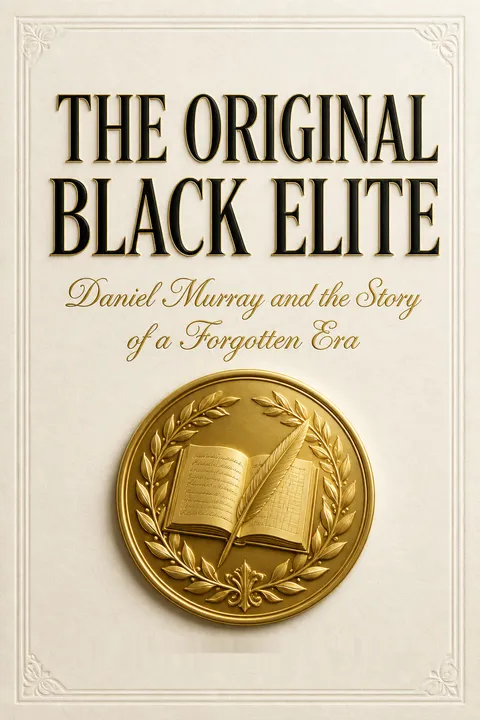


Key Takeaways
Read Black Washington's rise and retreat as one connected history
A brief opening upward. Daniel Murray was born in 1851 to free Black parents in Baltimore. By the 1890s, he had become a respected Library of Congress employee, property owner, civic leader, and member of Washington's small Black elite. His career reflected the opportunities created by emancipation and Reconstruction, when Black Americans gained citizenship, voting rights, education, and access to public office.
Then the reversal arrived. Federal withdrawal from Reconstruction enforcement left Black citizens exposed to disenfranchisement, segregation, and violence. In Washington, opportunities narrowed gradually, then unmistakably. Murray's stalled career and his family's experience show that the period between emancipation and the modern civil rights movement was not steady progress. It was an advance followed by a government-enabled rollback.
The book's central strength is its refusal to treat Reconstruction as a short preface to a later civil rights story. Murray's life makes the rollback visible in the same places where opportunity once appeared: government jobs, public institutions, and civic influence. This is a useful corrective to histories that measure progress only by formal laws or landmark dates. Rights matter, but their practical value depends on enforcement. The account also keeps its focus specific: Murray's experience illuminates a class of Black Washingtonians, not every African American's life.
A first-class seat offered recognition, not protection from Jim Crow
A rare public honor. In October 1899, Murray joined a committee of about forty prominent Washingtonians sent to escort Admiral George Dewey home after his victory at Manila Bay. He was the only Black member. On the specially equipped train, he rode in a first-class parlor car, dined among the committee, and entered the White House with the other escorts.
The limits were close by. Murray had already seen his Library of Congress advancement blocked by what a colleague called caste friction. Soon, when traveling into Virginia, he would be required to move to a Jim Crow car. The contrast captures the book's central tension: an exceptional invitation could recognize one Black man's standing without changing the rules that governed Black travelers as a group.
The scene distinguishes symbolic inclusion from durable access. Murray's invitation was real, meaningful, and earned, yet it did not give him control over the institution or the rules beyond the ceremony. That distinction helps explain why individual success stories can coexist with structural exclusion. The scene also warns against treating elite recognition as evidence that discrimination has faded. A system can make a conspicuous exception while keeping its ordinary barriers intact.
Talent opened doors, but patrons and white gatekeepers controlled their width
A career built through competence. Murray first worked as a waiter in his half-brother Samuel Proctor's Senate restaurant. There he met Librarian of Congress Ainsworth Spofford, who hired him in 1871 and mentored him in library work, research, and languages. Murray later became a full-time assistant, invested in real estate, and won a place on Washington's Board of Trade after helping shape a new property-assessment law.
Achievement did not erase dependence. Spofford's support mattered, as did relationships with white civic leaders such as real-estate developer Brainard Warner. Yet in 1897 Murray was demoted from chief of periodicals, and his salary was cut. The barrier was not lack of ability. It was the authority of white supervisors to decide which responsibilities a Black employee could hold.
Murray's rise shows how skill, mentorship, and assets can widen an individual's options. His experience also exposes the difference between personal mobility and institutional transformation. A patron can open a door, but a person who lacks power over the institution remains vulnerable when leadership changes. That is why Murray's professional success and his demotion belong in the same account. Together, they make the case that fair evaluation requires more than a talented candidate and a sympathetic manager.
Black elite uplift carried both solidarity and class exclusion
A small, selective circle. Washington's Black elite comprised fewer than a hundred families. Education, professional achievement, wealth, family reputation, and connections helped determine who belonged. Lighter complexion often helped as well. Members built social clubs, entertained at home, and cultivated influential white contacts, while many also supported charities, schools, and political campaigns aimed at improving conditions for Black people broadly.
Solidarity had limits. Elite members sometimes looked down on poorer Black people and used respectability as a defense against racist stereotypes. Their effort to distinguish themselves could reproduce class and color hierarchies within the community. They believed that personal example might challenge white prejudice, but also recognized that society often treated all Black people as one group. Their work for racial advancement and their social exclusivity were not opposites. They existed side by side.
This is a more demanding portrait than either celebration or condemnation. The elite had resources to organize and advocate, while their own boundaries could leave less privileged Black people outside the room. Their class position was both a tool for access and a source of distance. The tension matters because uplift depends on who defines improvement and who benefits from it. The book shows that racial solidarity can be politically necessary even when social life remains stratified.
Do not answer racial pseudoscience with a reverse hierarchy
A rebuttal with a flaw. Murray collected Black writing partly to disprove claims of Black intellectual inferiority. Yet he also argued that mixed-race people were biologically more capable than either Black or white people, and suggested that they might form a superior new race. He drew on contemporary ideas about heredity and hybrid vigor, using them to challenge the racist claim that people of mixed ancestry were weak or infertile.
The counterargument repeated the trap. Murray's theory assigned ability to ancestry rather than to opportunity, education, or experience. It also risked diminishing dark-skinned people whose accomplishments his own bibliographic work documented. His effort to claim recognition for mixed-race artists was historically important, but his genetic hierarchy contradicted his broader case for equal human potential.
The contradiction is instructive because it shows how easily opposition to a hierarchy can preserve its underlying logic. Murray challenged white supremacy but sometimes accepted the premise that racial groups could be ranked biologically. His example encourages a sharper question: does an argument dismantle the category that produces exclusion, or merely rearrange the people at its top? The book is strongest when it lets this conflict remain visible rather than smoothing a dedicated activist into a flawless representative.
Build early education as a public system, not a charitable favor
Anna Murray turned conviction into a program. A former teacher, she argued that children's character and learning should be nurtured before school-age problems took hold. In 1896, she helped open Washington's first kindergarten for Black children, with separate sessions for children from poor and more comfortable families. The program supplied more than lessons: children could receive food, clean clothing, and medical attention.
She built the workforce too. Anna organized teacher training, day nurseries, and meetings for mothers. In 1897, eighteen Black women graduated from a kindergarten training program she helped create. After an initial request failed, she lobbied Congress alone for public funding. In 1898, Congress appropriated $12,000 for kindergartens, including $4,000 for Black schools. Her work shifted early education from a fragile private project toward public provision.
Anna's campaign connects educational access with the practical conditions that make learning possible: trained teachers, care for young children, and support for working parents. It also shows how reform becomes durable when it moves beyond personal generosity into public budgets and institutions. The separate allocation for Black schools reflects both progress and the segregated setting in which that progress occurred. Her achievement was not simply founding a classroom. It was persuading public authorities to recognize early childhood education as a civic responsibility.
Coalitions need more than a powerful convention to survive
The National Afro-American Council organized nationally. Formed in 1898 after racial violence, including the murder of Black postmaster Frazier Baker and his young daughter, the Council brought activists, journalists, educators, and politicians together. Murray directed its legal and legislative bureau. Its agenda included anti-lynching legislation, challenges to voting restrictions, opposition to segregated rail travel, and a proposed federal inquiry into Black life and labor.
Public attention was not enough. The Council developed local chapters, a national structure, and plans for legal and legislative action. Yet many efforts stalled, and disagreements over tactics, personal rivalries, weak finances, and the influence of Booker T. Washington strained the organization. It ceased operating in 1908. The NAACP later pursued related strategies, including litigation and national advocacy, building on work the Council had helped establish.
The Council's history separates a movement's importance from its immediate victories. Its proposals often failed, but it helped make national coordination, legal challenges, and legislative pressure part of organized civil rights work. The obstacles are equally useful to study: a celebrated gathering cannot substitute for reliable funding, sustained local participation, and trust across factions. Coalition building is not just agreement on a diagnosis. It requires a structure capable of acting after the speeches and visitors have gone home.
Preserve Black authorship as evidence, even when the encyclopedia stalls
A bibliography became a public argument. For the 1900 Paris Exposition, Murray began with a list of 270 books and pamphlets by Black authors. He sought titles from schools, libraries, and readers across the country. By the time the exhibit was assembled, he had identified about 1,200 works. The display challenged the claim that Black Americans had made no serious contribution to literature and scholarship.
The larger work remained unfinished. Murray envisioned a multivolume encyclopedia and eventually gathered about 7,500 titles, thousands of biographical sketches, and a vast card file. He could not secure enough subscribers or a publisher willing to bear the cost. His papers were later preserved on microfilm, though their uneven organization and sourcing limited their scholarly use. The work was imperfect, but the act of collecting made neglected authors harder to erase.
Murray's project reveals that historical memory depends on infrastructure: lists, collections, catalogues, funding, and people willing to maintain them. A work can fail as a finished book and still change what later readers can find. At the same time, collecting is not the same as verified history. The author notes that Murray's papers needed stronger organization and evidence standards. His legacy therefore offers two lessons at once: preserve overlooked material, and make its sources clear enough for others to test and use.
Segregation produced institutions and cultural power, not a benign alternative
Black Washington built places of its own. As white businesses and institutions restricted access, Black residents developed churches, schools, professional networks, clubs, banks, and commercial districts. By 1920, the U Street area included about 300 Black-owned businesses. The Howard Theater became a major performance venue, while nearby schools and Howard University helped sustain intellectual and artistic life.
The gains were real, the cause was unjust. These institutions offered employment, audiences, safety, and a space for Black culture to thrive. The book calls their growth an ironic outcome of exclusion, not proof that segregation worked. A separate community could provide some services and build pride, but it could not replace equal access to public institutions, fair treatment by government, or freedom from racial violence.
The distinction between community strength and structural justice prevents a common historical mistake: admiring what people built under exclusion and then treating exclusion as beneficial. U Street's businesses and cultural life demonstrate agency, not consent to segregation. They also show that institutions can create belonging and opportunity when mainstream systems deny both. The limit is equally clear. A flourishing local network cannot correct unequal law or guarantee access beyond its boundaries.
Judge progress by children's choices, not their parents' achievements
The Murray children were prepared to succeed. Their sons attended institutions including Cornell, Harvard, and Howard. Nathaniel helped found Alpha Phi Alpha, the first Black college fraternity, while Henry and Nathaniel became teachers and Harold built a business career in Mexico. Their accomplishments extended the family's public service and intellectual life.
Credentials did not remove the barriers. The sons faced restricted career options, discrimination in schools and workplaces, and unequal access to professional opportunities. Harold's move abroad expanded his prospects; other sons remained in Washington's segregated institutions. Daniel Murray died in 1925, still working for racial advancement, after witnessing the Ku Klux Klan march through the capital. Anna continued her activism until her death in 1955. Their lives caution against confusing a family's achievement with society's fairness.
A family's trajectory is a useful test of whether progress has become structural. Murray and Anna could provide education, discipline, networks, and material support, but they could not guarantee their children an open field. This distinction applies beyond biography: social mobility for exceptional individuals does not show that barriers have disappeared for a population. The family's uneven paths also resist a simple ending. Their work produced institutions and records, while the public world around them remained deeply unequal.
Analysis
This biography works as both a family story and a study of institutional power. Its method is microhistorical: a life that might otherwise look exceptional becomes a way to track changes in employment, education, public space, politics, and historical memory. The Dewey train episode compresses the argument. Murray's participation was not imaginary inclusion, but neither was it a transformation of the racial order. Ceremony and exclusion could coexist, sometimes only months apart.
The book's account of the Black elite is valuable because it refuses a single moral verdict. These families used education, property, professional standing, and social networks to build influence and challenge racist claims. They also maintained boundaries shaped by class and complexion. That contradiction is not a distraction from their activism. It helps explain both their leverage and its limits. Respectability could produce access to particular people and occasions, but it could not force public institutions to apply equal rules.
Anna Murray's kindergarten campaign offers a particularly clear account of how activism can become policy. It links an individual's expertise to organizational work, fundraising, legislative persuasion, and public funding. By contrast, Daniel's encyclopedia project shows the vulnerability of preservation when one person bears nearly all the cost and labor. The collection mattered, but its unfinished form and weak sourcing complicated later scholarship. This makes the archive itself part of the story, not merely a container for it.
The biography also has a natural evidentiary asymmetry. Elite families left more letters, newspapers, institutional records, and photographs than many poorer Black residents. Murray's life therefore provides an unusually detailed view of a specific class, not a representative sample of Black Washington. The book acknowledges that distinction and uses it productively. Its broadest lesson is not that one family's perseverance solved a system, but that achievements, institutions, and rights remain vulnerable when enforcement and political power are withdrawn. Progress is a historical result, not an automatic direction.
Review Summary
People Also Read





Glossary
colored aristocracy
Washington's Black upper classA small, socially prominent group of African American families in Washington, especially visible in the late nineteenth and early twentieth centuries. Members were often educated, professionally successful, financially secure, and active in civic and racial uplift work. Access depended on more than wealth: family reputation, connections, education, and often lighter complexion helped determine who was accepted.
National Afro-American Council
National civil-rights organizationA national Black civil-rights organization formed in 1898. It created local chapters, held national meetings, and pressed for action against lynching, disenfranchisement, segregation, and unequal education. Daniel Murray directed its legal and legislative bureau. The Council's work and tactics helped establish approaches later used by the NAACP, although internal conflict and limited resources weakened the organization.
noblesse oblige
Elite duty to assist othersA sense of obligation among privileged people to use their resources and influence for the benefit of those with less. In the book, some Black elites invoked this idea to explain their work for education, charities, and racial advancement. Their efforts could be sincere and consequential, while still reflecting a hierarchy in which elite leaders presumed to define what others needed.
one-drop rule
Ancestry-defined racial classificationA racial convention that classified a person as Black if they had any known African ancestry, regardless of appearance or degree of ancestry. Murray sometimes turned this logic against white assumptions by claiming notable mixed-race figures for Black history. The book also shows that this strategy could reinforce the very racial categories it aimed to challenge.
double consciousness
Conflicted American and Black identityW. E. B. DuBois's term for the tension of understanding oneself both as an American and as a Black person viewed through a racist society. The book uses the idea to describe the strain on Black elites who sought full participation in American life while being repeatedly treated as members of a stigmatized race.
New Negro
Modern Black self-assertionA term associated with early twentieth-century African Americans who sought to challenge inherited stereotypes through art, writing, public speech, and confident demands for citizenship. In the book's contrast, younger New Negro figures differed from Daniel Murray's older generation in style and cultural expression, while sharing the goal of racial dignity and equal rights.
brown paper bag test
Complexion-based social exclusionA phrase used as a metaphor for colorism within Black communities, where lighter skin could bring social advantages and darker skin could lead to exclusion. The book connects the expression to the selectivity of some elite circles. It shows how racial discrimination from outside a community could coexist with complexion-based hierarchy within it.
Jim Crow
Racial segregation and disenfranchisementA system of laws and practices that enforced racial separation and unequal treatment, especially in the South, after Reconstruction. It included restrictions on voting, segregated transportation and public facilities, and the denial of equal protection. The book shows how these practices also spread into Washington, affecting even wealthy and highly educated Black residents.
Download PDF
Download EPUB
.epub digital book format is ideal for reading ebooks on phones, tablets, and e-readers.








