

Key Takeaways
More options can reduce the freedom they were meant to provide
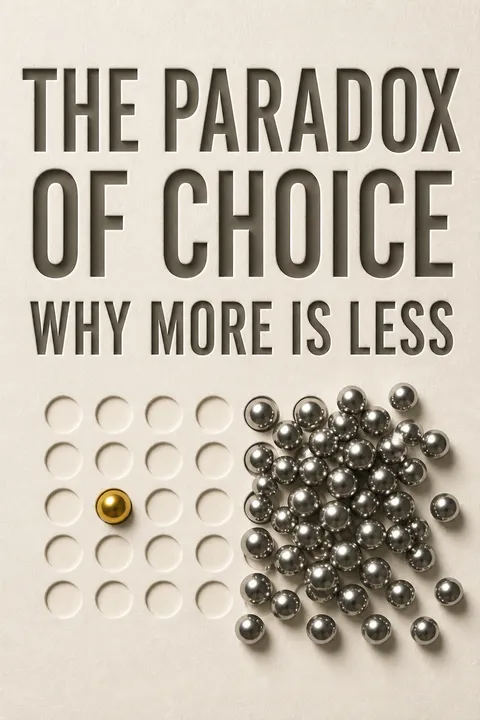
Choice has a tipping point. More options can help people find what suits them, but each option also adds work: comparing, deciding, and wondering about what was passed over. Schwartz opens with a jeans purchase that became a long search through cuts and washes. In a supermarket study, 30 percent of shoppers offered six jam samples bought a jar, compared with only 3 percent offered 24. The larger display attracted more people, but it converted fewer into buyers.
More is not automatically better. A larger menu may increase the chance of finding a favorite, yet make choosing and enjoying it harder. The problem is not choice itself. It is the assumption that each added option brings benefits without costs.
What's striking is that the jam display changed behavior without changing the products available to buy. The burden came from the decision setting, not from a lack of good options. That insight matters to anyone designing menus, websites, or public services: the way choices are grouped and presented can be as important as their number. Still, a small menu is not universally kinder. People with unusual needs can benefit greatly from variety. The useful question is whether extra options help people find a better fit enough to justify the added search.
Count the decisions modern freedom quietly transfers to you
Choice spreads beyond shopping. Schwartz tracks the shift from fixed or default arrangements toward decisions about utilities, health insurance, retirement investments, medical treatment, education, careers, relationships, religion, and identity. These changes can expand autonomy and correct old restrictions. They also make individuals responsible for researching complex options, often in areas where mistakes carry serious consequences.
Responsibility moves with choice. In retirement plans, employees may be offered many funds but lack the expertise to assess them. Some divide contributions evenly across the available options, which can create a risk profile they never intended. In medicine, patients may be asked to weigh treatments when what they most need is expert advice and care. More control is valuable, but handing people a decision is not the same as equipping them to make it.
The distinction between autonomy and administrative burden is essential. A choice can be formally voluntary while being practically difficult, especially when information is technical and the stakes are high. This connects to a basic principle of public-service design: people need usable options, not merely a long list of them. At the same time, simplified defaults can reproduce the assumptions of whoever designed them. A sound system preserves meaningful alternatives, explains them clearly, and provides competent guidance instead of treating individual decision-making as a substitute for institutional responsibility.
Treat forecasts and memories as imperfect guides to what you will prefer
Preference is hard to predict. Schwartz distinguishes expected utility, the anticipated feeling of an option, from experienced utility, how it feels in the moment, and remembered utility, how the experience is recalled. These often diverge. In studies associated with Daniel Kahneman, people’s memories of an experience were strongly shaped by its most intense moment and its ending, not by its total duration. Participants who underwent a longer unpleasant noise, but heard it end less harshly, often preferred repeating it.
Future tastes are slippery. Students choosing snacks for several weeks tended to select more variety than students choosing one snack at a time. They predicted they would tire of a favorite, but their forecasts were unreliable. The lesson is to be cautious when choosing now for a future self whose preferences are difficult to imagine.
This account highlights a quiet weakness in decision-making: people often choose based on a compressed story about experience rather than the experience itself. Memory needs shortcuts, and the peak-end pattern is one such shortcut, but it can distort judgments about duration and cumulative costs. Similar distortions matter in policy, where a memorable success or failure can outweigh less vivid evidence. The implication is not to distrust every preference. It is to distinguish what feels compelling in imagination from what a person has repeatedly found worthwhile in daily life.
Set a clear enough standard before searching for the absolute best
Two search strategies differ. A maximizer seeks the best available option and feels pressure to keep comparing. A satisficer sets standards, searches until an option meets them, and then stops. Satisficing is not settling for poor quality. Someone might require a warm, durable sweater at a fair price, then buy one that meets those criteria without inspecting every store.
The search has a price. Schwartz and colleagues found that people with stronger maximizing tendencies reported less life satisfaction, optimism, and happiness, alongside more regret and depressive symptoms. These findings show a relationship, not proof that maximizing causes unhappiness. The search for the best can sometimes improve objective results, but the time, anxiety, and second-guessing may outweigh the difference between the winning option and one that was already good enough.
A stopping rule turns an open-ended search into a manageable task. In computer science, algorithms often trade exhaustive optimality for a reliable answer reached within limited time; everyday decisions face the same constraint. The value of satisficing is not that standards should be low, but that standards should be explicit and tied to what matters. Its limit is equally important: in safety-critical or irreversible decisions, deeper comparison may be warranted. The practical skill is allocating scrutiny according to consequence, rather than treating every purchase as a championship final.
Limit comparisons before attractive alternatives drain satisfaction from your choice
Every option has an opportunity cost. This is the value of the next-best alternative that must be given up. A job near a partner may mean distance from family; a beach holiday may mean missing the restaurants available elsewhere. Comparing options can improve a decision, but considering every attractive feature of every rejected option can make the chosen one feel diminished.
Trade-offs can stall action. In a study, 66 percent of shoppers said they would buy a discounted CD player when it was the only offer. When a second, appealing model was added, fewer than a third chose either player, and almost half postponed the purchase. The added option created a difficult trade-off. A smaller, relevant shortlist can preserve useful comparison without turning every decision into an inventory of losses.
Opportunity cost is a powerful corrective to tunnel vision: a cheap purchase can still be costly if it displaces something more valuable. But exhaustive comparison has its own opportunity cost, namely the attention consumed by deliberation. Decision science describes this as a bounded problem: people have finite time and working memory, so a theoretically complete comparison is often impossible. The strongest approach is selective comparison. Identify the few dimensions that matter, compare credible alternatives on those dimensions, and stop when further information is unlikely to change the decision.
Do not let fear of future regret turn every decision into a trial
Regret makes options feel consequential. Postdecision regret follows a disappointing choice; anticipated regret is fear of disappointment before choosing. Both can intensify when people feel responsible and can imagine a better outcome they nearly reached. Schwartz describes research in which Olympic silver medalists were often less happy than bronze medalists: silver invites thoughts of narrowly missing gold, while bronze can feel like narrowly avoiding no medal.
An open exit can keep doubt alive. In studies of photographs and art prints, people who could reverse their choice rarely did so, yet reported less satisfaction than people whose decisions were final. A reversible choice may discourage the psychological commitment that helps people appreciate what they chose. This does not mean every decision should be irreversible. It suggests that keeping every alternative available can carry a cost of its own.
Regret is not merely noise. It can teach, signal that a decision affected others, and motivate repair. The difficulty arises when imagined alternatives become more vivid than the life actually being lived. Commitment can help contain that counterfactual churn, but irreversible decisions are dangerous when information is incomplete or circumstances can change. A useful distinction is between decisions that benefit from a cooling-off period and decisions that benefit from closure. The goal is not to abolish regret, but to prevent hypothetical perfection from overruling reasonable commitment.
Expect pleasure to fade before investing heavily in the perfect purchase
Good experiences lose novelty. Hedonic adaptation is the tendency to grow accustomed to changes in circumstances, so an early lift in pleasure fades toward a new normal. Schwartz recalls how a once-welcome improvement, such as cable television or a more capable computer, can become an expectation rather than a delight. People also misjudge how long a positive change will keep making them happy, focusing on the initial excitement instead of the ordinary months that follow.
The search can outlast the reward. A lengthy hunt for a car, house, or sound system may be worthwhile if the benefit lasts. But if pleasure soon becomes mere comfort, the effort invested in finding the perfect version can feel wasted. Anticipating adaptation helps keep expectations realistic and makes a good, durable choice more appealing than an imagined flawless one.
Adaptation is often protective: it helps people recover from hardship as well as absorb good fortune. The same mechanism that dulls novelty can make difficult circumstances more livable. That dual role cautions against treating fading pleasure as evidence that a choice was mistaken. It also suggests measuring a purchase by its sustained usefulness, not just its first impression. An object can stop being exciting and still serve its purpose well. The problem is the expectation that excitement should remain constant, especially when marketing repeatedly promises a fresh emotional beginning.
Judge your life by your values, not by an endless public scoreboard
Comparison changes the yardstick. People assess experiences against what they hoped for, expected, experienced before, and see others receiving. More options can widen the comparison set, while advertising and media expose people to lives far beyond their immediate communities. The result can be rising standards without rising satisfaction.
Some prizes are positional. These are goods whose value depends on having a better position than others, such as scarce places at elite schools or unusually desirable locations. If everyone competes harder for them, the contest can intensify without improving everyone’s relative standing. Schwartz also argues that close relationships and community involvement are strongly associated with happiness, even though they constrain individual freedom. The status race can consume time that might otherwise sustain those ties.
The public scoreboard is not simply a personal weakness. Positional competition is built into access to scarce goods, so telling individuals to stop comparing cannot solve every problem. Still, comparison is most informative when it reveals a concrete opportunity to learn, and least useful when it turns another person’s advantage into a verdict on one’s own life. Close relationships offer a different measure of success: mutual presence rather than rank. Their demands can feel restrictive, but they also create forms of security and meaning that a growing menu of consumer options cannot supply.
Use rules and commitments to save attention for choices that matter
Decide when to deliberate. A second-order decision is a decision about how future decisions will be made. Rules, defaults, standards, and routines can prevent small choices from repeatedly demanding attention. Someone might limit a clothing search to two stores, keep buying a familiar product unless dissatisfied, or decide in advance which retirement options meet basic criteria.
Reserve agency for what counts. Schwartz recommends narrowing the options considered, choosing when choice matters, lowering inflated expectations, and practicing gratitude for what is already good. He also argues that commitments, including relationships, can protect attention from endless comparison. These limits are not surrender. They are chosen boundaries that free time and mental energy for decisions that require judgment, care, or conversation.
Rules work like cognitive infrastructure: they reduce repeated decisions so attention can be spent where judgment matters. This aligns with choice architecture, the design of defaults and pathways that makes useful actions easier without eliminating alternatives. Yet rules deserve periodic review. A default that once helped can become harmful when needs or circumstances change, and commitments should not be used to excuse coercion. The strongest constraints are voluntary, transparent, and revisable at sensible intervals. They make autonomy more usable by protecting it from being consumed by low-value decisions.
Analysis
Schwartz’s central contribution is to separate the value of choice from the value of having every possible option. Choice supports autonomy because it lets people pursue distinct needs and express identity. Yet the book shows how an expanding menu can shift effort, risk, and responsibility onto the individual. Its memorable progression is from the jeans aisle to decisions about health, work, relationships, and identity: the same consumer logic spreads into domains where expertise, social obligations, and unequal power matter.
The psychological account is strongest when it identifies mechanisms that make choice burdensome. Maximizing encourages endless search. Opportunity costs make rejected options psychologically present. Regret grows when responsibility and imaginable alternatives converge. Adaptation weakens the pleasure that people expected to justify their effort, while social comparison continually resets the standard. Together, these mechanisms explain why objectively improved options need not improve subjective satisfaction.
The argument also needs careful boundaries. The jam and chocolate studies demonstrate that choice can discourage action in particular settings, not that every large assortment is harmful. The book’s claims about rising depression and modern choice are more suggestive than causal: depression has multiple causes, and historical comparisons cannot isolate choice from changing diagnosis, economics, family life, or social conditions. Nor should reduced choice be romanticized. Defaults and institutional constraints can protect people from overload, but they can also preserve unfair arrangements or hide who made the decision.
The practical lesson is therefore not to shrink autonomy indiscriminately. It is to match decision complexity to the stakes and to the chooser’s capacity. Offer real alternatives where personal fit matters, but provide guidance, usable defaults, and clear stopping rules where complexity is punishing. Individuals can set standards and commit; institutions can avoid offloading every difficult judgment. This view treats satisfaction not as a private mood alone, but as an outcome shaped by the architecture of choices and the social conditions in which people make them.
Review Summary
Readers find The Paradox of Choice thought-provoking, with many praising its insights on how excessive options can lead to unhappiness. The book's core idea resonates, explaining why more choices often result in decreased satisfaction. Some reviewers appreciate the practical advice for decision-making, while others find the content repetitive. Many readers report that the book has changed their perspective on choice and consumerism. Critics argue that the main points could have been conveyed more concisely. Overall, most reviewers recommend the book for its valuable insights into modern decision-making challenges.
People Also Read







Glossary
Maximizer
Seeks the best optionA person who aims to select the best available option and feels driven to compare alternatives before deciding. Because exhaustive search is rarely possible, a maximizer may remain uncertain after choosing, worry about options left unexplored, and experience more regret. The term describes a tendency that can vary across areas of life, rather than a fixed type that applies to every decision.
Satisficer
Stops at good enoughA person who sets standards for an acceptable choice and stops searching once an option meets them. Satisficing does not mean accepting poor quality. It means judging an option against defined needs rather than against every alternative that might exist. The approach can reduce search time and second-guessing, though it may not always produce the objectively highest-ranked outcome.
Expected utility
Predicted feeling from a choiceThe anticipated pleasure or discomfort associated with an option before it is experienced. People use these forecasts to choose restaurants, jobs, products, and other experiences. Schwartz emphasizes that expectations often diverge from what people actually feel, partly because people misjudge adaptation and do not accurately imagine ordinary life after the initial novelty fades.
Experienced utility
Feeling during an experienceThe pleasure or displeasure a person feels while an event is happening. It differs from expected utility, which is forecast before the event, and remembered utility, which is the later recollection of it. Because people often choose from predictions and learn from memories, a mismatch among these forms of utility can lead them to repeat experiences that were less satisfying than remembered or avoid ones that were better than expected.
Remembered utility
Recalled quality of experienceA person’s retrospective summary of how an experience felt. Schwartz draws on research showing that memory may give particular weight to an experience’s most intense point and its ending, while paying less attention to its duration or the balance of feelings across the whole event. This remembered summary can guide future choices even when it does not accurately represent the experience moment by moment.
Peak-end rule
Memory favors peak and endingA pattern in which people’s retrospective evaluations of an experience are influenced disproportionately by its most intense moment and how it ends. In research discussed by Schwartz, participants sometimes preferred a longer unpleasant experience when its final portion was less aversive. The remembered version of an event can therefore differ from its total experienced discomfort or pleasure.
Opportunity cost
Value of the next-best alternativeThe benefit a person gives up by choosing one option instead of another. Choosing a job in one city may mean surrendering proximity to family or a partner. Opportunity costs help people evaluate choices in context, but continually attending to the appealing features of rejected options can reduce satisfaction with the option selected.
Second-order decisions
Rules for future decisionsDecisions about when and how to make other decisions. Examples include following a rule, relying on a default, or setting a standard that narrows which options need attention. These advance decisions can spare people from reconsidering the same issue repeatedly and preserve attention for choices that deserve more careful thought.
Hedonic adaptation
Adjustment to changed circumstancesThe tendency for emotional responses to shift as people become accustomed to positive or negative changes. A new possession or improvement may initially produce strong pleasure, then become ordinary as expectations and reference points change. Adaptation can reduce lasting enjoyment of gains, but it can also help people adjust to difficult circumstances.
Positional goods
Goods valued by relative rankGoods whose availability or value depends partly on a person’s position relative to others. Examples include scarce places at highly selective colleges, desirable locations, and especially prestigious jobs. Their supply may be limited, or their appeal may diminish as access expands. Competition for positional goods can intensify without improving everyone’s relative standing.
Availability heuristic
Judging by ease of recallA mental shortcut in which people estimate how frequent or likely something is by how easily examples come to mind. Vivid events and memorable anecdotes can feel more common than they are, even when broader evidence points elsewhere. Schwartz uses this idea to show how stories, advertising, and media attention can distort judgments about products, risks, and other people.
FAQ
What's The Paradox of Choice about?
- Choice Overload: Barry Schwartz explores how an abundance of choices can lead to anxiety, dissatisfaction, and even depression, despite the common belief that more choice is better.
- Impact on Happiness: The book examines the relationship between choice and happiness, suggesting that more options do not necessarily lead to greater satisfaction.
- Cultural Context: Schwartz places the discussion within the broader context of American culture, emphasizing societal values around freedom and self-determination.
Why should I read The Paradox of Choice?
- Understanding Modern Dilemmas: The book provides insights into the psychological effects of living in a consumer-driven society with abundant choices.
- Practical Advice: Schwartz offers strategies for managing choice overload, such as setting limits and focusing on "good enough" options.
- Cultural Critique: It critiques the cultural obsession with choice and freedom, encouraging reflection on personal values and societal pressures.
What are the key takeaways of The Paradox of Choice?
- Choice Overload: Too many options can lead to paralysis and dissatisfaction, with a tipping point where choice becomes overwhelming.
- Maximizers vs. Satisficers: Schwartz distinguishes between those who seek the best possible option and those who settle for good enough, noting that satisficers tend to be happier.
- Opportunity Costs: The more options we consider, the more we feel the weight of what we are giving up, which can diminish satisfaction.
What are the best quotes from The Paradox of Choice and what do they mean?
- "When people have no choice, life is almost unbearable.": Highlights the essential role of choice in autonomy and well-being.
- "The fact that some choice is good doesn’t necessarily mean that more choice is better.": Encapsulates the central thesis that an abundance of options can lead to negative outcomes.
- "We would be better off if we embraced certain voluntary constraints on our freedom of choice.": Suggests that imposing limits can lead to greater satisfaction.
How does Barry Schwartz define "maximizers" and "satisficers" in The Paradox of Choice?
- Maximizers: Individuals who strive to make the best possible choice, often experiencing anxiety and regret due to extensive option exploration.
- Satisficers: Those who look for options that meet their criteria and are "good enough," making decisions more quickly and with greater satisfaction.
- Impact on Happiness: Satisficers are typically happier than maximizers, avoiding the stress and regret associated with seeking the absolute best.
How does choice overload affect our mental health according to The Paradox of Choice?
- Increased Anxiety and Stress: Too many options can lead to feelings of anxiety and stress, creating a cycle of indecision and dissatisfaction.
- Regret and Dissatisfaction: Choice overload can lead to regret over missed opportunities, diminishing satisfaction with the chosen option.
- Paralysis by Analysis: An abundance of choices can result in avoiding decisions altogether, leading to missed opportunities and frustration.
What is the "tyranny of choice" as described by Barry Schwartz?
- Choice as Burden: While choice is often viewed as freedom, it can become a burden when options are overwhelming, leading to negative emotional outcomes.
- Impact on Satisfaction: More choices can lead to less satisfaction with decisions, highlighting the complexity of modern consumer culture.
- Need for Limits: Imposing limits on choices can lead to greater satisfaction and well-being by allowing focus on what truly matters.
What role does opportunity cost play in decision-making according to The Paradox of Choice?
- Definition of Opportunity Cost: The value of what is given up when choosing one option over another, crucial for understanding trade-offs.
- Psychological Impact: As options increase, perceived opportunity costs rise, leading to greater dissatisfaction with the chosen option.
- Decision-Making Strategy: Awareness of opportunity costs can help make more informed decisions, reducing feelings of regret.
How does regret play a role in decision-making in The Paradox of Choice?
- Postdecision Regret: Individuals often experience regret after making a decision, particularly if they believe a better choice was possible.
- Anticipated Regret: Fear of future regret can lead to indecision and missed opportunities.
- Strategies to Mitigate Regret: Adopting a satisficing mindset and focusing on gratitude can reduce regret's impact on decision-making.
What is the role of social comparison in our choices according to Barry Schwartz?
- Influence on Satisfaction: Social comparison can significantly impact how we evaluate our choices, leading to feelings of inadequacy and dissatisfaction.
- Upward vs. Downward Comparisons: Upward comparisons can lead to negative emotions, while downward comparisons can boost self-esteem.
- Strategies to Reduce Comparison: Focusing on personal values and goals rather than comparing to others can mitigate negative effects on satisfaction.
What are some practical strategies from The Paradox of Choice?
- Choose When to Choose: Identify which decisions are truly important and focus energy there to reduce the burden of choice.
- Practice Gratitude: Cultivating gratitude can help appreciate choices and reduce regret.
- Limit Options: Restricting the number of options considered can lead to quicker decisions and greater satisfaction.
How does The Paradox of Choice relate to the concept of learned helplessness?
- Learned Helplessness: Too many choices can lead to feelings of helplessness when individuals feel overwhelmed by options.
- Impact on Well-Being: Lack of control over choices can lead to depression and anxiety, emphasizing the importance of autonomy.
- Cultural Implications: Schwartz critiques modern society for promoting an abundance of choices without recognizing the psychological burden.
About the Author
Other books by Barry Schwartz

Download PDF
Download EPUB
.epub digital book format is ideal for reading ebooks on phones, tablets, and e-readers.








