

Key Takeaways
Treat irrationality as a design constraint, not a defect to wish away
Start with real behavior. The book’s central argument is that people are not flawless calculators. We favor immediate rewards over distant benefits, misjudge our own reactions, and bring old instincts into environments that have changed faster than human nature. Behavioral economics studies how people actually decide, then asks how to make choices and institutions work better for them. Ariely learned this firsthand during hepatitis C treatment: the injections made him sick, so he paired them with movies he looked forward to watching. The treatment became easier to continue because the immediate experience held a reward as well as pain.
Build around limitations. Seat belts and safer roads assume that drivers make mistakes. Ariely argues that financial systems, workplaces, and health services deserve similar safeguards. Understanding irrationality is not a promise of perfect self-control. It is a way to stop blaming people for predictable failures and redesign conditions to make better choices easier.
What's useful here is the shift from moral judgment to system design. A person who misses medication or struggles to save is not necessarily careless; the task may pit an unpleasant present against a distant benefit. This resembles engineering approaches that plan for human error rather than demanding flawless operators. Still, design cannot substitute for agency in every case. A supportive environment improves the odds, but people also need room to choose, question, and revise the systems built around them.
Keep cognitive bonuses moderate; pressure can make skilled people perform worse
More reward can backfire. In an experiment in rural India, participants performed memory, puzzle, and coordination games for bonuses ranging from about one day’s pay to the equivalent of five months’ pay. Those offered the largest bonus did worse, reaching the target performance level less than a third as often as people offered smaller rewards. A separate test found that large bonuses helped with repetitive key-clicking, but hurt performance on simple math problems. The distinction matters: pressure can focus effort on a mechanical task while crowding attention on work that requires thought.
Stress changes the task. The researchers describe an inverse-U relationship: motivation helps up to a point, then excessive pressure undermines performance. Public anagram solving showed a similar effect, with participants solving about twice as many in private as in front of peers. The practical lesson is not to eliminate incentives, but to test their size and structure instead of assuming bigger means better.
The findings challenge a common management shortcut: paying for results is not the same as improving the conditions for producing them. When a task depends on judgment or creativity, a huge reward can make the reward itself a distraction. This fits a broader distinction between effort and cognitive bandwidth. However, the India games and student tasks do not reproduce executive work in full. They make a compelling case for measurement, not a universal rule that high pay always harms performance.
Make work visible, acknowledged, and finishable before spending more on incentives
Meaning changes persistence. In Ariely’s Lego experiment, students built small robots for declining payments. One group saw its completed work kept intact; in another, the experimenter dismantled each robot as soon as it was finished. The first group built an average of 10.6 robots, compared with 7.2 in the dismantling condition. In a second study, participants searched pages for repeated letter pairs. Those whose work was acknowledged completed about nine pages on average. People whose pages were ignored or shredded completed roughly six to seven.
Small meaning counts. Meaning here need not be a grand mission. It can come from seeing a task completed, knowing someone noticed the effort, or understanding how a small contribution fits a larger project. Ariely connects this to contrafreeloading, the tendency observed in many animals to work for food even when identical food is freely available. The implication for managers is concrete: show people what their work accomplishes, and avoid treating their output as disposable.
These experiments reveal a cost that standard efficiency measures can miss. Dividing work into specialized steps may increase output per task while hiding purpose and completion from the people doing it. In knowledge work, where persistence and problem-solving matter, that loss can be consequential. Recognition should not become empty praise or a substitute for fair pay. Its value depends on being credible and connected to real contribution, not merely delivered as a management ritual.
Effort makes creations precious, but unfinished effort can sour attachment
Labor alters the maker. Ariely, Mike Norton, and Daniel Mochon tested what they called the IKEA effect: people tend to value things more when they have helped make them. In an origami auction, participants who folded their own paper animals bid an average of 23 cents for them, while observers offered about 5 cents. The creators valued their lumpy results almost as much as expert-made origami. A similar pattern appeared when people assembled Lego models, even though the instructions left no room for customization.
Completion matters. People who struggled with difficult origami instructions and successfully finished their figures valued them especially highly. Those who struggled but failed to complete the task valued their results least. Effort alone does not guarantee pride; effort that produces a finished object is more likely to do so. The lesson is to take part in making things that matter, while keeping projects achievable enough to reach a satisfying endpoint.
The effect helps explain why participation can increase attachment, whether someone assembles furniture or helps shape a product. But it also warns against confusing subjective value with objective quality. A creator’s affection can be genuine and still exceed what others see, which matters in design, entrepreneurship, and family life. Inviting effort is therefore not automatically good. Too much friction drives people away, and an impossible project can turn investment into frustration rather than pride.
Invite people into ideas, then guard against ownership blinding them to better ones
Ideas acquire owners. Ariely and colleagues found that people rated their own proposed solutions as more practical and valuable than solutions supplied by researchers. In a follow-up, participants assembled the researchers’ exact ideas from word lists, giving them a sense of authorship without changing the ideas themselves. They still preferred the ideas they had constructed. Even rearranging a jumbled sentence to make it readable increased participants’ sense of ownership.
Ownership cuts both ways. Feeling that an idea is yours can increase commitment, which helps teams carry work forward. It can also make outside ideas easier to dismiss. The book illustrates this with Thomas Edison’s resistance to Tesla’s alternating-current system, which eventually proved more useful for large-scale electricity distribution. The Not-Invented-Here bias is the tendency to undervalue an idea because it came from somewhere else. Teams can use participation to build commitment, while deliberately comparing proposals on evidence rather than origin.
Ownership is a motivational tool and a source of epistemic risk. Participatory design can make people more invested, but investment can harden into defensiveness when criticism feels like an attack on the self. A useful distinction is between inviting people to shape a proposal and letting authorship determine whether it is true or effective. The book’s examples support that distinction, though Edison’s story also involved commercial rivalry and technological risk, not merely attachment to his own invention.
Repair disrespect quickly; an apology can interrupt costly revenge
Small insults matter. In a coffee-shop experiment, a researcher briefly interrupted participants with a phone call while explaining a paid task. When he later accidentally overpaid them, only 14 percent of the interrupted participants returned the extra money, compared with 45 percent of those who had not been interrupted. The experiment suggests that even a minor discourtesy can make people more willing to break a norm in response.
Acknowledgment can reset the exchange. In a second version, the researcher apologized for taking the call. Participants returned money at rates similar to those in the no-interruption group. Waiting fifteen minutes before offering a chance for retaliation also reduced the effect somewhat. Ariely links revenge to violated trust: people may spend their own resources to punish betrayal, even when doing so is costly. For a business, a sincere apology and a practical remedy can protect relationships better than a defensive script. Repeated apologies without changed behavior, however, risk losing their force.
The important variable is not only the original failure but whether the injured person feels seen. That makes apologies a form of social repair, not just politeness. In service work, the person who caused the frustration may not control the policy, yet the customer may retaliate against the company or another employee. A prompt apology can lower the temperature, but it cannot make an unfair system fair. Repair requires both recognition and an effort to address the source of the grievance.
Space pleasures and expect adaptation instead of buying another happiness spike
Novelty fades. Hedonic adaptation is the tendency for emotional reactions to many changes to weaken as people get used to them. Lottery winners and people with severe injuries in a study were less far apart in life satisfaction a year after their life-changing events than many people would expect. Ariely also describes how a new car or home can lose its initial thrill as it becomes ordinary. That fading excitement can fuel a hedonic treadmill: buying the next novelty to recover a pleasure that previous purchases no longer provide.
Use timing deliberately. Research on interrupted experiences found that short breaks made a massage more enjoyable, while a break during an annoying sound made the annoyance return. The implication is to space pleasurable purchases and experiences so each retains some novelty, and to finish unpleasant tasks rather than interrupting them unnecessarily. Adaptation is not universal, and it does not erase serious loss or ongoing hardship. It does mean that immediate forecasts of lifelong happiness or misery deserve skepticism.
The practical insight is about the time profile of satisfaction, not simply spending less. A sequence of smaller pleasures may renew attention, while constant access can make an enjoyable thing feel like background. This also aligns with the value of experiences that end and leave memories, rather than possessions encountered every day. The advice has limits: planned breaks may be necessary for fatigue, disability, or safety, and the experimental findings on sound and massage should not be treated as a rule for every chore or pleasure.
Judge compatibility through shared experience, not profile checklists
People are not searchable products. Ariely’s studies of online dating found that participants spent about 5.2 hours a week browsing profiles and 6.7 hours messaging, but only 1.8 hours meeting possible partners face to face. Daters also cared roughly three times more about experiential qualities, such as humor or a shared passion, than about attributes easily sorted by a computer. The book calls people experience goods: their qualities become clear through interaction, not a list of specifications.
Try things together. In a virtual dating experiment, participants explored images and objects while chatting, giving them something external to react to. Afterward, they were about twice as likely to want an in-person date with that person as they were after conventional profile-based interaction. Separate speed-dating research found that less physically attractive participants tended to place greater weight on traits such as kindness and humor. Compatibility emerges through shared moments, so arrange interactions that reveal how two people respond to the same world.
A profile can help people find one another, but it cannot reliably represent chemistry, humor, or how someone behaves in context. Shared activity creates evidence that a checklist cannot: each person sees the other respond, improvise, and pay attention. That principle applies beyond romance to hiring and collaboration, where simulations or joint tasks can reveal fit. Still, the virtual-date results came from a particular study environment. They suggest a promising design principle, not proof that every activity-based matchmaking system will work.
Turn mass suffering into one vivid person, then use rules to act
Faces move people. In a donation experiment, participants gave an average of 48 percent of their experimental earnings to help a named child, Rokia, compared with 23 percent when given statistics about hunger across several African countries. The identifiable victim effect describes this stronger response to a specific person than to a large, anonymous group. Closeness and vivid detail can make suffering feel immediate; vast numbers can instead feel abstract and impossible to address.
Emotion is not a budget system. When participants were prompted to calculate, they gave similarly little to both the individual and statistical causes. Adding statistics about the larger crisis to Rokia’s story also reduced donations compared with her story alone. To counter this bias, Ariely suggests rules that guide action even when emotion is weak, alongside vivid stories that make need legible. Individual stories can open attention, but resource decisions still need evidence about where help can do the most good.
The findings expose a tension between compassionate attention and effective allocation. A single face can mobilize help, yet emotional vividness is not a reliable measure of relative need. Pairing a personal story with a clear, precommitted giving rule can preserve motivation while reducing the chance that a photogenic case absorbs all available resources. That approach respects how people actually respond without treating their first impulse as a complete moral calculus.
Test consequential intuitions before they harden into policy or personal commitments
A mood can become a rule. In an ultimatum-game experiment, participants angered by a film clip rejected unfair offers more often than participants shown a comic clip. The difference persisted after the emotions had faded and even influenced how participants later divided money as senders. Ariely calls this an emotional cascade: an emotion-driven choice can become a guide for later decisions, even when the original feeling is gone. Repeating a past choice because it seems to reveal one’s character is self-herding.
Important choices invite bias. Ariely describes refusing doctors’ advice to amputate his badly injured arm. Attachment, fear of irreversible change, preference for the status quo, and later sunk costs all complicated the decision. His final argument is to test beliefs rather than trust intuition. Gideon’s biblical fleece test offers a simple model: compare a prediction with a control condition. In medicine, business, and policy, small controlled trials can catch confident mistakes before they become expensive commitments.
This is the book’s strongest practical synthesis: introspection alone cannot reliably expose the forces shaping a decision. A person may know the names of biases and still feel them, as the arm story makes plain. Experiments create a useful check by comparing what happens under different conditions. Their results still require judgment: a controlled test may not capture every consequence of a complex choice. Evidence is a corrective to intuition, not a machine that removes the need for ethical and contextual reasoning.
Analysis
The book’s unifying move is to treat irrationality as neither a defect to eliminate nor a quirk to celebrate indiscriminately. It is a set of recurring tendencies that can damage judgment in one setting and create motivation, attachment, or cooperation in another. A large bonus can impair thought, while modest effort can make a task meaningful. Attachment can turn labor into pride, yet the same ownership can make a person reject a superior idea. The value of a bias depends on the environment in which it operates.
That insight gives the book a practical theory of design. Instead of asking people to become perfectly rational, employers, businesses, and governments can shape choices around actual human attention, emotion, and limits. The argument is especially persuasive where Ariely connects an experiment to a familiar institutional failure: meaningless work, brittle customer service, or dating systems that search attributes while ignoring interaction. The personal stories also matter. The damaged arm and the treatment routine show that the researcher is subject to the same forces he studies, keeping the subject from becoming a catalog of other people’s mistakes.
The main caution is one of scale. Laboratory tasks isolate mechanisms, but they cannot settle every question about executive pay, romantic compatibility, or public spending. The book is most powerful when experiments are treated as diagnostic evidence that a confident intuition may be wrong, not as ready-made policy prescriptions. Its final standard is therefore appropriately modest and demanding: test consequential assumptions, preserve the irrational tendencies that help people flourish, and build safeguards around those that predictably mislead them.
Review Summary
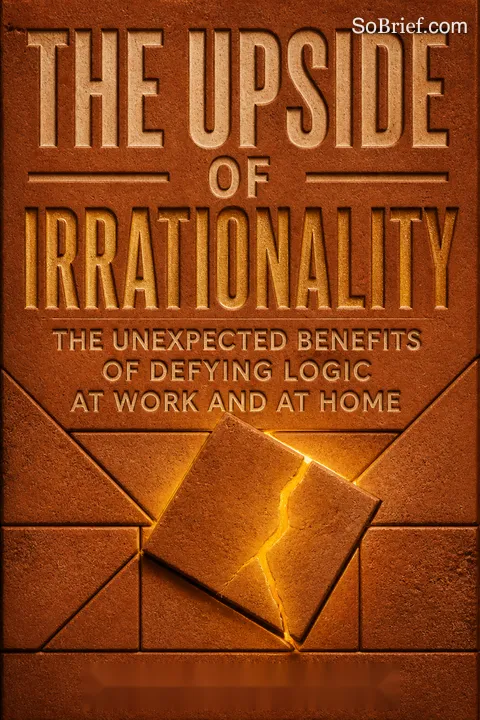
The Upside of Irrationality explores how human irrationality can be beneficial, covering topics like motivation, work meaning, and decision-making. Reviewers praised Ariely's engaging writing style, personal anecdotes, and clever experiments. Many found the book insightful and applicable to daily life, though some felt it repeated content from his previous work. While not as groundbreaking as Predictably Irrational, readers generally enjoyed the book's exploration of behavioral economics and its practical implications for understanding human behavior.
People Also Read








Glossary
Behavioral economics
Studies real-world decision patternsAn approach to economics that examines how people actually make choices rather than assuming they always calculate perfectly and act in their own long-term interest. In this book, experiments reveal predictable departures from rational models and help identify ways to design workplaces, markets, and policies that account for human limitations.
inverse-U relationship
Motivation peaks, then harms performanceA pattern in which increasing motivation or incentive first improves performance, but beyond a threshold further increases reduce it. Ariely connects the pattern to Yerkes and Dodson’s work and to experiments in which very large bonuses impaired tasks requiring thought, memory, or concentration.
contrafreeloading
Working for freely available rewardsA term for the observed preference of many animals to work for food even when the same food is freely available. The book uses the finding to question the assumption that organisms always minimize effort. It also suggests that activity, engagement, or a sense of accomplishment can matter alongside the reward itself.
IKEA effect
Effort increases attachment to creationsThe tendency to value an object more after investing labor in making or assembling it. Experiments involving origami and Lego models found that creators valued their own work more than observers did. The effect was strongest when effort led to a completed creation, and could appear even without personal customization.
Not-Invented-Here bias
Favoring ideas that feel self-createdThe tendency to rate an idea more highly because it seems to come from oneself or one’s own organization. Experiments found that people preferred solutions they had generated, even when their version was effectively identical to an externally supplied idea. The bias can support commitment but can also cause teams to reject better outside ideas.
hedonic adaptation
Emotional response fades with familiarityThe process by which people become accustomed to many changes in circumstances, so the initial emotional impact weakens over time. It can occur after positive or negative events, though not uniformly or completely. Ariely applies the idea to purchases, relationships, injuries, and the way interruptions can alter enjoyment or irritation.
identifiable victim effect
A named person attracts more helpThe tendency to respond more generously to a specific, identifiable person in need than to statistical descriptions of a larger group. In the experiment described in the book, participants donated more to help a named child than to address widespread hunger. The effect helps explain why vivid personal stories move donors.
experience goods
Qualities emerge through direct experienceProducts or services whose important qualities are difficult to evaluate from descriptions alone and become clearer through use or interaction. The book applies the term to dating: profiles can list measurable traits, but compatibility depends on qualities such as humor, manner, and shared experience that emerge when people interact.
emotional cascade
A feeling shapes choices beyond its momentA process in which a decision made under a temporary emotion becomes a template for later behavior, even after the original emotion has faded. Ariely’s experiments found that anger or amusement affected responses to unfair offers and influenced later choices in a different role in the same game.
self-herding
Using past actions to guide new onesThe tendency to treat one’s own previous behavior as evidence about what to do or what kind of person one is. A person may repeat a choice made under a temporary emotion because the action seems to reveal a stable preference. In Ariely’s account, this can extend a momentary decision into a wider pattern.
FAQ
What's The Upside of Irrationality about?
- Explores human behavior: The book examines the unexpected benefits of irrational behaviors in both work and home settings, challenging the notion that humans are always rational decision-makers.
- Behavioral economics focus: Dan Ariely uses experiments to show how our irrational tendencies can sometimes lead to better outcomes, emphasizing the importance of understanding these behaviors.
- Two main parts: The book is divided into sections focusing on workplace behaviors and personal relationships, each offering insights into how we defy logic.
Why should I read The Upside of Irrationality?
- Practical insights: Gain valuable insights into decision-making processes and learn how to leverage irrationality for better outcomes in everyday life.
- Engaging storytelling: Ariely's use of personal anecdotes and experiments makes complex concepts accessible and entertaining, keeping readers engaged.
- Improves self-awareness: Understanding biases that influence decisions can lead to more mindful choices, enhancing personal and professional relationships.
What are the key takeaways of The Upside of Irrationality?
- IKEA Effect: People overvalue things they create, illustrating how effort and ownership influence perceptions of value.
- Not-Invented-Here Bias: Preference for one's own ideas can hinder collaboration and innovation in workplaces.
- Power of Apologies: A simple apology can significantly reduce anger and foster better relationships.
What are the best quotes from The Upside of Irrationality and what do they mean?
- Procrastination: “All of us have important tasks that we would rather avoid.” This highlights the universal tendency to procrastinate and the need for strategies to overcome it.
- Evolutionary instincts: “The mechanisms we developed during our early evolutionary years might have made perfect sense in our distant past.” This reflects on how instincts can lead to poor decision-making today.
- Effort and value: “The effort that we put into something does not just change the object. It changes us and the way we evaluate that object.” This underscores the emotional connection formed with our creations.
What is the IKEA Effect as described in The Upside of Irrationality?
- Overvaluation of self-made items: The IKEA Effect refers to valuing items more when we have assembled or created them ourselves, due to the effort invested.
- Experiments illustrate the effect: Participants valued their own origami creations higher than identical ones made by others, showing how ownership influences value perception.
- Implications for consumer behavior: Businesses can design products that encourage consumer participation, enhancing satisfaction and loyalty.
How does the Not-Invented-Here Bias impact decision-making in organizations?
- Preference for own ideas: This bias leads individuals to favor their own ideas over others, potentially stifling innovation and collaboration.
- Experiments confirm the bias: Research shows participants rate their own solutions as more valuable, creating an insular culture.
- Strategies to mitigate bias: Encouraging open dialogue and considering all ideas can counteract this bias and foster collaboration.
What role do apologies play in mitigating negative feelings, according to The Upside of Irrationality?
- Restorative power of apologies: A sincere apology can significantly reduce anger and the desire for revenge, helping repair relationships.
- Experiments demonstrate effectiveness: Studies show that apologies lead to more positive outcomes, such as returning extra money.
- Implications for customer service: Training employees to apologize effectively can improve customer satisfaction and loyalty.
How does The Upside of Irrationality address the concept of hedonic adaptation?
- Understanding hedonic adaptation: People quickly adapt to changes, returning to baseline happiness levels, affecting future perceptions.
- Experiments on adaptation: Studies show individuals often underestimate their ability to adapt to life changes, leading to poor decisions.
- Practical applications: Recognizing this can help manage expectations and improve well-being by making informed choices about happiness.
How does The Upside of Irrationality explain the identifiable victim effect?
- Emotional connection: This effect describes our tendency to empathize more with a single identifiable individual than a large group.
- Research findings: Experiments show people donate more to specific individuals than to statistical groups, affecting resource allocation.
- Implications for charities: Charities use identifiable victims in appeals to evoke emotional responses and increase donations.
What is the hedonic treadmill as described in The Upside of Irrationality?
- Cycle of adaptation: The hedonic treadmill refers to adapting to changes, leading to a return to baseline happiness.
- Escalating desires: As we adapt, we seek more to achieve the same happiness, creating a cycle of consumption.
- Long-term happiness: Understanding this can help make better choices about pursuing happiness and fulfillment.
How does Dan Ariely suggest we manage our irrationalities in The Upside of Irrationality?
- Awareness of biases: Recognize and understand cognitive biases and emotional influences on decision-making.
- Testing assumptions: Conduct experiments to test beliefs and intuitions rather than relying on gut feelings.
- Creating rules: Establish guidelines for decision-making to mitigate the impact of emotions and biases.
What are some examples of irrational behaviors discussed in The Upside of Irrationality?
- Procrastination: Personal experiences illustrate how procrastination affects decision-making and task completion.
- Overvaluation of creations: The IKEA Effect shows how effort and ownership lead to irrational overvaluation of self-made items.
- Desire for revenge: The book explores the urge for revenge and its impact on social cooperation, highlighting emotional complexity.
About the Author
Other books by Dan Ariely








Download PDF
Download EPUB
.epub digital book format is ideal for reading ebooks on phones, tablets, and e-readers.








