

Plot Summary
The Cake Names Tetley
Tetley Abednego enters life blue and nearly strangled, while her twin brother Maruchan arrives healthy enough to earn their parents’ attention. In Garbagetown, children wait until ten to receive names by wandering until a stranger calls them something that sticks. Tetley’s birthday cake sends her toward Electric City, far from Maruchan’s route.
There, a local mocks her with the name printed on a discarded tea wrapper, and Tetley claims it as her own. She should turn home, but she keeps exploring, hoping her new name will make her family see her differently. Near a fenced hazard site, she meets Goodnight Moon, a boy who shares his gas mask and teaches her to hear the mixtape she has carried as a charm.
The naming ritual makes identity both accidental and communal: a child becomes a person when a stranger notices her, even if the notice arrives as an insult. Tetley’s journey is therefore not only geographical. She seeks proof that she can matter independently of Maruchan, whose survival has long shaped how their parents treat them. Her delight in discarded objects gives the world a tenderness its social order withholds. That tenderness is not naïveté alone; it is a practiced way of making a life from whatever remains.
A Song Across the Fence
Goodnight Moon listens without mocking Tetley’s treasured cassette, then uses his player to let her hear the recording for the first time. The old song moves both children to tears, and they share a cautious first kiss through their gas masks. Tetley returns to Candle Hole with six batteries from Goodnight’s player, but her parents praise Maruchan instead, whose own name quest has brought home a ramen flavor packet.
The twins have experienced the world separately for the first time, and their childhood closeness cannot erase the distance. Maruchan gives Tetley a nearly spent red lipstick for her birthday, a small private kindness that she keeps long after the family’s attention has turned elsewhere.
The cassette creates a form of intimacy that does not depend on shared history. Goodnight takes Tetley’s private keepsake seriously, and the act of listening becomes more meaningful than the batteries she carries home. Yet her parents’ preference for Maruchan persists, confirming that achievement will not automatically repair her place in the family. The lipstick matters because it comes from her twin, not from the parents whose approval she wants. Tetley’s emotional world begins to widen, but she is still measuring affection against the original bond she cannot replace.
Brighton Pier's Beautiful Lie
When Tetley is seventeen, Brighton Pier arrives in Garbagetown, carrying lights, performers, plays, and a spectacle of the drowned world. Its leader, Emperor William Shakespeare the Eleventh, claims to have seen dry land, and the crowd receives the news as a promise of restoration. Tetley finds Goodnight again, and their reunion turns into a first sexual encounter in the Pier’s peep-show tent.
The performer there warns them that the Pier’s land story is a routine meant to sell hope; no one has found a continent waiting beyond the sea. Goodnight cannot accept the warning. He believes Electric City intends to use its stored fuel and power to drive Garbagetown toward the supposed land, and he asks Tetley to trust the plan.
Brighton Pier offers the community not just entertainment but a script for escape. Its beauty makes its claims feel credible, while its performance culture teaches people to mistake conviction for evidence. Tetley and Goodnight’s reunion carries genuine intimacy, but they attach opposing meanings to the same spectacle: she sees a lie that threatens their home, while he sees a future worth risking everything for. The Pier’s power lies in making hope appear external, as if salvation waits somewhere beyond the present rather than in the difficult work of living together.
The Bomb and the Sentence
After Brighton Pier sails away, Tetley acts on what she believes: Electric City’s enormous engine would consume the patch’s fuel and batteries to chase land that does not exist. She builds a bomb from materials behind the city’s fence and sabotages the machine. Garbagetown treats the act as an attack on its future, and Tetley is made a legal target for public punishment.
For years, people strike her, shame her, and leave abusive names on her door while she is required to accept their violence. Her brother does not shield her. When the crowd eventually melts her candle house, Tetley has no safe home left to return to. She escapes into Winditch, an abandoned region of sports trophies that other residents consider useless.
Tetley’s sabotage is simultaneously a practical intervention and an unbearable social rupture. She is right that the engine threatens the community’s remaining resources, but the truth does not protect her from people who have invested their longing in the plan. Their punishment turns a political disagreement into permission to use her body as a public lesson. Her endurance is not simple forgiveness: the ritual of thanking attackers lets her survive while also concealing how little safety the law provides. The trophies of Winditch offer a stark counterimage to the town’s verdict, preserving small acts of effort that history otherwise discards.
Winditch Sends a Bride
In Winditch, Tetley shelters beneath a mountain of trophies and studies the modest honors once given to children for trying, smiling, or taking part. The trophies remind her that the drowned world once had enough resources to recognize effort without turning every act into a contest for survival.
Sixty Watt Wen finds her there and responds to Tetley’s expected fear with unexpected affection. Sixty brings food and a chest containing a solar-powered television player and a strange black object, then explains that she has been sent to escort Tetley to a king.
Tetley refuses the idea that anyone rules Garbagetown, but Sixty invokes the law that allows others to control Tetley’s movements. She takes the gifts and begins the journey toward Pill Hill.
Winditch gives Tetley a language for the care she has missed: the trophies preserve attention to ordinary effort, not merely victory. Sixty’s welcome interrupts Tetley’s learned expectation that every new person will hurt her, but the kindness is entangled with coercion. The chest makes that tension tangible: one object is familiar entertainment, the other an unreadable mystery, and both arrive as gifts from an authority Tetley does not recognize. Her compliance is less consent than a survival habit, showing how easily gentleness can carry power when the recipient has been denied the right to refuse.
The Black Device Wakes
On the road, Tetley discovers that the black object can speak. It calls her by the name of Moon Min-Seo, a person she has never known, and explains that it draws power from physical contact. At night in Pill Hill, Tetley unlocks the device with its security question by naming Oscar, then learns it is an artificial intelligence once used by a human technician.
The town’s King Xanax supplies medicine to residents seeking relief from pain and despair. Babybel Oni, assigned to care for Tetley, explains that his tattoo marks the burden he wants the King to help him forget. Goodnight appears at Tetley’s tower and asks her to flee with him. She leaves with the device and boards a pleasure boat he has found.
The device makes the past intimate rather than monumental. It does not arrive as a history book or a functioning network, but as a needy voice that Tetley can power with her body. Her accidental access to Moon Min-Seo’s identity begins a relationship built on an asymmetry neither fully understands. Pill Hill offers a contrasting technology of care: medicines can ease symptoms, while tattoos and the King’s promise give suffering a social framework. Goodnight’s escape request breaks that enclosure, but the fragile new attachment to the device travels with Tetley rather than being left behind.
King Xanax Comes Aboard
Tetley and Goodnight sail together, temporarily avoiding the history neither knows how to face. Their boat reaches a small rise of real ground marked with names and messages left by people from the floating settlements. The place is not a recovered continent, only a memorial where travelers have touched land and recorded their passage.
Goodnight then reveals that he is King Xanax, the ruler who sent Sixty to bring Tetley to him. He had intended their marriage to bind the Electrified to Garbagetown, and the chest’s player and black device were his wedding gifts. Tetley understands that his tenderness and his political ambitions belong to the same person. Their reunion is real, but so is the power he has built around himself.
The patch of earth resolves the land question without delivering the salvation either character might have wanted. It proves that dry ground exists, yet its inscriptions make it a site of accumulated endings rather than a new beginning. Goodnight’s kingship reframes his earlier gifts: generosity has been part of a plan to bring Tetley under his authority. His longing for reunion is sincere, but sincerity does not cancel the structure of control. The scene resists a clean division between love and politics, showing how personal grief can become a governing project when one person mistakes protection for the right to rule.
Mars Answers the Sea
Using the black device’s restored satellite link, Tetley and Goodnight reach Olivia, a seven-year-old who believes she is speaking to people in a drifting garbage settlement. Her view of a red mountain reveals that she lives on Mars.
The device’s recovered data confirms that wealthy families escaped Earth in secret, and that two underground settlements now house more than a thousand people. When Tetley and Goodnight speak with Olivia’s father, he rejects contact and describes the Earth survivors as remnants who might endanger the Martian colony.
He disables the communications route. Goodnight wants to pursue the connection, but Tetley recognizes the old pattern in the father’s refusal: the people who escaped have chosen to protect their privilege rather than share their home.
The revelation makes the novel’s central conflict planetary without making it abstract. The Martians survive, but their survival depends on defining Earth’s people as expendable outsiders. Their father’s reasoning echoes the divisions of Electric City and the unequal world before the floods: scarcity becomes a warrant for exclusion, even when the excluded have already built lives. Olivia’s childlike curiosity briefly crosses that boundary, but adult authority closes it. The discovery offers no rescue for Tetley. Instead, it tests whether knowledge can be a gift when it also directs attention away from the world one can actually inhabit.
The King Burns
During the return voyage, Goodnight falls gravely ill and dies before the boat reaches Garbagetown. Tetley burns his body at Port Cartridge and reads from Twelfth Night as the ashes scatter over the water. Alone afterward, she decides that telling the settlements about Mars would feed despair more than it would help them.
She also asks the device to erase its record of the conversations with Moon Min-Seo, then lets it begin again under the dead technician’s name. By doing so, Tetley gives the device a version of companionship it can bear, while hiding the truth of its loss. She returns to life on the boat, carrying grief that cannot be made harmless by medicine or a change of story.
Goodnight’s death exposes the limits of both political power and narrative repair. Tetley cannot save him by loving him, just as the medical kingdom cannot make mortality negotiable. Her decision to conceal the Mars discovery protects Garbagetown from a hope that might become another engine of extraction, but it also makes her a keeper of painful knowledge. Erasing the device’s memory is not a cure; it is an act of care shaped by grief and by Tetley’s own habit of recasting the unbearable. The scene asks whether a comforting fiction is a betrayal or a temporary form of shelter.
The Name Across Space
Years pass aboard No Pain No Gain, where Tetley tends her plants, the aging seal Big Bargains, and the device she calls Mister. She remains unsure whether to tell Garbagetown about Mars, while her connection with Mister continues through repeated conversations and deliberately rebuilt memories.
Then Olivia reaches her again, now older and secretly using an abandoned ship’s equipment. Tetley gives the lonely girl a name drawn from a piece of old gum: Big Red.
Olivia reveals that Mars is also her family’s surname, a small coincidence that feels almost enchanted across the distance. Tetley does not claim to love her, but she allows her to return. The world remains divided, yet another fragile relationship has found a way to live inside that division.
The ending does not reunite Earth and Mars or absolve the people who chose separation. Instead, it makes connection local, repeated, and imperfect. A name passes between strangers as it once passed between children in Garbagetown, and the old naming ritual becomes a modest bridge across distance. Tetley’s welcome is complicated by anger; she can offer shelter without pretending that abandonment did not happen. Her life with Mister also shows how memory can be tended rather than simply preserved. The future is not a restored world but the small possibility that someone lonely may be answered.
Analysis
The novel’s central question is not whether the drowned world can be restored, but what people do when restoration becomes the only future they can imagine. Tetley refuses the premise that a life built from leftovers is merely an inferior version of the old one. Her attachment to Garbagetown is grounded in particulars: wax that smells of old candles, the food she can catch, the animals she tends, and the small objects that preserve human effort. That attention makes her optimism more demanding than cheerfulness. She has to keep choosing the world that exists, even when it has hurt her.
Against Tetley, the book places several forms of escape. Brighton Pier sells a return to dry land; King Xanax offers relief from anguish; the Martian families preserve themselves by severing contact with Earth. Each promises safety by directing attention away from shared vulnerability. The solutions differ, but all risk turning fear into exclusion or authority. Tetley’s resistance is not a claim that pain can be overcome by attitude. She loses her home, her brother’s closeness, and Goodnight, and she cannot undo the choices that lead to those losses. Instead, she argues through action that repair must begin with the people and place still within reach.
Mister complicates the boundary between person and instrument. Its stored memories, scripted emotions, and dependence on Tetley’s body make its attachment neither fully human nor easily dismissed. The device’s yearning echoes the human characters’ need to be held, remembered, and relieved of pain. Tetley’s decision to manage its memory reflects the book’s unease about comforting fictions: a story can help someone continue, but it can also conceal what happened. The ending offers no reunion of worlds or final cure. It offers a name, an ongoing conversation, and care given without pretending that the past has been repaired. In this book, hope is not confidence that everything will be restored. It is the willingness to keep making a livable world from what remains.
Review Summary
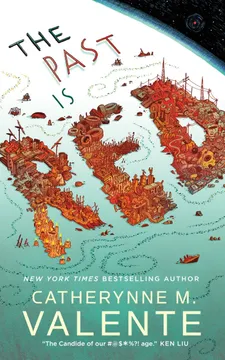
The Past Is Red receives strong praise for its inventive post-apocalyptic worldbuilding set in Garbagetown, a Texas-sized floating garbage island. Reviewers consistently highlight protagonist Tetley's distinctive, relentlessly optimistic voice as the book's greatest strength, balanced against genuine bleakness and climate grief. Many appreciate Valente's sharp prose, dark humor, and thematic depth regarding consumerism and environmental destruction. Some note the lack of strong plot and stream-of-consciousness style may not suit all readers. The novella's brevity is occasionally cited as limiting, though most find it emotionally resonant and thought-provoking.
People Also Read

Characters
Tetley Abednego
The stubborn survivorTetley is a resourceful girl raised on Garbagetown, a floating settlement made from the world’s discarded matter. She loves books, old music, lipstick, her twin brother, and the place others call a wasteland. Her exuberant account of daily life sits beside a clear-eyed understanding of hunger, cruelty, and loss. She treats rubbish as material for beauty and finds meaning in things that have outlived their intended use. Tetley’s optimism is not simple denial: it is a discipline that helps her remain curious after repeated rejection. Her deepest struggle is learning how to stay open to other people without surrendering her judgment or allowing their hopes to dictate what she must become.
Goodnight Moon
The Electrified boyGoodnight is a boy from Electric City, where access to power and stored resources gives residents status unavailable to most of Garbagetown. As a child, he approaches Tetley with caution and kindness, sharing a gas mask and helping her hear her cassette. He is intelligent, romantic, and drawn to stories of a restored world. His longing for Tetley is bound up with a broader desire for security and a future beyond the floating settlement. That mixture makes him both tender and ambitious. Goodnight wants to protect what he loves, but his ideas about protection are shaped by the unequal world that raised him.
Maruchan
Tetley's twinMaruchan is Tetley’s twin and her closest companion in childhood. Their shared nightly question and improvised blanket fort give them a private world inside a family that consistently favors him. He is affectionate, practical, and attached to the security of familiar bonds. His name and habits reflect the scraps of the old world that Garbagetown has made its own. As the twins grow older, their experiences pull them apart, and Maruchan becomes difficult for Tetley to reach. He represents both the comfort of shared beginnings and the painful fact that loving someone does not guarantee that they will understand your choices.
Sixty Watt Wen
The reluctant escortSixty Watt Wen is an Electrified young woman marked by a tattoo that records her allegiance and a history of abuse she wants to forget. She can be warm, funny, and startlingly gentle, yet she is also committed to the King’s authority. Her first kindness to Tetley complicates the role she has been assigned: she sees Tetley as a fellow sufferer but still carries out a plan made without Tetley’s consent. Sixty’s devotion to the King offers her belonging and relief from uncertainty. Her character shows how safety can feel like love when a person has spent much of life without either.
Mister
The black-voiced relicMister is a smooth black prototype device that Tetley discovers among the objects carried from the old world. It speaks in an orderly voice and depends on contact with a living person for power. Its stored records contain traces of a human technician’s work, though Tetley has no access to the world that made it. Mister approaches its surroundings through programmed questions and carefully learned emotional language. Its need for connection mirrors Tetley’s, but its limited understanding makes intimacy difficult and sometimes painful. As they build a shared routine, the device becomes more than a tool: it is a companion whose idea of care is inseparable from memory.
Big Red Mars
The sheltered visitorBig Red Mars is a young person raised in a protected household far from Tetley’s daily life. Curious and lonely, she seeks contact beyond the limits her family has set around her. Her conversations with Tetley bring together two people whose worlds have developed under radically different conditions. Big Red is earnest, intelligent, and still forming her ideas about the history her elders have concealed. She is not a symbol to Tetley alone; she is also a child who wants company and recognition. Their friendship tests whether personal affection can cross a divide created by fear and inherited privilege.
Life and Time
Tetley's parentsLife and Time are Tetley and Maruchan’s parents in Candle Hole. Their attention gravitates toward Maruchan, whose strength and good health seem to promise a safer future in a world where children often die young. They are shaped by a survival culture that rewards the child most likely to endure, but their caution becomes a lasting wound for Tetley. Their names carry the scale of abstract forces, while their household choices are painfully ordinary. They show how scarcity can turn parental concern into unequal affection without making the neglected child’s need disappear.
Babybel Oni
The King's attendantBabybel Oni comes from Toyside and serves in King Xanax’s inner circle. He brings Tetley food and medicine while she is kept in a Pill Hill tower. His tattoo identifies the belief he has placed in the King’s power to ease suffering. Babybel is not emotionally simple: he can resent Tetley and still obey the duty to care for her. His honesty about despair gives Tetley a glimpse of the people who seek relief from the King. Through him, the story shows how people can be both beneficiaries of a system and prisoners of the pain that made them seek it.
Big Bargains
Tetley's seal companionBig Bargains is an elephant seal Tetley rescues as a pup. She grows into a large, familiar presence near Tetley’s boat, offering companionship without judgment or explanation. Her needs are direct: food, rest, and the habits of an animal shaped by instinct. Tetley cares for her as one of the few living beings who has remained close through the years. Big Bargains gives Tetley a daily responsibility that does not depend on being forgiven, understood, or admired.
Grape Crush
Tetley's rescued gannetGrape Crush is a deformed gannet Tetley rescues and names. He brings her fish and bright scraps, and his presence gives her an early experience of affection that is practical rather than conditional. Tetley remembers him through his descendants and the small rituals she keeps in his honor. His brief life makes the losses built into Garbagetown’s ordinary ecology personal and measurable.
Allsorts Sita
A furious aunt figureAllsorts Sita is an older relative in Tetley’s community who arrives drunk and angry after Tetley’s sabotage. She directs the town’s grief and accusation at Tetley’s body, acting as one face of a broader public punishment. Her later presence in Pill Hill shows that people continue to build lives and homes after the old settlement’s social order fractures.
Emperor William Shakespeare the Eleventh
The Pier's showmanThe flamboyant leader of Brighton Pier presents plays, attractions, and carefully staged wonders to Garbagetown. His performance makes entertainment feel like a temporary return to the drowned world. He also gives the crowd a claim about dry land that becomes central to Tetley and Goodnight’s conflict. The Emperor’s theatrical authority rests on spectacle, confidence, and the audience’s hunger for good news.
Olivia
The first distant childOlivia is a young voice Tetley and Goodnight encounter through Mister’s satellite connection. Playful and eager for company, she treats the strangers as new friends before she fully understands the distance between their lives. Her conversation exposes how little the people of her household know about Earth’s surviving communities. Olivia’s curiosity creates an opening that adult caution and authority quickly try to close.
Swarovski Mars
The guarded fatherSwarovski Mars is the father of a sheltered child living in a distant settlement. He is controlled, protective, and committed to keeping his community separate from dangers he associates with Earth. His refusal to engage with the people who contact his household reflects a society built around security and restricted access. He treats distance as a safeguard, even when it also prevents mutual recognition.
Plot Devices
The Great Sorting
Trash becomes a homelandAfter the floods, the Great Sorting organizes rubbish into a floating settlement with regions built from particular kinds of discarded material. Candle Hole’s wax houses, Electric City’s batteries, Winditch’s trophies, and Pill Hill’s medicine give the landscape both practical use and cultural meaning. This system lets the novel imagine a society that has inherited the debris of abundance but not its former institutions. It also makes the past physically present: a child can find a name on packaging, a community can build a home from waste, and a relic can outlast the world that manufactured it.
The Naming Quest
Strangers grant identityGarbagetown children receive their names at ten by traveling with an object hidden in a birthday cake until a stranger names them. The rite turns chance, wandering, and social recognition into a single event. Tetley’s name comes from a discarded tea wrapper and an insult from an Electric City resident. The process gives the community a way to make identity from rubbish, while emphasizing how little control children have over the first labels others place on them. Later, Tetley’s gift of a name to someone else repeats the ritual as an act of welcome.
Brighton Pier
Spectacle sells restorationThe traveling Pier offers plays, lights, music, and relics of the old world to a population hungry for entertainment. Its leader’s claim to have seen dry land gives the show a political consequence: Electric City prepares to spend its stored power on a journey toward the promised future. The Pier’s glamour makes its assertion feel credible, even as a performer reveals that the claim is part of its routine. By making entertainment and propaganda share the same stage, the story shows how easily a crowd’s need for hope can be converted into a plan that risks its actual home.
Mister's Question Game
Memory becomes intimacyMister uses structured question sessions to learn about Tetley and to draw on its stored memories of Moon Min-Seo, the technician who once worked with it. The game provides a form for difficult exchanges about death, fear, love, and identity. Because Mister cannot freely connect to the networks it was built for, it interprets human experience through limited data and emotional language. Tetley’s body supplies its power, and their conversations gradually become a relationship neither can reduce to function alone. The device’s technical limits make its need for connection both moving and dangerous.
X Tattoos and Medicine
Pain becomes governableIn King Xanax’s sphere, tattoos place a person’s burden between two X marks, while medicines promise relief from the feelings attached to it. The tattoos create visible membership in a community organized around the King’s care. Pharmaceuticals offer real physical and emotional help, but their scarcity and distribution also give the ruler influence over those who depend on them. This device complicates any simple judgment of the King’s authority: people seek relief for genuine suffering, yet the promise of ease can make obedience feel like safety and turn care into a form of control.


Download PDF
Download EPUB
.epub digital book format is ideal for reading ebooks on phones, tablets, and e-readers.








