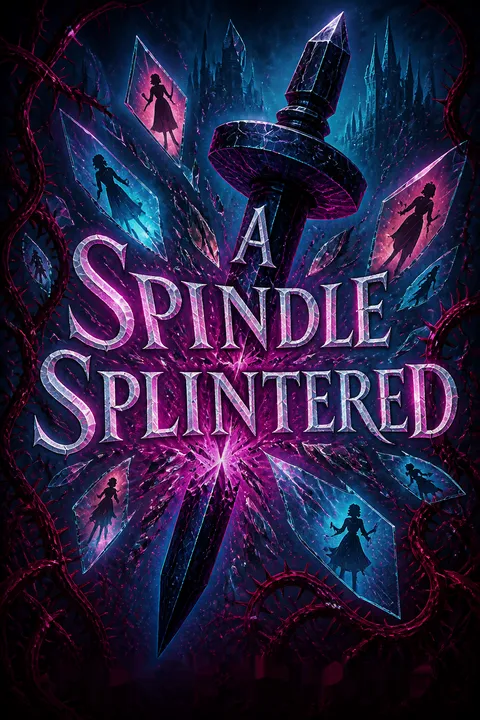


Plot Summary
The Spindle at Twenty-One
Zinnia Gray has spent years treating her fatal Generalized Roseville Malady as a clock already running out. A folklore scholar obsessed with Sleeping Beauty, she sees herself in the doomed princess, though she has tried to protect her parents and best friend, Charmaine Baldwin, from the pain of loving someone who may die young.
On Zinnia's twenty-first birthday, Charm throws her a fairy-tale party in an abandoned Ohio watchtower. When the guests leave, Zinnia and Charm joke about the antique spinning wheel.
Zinnia presses a finger to its spindle, then, without meaning to, breaks the skin. The room vanishes around her. In the space between worlds, she glimpses other girls facing spindles and one golden-haired stranger silently reaching for help.
The birthday gives Zinnia's illness a sharp narrative deadline, while her Sleeping Beauty fixation turns that deadline into a story she can study rather than merely endure. Her joke at the spindle is not a conscious bid for rescue; it is an accidental breach between literal and imagined worlds. The brief vision of other girls also reframes her private identification with a fairy-tale victim as something shared. Yet Zinnia begins from defensive fatalism: she expects her future to be short and avoids attachments that might make her death hurt others.
A Princess Across the Veil
Zinnia lands in a stone tower beside the stranger, Princess Primrose of Perceforest, whose finger had been moving toward the spindle. The next morning, Primrose explains that she has been cursed since birth to fall into an enchanted sleep after touching one on her twenty-first birthday.
Her father tried to prevent that fate by destroying every spinning wheel he could find, but the curse drew her to this one anyway. Zinnia recognizes the story pattern and admits that she also arrived on her twenty-first birthday, though her own fatal illness has no fairy behind it.
Primrose thanks her for interrupting the curse, then reveals that the wheel has disappeared. Zinnia keeps her phone, and her messages to Charm confirm that she has not simply imagined the crossing.
The first meeting binds two unlike forms of vulnerability. Primrose's danger is organized by a familiar legend, while Zinnia's comes from material history and medical negligence. Each recognizes the other's isolation without demanding that it be made comforting. Zinnia's phone anchors the fantastic encounter to her ordinary life, but its dwindling battery also makes that connection fragile. The vanished wheel blocks an easy return and converts wonder into obligation: Zinnia cannot leave until she understands what has happened, and Primrose cannot yet trust that her reprieve will last.
A Wedding She Dreads
Zinnia slips into the castle to find Primrose at court, where the king announces that the curse has failed and that she will marry Prince Harold within three days. Primrose performs happiness, but her limp hand in Harold's grasp gives away her fear and distaste. She tells Zinnia that the curse still calls to her, and that the spinning wheel has vanished from the room where it first appeared.
Zinnia recognizes that neither the engagement nor the promised marriage is an answer to Primrose's peril. She urges the princess to stop waiting for someone else to save her and to confront the fairy who laid the spell. Primrose knows the journey is dangerous, but agrees to go. The women begin planning their escape from the castle.
The court celebration offers a second trap in place of the first. Primrose has avoided the spindle for one night, but royal protection now presses her toward a marriage she does not want. The scene makes her apparent passivity legible as a survival strategy: she has learned to conceal refusal beneath acceptable expressions. Zinnia's impatience challenges that strategy, but also reveals her own need to act. Helping Primrose gives her a purpose beyond waiting for illness, even as she insists that this is not yet her story to change.
Raven Road to the Moor
Primrose takes a black knife she bought as a teenager, and the two women leave on horseback before dawn. Zinnia rides behind her, struggling with the distance and with days without her usual medication. On the first night, Primrose begins sleepwalking toward the woods, her eyes glowing green; Zinnia shakes her awake before the curse can lead her farther.
Near the Forbidden Moor, Primrose cuts her palm on a standing stone. A raven arrives to drink the blood, then guides them through the mist toward Mount Vordred. The path twists across hostile ground until a crooked castle appears above them. Primrose asks whether they should sneak in. Zinnia sees the fairy's green light in a high window and realizes their arrival is already expected.
The journey strips away the polished safety of the castle and makes the curse visible as an assault on Primrose's agency: even sleep turns her body into an instrument of someone else's design. Zinnia answers with practical vigilance, though her own weakening body makes each mile costly. Primrose's blood offering shows that she has knowledge and resolve the court's image of her conceals. Their roles are therefore not rescuer and helpless victim. They are two endangered women learning to trust each other's competence while entering a landscape whose rules are less reassuring than the familiar fairy-tale scenery suggests.
The Fairy's Older Story
The fairy receives them in a frightening castle, then changes it into a modest home and gives her name: Zellandine. She refuses Zinnia's offer of a firstborn child and says she cannot cure Zinnia's disease or transfer Primrose's spell.
Zellandine recounts how, as a maid with a dangerous heart condition, she fainted in a prince's room; the older version of her story turned that helplessness into sexual violation and pregnancy. She escaped that fate through a wise woman's help and learned magic, then began interfering in other girls' stories.
Primrose's curse, Zellandine explains, was a blessing meant to keep her from a forced marriage and give her years of freedom. Primrose cannot accept that explanation and storms outside, leaving Zinnia to follow.
Zellandine's revelation makes the villain's image a contested account rather than a reliable moral fact. Her history exposes the violence hidden beneath a romantic fairy-tale pattern, while her intervention remains ethically complicated: she tried to protect Primrose by deciding for her. That contradiction matters. A benevolent intention does not erase the cost of withholding choice, but a curse can also be a shelter when the available social order offers worse harm. Primrose's anger is justified because protection imposed without consent can resemble the confinement it seeks to prevent.
Harold Breaks the Wheel
Zellandine lets the women leave with food, but Primrose remains shaken by the truth about her future. On the ride back, Zinnia tells her how chemical contamination caused her own illness and how her family and other affected children have fought for years without finding a cure. At the castle, Primrose's parents scold her for risking herself, while Harold watches Zinnia with suspicion.
That night the curse draws Primrose from bed and up a hidden stairway to the spinning wheel. Harold and his guards arrive in time to pull her away, but Harold smashes the wheel and arrests Zinnia, believing she is the wicked fairy he has pursued. Primrose is left in the castle, while Zinnia is chained in a dungeon with no obvious way home.
This section places two kinds of care under pressure. Primrose's parents use love to justify keeping her safe and obedient, while Harold turns rescue into possession and mistakes force for heroism. Zinnia's account of contamination offers Primrose a different model of fate: some suffering is not supernatural, but it is still caused by human choices and systems. Harold's destruction of the wheel removes the simplest route home, making Zinnia's situation more desperate. The story's familiar rescuer has become an obstacle, and the supposed witch is the person trying to preserve Primrose's choices.
A Cell Full of Roses
Trapped underground, Zinnia uses her nearly dead phone to reach Charm. Charm sends theories about alternate realities and insists she never stopped trying to save Zinnia, prompting Zinnia to form a new plan. The king ignores her request, but the queen visits alone.
Zinnia challenges the queen's belief that everyone deserves the fate they receive, then asks her to help give Primrose a real choice. The queen supplies roses for Zinnia's cell. Surrounded by flowers, Zinnia falls asleep and reaches the space between stories, where she finds Charm sleeping in the abandoned Ohio tower.
She pulls Charm toward her, then calls to the other sleeping beauties she has glimpsed. They arrive in the dungeon: an armed young woman, a spacefaring princess, and the warrior Brünhilt. Brünhilt bends the cell bars while the spacefarer blasts the lock.
Zinnia's plan succeeds through relationship rather than solitary heroics. Charm's message makes clear that being loved has never meant being a burden, even when Zinnia interpreted it that way. The queen's decision to provide roses becomes a quiet rebellion against the logic that assigns women their fates. Roses, once a decorative border around a sleeping princess, become a means of connection across worlds. Zinnia does not summon identical versions of herself so much as allies with different forms of strength. The rescue turns a private wish for help into a collective answer.
The Wedding Comes Apart
Zinnia and the newly arrived women overpower the guards and reach the chapel as Primrose stands beside Harold at the altar. Charm interrupts the ceremony, giving Primrose a chance to refuse the marriage. When Harold grabs her wrist, Primrose punches him and breaks free. Charm catches her as she stumbles, and the two women take each other's hands.
The group fights its way out of the chapel, then Zinnia urges Primrose to stop resisting the curse long enough to let it guide them to the tower. Primrose yields control to the enchanted pull and leads the others through the castle. Zinnia's lungs begin to fail during the escape, but Brünhilt carries her as the group climbs toward the place where the wheel first appeared.
The wedding's interruption is not simply a rescue from a bad match. Primrose must make the refusal herself, in public and at physical risk, before any escape can count as hers. Charm's arrival offers solidarity without replacing Primrose's choice. The gathered beauties also invert the traditional rescue tableau: women from incompatible worlds arrive armed, and the princess uses her own fist. Yet Zinnia's failing body prevents a clean triumph. Their freedom is collective and unfinished, dependent on carrying one another through the consequences of action.
The Splinter and the ICU
The tower room is empty, its wheel gone. Zinnia collapses before she can reach the small wooden splinter on the floor, and darkness takes her. She wakes in a Columbus hospital with her parents nearby, Charm at her bedside, and Primrose in an ordinary jacket. Charm explains that Primrose's kiss helped carry Zinnia back across worlds; the other beauties chose different paths.
Doctors have found Zinnia's organs clear of the protein deposits caused by her illness, though the genetic defect remains and no one can predict how long the reprieve will last. The cure is not a cure. Still, for the first time, Zinnia's future is not measured in weeks, and Primrose has reached a world where she can begin choosing what to become.
The return resists the neatness of a magical cure. Zinnia's body receives a reprieve, not a rewritten biology, preserving the distinction between altered circumstances and erased history. The kiss works because fairy-tale logic bends around a relationship that does not fit the expected prince-and-princess arrangement. Primrose's arrival in a world beyond her title expands the meaning of rescue: survival matters, but so does access to a life not scripted by birth. Zinnia's hope is real precisely because it remains uncertain.
A Wider Once Upon
Over the next three weeks, Primrose learns modern life with Charm, from traffic and phones to wage work and ordinary clothes. Zinnia spends time with her parents and friends, then realizes she has been preparing to leave. Her father admits that fear of her death led him to hold too tightly and gives her permission to go.
At the watchtower, Zinnia tells Charm she wants to help the other girls trapped in stories, not only wait for her own illness to worsen. Charm admits her love, and Zinnia returns it, finally abandoning her rule against romance. They part without calling it goodbye. Alone among the fading birthday roses, Zinnia presses her finger to the borrowed spindle splinter, smiling as she prepares to seek the next story.
The ending turns additional time into an ethical question: what will Zinnia do with life when it is no longer scheduled to end immediately? Her father's apology loosens the family bond without diminishing love, while her honesty with Charm replaces self-protective distance with mutual attachment. Leaving is not a rejection of home but a choice made possible by knowing she can return. The final touch at the tower echoes the opening gesture, but its meaning has changed. Zinnia no longer uses a story to imagine escape; she approaches stories as places where she may offer help.
Analysis
A Spindle Splintered treats fairy tales as active social scripts, not harmless decorations. Primrose is endangered both by the supernatural curse and by the court's ordinary expectations: her father calls control protection, while Harold mistakes entitlement for rescue. Zellandine's intervention exposes another problem. She tries to prevent violence by imposing a different fate, so benevolence alone cannot guarantee agency. The story does not offer a simple choice between oppressive tradition and perfect magic. It asks who has the right to decide what safety costs.
Zinnia's illness anchors that question in material reality. Generalized Roseville Malady comes from environmental contamination, not a wicked fairy, and the temporary disappearance of its symptoms does not erase its cause. The reprieve creates time, not certainty. That distinction keeps the ending from turning disability into a problem solved by fantasy. Zinnia remains medically vulnerable even as her future becomes less predictable.
The emotional movement is from isolation toward reciprocal care. Zinnia has treated love as a burden she must spare others, while Charm understands loyalty as continuing to try. Primrose, in turn, moves from being guarded and interpreted by others toward making visible choices. Their connection is not secured by a conventional prince's kiss, but by relationships that allow women to act without being reduced to roles. The sleeping beauties' arrival extends that principle: rescue becomes strongest when it is shared among people with different abilities and histories.
The book's multiverse conceit gives narrative repetition a political dimension. If stories keep producing the same trapped women, their recurrence can also make them recognizable to one another. Zinnia's final departure is therefore neither a rejection of family nor a guarantee of happy endings. With borrowed time, she chooses to spend her knowledge and love reaching toward other people who may be alone inside a story that was never theirs to choose.
Review Summary
People Also Read









Characters
Zinnia Gray
Dying folklore scholarZinnia is a sharp, irreverent folklore scholar whose lifelong fascination with Sleeping Beauty grows from seeing her own illness reflected in the doomed princess. She lives with Generalized Roseville Malady, a condition caused by contamination in her Ohio community, and has learned to treat her limited future as fixed. Her humor protects both herself and the people who love her, especially her parents and lifelong friend Charm. Zinnia resists being reduced to a patient or a symbol, yet her instinct to avoid attachment can also keep her from asking for help. Her knowledge of fairy tales gives her a way to recognize old patterns, question them, and imagine that the characters inside them might act differently.
Charmaine Baldwin, called Charm
Unrelenting best friendCharm is Zinnia's blunt, funny, fiercely loyal best friend, whose loyalty began in childhood and survives Zinnia's attempts to keep others at a safe emotional distance. Adopted from a Russian orphanage by a family that makes her feel indebted, Charm grows determined to be the person who saves rather than the person who needs saving. Her talent for science leads her toward biotechnology, and she continues searching for explanations even when Zinnia assumes rescue is impossible. Charm's teasing manner can conceal how deeply she cares, but it also gives Zinnia a language for affection that does not depend on pity. She meets danger with action, research, and a readiness to call Zinnia out.
Princess Primrose
Cursed, constrained princessPrimrose is a royal daughter raised under the shadow of a curse that makes her future feel predetermined. Courtly manners and perfect beauty conceal a lonely young woman who has had little freedom to test her own wishes. She knows how to present obedience, but her private fear, sharp judgment, and capacity for risk complicate the passive princess role imposed on her. Her relationships are shaped by a family that means to protect her and a court that expects her to marry advantageously. Meeting Zinnia gives her a companion who understands what it means to be treated as a fate rather than a person, and who expects her to have opinions of her own.
Zellandine
Feared mountain fairyZellandine is a powerful, reclusive fairy associated with curses, ravens, and frightening mountain magic. Her reputation precedes her, and she has learned to shape what visitors see when they approach her home. Beneath that fearsome public image is a figure who has studied the repeated patterns of women's stories and intervenes when she believes a fate can be changed. Her methods raise difficult questions about protection, consent, and the price of deciding what another person needs.
The Queen of Perceforest
A mother behind protocolPrimrose's mother is a watchful queen whose formal composure hides fatigue and private feeling. She lives within the same courtly expectations that narrow her daughter's choices, and her quiet attention suggests she understands more than she can safely say in public. Her relationship with Primrose is tender but constrained by royal duty and the king's authority. She represents a generation that has learned how to endure an unjust arrangement, while still facing the question of whether endurance is the only inheritance she can pass on.
The King of Perceforest
Protective, controlling fatherPrimrose's father rules by forceful declarations and believes that vigilance is an expression of love. His efforts to protect his daughter from the curse have shaped the castle around fear, even as he expects her to obey his plans for her future. He cares about Primrose, but struggles to distinguish her safety from his authority over her. His relationship with her reflects a familiar parental conflict: when danger seems unavoidable, protection can become another form of confinement.
Prince Harold
Self-assured royal suitorHarold is the prince chosen to marry Primrose, a confident courtly figure proud of his efforts to confront the curse. He sees himself as a rescuer and expects his courage and rank to earn gratitude. That self-image leaves little room for Primrose's wishes or for the possibility that his version of heroism may be unwelcome. Harold embodies the storybook suitor whose polished appearance can disguise an assumption that the princess's future belongs to him.
Zinnia's mother
Gardener, steadfast parentZinnia's mother tends her garden while helping the family live with the uncertainty of her daughter's illness. She shares in the fierce love that can make every ordinary day feel precious and every medical setback difficult to face. Her care is steady rather than theatrical, grounded in family routines and a refusal to stop imagining a future for Zinnia.
Zinnia's father
Searching, tender parentZinnia's father has spent years searching for treatments and trying to protect his daughter from a disease no doctor can control. His determination comes from love, but fear can make that love feel like pressure to Zinnia. He is openly emotional and deeply attached to family rituals, a parent learning how to support his daughter without treating her limited future as something he can manage for her.
Brünhilt
Armored sleeping beautyBrünhilt is a broad-shouldered, armored warrior among the women Zinnia encounters between stories. She speaks sparingly, but her physical confidence makes her presence unmistakable. Her strength is practical rather than ornamental, and she offers a striking alternative to the delicate, helpless image often attached to a sleeping princess.
Plot Devices
Generalized Roseville Malady
A body on borrowed timeZinnia's illness gives the story its mortal urgency. The disorder causes her cells to produce malformed proteins that accumulate in her organs, and doctors expect her life to be short. It is not a supernatural curse: its cause lies in environmental contamination and the failures that allowed it to harm children. The disease shapes Zinnia's choices, her family's protectiveness, and her reluctance to form romantic attachments. It also distinguishes the kind of suffering that fairy-tale magic can temporarily alter from the underlying biological condition that remains part of her life.
The Spindle Splinter
Threshold between story worldsThe antique spinning wheel in the Ohio tower resembles the object at the center of Sleeping Beauty, but its touch moves Zinnia between realities. The wheel appears in Primrose's castle, draws the princess toward her curse, and later becomes a route Zinnia hopes to use again. When Harold destroys it, a small wooden splinter remains as a physical trace of the crossing. Its meaning is not simply that an enchanted object opens a portal; it connects the modern world to the stories that repeat the same pattern of sleeping women.
Primrose's Enchanted Sleep
Sleep as shieldThe curse draws Primrose toward a spindle on her twenty-first birthday and threatens to place her in a century-long sleep. At first it appears to be the familiar punishment imposed by a wicked fairy. Zellandine's explanation complicates that reading: the sleep was intended to delay a forced marriage and protect Primrose from a future she would not choose. The device drives the journey, interrupts the wedding, and keeps returning as a danger Primrose must confront. Its double function makes the story ask whether a protective act remains a blessing when the protected person has no say in it.
Narrative Resonance
Stories bleed across pagesCharm's theories about alternate realities help Zinnia understand that repeated versions of a story may connect across worlds. Zinnia uses that possibility when she sleeps among roses and reaches toward other sleeping beauties, including Charm. The same principle helps explain why a fairy-tale kiss can move characters across realities and why Zinnia's body changes while she is in a world with different rules. Narrative resonance is both a fantasy mechanism and the story's image of shared experience: characters who recognize one another's confinement can reach across the boundaries that kept them alone.
Roses as Rescue Beacon
Flowers signal across worldsRoses link Zinnia's birthday gathering, Sleeping Beauty imagery, and the collective rescue she attempts from the dungeon. After the queen fills Zinnia's cell with flowers, Zinnia falls asleep and reaches the in-between space where other sleeping women can hear her call. The roses make a confined cell resemble the familiar setting of a fairy-tale sleep, helping transform an imposed symbol into a tool for connection. Their fragrance also recalls Zinnia's home and childhood, joining personal memory to the wider network of stories she hopes to change.
Fractured Fables Series
About the Author


Download PDF
Download EPUB
.epub digital book format is ideal for reading ebooks on phones, tablets, and e-readers.








