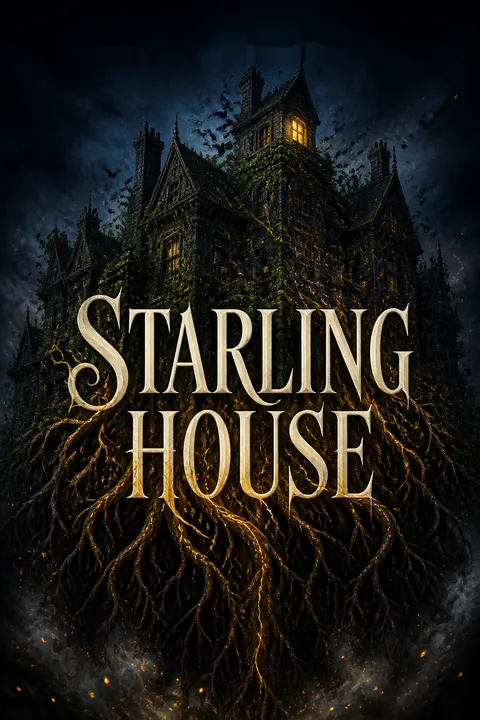


Plot Summary
Blood at the Iron Gate
At twenty-six, Opal Jewell1 measures her life by what her younger brother Jasper3 needs: food, asthma medicine, and tuition at a school far beyond their means. Their home is a shabby motel room in Eden, Kentucky, where coal pollution and bad luck have worn down every hope she permits herself.
One winter evening, walking past Starling House, Opal1 sees its amber window and cuts her palm on the beast-shaped gate. Arthur Starling,2 the reclusive heir, grabs her bleeding hand. His face twists with a rage that frightens her, and he orders her to run. Opal1 obeys, but her blood vanishes from the iron, and Arthur2 knows the House has chosen her.
Opal’s defining discipline is not simple selflessness. She has narrowed desire into a single acceptable purpose, Jasper’s safety, because wanting anything for herself feels dangerous. The gate makes that bargain physically unstable: her blood answers a place that seems to recognize her, while Arthur’s warning turns attraction to belonging into immediate threat. His anger is also misread as personal hostility; it is the first visible sign of a duty he has learned to express only as rejection. Their meeting sets the book’s central tension in motion: whether survival means leaving every dangerous attachment behind, or risking attachment despite its cost.
The House Opens
After the encounter, Opal1 dreams repeatedly of Starling House and a chained stone door beneath it. The visions leave her sleepless and her injured palm bleeding, so she returns during a work break and discovers that her blood opens the gate. Arthur2 refuses her request to look around, then offers her unusually high pay to clean the neglected mansion.
Opal1 accepts after making clear that the job is only housekeeping. Carrying the gate key, she begins scrubbing rooms that seem to rearrange themselves, while the House warms around her and responds to her attention. Portraits reveal generations of unrelated Wardens holding the same silver sword. Arthur’s2 contempt stings, but the wages begin funding Jasper’s3 school, and Opal1 keeps coming back.
The house becomes a rival definition of home before Opal can understand its danger. Its welcome is sensory and practical: warmth, a key, work that pays enough to alter Jasper’s prospects. That matters because Opal has learned to trust material exchanges more than emotional promises. Arthur’s offer is both an attempt to repay an old debt and a strategy to drive her away, but the task instead binds her to the place. The portraits quietly revise her assumption that Starling identity is inherited through blood. Their succession suggests that belonging here is made through repeated labor, not simply claimed by birth.
Eden’s Competing Histories
As Opal1 cleans, she finds a locked trapdoor, a vast library, and Arthur’s2 research on former Starlings. At the motel, Bev5 tells the town’s familiar legend: Eleanor Starling4 supposedly murdered her wealthy husband and cursed Eden.
Librarian Charlotte Tucker6 offers a harsher counterhistory recorded from Calliope Boone,9 whose ancestor Nathaniel was enslaved by the Gravely coal operators. Nathaniel escaped after reaching a nightmare world beneath the mines and later helped Eleanor4 avoid suicide.
The competing accounts make the Starlings harder to dismiss as villains or saints. Meanwhile, Elizabeth Baine,7 a consultant working for Gravely Power, approaches Opal1 for access to the property. She says the company wants its mineral rights and asks Opal1 to carry its interest to Arthur.2
The town’s stories are not neutral folklore. Bev’s version preserves local suspicion while making a woman’s power look like innate wickedness; Calliope’s account restores the labor and racial violence that the town’s respectable history omits. Charlotte’s archive offers evidence, but even evidence arrives through institutions that have neglected or distorted it. The contrast teaches Opal to hear what each narrator gains by telling a story. Baine’s arrival links those old evasions to modern extraction: the company’s interest in the land is not merely legal or historical. It is also a bid to reach something the town has spent generations turning into rumor.
A Leash Made of Jasper
Baine7 gives Opal1 a ride and shows her records of Eden’s unusually high rates of illness, accidents, and deaths, all clustered near Starling House. She also displays evidence of Opal’s mother’s1 fatal car crash, forcing Opal1 back into the memory of surviving the river. Then Baine7 offers money for information about Arthur2 and threatens Jasper’s3 chance at Stonewood Academy if Opal1 refuses.
Dizzy from the encounter, Opal1 agrees to report what she sees. Arthur,2 learning that Baine7 has targeted her, gives Opal1 his father’s old pickup and a phone number so she can contact him if approached again. He also leaves her a letter from his mother. Opal1 secretly photographs it for Baine,7 then deletes the image and returns the letter to the library.
Baine understands that Opal’s loyalty can be coerced through the person she has made the center of her life. Her tactics mirror the town’s familiar bargain with power: accept the terms, keep your head down, and call the compromise necessary. Opal’s agreement is therefore neither free collaboration nor pure resistance. She sends information because the threat is real, then destroys the evidence because Arthur’s trust and her own reluctance have become real too. The pickup and letter complicate the ledger between them. Arthur offers practical care without demanding affection, while Opal struggles to receive help that cannot be paid back cleanly.
The Door Beneath the Pantry
Baine7 continues pressing for photographs, maps, and access to the locked pantry door. Opal1 steals two keys from Arthur’s2 room and takes pictures of the House’s wards and chained underground entrance. She also finds his drawings of the grounds, including one of herself approaching the mansion. Arthur2 catches her beside the cellar door, where a scratching sound comes from beyond the stone barrier, and forces her out.
Opal’s1 theft follows after a visit to Jasper,3 who reveals he knows about her secret job and resents being managed without explanation. Arthur2 then tells her the truth: he failed to stop a Beast that escaped Starling House on the night Opal’s mother1 died. The creature caused the crash, and Arthur2 pulled Opal1 alive from the car.
The cellar is the point where curiosity becomes complicity. Opal’s photographs turn the House’s private defenses into data for Baine, while the keys carry her past ordinary theft into a breach of trust. At the same time, Jasper’s anger exposes the paternal shape of Opal’s protection: she has made his future her responsibility so completely that she withholds information he has a right to know. Arthur’s confession collapses the distance between their separate griefs. He has spent years treating guilt as a sentence; Opal discovers that the man she is beginning to trust was present at the moment she lost her mother, and also at the moment she survived.
Names and Chosen Battles
A Gravely family photograph reveals Opal’s mother1 was Delilah Jewell Gravely, the estranged daughter of the family that owns the power company. Opal1 also uncovers the missing half of Arthur’s2 mother’s letter, which says he was never bound by birthright and could choose another life.
Jasper3 steals Arthur’s2 research and reconstructs the Warden succession: the House has repeatedly called displaced and lonely people, each of whom chose to take up the sword, and each of whom was eventually lost.
The Wardens were not trapped by blood, but their losses came faster in recent decades. Jasper3 tells Opal1 that he has made his own plans and will not let either her or the House decide his future. Their revelations leave Opal1 facing a choice rather than a family obligation.
The discoveries dismantle two seductive forms of destiny. Opal’s newly recovered surname does not provide a ready-made family or repair the years of abandonment; Arthur’s mother’s letter shows that duty was a choice, even when grief made it feel compulsory. Jasper’s refusal matters because Opal’s care has sometimes become control. He is not a fragile object she must deliver to a better life, but a young person already making decisions. The Wardens’ history gives that distinction moral weight: accepting a calling may be an act of courage, but calling it inevitable can disguise the sacrifices others are asked to make.
Fire at Room Twelve
After Baine7 confronts Opal1 at Tractor Supply, Opal1 refuses to give her the keys and punches her, losing her job. That night, a Beast-linked fire destroys the Garden of Eden Motel. Opal1 rushes toward room twelve, convinced Jasper3 may be inside, but firefighters restrain her and Constable Mayhew arrests her for arson after Baine’s7 operative plants evidence.
At the detention center, Baine7 and Don Gravely8 pressure Opal1 to help seize Starling House in exchange for security and a place in the family. Arthur2 arrives, frees Opal,1 and gives Baine7 three keys while keeping the fourth. He has signed away enough access to protect Opal1 and Jasper,3 but the bargain leaves the House vulnerable. Jasper3 is found safe, and Opal1 sends him toward Louisville.
The fire converts corporate pressure into bodily danger and destroys Opal’s tenuous shelter. Baine’s plan works by exploiting public suspicion: Opal’s record and anger make a false accusation plausible, while the motel’s destruction gives the company leverage over both siblings. Don Gravely offers family only when it can serve a business transaction, exposing the difference between shared ancestry and care. Arthur’s sacrifice reverses Opal’s usual role as the one who pays every cost for Jasper. Yet his bargain is not uncomplicated heroism: handing over three keys may protect them immediately, but it transfers risk to the House and prepares his own disappearance.
The Last Warden’s Choice
Before Jasper3 leaves, he tells Opal1 he has already secured admission and financial aid at the University of Louisville, and will not attend the private school she chose for him. Opal1 accepts that he must choose his own future, then stays in Eden rather than follow him. She returns to Starling House and finds Arthur’s2 will naming her its heir.
Arthur2 has entered Underland, having surrendered his weapon to a Beast and used the fourth key to pass the chained door. Opal1 cuts her palm with the silver sword and becomes the House’s new Warden. Beasts escape as Baine’s7 team enters the property. Opal1 saves Baine7 from a falling sycamore, refuses to attack a Beast, and searches for the old mine entrance to follow Arthur.2
Opal’s change is not a sudden turn from fearlessness to courage. It is a refusal to let fear make every decision for her. Jasper’s departure proves that loving him does not require keeping him dependent, and Arthur’s will cannot substitute for her consent to inherit the House. She chooses the Warden’s role through blood, but does so under conditions he could not create for her. Her mercy toward Baine is equally significant. Opal does not confuse justice with revenge, even when the woman before her has threatened her family. She enters the mine not because the House owns her, but because she chooses the person she hopes to bring back.
The River Under Eden
Mayhew blocks Opal’s1 route across the bridge, so she enters the abandoned mine beneath Gravely land and follows its tunnels toward the underground river. She finds the remains of Willy Floyd, then reaches a cavern with stairs leading toward Starling House and bodies floating in the water. Eleanor Starling4 and Arthur2 lie submerged there, alive but held fast.
Opal1 drinks from the river and enters Underland, where she finds Arthur2 facing a pack of solid, flesh-and-bone Beasts. A pale girl watches them from a window: Eleanor,4 still living inside the world created by her own dreams. Opal1 recognizes that the published story and the town’s legends contain distorted pieces of her history, and asks Eleanor4 to explain herself.
The mine joins the town’s buried history to its supernatural present. Opal’s route passes the bones of a missing child and the landscape shaped by generations of coal extraction, so Underland cannot be separated from Eden’s material violence. The river’s power is more intimate than a simple portal: it suspends lives in a dream-state and makes entry depend on surrendering control. Opal arrives not as a detached investigator but as someone whose own survival has always been tangled with water, memory, and other people’s choices. Recognizing Eleanor as both a storybook figure and a person prepares Opal to challenge the revenge narrative without erasing the harm that produced it.
Eleanor’s Unfinished Story
Eleanor4 tells Opal1 that her father and uncles abused and exploited her, then arranged for her to marry the uncle who controlled her inheritance. Nathaniel Boone, an enslaved miner who escaped through a crack into Underland, stopped her suicide and explained the place beneath the earth.
Eleanor4 used its Beasts to kill her abusive husband, then built Starling House as a barrier around the way below. Years later, when another Gravely threatened her land, she returned to Underland and set the Beasts loose in revenge.
The creatures came from her dreams, not an outside Hell. Opal1 learns that Gravely Power’s leaking ash pond has poisoned the underground river, strengthening Eleanor’s4 world. Eleanor4 claims the contamination has been diverted into an empty grave.
Eleanor’s account resists the town’s easy categories of witch, murderer, or innocent victim. She was harmed, fought back, and then made her wound into an engine of punishment that outlasted its original targets. The Beasts are neither arbitrary monsters nor simple agents of justice; they are dreams given force by a person who could not imagine safety without retaliation. Industrial pollution extends that private nightmare into the present, feeding the river from Eden’s ongoing exploitation. Opal’s task is consequently not to absolve Eleanor or excuse the town. It is to acknowledge the truth of her suffering while refusing to let inherited grievance dictate what happens next.
A Home Beyond the War
Opal1 convinces Eleanor4 that the Gravely men who harmed her are dead and that her book has carried her truth to readers, even if most people misunderstood it. She promises to tell the tangled history honestly. Eleanor4 cries, then falls asleep, ending her hold on Underland. Opal1 returns to Arthur,2 who is trapped in a nightmare of the dead he could not save.
She reaches him through the Beasts, reminds him that they are both alive, and helps him relinquish the sword. Flowers grow across his barren dream as he begins to imagine a life not organized around battle. In the waking world, the contaminated flood settles into the abandoned Big Jack site. By autumn, Opal1 and Arthur2 emerge from the House together.
The resolution changes the function of inheritance. Opal receives a house, a sword, and a violent history, but she does not simply repeat the role of the person before her. She listens to Eleanor without accepting her revenge as the only possible ending, and reaches Arthur without treating his guilt as proof that he must die. The flowers in Underland signify not innocence restored but imagination redirected: the same faculty that produced Beasts can picture something other than endless punishment. Their return to the surface leaves grief and environmental damage real, while opening the possibility of repair, truthful memory, and a home made through reciprocal care.
Epilogue
After the fire and flood, Eden suffers power loss and faces a lawsuit against Gravely Power. A newly found will supports Delilah’s claim to the family fortune, while the company’s expansion stalls. Opal1 and Arthur2 are missing through the summer, and Starling House appears abandoned until an amber window lights in September.
They emerge holding hands, with the hellcat10 at their feet. Jasper3 visits with his camera equipment, and Bev5 and Charlotte6 return as a couple. Repairs begin on the House, while Opal1 and her friends gather the town’s conflicting accounts into a history meant to tell the truth.
The epilogue refuses a clean reset. Gravely Power faces consequences, but the polluted town and the damaged House still require repair; a supernatural victory cannot undo generations of extraction. The new Starlings also become the subject of fresh gossip, showing how readily Eden replaces one distorted legend with another. Opal’s promise to record the history offers a different response: not a final authoritative myth, but a record that includes contradictions, suppressed witnesses, and the people who were made invisible. The amber window answers the opening image of home, though its meaning has changed. It no longer calls a solitary dreamer toward a refuge. It marks a place people can enter, leave, and help rebuild.
Analysis
Starling House asks what it means to inherit a place when inheritance has been used to excuse exploitation. The Gravely family’s wealth comes from coal and human bondage, yet the town’s legends convert its violence into a tale about a dangerous woman. That distortion is not merely historical: Gravely Power continues to profit from damaged land, while officials and neighbors often prefer a familiar story of bad luck to an account of responsibility. The novel’s supernatural system gives that avoidance a physical shape. Beasts born from dreams move through a poisoned landscape, turning concealed harm into visible danger.
Opal1 and Arthur2 respond to inherited damage in opposite but related ways. Opal1 makes herself indispensable to Jasper,3 believing that love must be demonstrated through constant sacrifice. Arthur2 accepts the Warden’s work as a private sentence, mistaking self-destruction for protection. Both have reduced their lives to one necessary duty. Their relationship becomes meaningful when they stop treating care as a debt and begin to recognize it as a choice. Jasper’s3 insistence on his own future is essential to that shift: Opal1 must let him leave, while Arthur2 must imagine a life beyond the sword.
Eleanor4 complicates the familiar promise that justice will heal the injured. Her rage begins in real abuse and social complicity, but the Beasts prolong her punishment beyond the people who caused it. Opal1 neither denies Eleanor’s4 suffering nor accepts vengeance as a permanent inheritance. She listens, promises to tell the truth, and asks the living to take responsibility for what they can still change. The ending therefore offers no easy cleansing of Eden. Pollution, damaged buildings, and contested history remain. What changes is the possibility of response: a house can become a home through care, and a story can preserve the people whom official memory tried to erase.
Review Summary
People Also Read



Characters
Opal Jewell
A guarded survivorOpal is a sharp-witted, resourceful young woman who has spent years making unstable circumstances look manageable. She works, lies, steals, and bargains to protect Jasper3, whose intelligence and asthma make Eden feel especially limiting. Her suspicion of charity comes from experience: help can carry hidden costs, and dependence can be used against her. Beneath her practical focus is a hunger for stories, beauty, and a home she has never trusted herself to want. Her humor keeps other people at a distance, but it also helps her endure a town that looks away from poverty and harm. Opal’s central struggle is learning to distinguish care from control, and desire from a danger she must automatically refuse.
Arthur Starling
The house’s watchful heirArthur is an isolated, awkward young man shaped by the demanding world of Starling House. He studies mythology, keeps careful records, draws the land, and carries himself as though every ordinary kindness might become a liability. His reserve hides a powerful conscience and an almost reflexive readiness to take blame. Arthur believes self-denial is the surest way to protect others, so he often rejects people before they can choose to stay. His relationship with Opal1 unsettles that strategy: she refuses his warnings, notices the person beneath his frightening reputation, and challenges his habit of treating sacrifice as the only honorable response. His awkwardness is not indifference; it is the armor of someone who has rarely been allowed an ordinary life.
Jasper Jewell
Opal’s ambitious brotherJasper is a gifted teenager, a filmmaker with a strong visual imagination and a dry sense of humor. His asthma and brown skin mark him as vulnerable in a town shaped by pollution and prejudice, but he is neither helpless nor naive. Opal’s1 fierce protection gives him stability, yet it can also leave him outside decisions that affect his own life. Jasper notices more than he says, including the ways adults underestimate him and the ways Opal1 turns care into obligation. His creative work gives him a language for the eerie pressures surrounding Eden, while his academic plans point toward a future he wants to choose for himself.
Eleanor Starling
A haunted authorEleanor is the nineteenth-century author of The Underland, a solitary figure whose strange children’s book has become entangled with Eden’s folklore. Her life is difficult to recover from official records, and the town’s accounts of her tend to reveal more about its prejudices than about her character. She is remembered as remote, unsettling, and resistant to public scrutiny. Her drawings and research suggest an observant mind drawn to the stories people use to explain fear. Eleanor’s name connects art, memory, and the history of Starling House, while the gap between her public legend and private experience invites questions about who gets believed.
Jasper’s sister
A practical motel keeperBev owns and manages the Garden of Eden Motel, where Opal1 and Jasper3 have lived for years. Blunt, stubborn, and quick with an insult, she offers help in forms that preserve her pride and the recipient’s: a room, food, internet access, or a remedy for a child’s wasp sting. Her hostility toward Gravely Power comes from watching what the company has done to the land and its people. Bev is more compassionate than her manner suggests, though she is slow to reveal what she knows and reluctant to expose her private life to a judgmental town.
Charlotte Tucker
Eden’s patient historianCharlotte is the local librarian and a determined researcher of Eden’s past. She is generous with books, time, and advocacy, especially when Jasper3 faces discrimination, but her kindness does not make her gullible. She recognizes when Opal1 is hiding something and asks for honesty rather than merely offering comfort. Charlotte’s historical work brings excluded testimony into view, including Calliope Boone’s9 account of the Gravely family. Her affection for Bev5 develops quietly alongside her belief that she may need to leave Eden to build a fuller life.
Elizabeth Baine
A polished corporate fixerBaine represents the consulting group working for Gravely Power. Composed, observant, and skilled at finding leverage, she treats personal information as a tool and presents coercion as professional negotiation. She understands that Opal’s1 devotion to Jasper3 can be turned into pressure more effectively than money alone. Baine is not driven by local loyalty or folklore; she sees Starling House as a valuable anomaly and a problem to solve. Her immaculate manners make her threats more unsettling, because she rarely needs to raise her voice to make clear that she intends to get what she wants.
Don Gravely
The coal company’s heirDon Gravely leads the family power company and carries himself with the confidence of a man accustomed to having influence mistaken for virtue. He speaks of investment and opportunity while the company’s pollution contributes to Eden’s failing health. His connection to Opal’s1 family is obscured by years of silence and by the family’s preference for respectability over responsibility. Don’s interest in kinship becomes visible when it can advance the company’s plans, revealing how easily he treats both people and land as assets.
Calliope Boone
A keeper of testimonyCalliope Boone is a descendant of Nathaniel Boone, an enslaved miner connected to the earliest history of Starling House. Through an interview recorded by Charlotte6, she offers a family account that corrects Eden’s comforting legends about its founders. Her insistence on truth rather than entertaining folklore makes her testimony a moral counterweight to the town’s official memory.
Baast
A feral house companionBaast is the calico cat Opal1 knows as the hellcat, a sharp-clawed stray from the motel dumpster. She is suspicious, territorial, and impossible to command, yet gradually makes Starling House her domain. Her presence brings a small, comic domesticity into Arthur’s2 isolated life and links the motel’s scrappy world with the mansion’s strange one.
Plot Devices
Starling House
A home that choosesStarling House is a shifting, semi-living mansion whose doors, rooms, warmth, and lights respond to its occupants. Its architectural oddities are not decoration: the labyrinthine passages protect a sealed route beneath the pantry, while the house itself shelters the people who take responsibility for it. The House calls people who are displaced or hungry for belonging, but its welcome is bound to real danger. It also preserves its history through portraits, letters, and rooms that react to grief and care. Its changing condition makes emotional attachment visible: cleaning and tending it restore more than appearances.
The silver sword and keys
Tools against the BeastsThe sword and three iron keys are part of the inherited equipment of the Wardens. The silver blade is engraved with protective symbols and can injure the Beasts, while the keys control access to the gates, the House, and its hidden depths. Their apparent incompleteness points to a fourth lock that cannot be opened by ordinary means. The sword represents both protection and the burden of repeating past sacrifices. Opal’s1 use of the gate key as a weapon also turns a token of entry into an instrument of self-defense.
The river of dreams
A passage into UnderlandA hidden river runs beneath Eden and connects the mine tunnels to Underland. Drinking from it induces sleep and carries a person into a dream-shaped world where fears, memories, and imagined creatures become substantial. The river also holds Eleanor4 and Arthur2 suspended beneath its current. Its waters make the boundary between reality and dream porous, so entering Underland requires more than finding a physical route. In Eden, pollution from Gravely Power’s ash pond contaminates the underground system and intensifies the danger.
The Underland
A story that records truthEleanor’s4 illustrated children’s book appears at first to be a strange work of gothic fantasy. Its images, dedication, and recurring tale of a girl, a river, and dangerous Beasts preserve clues to the history of Starling House and the way into Underland. Opal’s1 childhood attachment to the book shapes her dreams before she understands its connection to the real house. The book also demonstrates how testimony can survive in a form that readers dismiss as make-believe. Its story is neither a complete historical record nor a simple invention.
Eden’s mist and Beasts
Violence made visibleThe Beasts emerge through mist and move between Underland and Eden, where their attacks appear to ordinary observers as accidents, illnesses, fires, or other runs of bad luck. Only people connected to Starling House can see them clearly. They are shaped by dreams, history, and injury rather than by a simple division between good and evil. The mist signals that the boundary is weakening, while the creatures make the town’s buried violence physically consequential. Their presence links family trauma and environmental damage to Eden’s recurring disasters.
About the Author

Download PDF
Download EPUB
.epub digital book format is ideal for reading ebooks on phones, tablets, and e-readers.








