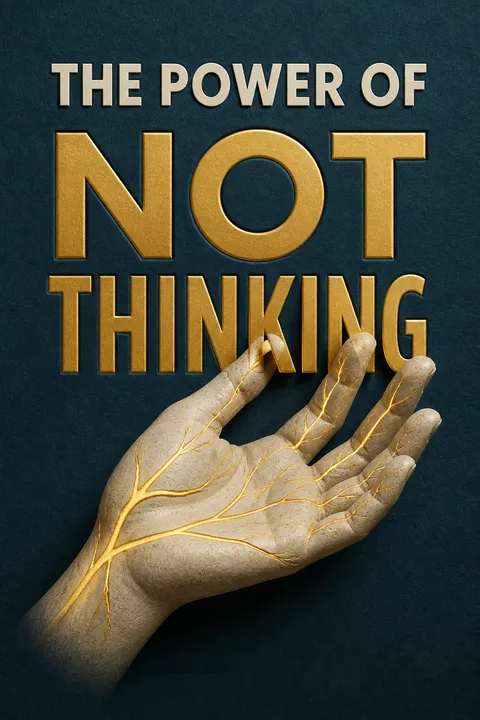


Key Takeaways
Treat the body as a partner in intelligence, not a vehicle for the brain.
Knowing begins in contact. The book challenges the old picture of a rational mind directing a passive body. Descartes helped establish that division; philosopher Maurice Merleau-Ponty argued instead that perception and understanding begin with bodily engagement. The author calls the practical knowledge gained through perception and experience embodied knowledge. It is what lets a driver coordinate pedals, hear an engine, read traffic, and respond without reciting instructions.
The world teaches back. A school janitor understood his building’s quirks through years of tending its heating and ventilation. When administrators replaced that local knowledge with remote sensors, the school’s energy costs rose. Data and brains matter, but understanding also depends on what bodies sense and learn by acting in a particular world.
The argument is strongest when it rejects a false choice between reason and sensation. A good diagnosis often combines measurement with the practical feel of a setting, much as a clinician uses both test results and a patient’s account. The body is not automatically wise, however. Pain, fear, and habit can distort judgment, while direct experience can be narrow or biased. The useful principle is not to trust every gut reaction, but to treat bodily experience as evidence that can enrich, challenge, and be checked against analysis.
Use maps and metrics as guides, then test them against lived reality.
A model leaves things out. GPS gives a driver an accurate route, but studies described in the book find that relying on it can reduce attention to surroundings and weaken a person’s sense of place. London taxi drivers develop a contrasting knowledge of streets by riding routes repeatedly, learning landmarks, and noticing how traffic behaves. Their training can involve more than 60,000 miles over three years.
Numbers need context. The author contrasts a data-controlled school with Google’s carefully engineered data centers. Sensors helped Google reduce cooling costs, but sensors alone could not make sense of an old school full of leaky windows, changeable rooms, and children adjusting thermostats. A restaurant’s foot traffic may reveal how busy it is, but not whether its atmosphere feels intimate or rowdy.
This is a useful corrective to the assumption that more data automatically means more understanding. Models make complex settings legible by simplifying them, and that simplification is often their strength. Trouble starts when the simplified picture is treated as complete. The same caution applies to first-hand experience: a taxi driver’s expertise in one city does not replace a map for every traveler. The best approach is complementary. Use measurement to identify patterns, then use situated observation to discover what the measurements mean and what they fail to capture.
Watch skilled people closely; bodies learn before explanations catch up.
Observation is active learning. In Yemen, anthropologist Trevor Marchand joined builders constructing a minaret without architectural plans. Apprentices began with errands and simple tasks, watched experienced masons, copied their movements, and gradually took on harder work. Formal explanation was scarce, yet observation and imitation transmitted intricate skills.
Seeing can prime doing. The book describes motor simulation theory, the idea that observing an action activates parts of the observer’s motor system involved in performing it. This helps explain why a demonstration can teach what a verbal description cannot. A gymnastics teacher can show a forward roll more clearly than a string of instructions can describe one. Watching is not a substitute for practice, but it gives the body a first map of the action.
Learning by observation is especially valuable when a skill depends on timing, force, or coordination that is difficult to put into words. It also explains why apprenticeships and demonstrations can succeed where manuals feel thin. The limitation is that copying can preserve bad habits as efficiently as good ones. Effective observation therefore needs opportunities to compare attempts with outcomes, ask questions, and receive correction. The broader lesson is that instruction should include visible models and practice, not just verbal rules.
Practice until rules become feel, then stop micromanaging every move.
Repetition changes the kind of knowing. Most people can ride a bicycle but cannot fully explain how they balance. Experiments and engineering research eventually clarified that steering into the direction of a fall helps keep a bike upright, but riders usually learn that adjustment through trial and error. The bicycle comes to feel like an extension of the rider.
Expertise shifts attention. Hubert Dreyfus described skill development from rule-following beginners to experts who respond fluidly to familiar patterns. Early learners benefit from instructions such as where to shift their weight. For experienced performers, conscious attention to each movement can disrupt coordination. In a golf experiment, skilled putters performed worse when asked to monitor their swing than when attending to an unrelated tone. This does not mean experts stop concentrating; they focus on the task, not every component.
The distinction between useful attention and intrusive self-monitoring matters well beyond sport. Once a routine is learned, attention can move from mechanics to purpose, context, and feedback. But automaticity is not always an advantage: familiar tasks can invite complacency, and high-stakes work may require deliberate checks. The practical question is what deserves attention now. Beginners often need to inspect each step; experienced people may perform better by keeping awareness broad and responding to the situation rather than narrating their own movements.
Build judgment through varied experience, because real life has no complete script.
Experience supports improvisation. In chess, openings and endgames can be studied in advance, but the middle game brings unfamiliar positions. Skilled players cannot calculate every possible move; they recognize patterns and focus on promising options. Gary Klein found a similar process among firefighters. Experienced commanders often recognize a dangerous situation and choose a workable response without comparing every option in a formal decision tree.
Real environments resist exhaustive rules. Driving makes this plain. A person may have to judge what a pedestrian, cyclist, or other driver is about to do, while accounting for weather, road conditions, and nearby traffic. Autonomous cars struggle because no written rule can cover every combination. Human improvisation draws on past encounters, perception, and quick adjustment, though intuition can still be wrong.
This is a strong account of judgment as pattern recognition under pressure, rather than as a mysterious gift. It also gives a practical reason to seek varied experience: a larger range of situations supplies more patterns to recognize. Yet familiarity can create overconfidence, especially when past conditions differ from present ones. Good judgment therefore combines rapid recognition with a readiness to pause when a situation is novel, consequential, or poorly understood. Intuition is most trustworthy when it has been trained by relevant experience and tested against results.
Enter other people's conditions to make distant hardship emotionally legible.
Empathy benefits from experience. In the Crossroads Foundation’s refugee simulation, participants are separated from their families, lose possessions, build makeshift shelters, and face the uncertainty of displacement. The exercise includes factual briefings and testimony from people with direct experience. Participants learn that displacement can last decades, not just a few years, and that basic needs such as water and safety shape daily choices.
Design can also teach through the body. In architect David Dillard’s Sleepover Project, designers spent a day in a senior living facility while simulating limitations associated with aging. One wheelchair user noticed how thresholds and furniture affected movement. The experience revealed practical and emotional details that a report alone might not convey. Such simulations offer a glimpse, not an equivalent of living with the real condition.
Embodied exercises can turn distant facts into questions people are more likely to take seriously. Their value is not that participants now know exactly what it is like to be displaced or old. They do not. Their value is that the exercise can expose assumptions, prompt better listening, and give data a human context. Ethical design matters: simulations should be developed with affected communities, avoid spectacle, and make clear where the analogy ends. Empathy is a starting point for understanding, not a substitute for the voices or expertise of those directly affected.
Anchor memory in movement, surroundings, and useful tools.
The body helps retrieve what the brain cannot summon alone. A taste or smell can bring back a vivid memory, while practiced movements such as typing or tying shoes can be performed without recalling each step. The book calls this kind of learned action procedural memory. Actors Helga and Tony Noice found that performers recalled lines better when dialogue was connected to movement and the meaning of a scene.
The environment can serve as memory. In a study of Scottish scuba divers, participants recalled word lists better when tested in the same setting, underwater or on land, where they had learned them. The extended mind theory, developed by Andy Clark and David Chalmers, makes a related claim: tools such as notebooks and phones can participate in thinking when people rely on them to store and retrieve information.
These examples suggest that memory is often less like a file retrieved from a single location and more like a route reconstructed with help from cues. Movement, setting, and external notes can all support recall. This has practical implications for studying and work: rehearsal in a relevant context, meaningful action, and reliable external reminders may outperform isolated memorization. There is a tradeoff, though. External aids can reduce the need to retain details internally, so a useful system should make information accessible without making the person helpless when the device or cue is absent.
Let teams experience the customer world before interpreting customer data.
Immersion makes abstractions concrete. Duracell executives camped with experienced outdoor enthusiasts, learning why different lights, batteries, and warm clothing mattered in real conditions. A product specification became meaningful when participants felt the cold and saw how campers used equipment. The campaign that followed connected the company’s batteries with nighttime climbing and attracted wide attention in the outdoor community.
Make experience shareable. Facebook’s 2G Tuesdays let engineers simulate slow, unreliable internet connections like those encountered by many users in India. Engineers could feel how their own product behaved under those constraints, then connect that experience to market data. The author’s point is not that fieldwork replaces analytics. Direct exposure helps employees understand what the numbers describe and carry that understanding into decisions.
Immersion can correct the home-market bias that creeps into product decisions, especially when teams design from comfortable offices for users with different resources or routines. It also creates shared reference points across departments, which can help an insight survive the journey from research to execution. Still, a memorable trip can seduce a team into overgeneralizing from a handful of encounters. Strong practice pairs direct experience with systematic research, then checks whether the vivid story is representative or merely memorable.
Take policymakers out of their usual circles before trusting their picture of society.
Proximity changes what becomes visible. Dutch ambassador Simon Smits rode with a truck driver to understand how trade and borders worked in practice. The journey exposed him to the driver’s routine and to the complications that official descriptions of frictionless movement could hide. A British inquiry into the Iranian Revolution similarly found that diplomats had focused too narrowly on elite circles and missed wider opposition.
Distance can distort political judgment. Economist Larry Summers described learning about small-town America during a long drive on local roads, where he saw concerns and cultural signals unlike those prominent in his policy circles. George Orwell’s time living among the poor also shaped his writing about hunger and social exclusion. Statistics and polling remain useful, but they cannot fully describe what daily life feels like.
The case for getting out of professional bubbles is not simply moral. It is epistemic: people often notice different problems when they encounter different routines, constraints, and social codes. But a road trip or a short immersion cannot stand in for representative evidence, and proximity does not erase unequal power. Policymakers need both broad measures and sustained contact with affected communities. The strongest version of this approach treats listening as ongoing work, not a one-off tour that allows decision-makers to declare the gap closed.
Act out a design idea to expose flaws polite discussion can hide.
Performance reveals hidden constraints. A Brazilian user testing Motorola’s personal safety app objected that opening a phone and tapping a screen would be impossible during a mugging. He demonstrated the problem by restraining a product manager in a controlled session. The team understood why the alert had to work discreetly, without removing the phone from a pocket, and redesigned the feature around a button press.
Bodystorming turns speculation into a scene. Designers use this method to act out how a product or service might be used, either in a mock setting or in the real world. Pixar teams also visit environments they plan to depict. For Ratatouille, they studied restaurant kitchens so heat, workflow, and small signs of wear could make the animated setting feel convincing.
Acting out a scenario can surface dependencies that are invisible in a slide deck: who has free hands, who controls the space, what can be seen, and what feels socially awkward. It is a fast way to test assumptions before costly development. Yet staged scenes can become theatre that confirms the team’s preferred story. Participants need the power to challenge the setup, and designers should treat performance as one source of evidence among several, not as proof that a product will work for every user.
Expect AI to master bounded puzzles before messy, physical everyday life.
Computers excel where the world is constrained. Chess engines can search many moves, while AlphaGo learned through human examples and repeated play. Yet a road is not a game board: weather shifts, markings change, and people behave unpredictably. The difficulty of autonomous driving is not just steering. A vehicle must perceive its surroundings, predict what others may do, and plan a response.
Embodiment is a major gap. Early symbolic AI tried to represent the world through rules. Roboticist Rodney Brooks instead built machines that sensed and reacted to their surroundings, drawing inspiration from insects. The book highlights a broader paradox: computers can outperform people at some abstract tests while struggling with tasks that a young child handles, such as perception and dexterous movement. AI can still assist in bounded tasks, including medical screening.
The contrast between game competence and everyday competence is a useful antidote to treating a single benchmark as a measure of general intelligence. Real-world capability depends on context, perception, action, and adaptation, not merely fluent output or rapid calculation. At the same time, machines need not imitate human bodies to be useful. A system can outperform people in a narrow task and still lack broad understanding. The practical question is therefore not whether AI is intelligent in the abstract, but what it can reliably do, under which conditions, and with what human oversight.
Analysis
The book’s central contribution is to shift the question from where intelligence is stored to how it is accomplished. Knowledge emerges through a loop: bodies sense a situation, act within it, receive feedback, and retain patterns that can guide future action. The brain remains essential, but it is not an isolated command center. This view makes the book’s examples cohere, from driving and craft apprenticeship to empathy, memory, organizational decisions, and robotics.
Its most useful distinction is between knowledge by description and knowledge by acquaintance. A spreadsheet, route map, or report can provide accurate information while leaving out the texture that determines how the information matters in practice. Direct experience supplies context and salience; formal data can test whether that experience generalizes. The strongest lesson is therefore integration, not an inversion of the old hierarchy. Numbers without contact can become empty abstractions, while experience without comparison can become anecdote elevated into policy.
The five features of embodied knowledge, observation, practice, improvisation, empathy, and retention, are best understood as interacting capacities rather than a checklist. Observation gives a learner a model to imitate. Repetition turns it into a usable skill. Retained experience makes improvisation possible, while bodily and social cues support understanding of others. The cycle is recursive: action changes perception, and new perception changes what action seems possible.
The account is persuasive but requires calibration. Bodily intuition is not inherently accurate, and immersive simulations can never reproduce another person’s full history or structural position. Mirror neuron explanations are also more tentative than the book’s broad discussion can suggest. These caveats do not defeat the thesis. They clarify its practical form: treat experience as an indispensable source of hypotheses and meaning, then test those hypotheses with evidence, reflection, and the testimony of people whose worlds are being interpreted. In an age of sophisticated models, this is not a call to abandon abstraction. It is a case for keeping abstraction answerable to the world it represents.
People Also Read





Glossary
embodied knowledge
Practical knowledge gained through experiencePractical understanding and ability acquired through perception, experience, and action. It can guide behavior without requiring a person to consciously recall rules or explain each movement. Driving smoothly, navigating a familiar place, and reading a social situation are examples. The book treats it as a product of interaction between brain, body, environment, and experience.
Cartesian dualism
Mind and body as separateThe mind-body distinction associated with René Descartes. In this account, the mind is the thinking source of reason and knowledge, while the body is material and comparatively passive, sometimes even misleading the mind through the senses. The book argues that this division has shaped modern ideas about intelligence, education, science, and computing.
body schema
Practical sense of bodily positionA term associated with Maurice Merleau-Ponty for the body's implicit sense of its position, movement, and relation to objects, other people, and the surrounding world. It helps explain how people use familiar tools and perform practiced actions without consciously calculating each movement, as when typing or moving through a crowded space.
motor simulation theory
Observed actions prime movementAn account of how watching an action can activate motor systems related to performing that action. The body may prepare, in small and often unnoticeable ways, to reproduce what it observes. The book uses this idea to explain how demonstrations and imitation can support learning, particularly when verbal descriptions do not capture timing or movement.
Dreyfus' model of skill acquisition
Stages from novice to expertHubert Dreyfus's account of skill development through stages commonly described as novice, advanced beginner, competent, proficient, and expert. Beginners rely heavily on instructions and rules. With experience, they recognize relevant features and respond more intuitively to situations. Experts can act fluidly, while still needing to attend to the task and adjust when circumstances require it.
recognition-primed decision-making
Experience-guided rapid decisionsA decision process studied by Gary Klein in which experienced people recognize patterns in a situation and generate a plausible response without first comparing every option. Fire commanders, for example, may use familiar cues to judge how a fire is likely to develop. If the first plan seems weak, they revise it or consider another.
bodystorming
Acting out design situationsA design method in which participants physically perform or improvise a possible interaction, service, or use situation instead of discussing it only in abstract terms. It can happen in a staged environment or in the real setting. The method helps reveal practical, social, and emotional constraints that people may struggle to explain in an interview.
extended mind
Thinking supported beyond the brainA theory associated with Andy Clark and David Chalmers that cognitive processes can include reliable features of the body and environment, not only activity inside the brain. A notebook, phone, or rearranged set of objects can help someone remember, calculate, or reason. The claim is that such tools can function as active parts of thinking.
GOFAI
Rule-based early artificial intelligenceAn abbreviation for good old-fashioned artificial intelligence, an early approach that treated intelligence as the manipulation of symbols according to explicit rules. Systems represented aspects of the world internally and processed those representations. The book contrasts this disembodied approach with robotics that senses and responds directly to changing surroundings.
Moravec's paradox
Abstract tasks easy, sensorimotor tasks hardThe observation that computers can perform some tasks associated with adult reasoning, such as playing chess, while finding apparently simple human abilities difficult to reproduce. Perception, mobility, and dexterous manipulation are especially challenging. The book uses the paradox to emphasize how much human intelligence depends on long-developed sensorimotor abilities.
Download PDF
Download EPUB
.epub digital book format is ideal for reading ebooks on phones, tablets, and e-readers.








