Key Takeaways
1. The "Problem of Twelve" is a Recurring Threat to American Democracy
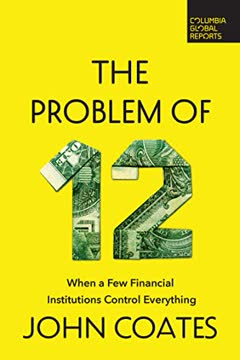
A “problem of twelve”* arises when a small number of actors acquires the means to exert outsized influence over the politics and economy of a nation.
Historical pattern. American history reveals a recurring tension between its constitutional commitment to fragmented political power and capitalism's tendency to concentrate wealth. This clash repeatedly creates a "problem of twelve," where a small, powerful group gains disproportionate influence, threatening both the political system and the broader populace. Past iterations involved central banks, private banks, insurance companies, and "money trusts."
Two-sided threat. Each time, this concentration of power presents a dual challenge. On one hand, it risks undermining democratic principles and public welfare. On the other, the political responses to contain this power can inadvertently harm the very financial institutions that, despite their concentrated influence, also generate significant economic benefits. The current era sees this dynamic re-emerging with the unprecedented growth of index funds and private equity.
Accidental power. Today's "problem of twelve" is largely an unintended consequence of financial innovation and regulatory evolution. These new institutions, while pooling savings and facilitating capital allocation, have grown so large that their economic and political power is undeniable, regardless of their initial intent. Understanding this historical context is crucial for navigating the contemporary challenges they pose to American capitalism.
2. Twentieth-Century Capitalism: Managers, Not Owners, Held the Reins
As a result, large public companies for most of the twentieth century were controlled not by their owners but by their executives.
Managerial dominance. For much of the 20th century, the American economy was characterized by "managerialism," where large public companies were effectively run by professional executives rather than their dispersed, numerous shareholders. This separation of ownership and control, famously diagnosed by Berle and Means in 1932, meant that corporate power resided within a professional management class.
Accidental byproduct. This managerialist structure wasn't by design but emerged from two key forces:
- Economies of scale: The industrial revolutions of the 19th century led to massive corporations.
- Legal constraints: Laws inhibited large banks and insurance companies from owning controlling stakes in other public companies, preventing alternative forms of concentrated financial power.
Restoring legitimacy. The Great Depression and widespread corporate abuse exposed the accountability deficit of these manager-controlled giants. Franklin Roosevelt's New Deal responded by creating the SEC, mandating "full and fair disclosure," and imposing regulations. This transparency, coupled with labor laws and progressive taxation, helped restore public confidence in capitalism and made public companies more accountable, not just to shareholders, but to society.
3. Index Funds: Accidental Giants Reshaping Public Company Governance
No longer do we have an economy controlled by thousands of executive managers of thousands of public companies, held in check by an array of dispersed governance institutions.
Passive revolution. Index funds, born from academic theories like the efficient market hypothesis, offer ordinary investors a low-cost, diversified way to invest by simply tracking a market index. Pioneered by Vanguard in 1976, this "passive" approach dramatically reduces fees and complexity for individual investors, making it one of the top financial innovations in history.
Explosive growth. Initially derided, index funds experienced slow but steady growth until 2000, when their assets under management surged. They now hold over 20% of large US public companies (e.g., S&P 500), with projections suggesting they could own the majority within decades. This growth is fueled by:
- Relaxed trust laws for institutional investors.
- Technological advancements reducing administrative costs.
- Globalization making diversified investing more attractive.
- Increased adoption in 401(k) plans and pension portfolios.
Concentrated influence. The inherent economies of scale in indexing have led to extreme concentration. The "Big Three" (Vanguard, BlackRock, State Street), and increasingly the "Big Four" with Fidelity, collectively control a pivotal share of votes in major public companies. This shifts power from thousands of corporate executives to a handful of index fund managers, creating the first modern "problem of twelve."
4. Private Equity: A Shadow Economy Operating Beyond Public Scrutiny
Private equity funds, such as Apollo, Blackstone, Carlyle, and KKR, are doing as much if not more than index funds to erode the legitimacy and accountability of American capitalism, not by controlling public companies, but by taking them over entirely, and removing them from the SEC’s disclosure regime.
Beyond public view. Private equity funds acquire entire companies, often taking them off public markets and thus exempting them from SEC disclosure requirements. This creates a "shadow economy" where a significant and growing portion of corporate activity operates with minimal transparency. The industry's assets under management have skyrocketed from $770 billion in 2000 to over $12 trillion in 2021, vastly outpacing overall economic growth.
Misleading "privacy." The term "private equity" is a clever rebranding from "leveraged buyouts," designed to shed negative connotations and imply single, private ownership. However, private equity funds raise capital primarily from institutions like pension funds, which represent thousands or millions of individual beneficiaries. This means private equity manages "other people's money" just as public companies do, but without the same public accountability.
Regulatory avoidance. The industry's growth is deeply tied to successful lobbying efforts that created regulatory loopholes. The National Securities Markets Improvement Act of 1996, for instance, allowed private funds to raise unlimited capital from institutions without triggering SEC registration. This deliberate regulatory avoidance is a core feature of the private equity business model, enabling its opacity and rapid expansion.
5. The Dual Concentration of Power: New Problems of Twelve Emerge
It is not an exaggeration to say that even if this mega-trend begins to taper off, the majority of the thousand largest US companies could be controlled by a dozen or fewer people over the next ten to twenty years.
Two paths to power. The American corporate governance system is undergoing a profound transformation, with both index funds and private equity funds contributing to a new era of concentrated financial power. Index funds are dominating the ownership of public companies, while private equity funds are increasingly taking companies private, creating parallel systems of control.
Index fund concentration. The economies of scale inherent in passive investing mean that a tiny number of index fund complexes—the "Big Four"—are accumulating unprecedented voting power over the largest public companies. Their collective influence on board elections, mergers, and shareholder resolutions is often pivotal, effectively shifting control from dispersed shareholders and even corporate managers to a few unelected fund managers.
Private equity concentration. Despite a larger number of private equity firms, the bulk of the industry's assets are concentrated within the largest complexes like Blackstone, KKR, Carlyle, and Apollo. These firms increasingly cooperate through "club deals" and "secondary buyouts," further consolidating control and creating an "incestuous" network that can reduce competition and keep prices low for acquisitions. This dual concentration represents a significant departure from the managerial capitalism of the 20th century.
6. Index Funds Wield Growing Political Influence on ESG and Corporate Conduct
Corporate governance can be—and increasingly has become—a substitute for ordinary political governance.
Indirect influence. Index funds exert significant political influence primarily through their massive ownership stakes in public companies. They use their voting power to shape corporate decisions on issues ranging from board diversity and executive compensation to climate change and corporate political activity. Their "engagements" with company executives provide strong signals, often leading managers to proactively align with fund preferences to avoid contested votes.
ESG as a driver. The rise of ESG (Environmental, Social, and Governance) investing has amplified index funds' political role. As more investors demand socially responsible portfolios, index funds respond by pushing companies on issues like climate risk and racial equality. BlackRock CEO Larry Fink's annual letters, for example, explicitly link climate risk to investment risk, driving capital allocation and influencing public policy debates.
Direct lobbying. Beyond corporate governance, index funds also engage directly in the political arena. They maintain substantial public and government relations staffs, write comment letters on proposed regulations (e.g., SEC climate disclosure rules), and lobby elected officials. While often working through trade groups like the Investment Company Institute, individual firms like BlackRock also actively shape policy discussions, sometimes clashing with traditional business lobbies.
7. Private Equity's Political Playbook: Secrecy, Lobbying, and Tax Arbitrage
Private equity is in part a long-term strategy of regulatory avoidance.
Covert origins, overt power. Historically, private equity's political influence was subtle, focused on lobbying for deregulation to maintain its "private" status and avoid transparency. However, since the 2008 financial crisis, the industry has become overtly political, pouring hundreds of millions into lobbying and campaign contributions. This engagement aims to protect its unique business model and tax advantages.
Tax arbitrage. A key to private equity's profitability lies in exploiting tax laws. They leverage debt, whose interest payments are tax-deductible, and benefit from "carried interest," where their performance fees are taxed at lower capital gains rates rather than ordinary income. This effectively provides a public subsidy for their investments, enhancing profits at the expense of the broader tax base.
Dark money and influence. Private equity firms are adept at using "dark money" channels to influence policy, as seen in their efforts to derail the No Surprises Act, which targeted their portfolio companies' billing practices. Their trade groups, like the American Investment Council, actively lobby on issues such as partnership audits and the deductibility of interest, while also funding research to burnish the industry's public image.
8. The Political Backlash: Funds Face Threats from Across the Spectrum
If it were not for the giant scale of the index funds, and their consequent political power, the political attacks on them would not be occurring.
Index funds under fire. The growing influence of index funds has triggered a bipartisan backlash. Republicans accuse them of "woke capitalism" and "socialist tools," alleging they prioritize ESG agendas over investor returns. This has led to red states pulling funds from firms like BlackRock and legislative proposals, such as Senate Bill 4241, aimed at stripping index funds of their governance power.
Private equity as a target. Private equity faces intense scrutiny from the left, with critics labeling them "locusts" and "asset strippers." Democrats, led by figures like Elizabeth Warren, target the carried interest loophole and propose legislation like the "Stop Wall Street Looting Act." This bill seeks to impose liability on private equity firms for their portfolio companies' debts and legal judgments, ban dividends post-buyout, and increase transparency.
Scale attracts scrutiny. Both types of funds are experiencing political threats precisely because of their immense scale and perceived power. As Charlie Munger noted, "We have a new bunch of emperors, and they’re the people who vote the shares in the index funds." This recognition of concentrated power inevitably draws attention from political actors seeking to either harness or curb their influence.
9. Managing the Dilemma: Simple Solutions Risk Destroying Economic Benefits
Simple “solutions” to the problem of twelve—caps, bans, or complicated laws that assume individual investors can or will be willing to control the funds—are likely to be mistakes, and are unlikely to attract bipartisan support.
Dilemma, not problem. The "problem of twelve" is not a simple issue with a straightforward solution, but rather a deep-seated dilemma arising from the inherent conflict between capitalism's economies of scale and democratic principles. Attempting to "solve" it with blunt instruments like caps or outright bans risks destroying the significant economic benefits these institutions provide.
Preserving benefits. Index funds offer immense value to middle-class investors through low-cost, diversified investments and have improved corporate governance by challenging managerial complacency. While private equity's societal benefits are less clear, they attract substantial capital for a reason. Any policy response must carefully balance curbing power with preserving these potential advantages.
Cautious intervention. History shows that overreactions to financial concentration can be detrimental. Instead of radical overhauls, a more effective approach involves cautious, provisional interventions, delegating authority to expert regulatory agencies. This allows for flexibility and refinement as markets evolve, aiming to manage the dilemma rather than eliminate it entirely.
10. Transparency and Consultation: Essential Tools for Accountability
The same tools that allow index funds to have major influence over the US economy can be used to increase their legitimacy and accountability in doing so.
Enhanced disclosure for index funds. Given their quasi-regulatory role over public companies, index funds should face increased transparency requirements. The SEC should mandate more frequent reporting of their portfolio company voting (e.g., quarterly) and detailed qualitative disclosures on how they develop voting positions, engage with companies, and manage conflicts of interest. This would empower fund investors to better understand how their capital's voting power is being used.
Structured investor engagement. Beyond disclosure, index fund advisors could be required to engage regularly with their dispersed investors through structured mechanisms. This could involve online forums, investor portals, or soliciting feedback on emerging governance issues. While not binding, such consultations would provide a channel for end-investors to voice their views, mirroring the public comment processes required of government agencies.
Legitimacy through openness. These measures would address the legitimacy and accountability deficits of index funds, which stem from their accidental rise to power and existing regulatory gaps. By making their influence more visible and responsive to their ultimate beneficiaries, these funds can better align their actions with broader societal expectations, without necessarily resorting to economically disruptive "pass-through voting" schemes.
11. Reimagining "Private": Addressing the Fictional Secrecy of Private Equity
The primary way in which private equity is private is that its business is clothed in secrecy.
Challenging the "private" facade. Private equity's legitimacy deficit is deeply rooted in its opacity. While legally structured to avoid public company disclosure, its capital comes from institutions representing millions of ordinary individuals. This "privacy" is a legal fiction that shields its operations from scrutiny by end-beneficiaries, regulators, and the public, hindering reliable assessment of its societal impact.
Tailored disclosure for private equity. Imposing full SEC reporting on private equity-owned companies would be an existential threat to their business model. Instead, a more nuanced approach is needed, focusing on disclosures that are narrower, shallower, and less frequent than for public companies, but still meaningful. The SEC's recent proposals for private fund reporting are a step in this direction, but face fierce industry resistance.
Accountability through intermediaries. Since private equity funds primarily deal with institutional investors, accountability can be enhanced by requiring these institutions (e.g., pension funds) to:
- Demand more detailed information from private equity advisors.
- Report to and engage with their own beneficiaries about these fund-level engagements.
- Disclose names, fees, governance arrangements, and conflict-of-interest protections negotiated with private equity firms.
This approach acknowledges that private equity is not truly "private" in its economic impact, and seeks to bridge the information gap between the funds and the millions whose money they manage.
Last updated:
Review Summary
The Problem of Twelve examines index funds and private equity firms' influence on the economy. Reviews averaged 3.53/5, with readers appreciating the educational content but finding the structure disorganized, jumping between topics that don't relate well. Some felt the index fund critique was weak, while private equity analysis was more compelling. Readers valued the accessible writing for non-finance professionals and the "problem-history-solutions" format, though expertise levels varied. Most agreed both industries wield excessive power, with private equity being particularly opaque and potentially harmful.
Similar Books