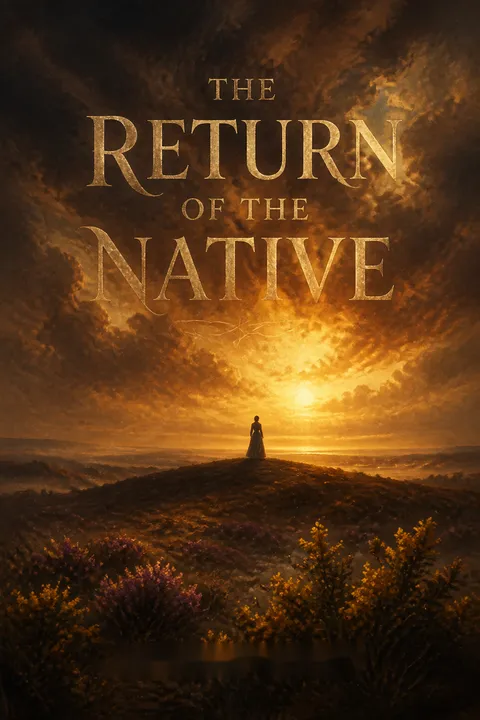


Plot Summary
The Wedding That Failed
As November darkness gathers over Egdon Heath, reddleman Diggory Venn carries the exhausted Thomasin Yeobright in his van toward her aunt’s home. Her wedding to Damon Wildeve has failed because their marriage license is valid for the wrong town.
Thomasin had fled Anglebury rather than return beside Wildeve, and Mrs. Yeobright receives her with anger sharpened by fear of local gossip. At Rainbarrow, meanwhile, the heathfolk celebrate their bonfire and discuss the marriage.
Venn’s red-stained figure alarms them, but a more troubling discovery comes later: Johnny Nunsuch, the boy who tended Eustacia Vye’s fire, tells Venn that she met Wildeve there. Venn realizes the failed ceremony may have less to do with paperwork than with Wildeve’s divided loyalties.
The opening binds intimate trouble to a landscape that seems older than anyone living on it. Yet the heath does not cause the failed wedding; people do, through carelessness, pride, and choices concealed from one another. Thomasin’s public vulnerability contrasts with the villagers’ ease in turning private pain into talk. Venn enters as an outsider whose red trade makes him a spectacle, but his attention is unusually precise. By noticing the connection between Eustacia and Wildeve, he begins to act where others merely speculate.
Three Claims on Wildeve
Venn has loved Thomasin for years, though she once rejected him, and he now tries to protect her from Wildeve’s indecision. He visits Eustacia and urges her to release Wildeve, offering to arrange a position in Budmouth that would take her away from Egdon. Eustacia refuses both the bargain and the idea that Venn can direct her life.
Mrs. Yeobright then tells Wildeve that another suitor may marry Thomasin, hoping to force him to make a clear choice. Wildeve instead visits Eustacia and proposes that they leave for America. She postpones her answer, recognizing that his renewed urgency may come from losing Thomasin rather than from deeper devotion. News that Clym Yeobright is returning from Paris gives Eustacia a new object for her longing.
Each character mistakes a different form of leverage for freedom. Venn offers practical rescue, but Eustacia experiences the offer as another person arranging her future. Mrs. Yeobright uses the possibility of a rival to protect Thomasin, only to intensify the instability she hopes to end. Wildeve’s appetite rises when something is withheld, while Eustacia’s pride depends on being chosen above another woman. The emerging triangle is therefore not simply a contest for affection. It is a collision between security, autonomy, and the intoxicating feeling of being desired.
The Turkish Knight
Clym returns to Blooms-End after years in Paris, and Eustacia begins imagining him as a passage from Egdon into a larger life. She has not yet seen his face when his voice and the villagers’ accounts fill her thoughts.
At Christmas, she persuades the young mummer Charley to lend her his Turkish Knight costume, then joins the troupe visiting the Yeobright home. Behind the ribbons masking her face, she watches Clym serve supper and tries to measure the man against her romantic vision.
Clym recognizes that the performer is a woman and speaks with her outside. Eustacia admits that she sought excitement, but conceals the deeper reason for her disguise. Their strange meeting leaves her more fascinated, while Clym is curious about the cultivated stranger who chose a boy’s part.
Eustacia’s disguise is both a route into society and a shield against being seen too clearly. She wants Clym’s attention, yet approaches him as an invented figure rather than as herself. The gap between her fantasy and his actual character is established early: she imagines a man who can restore the pleasures of the world she misses, while he is already questioning conventional success. Their attraction begins not in shared knowledge but in projection, a fragile arrangement that gives each of them room to imagine the other into a desired shape.
A Wedding Witness
After the Christmas gathering, Eustacia sends Wildeve a letter ending their secret connection and returns the small gifts he gave her. Venn carries it, although helping Thomasin marry Wildeve means assisting the man who has taken the woman he loves.
Wildeve reads the letter as a final loss and hurries to Blooms-End, where Thomasin agrees to marry him privately. She wants the humiliation of the failed ceremony put behind her before Clym learns the full story.
On the wedding morning, Eustacia happens to be near the church and is asked to serve as witness. Wildeve believes her presence is a display of regret; in truth, she is glad Thomasin’s marriage is secure. Venn, having watched Thomasin marry, leaves Egdon without revealing his own sacrifice.
The scene reverses the expected rivalry. Eustacia relinquishes Wildeve not because she has become morally serene, but because her desire has shifted toward Clym and she can now act generously toward Thomasin. Venn’s choice is more costly: he helps complete a marriage that forecloses his own hope. Thomasin accepts a wedding arranged under pressure from reputation as much as affection. Hardy makes kindness, pride, and self-interest coexist within the same actions, so that a public ceremony settles appearances without settling the emotional debts beneath them.
Clym Chooses Egdon
Clym tells the heathfolk that he has left the diamond business because he wants to educate people who have been denied learning. His mother, Mrs. Yeobright, fears he is throwing away a secure future for an impractical scheme. After hearing that Eustacia has been stabbed with a needle in church by Susan Nunsuch, who believes her a witch, Clym goes to Mistover to help recover Captain Vye’s well bucket.
There he meets Eustacia properly, sees her injured arm, and offers to involve her in his educational work. She is moved by his sympathy but cannot share his attachment to the heath or his contentment with modest aims. Their interest deepens, even as their different ideas of a good life become visible.
Clym’s return is not a retreat into nostalgia. He rejects the profitable trade in luxury goods because he believes knowledge should reach people who cannot buy access to it. His idealism gives purpose to his homecoming, but it also risks turning other people into instruments of his moral plan. Eustacia sees his learning and gentleness as signs of a wider world, while he sees her suffering as a reason to include her in useful work. They are drawn together by qualities that each interprets differently, and the mismatch is already shaping their future.
Marriage Against Advice
Clym and Eustacia meet secretly through the winter and fall deeply in love. When he asks her to marry him, she agrees while hoping that he may eventually return to Paris. Mrs. Yeobright opposes the match, distrustful of Eustacia’s restlessness and worried that Clym has mistaken attraction for a sound future. A bitter argument leaves mother and son estranged.
Eustacia and Clym marry quickly, then move to a small cottage near East Egdon while he prepares to open a school in Budmouth. Clym believes the arrangement is temporary; Eustacia expects their shared life to lead toward a more expansive world. Their wedding joins them legally, but their opposing expectations remain unspoken and unresolved.
Clym’s marriage is an act of loyalty to his own judgment, but he makes it at the precise moment when his mother needs reassurance and conversation. Eustacia’s consent is sincere, yet it rests partly on an imagined future Clym has never promised. Their conflict is not reducible to a bad choice by one person: he assumes that purpose can sustain a household, while she assumes that love may eventually restore the life she wants. The haste of the wedding gives them intimacy before they have tested whether their hopes can inhabit the same home.
The Furze-Cutter’s Life
Clym studies late into the night to prepare for teaching, but severe eye inflammation leaves him unable to read for an uncertain length of time. To avoid living on their savings, he begins cutting furze with Humphrey, work he finds honest and calming. Eustacia sees the occupation as a humiliating collapse of the future she expected, while Clym regards it as useful labor during a temporary setback.
Their arguments expose the distance between them. At a village dance, Eustacia, desperate to escape her isolation, accepts Wildeve as a partner. The moonlit dancing rekindles their old attraction. Clym meets them on the walk home with Venn, though his impaired sight prevents him from seeing Wildeve leave Eustacia’s side.
Clym experiences physical limitation as a change in circumstance, not a collapse of identity. Eustacia experiences the same event as the destruction of a future she believed marriage would deliver. Their disagreement over furze cutting is therefore about status and hope as much as income. The dance reveals how readily desire returns when it is intensified by secrecy and deprivation. Eustacia’s renewed closeness to Wildeve does not erase her attachment to Clym, but it exposes the instability of a marriage built around incompatible definitions of a worthwhile life.
The Door Left Shut
Mrs. Yeobright decides to visit Clym and Eustacia, hoping to repair the estrangement. On the hot walk to their cottage, she follows a furze cutter who turns out to be her son. Before she reaches the door, Wildeve arrives to see Eustacia. Clym, exhausted from work, sleeps inside. Eustacia sees Mrs. Yeobright at the window but does not open the door at her first knock, believing Clym will answer.
When she discovers he has not, she opens it, but Mrs. Yeobright has already gone. The older woman interprets the closed door as deliberate rejection and struggles home through the heat. An adder bites her, and she collapses before reaching Blooms-End. Clym finds her, but she dies after the neighbors gather.
The tragedy grows from a narrow interval between intention and perception. Eustacia’s hesitation is real, and her assumption that Clym will answer is mistaken; Mrs. Yeobright has no way to know either fact. Her exhaustion and the adder bite turn an emotional injury into a physical emergency. The scene resists a simple verdict because no single action alone explains the death, yet the door becomes its morally charged center. Hardy shows how a private misunderstanding can acquire irreversible force when pride, fatigue, and distance prevent anyone from checking what the other person meant.
The Boy’s Account
Clym falls gravely ill with grief, especially after Johnny Nunsuch repeats Mrs. Yeobright’s dying description of herself as rejected by her son. Thomasin tries to comfort him, while Eustacia hides her knowledge that she saw the older woman at the window. Weeks later, Johnny tells Clym that Mrs. Yeobright first went to the cottage, saw a man enter, and then found Eustacia looking out without opening the door.
Clym confronts his wife. Eustacia admits that she failed to answer the first knock and insists she would have opened the door later, but she will not explain that Wildeve was there. Clym sees the silence as betrayal. Eustacia leaves him and returns to Captain Vye’s house at Mistover.
The discovery converts Clym’s grief into accusation, but it does not provide the complete knowledge he wants. Eustacia’s partial confession is true and inadequate: she accepts responsibility for the delay while concealing Wildeve’s presence, partly to protect herself and partly because she refuses to submit to Clym’s interrogation. Clym, in turn, treats uncertainty as proof of the worst. Their confrontation shows how shame narrows speech until honesty becomes harder than concealment. The result is not reconciliation but a separation in which each believes the other has made repair impossible.
A Fire Calls Wildeve
At Mistover, Eustacia sinks into despair and briefly considers taking one of Captain Vye’s pistols. Charley, the stable lad, removes the weapons after noticing her attention and stays near her. Meanwhile, Wildeve inherits a fortune of eleven thousand pounds. Eustacia hears of his new wealth and imagines that it could make escape possible, though she is still reluctant to depend on him.
On Guy Fawkes night, Charley lights a bonfire without knowing that its old meaning has returned for Eustacia. Wildeve answers with a signal. He comes to the bank, listens as she explains her separation from Clym, and agrees to drive her to Budmouth so she can travel on alone. She sets the hour and leaves the decision to herself.
Eustacia’s crisis is shaped by a contradiction between wanting escape and fearing the terms on which escape can be bought. Wildeve’s inheritance appears to transform him, but the money chiefly changes what she can imagine doing with him. Charley’s intervention is protective without being controlling: he removes a means of self-harm and lets her remain in the house. The bonfire then revives an earlier language of secret signals, giving Eustacia a practical plan at a moment when her ordinary options feel exhausted. Hope arrives, but it is entangled with dependence and secrecy.
The Letter Never Delivered
At Blooms-End, Clym’s anger begins to soften, and he writes Eustacia a letter asking her to return without further punishment. He gives it to Timothy Fairway, who forgets it in his hat and delivers it to Captain Vye late that night. The captain leaves it downstairs because Eustacia seems asleep. She has already signaled Wildeve and, before midnight, slips out into heavy rain with a small bundle.
At the Quiet Woman, Thomasin grows suspicious when Wildeve claims he must travel overnight and secretly takes money from their chest. She carries her baby to Clym’s house and asks him to stop her husband. Captain Vye arrives with news of Eustacia’s earlier despair. Clym and the captain set out through the storm toward Wildeve.
The undelivered letter is not a magical missed chance so much as the final consequence of habits already established: Clym delays speaking, Eustacia has stopped trusting his welcome, and the people around them act on incomplete knowledge. Thomasin’s alarm is grounded in small observations, including the hour and the unexplained money, rather than certainty about Wildeve’s intent. The storm brings these separate routes into one exposed landscape. Each character is trying to prevent a loss, but none knows enough to coordinate with the others before events outrun them.
The Weir Takes Three
Near Shadwater Weir, Clym and Wildeve hear a body fall into the river and rush toward the pool below the hatches. Clym recognizes Wildeve and accuses him of leading Eustacia away, then both men enter the water when they see a figure caught in the current. Diggory Venn reaches the weir with Thomasin, who carries the baby.
Venn finds Clym and Wildeve submerged and uses a floating hatch to pull them toward shallow water. After other men help lift them out, Venn returns to search the pool. He finds Eustacia’s body beneath the water. Thomasin brings the child to safety, but Eustacia and Wildeve cannot be revived. Clym survives, awakening to a world in which his mother and wife are both gone.
The climax turns the novel’s recurrent misreadings into physical danger. Clym and Wildeve, rivals in love and judgment, become equally helpless in the same current; Venn’s practical knowledge and composure make the difference between rescue and another death. Eustacia’s fall remains uncertain in its precise cause, but the novel has prepared the reader for her despair and for the danger of her night journey. Water does not deliver a moral sentence. It overwhelms bodies indiscriminately, leaving the survivors to interpret what happened without the certainty they crave.
The Survivors’ Inheritance
Thomasin mourns Wildeve despite his failures, and his daughter, also named Eustacia, becomes the center of her life. Because Wildeve dies without a will and is his uncle’s heir, the estate eventually passes to Thomasin and the child, leaving them financially secure. Thomasin settles at Blooms-End as Clym’s tenant, while he confines himself to rooms upstairs and continues to blame himself for the deaths around him.
His eyesight improves only enough for limited work. He walks Egdon alone, revisiting places that hold memories of his mother and Eustacia. Thomasin’s gradual recovery comes through ordinary seasons and the needs of her child; Clym finds no comparable release, and turns his grief into a private reckoning with the past.
The aftermath refuses the idea that money can repair emotional damage. Wildeve’s fortune gives Thomasin and her child security, but it cannot restore the household or clarify the intentions that ended in tragedy. Thomasin’s care for her daughter creates a forward-moving routine, while Clym’s habit of self-blame keeps him bound to scenes he cannot change. Their shared home preserves kinship without dissolving grief. Hardy presents survival not as triumph but as unequal adaptation: one life gathers around daily responsibilities, while another remains organized by the question of what might have been done differently.
Rainbarrow Becomes a Pulpit
After some time away, Venn returns to Egdon as a prosperous dairy farmer, his skin finally clear of reddle. Thomasin welcomes him, and their affection grows into a marriage. Clym attends the service but avoids the celebration, unable to join a happiness that recalls what he has lost.
He has abandoned his earlier plan for a school because his sight cannot support it, yet he finds a different vocation in open-air preaching and public lectures. On Rainbarrow, where Eustacia once stood alone to signal a lover, Clym addresses the heathfolk from the same exposed height. His work is modest and imperfectly received, but it gives his days a purpose beyond remorse.
The closing movement does not restore the original family arrangement. Thomasin and Venn build a quieter household, while Clym remains near them but emotionally apart. The hill’s change from signal point to pulpit marks a shift in how Clym uses the landscape: he once returned to Egdon with an abstract plan to educate, then lost the capacity to carry it out, and now speaks publicly from the place most associated with longing and isolation. His vocation offers direction, not absolution. The ending permits renewed life while refusing to make it a cure for the dead.
Analysis
The Return of the Native turns on the distance between what people intend and what others can reasonably infer. A failed license becomes public humiliation; a closed door becomes evidence of rejection; a delayed letter arrives after its recipient has left; a walk toward rescue becomes a fatal encounter at the weir. These are not arbitrary misunderstandings. They emerge from pride, class expectations, secrecy, physical distance, and the characters’ habits of imagining other minds instead of asking directly.
Egdon Heath intensifies this problem without causing it. Its remoteness gives the characters privacy, but it also makes news travel slowly and makes help difficult to reach. The heath’s apparent permanence throws human projects into relief: Clym returns believing he can improve lives, Eustacia longs to escape, and Thomasin tries to preserve a household. Each reads the same place through a different need. The landscape is neither punishment nor refuge in itself; it becomes one or the other according to the life a person is trying to live there.
The novel’s romantic conflicts are also conflicts over agency. Eustacia wants more than a husband, she wants access to a vivid world in which her intelligence and appetite can matter. Her longing is legitimate, but she often treats other people as possible vehicles for escape. Clym’s self-denial is ethically serious, yet he assumes his chosen simplicity can serve as a shared good. Thomasin seeks security and respectability, while Venn’s love asks for little in return. Wildeve, drawn toward what is unavailable, destabilizes every arrangement he enters. None is free of self-deception, but their choices carry unequal costs, especially for women whose reputations and finances are judged by others.
Hardy refuses easy moral bookkeeping. Eustacia’s hesitation contributes to Mrs. Yeobright’s despair, but the death also depends on exhaustion, an adder bite, and the failure of both women to understand each other. Clym’s remorse acknowledges harm while becoming another form of self-absorption. The ending offers work, marriage, and a child as ways life continues, not as repairs for the dead. Its deepest lesson is not that desire must be suppressed, but that private conviction becomes dangerous when it replaces communication and when social conditions leave too little room to revise a choice.
Review Summary
The Return of the Native is praised for its vivid descriptions of Egdon Heath and complex characters, particularly Eustacia Vye. Readers appreciate Hardy's poetic prose and exploration of themes like fate, societal expectations, and the clash between tradition and modernity. The novel's tragic elements and melodramatic plot are noted, with some finding it more accessible than other Hardy works. Alan Rickman's audiobook narration is highly regarded. While some find the pacing slow initially, many consider it a rewarding read that showcases Hardy's masterful storytelling and character development.
People Also Read

Characters
Eustacia Vye
The heath’s restless queenEustacia is the granddaughter of Captain Vye and an outsider on Egdon Heath, where she lives far from the lively seaside world of Budmouth that formed her early imagination. Intelligent, proud, and intensely responsive to beauty, she longs for passionate love and a life of movement, culture, and consequence. Her need for escape can make her perceptive about confinement and reckless about the people caught in her plans. She does not simply want a particular man; she wants the sensation of being chosen by someone capable of carrying her beyond the limits of her surroundings. Her deepest conflict lies between independence and dependence: she resists being managed, yet repeatedly hopes another person will provide the life she cannot reach alone.
Clym Yeobright
The idealist who comes homeClym is Mrs. Yeobright’s son and Thomasin’s cousin. After building a career in the Paris diamond trade, he returns to Egdon convinced that education and service matter more than wealth. He is earnest, reflective, and willing to surrender status for work he considers meaningful, but his moral certainty can become stubbornness. Clym loves deeply and expects purpose to make hardship bearable; he is less able to see how another person may experience the same hardship as confinement. His attachment to his mother and his wish to live by his principles pull against each other, while his relationship with Eustacia tests whether affection can bridge radically different visions of happiness.
Thomasin Yeobright
The gentle survivorThomasin is Mrs. Yeobright’s niece and Clym’s cousin. Gentle, modest, and socially vulnerable, she is often treated as someone whose future must be arranged by more forceful people. Yet beneath her apparent pliability is a practical resolve: she understands the value of reputation, family loyalty, and economic security, and she can make difficult choices without dramatizing them. Her affection is generous, though it can make her reluctant to confront a husband directly. Thomasin’s life is shaped by the contrast between how others judge her and how she understands her own conduct. She keeps trying to preserve connection, even when the people around her make that task painful.
Diggory Venn
The red-stained guardianDiggory Venn is a capable young former dairy farmer who travels as a reddleman, selling the red pigment used on sheep. His trade stains his appearance and isolates him from ordinary society, but his mind is observant, strategic, and unusually patient. He loves Thomasin without demanding that she return his feelings, a restraint that shapes many of his choices. Venn can also be manipulative and rough when he believes someone vulnerable needs protection, making his loyalty morally complicated rather than saintly. Beneath the vivid disguise is a man who accepts obscurity and inconvenience more readily than he accepts another person’s suffering.
Damon Wildeve
The restless innkeeperWildeve owns the Quiet Woman Inn and was trained as an engineer before abandoning that profession. Charming, clever, and emotionally changeable, he is attracted to what he cannot securely possess and can mistake jealousy for devotion. He wants to be admired, yet resents obligations that limit his freedom. His courtship of Thomasin and his earlier attachment to Eustacia reveal a man capable of tenderness but unreliable when practical consequences arrive. Wildeve is not a simple villain: he can show tact and generosity, but his self-interest repeatedly competes with his better impulses. He is most vulnerable when a rival, a refusal, or a lost possibility makes desire feel newly urgent.
Mrs. Yeobright
A proud, protective motherMrs. Yeobright is Clym’s mother and Thomasin’s aunt, a capable widow whose pride reflects both her family responsibilities and her genteel upbringing. She wants Thomasin protected from disgrace and Clym protected from choices she believes will waste his abilities. Her judgments are often perceptive, but love makes her controlling, and her reserve can keep affection from reaching the people who most need to hear it. She regards practical security as a form of care, while Clym regards sacrifice for a principle as a higher good. Their closeness makes disagreement especially painful.
Captain Vye
Eustacia’s indulgent grandfatherCaptain Vye is Eustacia’s grandfather, a retired naval man who lives with her at isolated Mistover. He is fond of her and allows her considerable freedom, but he rarely probes the emotional life behind her moods. His memories of the sea and his blunt judgments give him a worldliness distinct from the heathfolk, though he is not equipped to guide Eustacia through her romantic hopes. His protection is affectionate but intermittent, shaped by an old man’s wish to be left to his own habits.
Charley
The devoted stable ladCharley works at Captain Vye’s home and carries a quiet, idealized affection for Eustacia. She once allows him to hold her hand in exchange for lending her a mumming costume, an intimacy he remembers long after the brief encounter. His reverence makes him attentive to her distress, though he understands little of the forces shaping it. Charley’s devotion is expressed through practical acts and watchfulness rather than bold declarations.
Christian Cantle
The anxious village jokerChristian is Grandfer Cantle’s nervous, superstitious son. He is easily frightened and eager to believe in luck, omens, and supernatural explanations, yet he wants to be useful and welcomed by the community. His insecurity makes him susceptible to persuasion, especially when someone presents risk as a chance to prove himself. Christian’s comic manner never removes the consequences of his choices.
Johnny Nunsuch
The child who witnessesJohnny is Susan Nunsuch’s young son, a shy child who tends Eustacia’s bonfire and wanders the heath. He is easily frightened by unfamiliar sights, but he remembers what he sees with an unvarnished directness. Adults often use his words to support beliefs he does not understand, including local superstition. His small observations become important because grown people fail to speak plainly to one another.
Susan Nunsuch
The fearful village motherSusan is Johnny’s mother and one of the heath’s working women. She believes Eustacia’s presence has harmed her child and acts on that fear rather than on evidence. Her suspicion grows from a community ready to label a solitary, unconventional woman dangerous. Susan is capable of care and fierce protection, but anxiety turns those qualities toward cruelty.
Timothy Fairway
The heath’s practical voiceTimothy is a furze cutter and one of the community’s most familiar voices. He carries local news, takes part in the heath’s customs, and often moderates the group’s judgments with dry humor. His practical knowledge and sense of social belonging contrast with the isolation of Eustacia and Clym. Fairway is not an authority on the protagonists’ private motives, but his actions can affect the timing and movement of crucial messages.
Grandfer Cantle
The boastful old revelerGrandfer Cantle is Christian’s elderly father, a former soldier who enjoys singing, dancing, and retelling stories about his youth. His cheerfulness can make him seem oblivious, but it gives the community a continuing appetite for celebration even in hard times.
Humphrey
Clym’s fellow furze cutterHumphrey is a local laborer who teaches Clym the practical work of cutting furze. He represents the grounded knowledge of people who understand the heath through daily work, not romantic ideal or abstract theory.
Olly Dowden
The kindly besom makerOlly makes heath brooms and moves easily among the local households. Her instinct is to be civil and helpful, and she often offers a plain kindness amid the community’s gossip and suspicion.
Plot Devices
Egdon Heath
A landscape of limitsEgdon is not merely the setting but the physical and social world that shapes the characters’ choices. Its scattered homes, difficult paths, and long distances make private encounters hard to verify and make travel a real undertaking. The heath also carries the force of continuity: people arrive with plans, desires, and grievances, while the ground appears to persist beyond them. Characters read it differently. Clym finds familiarity and strength there; Eustacia experiences confinement; Thomasin knows its routes through habit; Venn uses its obscurity to watch and move unseen. The landscape magnifies human decisions without acting as a moral judge.
Bonfire signals
Secret calls across darknessEustacia uses bonfires on the bank near Mistover to draw Wildeve to private meetings. The fire is visible across the heath, allowing a distant signal without a letter or messenger. Its meaning depends on shared history, so an ordinary Guy Fawkes celebration can become a personal summons. The signal returns at pivotal moments, first tying Eustacia to Wildeve and later helping her arrange a possible escape from Egdon. The device makes communication vivid but incomplete: a flame can summon someone, yet it cannot explain a change of heart or guarantee that the person waiting understands the sender’s true intentions.
The reddleman disguise
Color as concealmentDiggory Venn’s sheep pigment stains his face, clothes, and equipment, making him immediately recognizable and socially strange. The trade also gives him a reason to travel and camp across the heath without attracting the questions that would follow an ordinary visitor. His bright appearance conceals a careful observer: he listens, watches paths, and quietly intervenes in Thomasin’s affairs. The red stain becomes a practical disguise when he needs to approach people or remain unnoticed, while its threatening look feeds local superstition. When Venn later gives up the trade, his altered appearance signals a return to ordinary rural life and a change in how the community can see him.
The delayed letter
A reconciliation that arrives lateClym writes Eustacia a letter asking her to return and promising not to reopen their quarrel. He entrusts it to Timothy Fairway, who forgets it in his hat and delivers it to Captain Vye only late at night. The captain sees Eustacia apparently asleep and leaves the letter downstairs. She departs without reading it. The message matters because it offers a possible change in Clym’s position, but the delay also exposes how much the couple’s relationship depends on assumptions rather than direct contact. The letter cannot repair what its writer and recipient have not managed to say face to face.
The family guineas
Money becomes a test of trustMrs. Yeobright divides inherited guineas between Thomasin and Clym, intending to give each a measure of independence. Christian carries the money to Mistover but is drawn into gambling with Wildeve, who wins it. Venn challenges Wildeve and recovers most of the gold, but mistakenly gives the entire sum to Thomasin. The episode exposes Wildeve’s resentment, Christian’s credulity, and Venn’s imperfect knowledge, while the missing portion contributes to the later misunderstanding between Mrs. Yeobright and Eustacia. The money is modest beside Wildeve’s later inheritance, yet it carries the weight of family trust and of who is considered entitled to manage another person’s property.
FAQ
Synopsis & Basic Details
What is The Return of the Native about?
- A Tale of Unfulfilled Desires: The Return of the Native centers on Clym Yeobright, who returns to his ancestral home on Egdon Heath from Paris with idealistic plans to become a schoolmaster. His arrival ignites a complex web of passions and conflicts among the heath's inhabitants, particularly the beautiful and restless Eustacia Vye, who yearns for a life of glamour and escape from the desolate heath.
- Love Triangles and Societal Constraints: The narrative explores the intertwined fates of Clym, Eustacia, Thomasin Yeobright (Clym's gentle cousin), and Damon Wildeve (Thomasin's fickle husband and Eustacia's former lover). Their romantic entanglements are constantly thwarted by personal ambitions, societal expectations, and the unyielding, almost sentient, landscape of Egdon Heath.
- The Heath as a Character: More than just a setting, Egdon Heath acts as a powerful, brooding character, symbolizing fate, isolation, and the unchanging nature of existence. It both shapes and reflects the characters' inner lives, ultimately playing a crucial role in their tragic destinies and the novel's exploration of human longing and disillusionment.
Why should I read The Return of the Native?
- Deep Psychological Insight: Thomas Hardy masterfully delves into the inner lives of his characters, exploring their complex motivations, desires, and flaws. Readers gain a profound understanding of human nature, particularly the struggle between individual aspirations and the forces of fate and environment. This psychological depth makes The Return of the Native a compelling read.
- Rich Symbolism and Atmosphere: The novel is renowned for its evocative descriptions of Egdon Heath, which functions as a powerful symbol of primal nature, isolation, and the indifference of the universe. Hardy's atmospheric prose creates a vivid, almost palpable sense of place that deeply impacts the characters and the reader.
- Tragic Yet Thought-Provoking Themes: The Return of the Native explores enduring themes such as the clash between nature and civilization, the pursuit of happiness, the destructive power of unfulfilled ambition, and the limitations of human will. Its tragic events offer a poignant commentary on the human condition, prompting reflection long after the final page.
What is the background of The Return of the Native?
- Victorian Era Rural Life: Set between 1840 and 1850, the novel vividly portrays rural life in Wessex, England, during the Victorian era. This period saw significant social and economic changes, but Egdon Heath remains largely untouched, representing a resistance to modernity and a clinging to ancient customs and superstitions. The contrast between traditional rural existence and the allure of urban sophistication (like Paris or Budmouth) is central to the characters' conflicts.
- Hardy's Wessex Novels: The Return of the Native is one of Thomas Hardy's most celebrated "Wessex novels," a series of works set in a fictionalized version of Dorset, England. Hardy drew heavily on the landscape, dialect, and folklore of his native region, imbuing his stories with a strong sense of place and a deep connection to the land. The heath itself is a composite of several real-life Dorset heaths.
- Philosophical Underpinnings: Hardy's writing is often characterized by a deterministic worldview, where characters are often victims of fate, circumstance, and their own flawed natures. The novel reflects contemporary philosophical debates on free will versus determinism, and the impact of environment on human destiny, often with a pessimistic outlook on human happiness.
What are the most memorable quotes in The Return of the Native?
- "A Saturday afternoon in November was approaching the time of twilight, and the vast tract of unenclosed wild known as Egdon Heath embrowned itself moment by moment.": This opening line immediately establishes the dominant presence of Egdon Heath, setting a somber, atmospheric tone that foreshadows the novel's tragic events. It highlights the heath's role as a central, almost living, entity in the story.
- "To be loved to madness—such was her great desire. Love was to her the one cordial which could drive away the eating loneliness of her days.": This quote encapsulates Eustacia Vye's fervent longing for passionate love and escape, revealing the depth of her emotional needs and her desperate search for fulfillment. It defines her character and foreshadows the intensity of her romantic pursuits.
- "The truth seems to be that a long line of disillusive centuries has permanently displaced the Hellenic idea of life, or whatever it may be called. What the Greeks only suspected we know well; what their Aeschylus imagined our nursery children feel.": This profound philosophical statement from the narrator reflects Clym Yeobright's disillusionment with traditional notions of happiness and progress. It speaks to the novel's broader themes of existential weariness and the shift in human consciousness from ancient ideals to modern anxieties.
What writing style, narrative choices, and literary techniques does Thomas Hardy use?
- Omniscient and Philosophical Narration: Hardy employs a highly omniscient narrator who not only recounts events but also frequently interjects with philosophical reflections, psychological analyses, and historical context. This narrative voice often adopts a detached, almost cosmic perspective, emphasizing the insignificance of human struggles against the backdrop of vast, indifferent nature, as seen in the extensive descriptions of Egdon Heath.
- Detailed Naturalism and Symbolism: Hardy's style is characterized by meticulous, often poetic, descriptions of the natural world, particularly Egdon Heath. These descriptions are not merely decorative; they are deeply symbolic, reflecting the characters' inner states, foreshadowing events, and embodying thematic concerns like fate, isolation, and the primitive. For example, the heath's "swarthy monotony" mirrors Eustacia's despair.
- Tragic Irony and Determinism: A pervasive sense of tragic irony underscores the narrative, where characters' best intentions often lead to their downfall, and fate seems to conspire against their happiness. Hardy frequently uses foreshadowing and dramatic irony to highlight the characters' limited agency, suggesting a deterministic universe where human will is often powerless against larger forces.
Hidden Details & Subtle Connections
What are some minor details that add significant meaning?
- Christian Cantle's "No Moon, No Man" Superstition: Grandfer Cantle's son, Christian, is described as being born "no moon," leading to the local saying, "'No moon, no man.' 'Tis one of the truest sayings ever spit out. The boy never comes to anything that's born at new moon." This seemingly throwaway detail about Christian's birth and his subsequent social awkwardness subtly introduces the pervasive influence of superstition and fatalism on Egdon Heath, hinting at how such beliefs can shape a person's self-perception and destiny.
- The Inn Sign of "The Quiet Woman": The inn where Wildeve resides bears a gruesome sign depicting "a matron carrying her head under her arm, beneath which gruesome design was written the couplet... 'SINCE THE WOMAN'S QUIET LET NO MAN BREED A RIOT.'" This macabre detail is a dark foreshadowing of the tragic fates awaiting the women in the story, particularly Eustacia, whose passionate nature ultimately leads to her demise. It also subtly comments on societal expectations for female submission.
- Clym's Eye Ailment and the Moth: Clym's eye inflammation, caused by his intense night studies, is a physical manifestation of his intellectual ambition clashing with the harsh realities of Egdon. Later, Wildeve uses a moth flying into a candle flame as a signal to Eustacia. This seemingly minor detail connects to Clym's affliction, symbolizing the destructive allure of passion and ambition, and foreshadowing the fatal attraction that draws Eustacia to her doom, much like the moth to the flame.
What are some subtle foreshadowing and callbacks?
- Eustacia's Hourglass and Telescope: Early in the novel, Eustacia is often seen with her grandmother's hourglass and grandfather's telescope. The hourglass, which she watches "time's gradual glide away," subtly foreshadows her preoccupation with the fleeting nature of life and her desperate desire to seize happiness before it's gone. The telescope, used to spy on Wildeve, foreshadows her active, often manipulative, role in her own destiny, and her yearning for a wider world beyond Egdon.
- The Bonfires as Signals and Omens: The bonfires lit on Guy Fawkes Night serve as a recurring motif. Eustacia lights one as a signal for Wildeve, recalling an earlier, similar signal. This callback emphasizes the cyclical nature of their illicit affair and Eustacia's persistent longing for Wildeve, even after her marriage to Clym. The fires also symbolize fleeting passion and destructive forces, foreshadowing the eventual conflagration of their lives.
- The Heath-Croppers' Behavior: The wild ponies, or "heath-croppers," are frequently mentioned. Their untamed nature and tendency to stray into cultivated lands subtly mirror the characters' own wild impulses and their inability to conform to societal norms. When Wildeve is tripped by tied-together heath tufts, it's a direct intervention by Venn, but also a symbolic representation of the heath itself resisting Wildeve's "errant tastes," foreshadowing the heath's ultimate role in the characters' fates.
What are some unexpected character connections?
- Diggory Venn's Unseen Influence: Diggory Venn, the reddleman, initially appears as a peripheral figure, but his actions subtly yet profoundly influence the main characters' lives. His unrequited love for Thomasin drives him to protect her, leading him to intervene in Wildeve's affairs and even to act as a matchmaker for Thomasin and Wildeve. His presence as an "invisible guardian" connects him to all major characters, often without their knowledge, making him a silent orchestrator of events.
- Charley's Unspoken Devotion to Eustacia: The young stable lad, Charley, develops a deep, almost worshipful, affection for Eustacia. His willingness to participate in her mumming disguise and his later act of hiding her pistols to prevent her suicide reveal a profound, selfless devotion that contrasts sharply with the more self-serving loves of Wildeve and Clym. This connection highlights Eustacia's captivating allure and the diverse ways she impacts those around her, even those she barely acknowledges.
- Mrs. Yeobright's Unrecognized Intuition: Despite her seemingly rigid and conventional nature, Mrs. Yeobright possesses a keen, almost intuitive understanding of character and future events. Her initial disapproval of Wildeve and her later misgivings about Eustacia prove tragically accurate. Her "singular insight into life, considering that she had never mixed with it," connects her to the deeper, primal wisdom of the heath, making her a Cassandra-like figure whose warnings go unheeded.
Who are the most significant supporting characters?
- Diggory Venn, the Reddleman: Diggory Venn is arguably the most significant supporting character, acting as a moral compass and a silent guardian. His distinctive red appearance makes him an outsider, yet he is deeply embedded in the heath's life. His unwavering love for Thomasin drives much of the plot, leading him to make sacrifices and strategic interventions that directly impact the fates of Eustacia, Clym, and Wildeve. His transformation from reddleman to dairyman symbolizes his eventual integration and reward.
- Grandfer Cantle: Grandfer Cantle, with his jovial yet often inappropriate pronouncements, serves as a voice of traditional Egdon life and a source of comic relief. His anecdotes and songs provide historical and cultural context, grounding the narrative in the heath's ancient customs. He also inadvertently reveals crucial information through his garrulous nature, highlighting the pervasive gossip and interconnectedness of the small community.
- Susan Nunsuch: Susan Nunsuch embodies the superstitious and darker aspects of Egdon Heath's folk culture. Her belief in Eustacia as a witch and her subsequent act of pricking Eustacia with a needle illustrate the destructive power of fear and ignorance. Her character highlights the clash between modern sensibilities and ancient beliefs, and her actions directly contribute to the tragic chain of events.
Psychological, Emotional, & Relational Analysis
What are some unspoken motivations of the characters?
- Eustacia's Fear of Mediocrity: Beyond her explicit desire for a glamorous life in Paris, Eustacia's deepest unspoken motivation is a profound fear of mediocrity and insignificance. Her passionate nature and striking beauty make her feel destined for something grander than Egdon Heath can offer. This fear drives her reckless choices, her pursuit of Clym (initially seen as a "visitant from a gay world"), and her inability to find contentment in a simple life, ultimately leading to her tragic end.
- Clym's Subconscious Desire for Redemption: While Clym explicitly states his desire to educate the heathfolk, a deeper, unspoken motivation seems to be a form of self-punishment or redemption. His rejection of the diamond trade and his embrace of a humble, self-sacrificing life on the heath can be interpreted as an atonement for his past "effeminate" existence in Paris and a subconscious attempt to reconnect with a more authentic, perhaps even ascetic, self. This drive is intensified by his later guilt over his mother's death.
- Wildeve's Need for Constant Validation: Damon Wildeve's fickle affections and his tendency to pursue women who are difficult to obtain stem from an unspoken need for constant validation. He is drawn to Eustacia precisely because she is elusive and challenging, and his interest wanes once she is "secure." His gambling, too, reflects this need for excitement and the thrill of the chase, rather than a genuine desire for wealth, as he is "weary of that offered" and "care for the remote."
What psychological complexities do the characters exhibit?
- Eustacia's Epicurean Sensuousness vs. Intellectual Apathy: Eustacia is a complex blend of intense sensuousness and intellectual apathy. She craves "music, poetry, passion, war, and all the beating and pulsing that are going on in the great arteries of the world," yet she shows little interest in Clym's intellectual pursuits or the practicalities of life. Her "pagan eyes" and "flamelike" soul suggest a primal, almost animalistic, connection to emotion, but her mind struggles with the "chastened sublimity" of the heath, leading to profound depression and a sense of being "banished."
- Clym's Idealism vs. Practicality: Clym Yeobright embodies the psychological complexity of an idealist struggling with practical realities. His vision of educating the heathfolk is noble, but his "well-proportioned mind" is also "unfortunate" because "the rural world was not ripe for him." His intellectual pursuits lead to physical blindness, symbolizing the tragic irony of his efforts. He is "permeated with [the heath's] scenes, with its substance, and with its odours," yet his Parisian experiences have instilled in him a desire for progress that clashes with the heath's ancient permanence.
- Mrs. Yeobright's Pride and Possessiveness: Mrs. Yeobright's character is marked by a fierce pride and a possessive love for her son, Clym. Her "superior communicative power" and "estranged mien" reveal a woman who feels herself above her neighbors, yet her actions are often driven by a deep-seated fear of losing her son and her family's respectability. Her inability to compromise, particularly regarding Eustacia, stems from a rigid moral code and a desire to control outcomes, ultimately leading to her tragic isolation and death.
What are the major emotional turning points?
- Eustacia's "Queen of Night" Revelation: The chapter "Queen of Night" is a major emotional turning point for Eustacia, as it fully reveals her inner world, her "passions and instincts which make a model goddess," and her desperate longing for love and escape from Egdon Heath. Her prayer, "O deliver my heart from this fearful gloom and loneliness; send me great love from somewhere, else I shall die," marks the intensity of her emotional state and sets the stage for her subsequent actions and tragic fate.
- Clym's Decision to Become a Furze-Cutter: Clym's declaration, "I am going to be a furze- and turf-cutter," is a devastating emotional turning point for Eustacia and a significant one for Clym. For Eustacia, it shatters her dream of Paris and confirms her "blasting effect upon her own life." For Clym, it represents a stoic acceptance of his physical limitations and a commitment to his humble ideals, even if it means sacrificing his wife's happiness. This moment highlights the irreconcilable differences in their aspirations.
- Mrs. Yeobright's Rejection at Alderworth: Mrs. Yeobright's journey to Alderworth to reconcile with Clym and Eustacia, only to be turned away, is a pivotal emotional turning point. Her "physical and emotional" exertions lead to her death, directly caused by the adder bite but exacerbated by her heartbreak. This event unleashes a cascade of guilt and recrimination, profoundly impacting Clym and Eustacia, and setting the stage for the novel's tragic climax.
How do relationship dynamics evolve?
- Eustacia and Wildeve: From Passion to Resentment: Their relationship begins with intense, clandestine passion, fueled by shared dissatisfaction with Egdon. Wildeve is drawn to Eustacia's exotic beauty, and she to his "lady-killing career." However, as Wildeve marries Thomasin and Eustacia marries Clym, their dynamic shifts to a complex mix of lingering attraction, resentment, and a desire for what is forbidden. Wildeve's "old longing for Eustacia had reappeared... mainly because he had discovered that it was another man's intention to possess her," illustrating his fickle nature and the destructive cycle of their connection.
- Clym and Mrs. Yeobright: From Devotion to Estrangement: Initially, Clym and his mother share a deep, if undemonstrative, bond. Mrs. Yeobright's life is "lived only for him." However, Clym's return from Paris with his radical ideas and his choice to marry Eustacia creates an irreparable "breach." Their relationship devolves into "steady opposition and persistence in going wrong," culminating in Mrs. Yeobright's tragic death, which Clym blames himself for, highlighting the destructive power of unheeded maternal love and filial disobedience.
- Thomasin and Diggory Venn: From Unrequited Love to Steadfast Partnership: Diggory Venn's love for Thomasin is initially unrequited, as she is infatuated with Wildeve. Despite her rejection, Venn remains her loyal protector, subtly intervening in her life. After Wildeve's death, their relationship slowly evolves from one of quiet devotion and gratitude to a stable, loving partnership. Thomasin's eventual acceptance of Venn represents a shift from romantic idealism to a more practical, enduring form of happiness, grounded in mutual respect and kindness.
Interpretation & Debate
Which parts of the story remain ambiguous or open-ended?
- The True Nature of Eustacia's Love for Clym: While Eustacia claims to love Clym, the narrative often suggests her affection is intertwined with her desire for escape and a more glamorous life. Her confession, "I married him because I loved him, but I won't say that I didn't love him partly because I thought I saw a promise of that life in him," leaves the true depth and purity of her love ambiguous. Readers are left to debate whether she genuinely loved Clym for himself or primarily as a means to an end, a "visitant from a gay world."
- The Extent of Egdon Heath's Sentience: Hardy frequently personifies Egdon Heath, describing it as "a near relation of night," "await[ing] something," and having a "lonely face, suggesting tragical possibilities." The narrative leaves it open to interpretation whether the heath is merely a powerful backdrop reflecting human emotions, or if it possesses a genuine, almost malevolent, sentience that actively influences the characters' fates. This ambiguity enhances the novel's fatalistic atmosphere.
- The "Accident" of Mrs. Yeobright's Death: While the immediate cause of Mrs. Yeobright's death is an adder bite, the circumstances surrounding it—her exhaustion, her emotional distress from [
About the Author
Other books by Thomas Hardy
Download PDF
Download EPUB
.epub digital book format is ideal for reading ebooks on phones, tablets, and e-readers.








