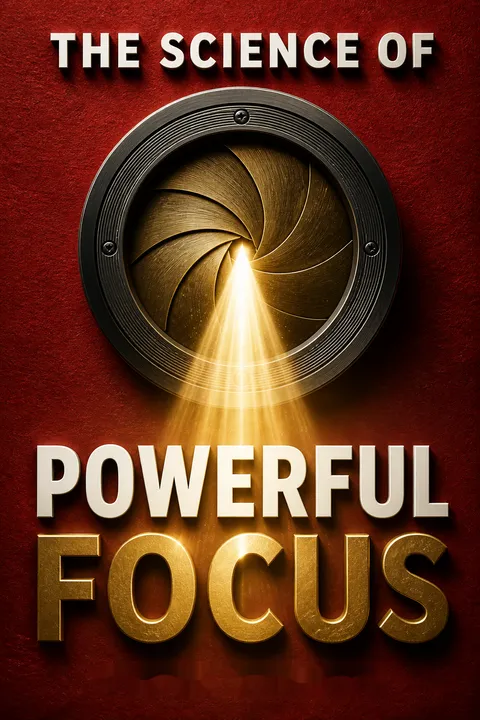


Key Takeaways
Treat focus as a designed ability, not a last-minute act of heroism
The deadline trap. Peter Hollins begins with his college reputation: he routinely finished assignments at the last possible minute, sometimes staying awake for two days. The method worked until a demanding 50-page paper made panic an inadequate plan. A friend introduced him to the Pomodoro Technique, a cycle of 25 minutes of focused work followed by a short break. Hollins finished the paper early and began exploring focus as a skill rather than a crisis response.
Build a repeatable rhythm. The book’s central promise is practical: focus improves when work, breaks, goals, and surroundings are deliberately arranged. No single trick worked for Hollins every time, but several did. The point is not to become a tireless machine. It is to make useful effort more reliable than deadline-fueled desperation.
The opening story gives the book a useful test: a productivity method matters if it replaces a costly pattern, not merely if it sounds scientific. A timed work interval is effective partly because it makes the next step finite and observable. That aligns with a broad principle in behavior design: reduce ambiguity at the moment of action. Still, a timer is a tool, not a universal attention span. A writer, caregiver, and emergency clinician face very different interruption patterns. The strongest reading is experimental: borrow a structure, observe whether it helps, and adapt it rather than treating one schedule as a law of the brain.
Start for ten minutes before your anxious brain negotiates another escape
Avoidance wears disguises. Hollins groups procrastination into three patterns: seeking the thrill of a deadline, dodging an unpleasant task, and delaying because the first step feels unclear. Frank Lloyd Wright reportedly produced plans for Fallingwater in a burst after a client unexpectedly asked to see them. By contrast, Hessian commander Johann Rall reportedly left a warning about Washington’s attack unopened while playing cards. One kind of delay can sometimes precede creative work; another can have grave consequences.
Make the first move small. Researcher Kenneth McGraw’s starting-point insight leads to the 10-minute rule: work on the avoided task for just ten minutes. If resistance remains, take a brief physical break, then try again. The aim is not to finish immediately. It is to stop rehearsing the task as a threat and create a small piece of progress.
This framing is more useful than calling procrastination laziness because it asks what discomfort the delay is regulating: boredom, uncertainty, fear of evaluation, or something else. A short start lowers the emotional price of beginning without requiring a dramatic burst of motivation. The brain account in the book, which casts instinct and planning as opposing forces, is a simplified model rather than a full explanation of procrastination. That distinction matters: people may delay because of exhaustion, unclear instructions, or competing obligations, not just a desire for immediate pleasure. A ten-minute trial helps reveal whether the barrier is momentum or a real constraint.
Turn wishes into written goals, visible cues, and short deadlines
Make the target concrete. A wish such as “get healthier” offers little guidance when a snack or a busy afternoon arrives. Hollins describes Gail Matthews’s study in which participants who wrote down goals were reported to be 42% more likely to achieve them. Sharing progress with supportive people added accountability. A useful goal specifies what will change, how progress will be measured, whether it is attainable and realistic, and when it is due. Hollins presents these elements as SMART goals.
Let the setting help. Put reminders and useful tools where action happens, and make tempting alternatives less convenient. Preparing food or placing exercise gear in sight can shift the easiest choice toward the goal. Parkinson’s Law, the observation that work tends to expand to fill its allotted time, offers another lever: set a realistic deadline instead of leaving the task open-ended. Speed still needs judgment; finishing the wrong thing quickly is not success.
Written goals can turn a vague intention into something retrievable, while environmental cues reduce reliance on remembering at exactly the right moment. This connects goal-setting to prospective memory, the mental ability to remember to act in the future. Yet accountability can motivate or shame, depending on the person and the social setting. A public commitment is not inherently better than a private plan with trustworthy support. Deadlines also help only when the work can be estimated and quality checked. A practical goal therefore needs both a finish line and a way to notice when haste is degrading the result.
Practice self-control by noticing your choices and rehearsing better ones
Make the choice visible. Hollins connects discipline with delayed gratification: turning down an immediate reward to protect a later benefit. In the marshmallow test, children were offered a treat immediately or a larger reward if they waited. The book describes follow-up findings linking childhood waiting with later measures of self-control, academic performance, and body weight. It also cites research in which participants who explained why they had resisted a temptation were more likely to resist another one than participants who merely recalled resisting.
Rehearse a pause. A small, deliberate change in routine can interrupt automatic reactions. One study described in the book asked adults to brush with their non-dominant hand or change a habitual expression; after two weeks, those groups reported less irritability with partners, unlike a control group. Reminders, alarms, and an accountability partner can serve as external prompts to notice a choice before acting.
The useful lesson is not that self-control is a fixed trait, but that awareness can create a pause in which behavior becomes selectable. The long-term marshmallow findings are suggestive, not a verdict on a child’s future. Later research has emphasized that a child’s willingness to wait can depend on whether the promised reward seems dependable and on conditions outside the child’s control. That nuance strengthens the practical message: build reliable cues and supportive routines rather than blaming character. Small behavioral exercises may train attention to choice, although changes in one setting do not guarantee broad improvements across every part of life.
Schedule demanding work around energy, then rest before attention frays
Work with your rhythm. Hollins describes circadian rhythms as daily patterns in alertness and sleep, while noting that people differ: some feel sharper early, others later. The book draws on research describing roughly 90-minute periods of focused effort followed by short recovery breaks. Professional violinists are cited as using intense practice blocks with breaks. The Pomodoro Technique offers a shorter alternative: 25 minutes of work, a brief pause, and a longer rest after four rounds.
Match task to moment. The book describes a common afternoon dip in energy, while citing a study in which students performed better on creative problems at non-peak times. That suggests using sharper periods for demanding analysis and lower-energy periods for creative exploration or simpler work. Breaks also help restore attention: in one computer task study, people who paused briefly maintained performance better than those who worked continuously for an hour.
Energy management replaces the fantasy of uniform effort with a more realistic question: what kind of work fits this hour? The distinction between analytical and creative tasks is especially useful because fatigue does not affect every activity in the same way. Still, 90 minutes should be treated as a hypothesis to test, not a biological timer that expires identically for everyone. Sleep, health, job control, and chronotype all shape alertness. A simple log of energy and task quality can reveal a personal pattern more reliably than adopting a schedule because a study or famous musician used it.
Use manageable pressure to engage, not overwhelm, your thinking
Find the useful middle. The Yerkes-Dodson Curve describes an inverted-U relationship between arousal and performance: too little engagement can leave someone inattentive, while too much stress can impair performance. A confident contestant answering questions about a familiar subject may feel alert and capable; facing an unfamiliar subject may push that alertness into panic. The best level depends partly on the task.
Adjust the challenge. Hollins suggests adding a deadline or a self-imposed challenge when work feels dull, and alternating difficult tasks with easier ones when the workload feels relentless. He also describes situational awareness as noticing one’s own arousal and its source. Firefighters train to act despite fear, using it as a signal to stay alert rather than a command to flee. For cognitively demanding work, planning ahead can prevent urgency from becoming a crisis.
The curve is a memorable corrective to the idea that either total calm or maximum pressure always produces the best work. It also explains why a deadline can energize one task and sabotage another. The model is broad, however, and should not be mistaken for a precise personal performance formula. Task complexity, skill, and individual responses all matter. The practical value lies in diagnosis: is the work boring, intimidating, or genuinely overloaded? Those conditions call for different adjustments, such as adding a challenge, clarifying the next step, or reducing demands.
Protect one task long enough for momentum to become flow
Switching has a cost. Hollins draws on Sophie Leroy’s research on attention residue, the lingering mental focus on a previous task after someone switches to another. In experiments, people interrupted while solving puzzles performed worse on a following task than people allowed to finish first. He also describes research in which frequent media multitaskers had trouble ignoring irrelevant images and remembering sequences. The practical response is singletasking: silence notifications, close unrelated tabs, and capture stray thoughts on paper instead of pursuing them.
Make immersion possible. Flow is a state of deep involvement marked by concentration, clear goals, feedback, and a workable balance between skill and challenge. Cal Newport’s deep work describes distraction-free professional effort that stretches cognitive ability. Both ideas depend on protecting time and reducing interruptions. They are not demands to work endlessly; a person can build up gradually to longer focused blocks.
The key insight is that attention does not instantly travel with the worker. A person may be physically on a new task while mentally completing the old one. This gives a strong case for batching communication and protecting stretches of uninterrupted work. Flow adds an important design condition: a task needs enough difficulty to hold interest, but not so much that progress disappears. The claim that multitasking is always useless would be too broad, since some routine activities can coexist. The relevant distinction is whether each activity competes for the same attention and working memory.
Batch similar work and remove tasks that only imitate importance
Keep the mind in one mode. Batching means grouping similar activities so fewer transitions are needed. Henry Ford’s assembly line illustrates the principle: workers repeated a specialized step rather than switching constantly between stages of making a car. For an office worker, checking email at set times can preserve longer stretches for other work. Hollins extends this idea to meetings, phone calls, and even scheduled distractions.
Sort before doing. The ABCDE priority list separates tasks by consequence: A tasks are urgent and consequential, B tasks matter but can wait behind A, C tasks are optional, D tasks can be delegated, and E tasks can be eliminated. A don’t-do list adds tasks that are waiting on someone else, add little value, or have reached diminishing returns. The point is not to fill every hour. It is to stop giving low-impact work the same claim on attention as essential work.
Batching is a form of cognitive housekeeping: it reduces the repeated effort of changing tools, context, and mental stance. The priority framework is useful because a long task list often hides the difference between urgency and mere visibility. Its limitation is that categories can create false certainty. A task that looks delegable may require expertise or carry relational costs, while an apparently low-value task can prevent a serious downstream problem. These labels work best as prompts for judgment, not automatic rules. Regularly revisiting priorities helps prevent yesterday’s categories from becoming today’s unquestioned obligations.
Make progress visible, and pre-decide your response to predictable distractions
Measure what happens. Hollins recommends tracking time in 15-minute increments, then comparing the record with what one expected to accomplish. He cites pedometer research in which people assigned to track walking averaged an additional mile per day and increased activity by 27%. Tracking also makes small wins visible, which can counter the tendency to notice setbacks more readily than accomplishments.
Decide before temptation arrives. An implementation intention is an if-then plan linking a recognizable situation to a chosen response. For example, when beginning a focused work block, a person might silence the phone. The book reports research associating these plans with substantially greater progress toward goals. It also recommends preparing the next day in advance and starting with manageable tasks to build momentum. Recording distractions without acting on them preserves the idea while keeping attention on the current task.
Measurement can reveal the difference between being busy and making progress, but the metric must represent something worth improving. Counting hours alone can reward visible effort while ignoring quality, rest, or the value of the outcome. If-then planning is powerful because it shifts a decision from the moment of temptation to a calmer earlier moment. That does not make every obstacle predictable, nor does a plan guarantee follow-through. Tracking works best as feedback, not surveillance: the record should help revise the system rather than become another source of guilt.
Condition attention with recovery, natural light, and a calmer workspace
Prepare the brain. Hollins treats focus as dependent on sleep, hydration, nutrition, and stress management, not willpower alone. He cites research associating sleep loss with poorer attention and memory, and reports that even modest dehydration can impair cognitive performance. The book also argues for periods of quiet and unstructured rest, when the mind can recover rather than absorb another stream of media.
Shape the surroundings. Studies described in the book found that a brief look at a green roof during a tedious task improved performance, and office workers with natural light reported better sleep and quality of life. Plants may improve perceived comfort and concentration. Meditation, doodling, and chewing gum are offered as possible focus aids, though they are not universal remedies. Test small changes: a quieter spot, a short outdoor break, or a plant within view.
This section usefully rejects the idea that concentration is produced by effort alone. It depends on the body’s capacity and on sensory conditions that can either drain or support attention. Nature and daylight are promising environmental levers, but one should separate a specific study’s result from a guarantee that a plant or image will transform every workplace. Individual preferences matter, as the book acknowledges about silence and background sound. The broader principle is strong: make recovery and workspace design part of the productivity plan, rather than treating them as rewards that must wait until every task is finished.
Analysis
The book’s most durable contribution is its shift from a moral account of focus to a design account. Hollins begins with a familiar failure, deadline dependence, then assembles tools for altering the conditions that produce it: smaller starting steps, defined goals, scheduled recovery, reduced switching, and visible priorities. That makes the book less a single theory of attention than a practical toolkit. Its variety is an advantage for readers whose obstacles differ, but it also means the advice can feel like a catalogue unless the reader chooses a few methods and tests them against a real task.
The strongest connecting idea is friction. Procrastination thrives when a task is emotionally vague and its alternative is immediately rewarding. A timer, written next action, or prepared workspace reduces the effort required to begin. Likewise, batching and singletasking reduce the cost of returning to a task after interruption. These methods do not eliminate limits; they make limited attention go further. The book’s emphasis on sleep, breaks, and energy is therefore not separate from productivity. It challenges the assumption that more hours automatically produce more useful work.
Some scientific claims are presented more confidently than the evidence warrants. The popular marshmallow-test narrative, rigid interpretations of 90-minute work cycles, and broad claims about multitasking or brain chemistry benefit from qualification. The text also risks making productivity sound like an individual responsibility, even though interruptions, workload, caregiving, and organizational demands may be outside a worker’s control. These qualifications do not erase the practical value of the methods. They suggest a better way to use them: treat each claim as a starting hypothesis, track whether the change improves meaningful output, and distinguish personal habits from structural constraints. Focus is neither a fixed virtue nor a trick. It is an interaction between a person, a task, and an environment.
Review Summary
The Science of Powerful Focus receives mixed reviews, with an average rating of 3.88/5. Readers appreciate its concise, dense content summarizing productivity practices, finding it helpful for both beginners and those needing reminders. Some praise its flow and interesting anecdotes, while others criticize it as basic advice available elsewhere. The book is commended for its minimalistic approach to focus and discipline, offering practical methods for daily implementation. Some readers find it particularly valuable for improving productivity and achieving objectives.
People Also Read





Glossary
Pomodoro Technique
Timed work and breaksA time-management method described as alternating 25 minutes of focused work with a short break, commonly five to ten minutes. After four work intervals, the user takes a longer rest. The method uses a timer to make work periods bounded and to protect breaks, while requiring a decision about whether to pause or postpone interruptions.
SMART Goals
Structured goal settingA goal-setting framework organized around five qualities: specific, measurable, attainable, realistic, and timely. A SMART goal defines what is to be achieved, how progress will be assessed, whether the target is feasible, and when it should be completed. Hollins also notes that the final letter can mean tangible, emphasizing an outcome that can be clearly experienced.
10-minute rule
A small start commitmentA method for overcoming resistance to an intimidating or unpleasant task by committing to work on it for ten minutes. The limited commitment lowers the perceived cost of beginning and can create momentum. If resistance remains, the person can take a brief physical break and then make another ten-minute attempt.
Marshmallow test
A study of waitingA research task in which a child is offered a small immediate treat or the possibility of a larger reward for waiting. Hollins uses follow-up findings to discuss delayed gratification and self-control across life. The test is a study paradigm, not a definitive measure of a child’s character or future success.
circadian rhythm
Daily alertness and sleep patternsThe recurring pattern of biological timing that influences sleep, wakefulness, and energy across the day. Hollins uses the concept to encourage scheduling demanding work around individual periods of alertness and allowing for lower-energy periods. The book stresses that people vary, including in whether they function best earlier or later.
Yerkes-Dodson Curve
Arousal and performance relationshipA model describing an inverted-U relationship between arousal and performance. At low arousal, someone may be disengaged; as alertness rises, performance can improve; beyond an optimal point, excessive stress can interfere with it. The useful level of arousal can differ according to the task and the person.
attention residue
Lingering focus after switchingThe remaining mental attention attached to a previous task after a person has moved to another. In the research discussed by Hollins, interruption or task switching can leave someone partly preoccupied with the first activity, reducing performance on the next one. The concept supports finishing a task or creating a deliberate transition before switching.
flow
Deep, absorbed engagementA state of sustained involvement in an activity, associated with strong concentration, clear goals, feedback, and a balance between the challenge and the person’s skills. People may experience time differently and find the activity rewarding in itself. Flow is not guaranteed on demand, but conditions such as fewer distractions can make it more attainable.
deep work
Distraction-free demanding workCal Newport’s term for professional activity performed with sustained, distraction-free concentration that stretches cognitive abilities. Hollins presents it as a way to produce substantial work by protecting time, limiting interruptions, and gradually increasing the duration of focused sessions. It requires deliberate scheduling and practice rather than simply working longer.
Implementation Intention
Situation-linked action planA plan that connects a recognizable situation to a specific response using an if-then structure. The person decides in advance what action to take when a predictable cue occurs. Hollins presents this as a way to reduce in-the-moment deliberation and make goal-directed behavior easier to carry out.
ABCDE priority list
Task sorting by consequenceA method for organizing tasks into five categories: A, urgent and consequential; B, important but less urgent; C, optional; D, delegable; and E, removable. The categories help distinguish tasks that require immediate personal action from those that can wait, be assigned to someone else, or be taken off the list.
FAQ
What's "The Science of Powerful Focus" about?
- Focus on Focus: The book explores the science behind achieving powerful focus, aiming to enhance productivity, discipline, and reduce procrastination and stress.
- 23 Methods: It presents 23 scientifically-backed methods to improve focus and achieve more in less time.
- Personal Journey: The author, Peter Hollins, shares his personal journey from a chronic procrastinator to someone who consistently works ahead of schedule.
- Research-Based: The book is grounded in research from fields like evolutionary biology, behavioral economics, and psychology.
Why should I read "The Science of Powerful Focus"?
- Improve Productivity: Learn practical techniques to boost your productivity and get more done in less time.
- Reduce Stress: Discover methods to manage stress effectively, which is crucial for maintaining focus.
- Overcome Procrastination: Gain insights into why we procrastinate and how to overcome it using proven strategies.
- Personal Development: The book offers tools for personal growth, helping you achieve your goals and improve your life.
What are the key takeaways of "The Science of Powerful Focus"?
- Discipline and Willpower: These are essential for focus but not the only factors; delayed gratification plays a significant role.
- Goal Setting: SMART goals and creating a supportive environment are crucial for maintaining focus.
- Energy Management: Understanding and managing your energy levels can significantly enhance your focus.
- Singletasking Over Multitasking: Focus on one task at a time to improve efficiency and productivity.
How does Peter Hollins define discipline and willpower in the book?
- Discipline as Training: Discipline is seen as training that corrects, molds, or perfects mental capacity or moral character.
- Willpower as Determination: Willpower is the energetic determination that allows discipline to manifest, often associated with avoiding temptation.
- Delayed Gratification: Both traits are linked to the ability to delay gratification, which is crucial for achieving long-term goals.
- Substitutes for Motivation: Discipline and willpower can substitute for motivation when it is lacking, helping to push through difficult tasks.
What strategies does "The Science of Powerful Focus" offer to combat procrastination?
- Understanding Procrastination: Procrastination is linked to the brain's pleasure systems, which prefer short-term enjoyment over long-term goals.
- 10-Minute Rule: Commit to starting a task for just 10 minutes to build momentum and overcome initial resistance.
- Breaking Down Tasks: Divide large tasks into smaller, manageable parts to reduce overwhelm and increase focus.
- Self-Control and Awareness: Developing self-control and being aware of procrastination triggers can help in overcoming it.
How does the book suggest managing energy for better focus?
- Circadian Rhythms: Understanding your natural energy cycles can help you schedule tasks for peak performance times.
- 90-Minute Work Cycles: Work in 90-minute cycles followed by short breaks to maintain high energy levels and focus.
- Pomodoro Technique: Use the Pomodoro Technique to work in short, intense bursts with regular breaks to boost productivity.
- Listen to Your Body: Pay attention to your body's signals and adjust your work schedule to align with your natural rhythms.
What is the Yerkes-Dodson Curve and its relevance in the book?
- Optimal Stress Level: The Yerkes-Dodson Curve illustrates that there is an optimal level of stress that enhances performance.
- Sweet Spot: Being in the "sweet spot" of stress means you're alert and engaged without being overwhelmed.
- Balancing Stress: The book emphasizes finding a balance between too little and too much stress to maintain focus.
- Task Design: Design tasks to alternate between easy and difficult to keep stress levels optimal and maintain engagement.
Why does "The Science of Powerful Focus" advocate for singletasking over multitasking?
- Multitasking Myth: Multitasking is a myth that leads to decreased efficiency and focus due to constant task-switching.
- Attention Residue: Switching tasks leaves a residue of attention on the previous task, reducing performance on the new task.
- Singletasking Benefits: Focusing on one task at a time improves concentration and allows for deeper work.
- Flow State: Singletasking helps achieve a flow state, where you are fully immersed and productive in your work.
What role does nature play in enhancing focus according to the book?
- Nature's Calming Effect: Nature has a calming effect that can reduce stress and improve focus and productivity.
- Green Spaces: Looking at green spaces or images of nature can improve attention and performance on tasks.
- Natural Light: Working in natural light improves sleep quality and overall well-being, enhancing focus.
- Plants and Animals: Having plants and viewing images of cute animals can boost mood and concentration.
How does "The Science of Powerful Focus" suggest using goals to improve focus?
- SMART Goals: Setting Specific, Measurable, Attainable, Realistic, and Timely goals provides structure and clarity.
- Positive Environment: Create an environment that supports your goals by removing distractions and making default decisions that align with your objectives.
- Accountability: Sharing goals with others and tracking progress increases accountability and motivation.
- Parkinson's Law: Be aware of Parkinson's Law, which states that work expands to fill the time available, and set realistic time frames for tasks.
What are some specific tactics from the book to improve focus?
- Batching Tasks: Group similar tasks together to complete them more efficiently and reduce mental fatigue.
- Don't-Do List: Create a list of tasks to avoid, focusing only on those that add value and align with your goals.
- ABCDE Priority List: Prioritize tasks using the ABCDE method to focus on what's most important and eliminate distractions.
- Implementation Intentions: Use "if-then" statements to plan responses to common situations, reducing decision fatigue and improving focus.
What are the best quotes from "The Science of Powerful Focus" and what do they mean?
- "Focus is the end game for much of self-improvement." This quote emphasizes that focus is crucial for achieving personal growth and success.
- "Discipline and willpower are what we aspire to because we tend to feel that we aren’t doing as much as we can." It highlights the importance of discipline and willpower in overcoming challenges and achieving goals.
- "The goal of discipline today is to receive a direct benefit in the future." This quote underscores the concept of delayed gratification and its role in long-term success.
- "Multitasking is a huge myth." It challenges the common belief in multitasking, advocating for singletasking as a more effective approach to productivity.
About the Author
Other books by Peter Hollins









Download PDF
Download EPUB
.epub digital book format is ideal for reading ebooks on phones, tablets, and e-readers.








