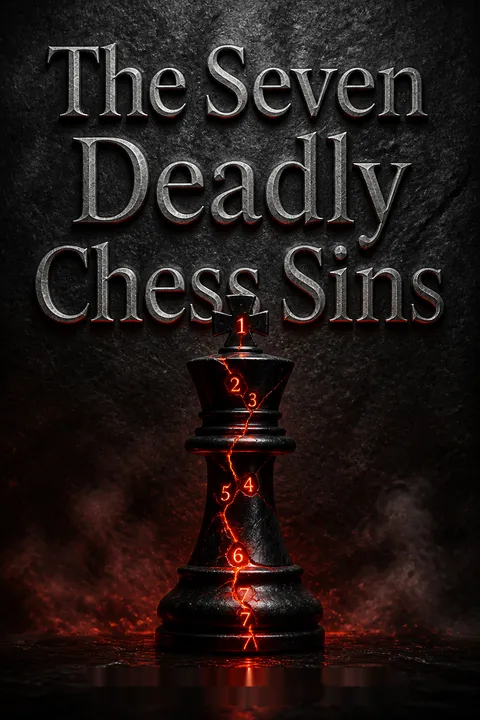


Key Takeaways
Treat recurring chess errors as misreadings, not isolated bad moves
Errors have sources. Rowson calls a chess “sin” a recurring psychological misreading that generates mistakes. The point is not moral blame: a player who misses a move may be confused, fixated on material, worried about the result, or inattentive to the opponent. The same blunder can have several causes, and the seven categories overlap. They are best used as prompts for diagnosis, not labels for a player’s character.
The board needs you. A chess position is only a pattern of pieces until players give it meaning through their judgments, emotions, plans, and attention. The book’s central claim is that improving those mental habits can prevent errors that technical study alone will not catch. Rowson does not dismiss openings or tactics. He asks players to notice the human processes that determine how well they use that knowledge.
The framework is strongest when treated as a map of recurring failure modes rather than a complete taxonomy. Its practical promise lies in changing the postgame question from “Which move was bad?” to “What made that move seem right at the time?” That shift resembles a useful distinction in error analysis: the visible failure is not always the underlying cause. The categories also overlap by design. A player absorbed in winning material may be ignoring the opponent, while the same fixation can consume time and trigger a later lapse. Diagnosis is more useful than assigning one sin per mistake.
Trust intuition, but keep teaching it new patterns
Intuition recognizes patterns. Rowson uses the term for rapid judgment grounded in stored chess experience, not supernatural insight. Strong players often recognize a meaningful arrangement before they can explain it. But old patterns can also mislead: a familiar rule or remembered game may be applied to a position where it does not fit. Improvement therefore means learning new patterns and loosening mistaken ones.
Listen to every piece. In a game against Spassky, Karpov played 14...Rf1, preparing to meet the likely central advance with a coordinated setup. In Rowson’s own game against Kulaots, he found 20 g3 partly because his king needed safety before his other pieces could work. Rowson calls this “talking with your pieces”: consider which unit is idle, exposed, or asking for a better role. It is a way to surface intuitive judgments, then check them with calculation.
Intuition is best understood as compressed experience: useful precisely because it avoids rebuilding every judgment from scratch. That efficiency has a cost. A familiar pattern can become a reflex, and a reflex can conceal the details that make the current position different. Rowson’s invitation to consult the pieces is a practical interruption of that autopilot. It shifts attention from a favored line to the whole team. The method is not a substitute for calculation, especially in tactical positions. Its value is in helping calculation start in the right place.
Track changing trends, not just the position in front of you
Positions keep moving. Rowson argues that a static assessment, such as “White is slightly better,” can hide the direction of play. A player may be better in one snapshot while the opponent’s counterplay is gathering force. Trend sensitivity means noticing whether the advantage is growing, stalling, or changing hands. A “gateway position” is a moment when one phase of the struggle gives way to another.
Notice the warning signs. A turning point often comes when the opponent’s idea is about to happen, your natural continuation has run out, or several plausible moves appear without one clear choice. In Emms-Webster, White’s 19 Rfe1 let Black seize the initiative after a sequence of passive decisions. The key lesson is to reassess at such moments, rather than carrying yesterday’s evaluation into a changed position.
This distinction resembles the difference between a photograph and a film. A snapshot describes what is present; a trend captures how the balance is changing. Rowson’s model is especially useful in modern positions, where initiative and counterplay can matter more than a tidy static advantage. Still, “trend” is not an objective meter. Players can mistake activity for progress, or infer a decisive shift from a few ordinary moves. The safeguard is to pair the trend judgment with concrete questions: what is threatened, what has become harder to do, and which transformation would alter the balance?
Play the contest, not the result
Wanting distorts judgment. Excessive concern with winning, drawing, or protecting a tournament score can pull attention away from the position. Rowson’s term “gumption” describes the energy and commitment to engage with the task itself. He also discusses “flow,” a state of absorbed play in which attention rests on the activity rather than constant self-monitoring.
Keep the result in perspective. In Miles-Arkell, Black offered a draw in a roughly level position. After Miles declined, Arkell became preoccupied with the rejected offer and eventually lost a difficult game. Rowson’s practical question is how many results a player is playing for: a solid approach may keep a draw available while still creating winning chances. “Plus equals mode” describes persistent, low-risk pressure from a small advantage, rather than a desperate attempt to force a win.
The point is not that results should stop mattering. Competitive goals can focus effort, and a player may rationally choose risk based on tournament standings. The danger arises when the imagined outcome takes over the attention needed to produce it. Rowson’s distinction between playing and winning is a useful way to expose that trap. “Plus equals mode” also complicates the familiar idea that a player must force the issue to demonstrate ambition. Patient pressure can be a form of active competition, provided the position genuinely supports it.
Value what pieces can do, not only what they are worth
Material is only one measure. Players commonly count a pawn as one point, a knight or bishop as about three, a rook as five, and a queen as nine. Rowson argues that these values are guides, not verdicts. A piece’s practical worth depends on its activity, coordination, targets, and the time available to use it. He describes chess through material, time, and quality, with a fourth dimension in the player’s own process of judgment.
Judge the whole position. In Kasparov-Shirov, 17 Rxb7!! gave up a rook for a knight and pawn, but left Black’s remaining pieces poorly placed while White’s army worked together. In Capablanca-Lasker, 19 Ne4!! prioritized the activity of White’s pieces over immediate pawn defense. Rowson’s energy analogy is a reminder to ask what the pieces can accomplish, not merely to total them.
The most useful part of this argument is its attack on false precision. A point count is a shared shorthand, not a measurement of a piece’s value in every position. Comparing a trapped rook with an active knight requires attention to context, not arithmetic alone. The analogy to energy makes that point vivid, but it should remain an analogy, not a literal equation or a replacement scoring system. Material still matters enormously. The skill is to recognize when activity, king safety, or coordination makes the simple count temporarily misleading.
Make your opponent’s plans part of your own calculation
Chess has two subjects. Egoism means becoming so absorbed in one’s own plans, fears, or preferred style that the opponent’s ideas receive too little attention. Rowson calls a fuller awareness “inter-subjectivity”: recognizing both players as people interpreting the same position. “Prophylaxis” is the practice of anticipating and limiting an opponent’s plans before they become direct threats.
Prevent without surrendering. In Jansa-Bilek, White’s surprising 1 Na1! looked like retreat, but it stopped Black’s queenside attack and left the rook available for active duty elsewhere. Rowson also uses Tal’s attacking games to show how psychological pressure can make an opponent lose confidence in their own judgment. Prophylaxis is not merely defensive. By removing the opponent’s best plan, a player can clear room for an attack of their own.
Opponent modeling is a form of strategic empathy: it asks what the other player wants, not what they ought to want. That can reveal quiet moves such as Jansa’s knight retreat, which look passive when judged only by one’s own ambitions. The same habit also has limits. Over-reading an opponent’s psychology can turn into speculation, and trying to anticipate everything can create the very indecision the book warns against. The practical balance is to identify the opponent’s most consequential plan, test whether it is real, and address it without losing sight of one’s own.
Choose a good move before demanding the perfect one
Perfection burns time. Rowson links perfectionism to time trouble, over-analysis, and a desire to punish every imperfect opponent move. “Jam lust” is his image for demanding an extra advantage after the position already offers enough: bread and butter are not satisfying if the player insists on jam. In Wells-Ibragimov, White spent a long time seeking a forced attack after building a strong position, then entered a mutual time scramble where the game became harder to control.
Know when to stop. Before extending a calculation, ask whether more thought is likely to change the decision. If not, choose the sound move and keep enough time for later problems. Rowson does not claim that time trouble can always be avoided: complex positions and high-pressure games can make it inevitable. But repeatedly searching for perfection, or moralizing about how the opponent should play, can waste time without improving the move.
Perfectionism often disguises itself as seriousness. Yet analysis has diminishing returns: after a point, further calculation can add fatigue and confusion faster than certainty. Rowson’s “jam lust” image captures the emotional side of that tendency, the suspicion that a merely good position is somehow not enough. The corrective is not carelessness. It is decision discipline: estimate whether additional thought has value, then act. The book’s treatment is most persuasive when it distinguishes unavoidable time pressure from habits that manufacture it, such as repeatedly revisiting a choice that has already been made.
Reset after every major change, or old emotions will play for you
The past follows the pieces. Rowson calls “echoes” the emotional residue of earlier positions that distorts judgment in the present. A player who has spent moves defending a king may keep feeling danger after the position has changed. “Neural hijacking” describes an intense emotional reaction that outruns deliberate thought. Tension can also be displaced onto the board: a player may simplify or release pressure merely to escape their own discomfort.
Return to the current game. In Rowson-Hodgson, Rowson’s nervous excitement after gaining an advantage contributed to 35 e4?, which let Black back into the game. His earlier fears continued to shape decisions even after the position had changed. A practical reset means pausing after a major exchange or shift in the attack, checking the new threats, and asking what the current position requires. Varied attention and short breaks can help concentration, especially in long games.
This is the book’s most psychologically revealing idea: a chess player does not encounter each position with a blank mind. Earlier fear, relief, and confidence become part of the next decision, even when the board no longer justifies them. The reset is therefore not a demand to forget. It is an effort to distinguish present evidence from emotional carryover. That distinction is useful beyond chess, but it is not perfectly controllable. Under pressure, emotion can supply information as well as noise. The task is to notice the feeling, then test whether the current position supports it.
Analysis
Rowson’s book is a psychological guide to practical chess, built around seven recurring sources of error rather than a technical system of openings or positional rules. Its organizing idea is that mistakes are often symptoms of a player’s way of reading the game. A missed tactic, for example, may reflect fixation, fear, result anxiety, or a failure to notice the opponent’s plan. The seven sins give readers a vocabulary for examining those causes.
The most original contribution is the book’s insistence that chess cannot be reduced to calculation or material. Players evaluate through pattern recognition, emotion, memory, and attention. The position itself is not experienced neutrally: it is interpreted by two people, each carrying expectations and fears. This explains why a theoretically sound position may feel difficult to play, why an inferior move can unsettle an opponent, and why a clear advantage can disappear when the player becomes attached to winning it.
The practical advice follows from that view. Develop intuition by absorbing and questioning patterns. Track changes in the game, not only static assessments. Consider the opponent’s aims. Treat material as context-dependent, and make decisions without waiting for perfect certainty. When the game changes sharply, reassess rather than letting the emotional tone of the previous phase dictate the next move.
The book’s evidence is mainly annotated games, personal experience, and psychological research cited in the text. Its vivid examples make abstract errors memorable, but they do not establish that every mistake fits neatly into one category. The sins overlap, and some advice, such as trusting intuition or choosing a more pragmatic move, requires judgment of its own. Nor does psychological awareness replace tactical skill, opening preparation, or endgame knowledge. The book’s value is as a companion to those skills: it helps explain why a player may fail to use what they know. Its central invitation is modest but demanding: notice the mind’s distortions while the game is still in progress.
Review Summary
The Seven Deadly Chess Sins is highly praised for its insightful analysis of common chess mistakes and their psychological roots. Readers appreciate Rowson's unique approach, blending chess strategy with philosophy and diverse references. The book is seen as valuable for serious players looking to improve, offering practical tips and thought-provoking discussions. Some find parts of the book challenging, but most consider it a fascinating resource for long-term study. Reviewers commend its depth, humor, and ability to provoke self-reflection, making it more than just a standard chess book.
People Also Read



Glossary
The Seven Deadly Chess Sins
Recurring sources of chess errorRowson’s seven-part account of psychological habits that generate chess mistakes: Thinking, Blinking, Wanting, Materialism, Egoism, Perfectionism, and Looseness. The categories describe recurring sources of error, not moral faults or mutually exclusive diagnoses. One mistake may arise from several at once, such as material fixation combined with result anxiety and time pressure.
Intuition
Fast pattern-based judgmentIn Rowson’s usage, intuition is rapid recognition and evaluation based on chess experience and stored patterns. It can guide a player toward useful candidate moves before conscious analysis is complete. It is not infallible: rigid or mistaken patterns can distort judgment, so intuition benefits from continued learning and from checking concrete variations when needed.
Trend sensitivity
Noticing how play is shiftingThe ability to notice whether the direction of a game is improving, stalling, or turning against a player. Rowson contrasts this with assessing only a single position. A favorable static evaluation may be misleading if the opponent’s counterplay is gaining force, or if the player has no good way to continue the current plan.
Gumption
Energy for the contestRowson uses this colloquial term for the commitment and readiness that help a player engage fully with a chess game. Gumption connects desire to compete with willingness to take part in the actual struggle. It can be weakened when a player cares only about the result, resents the position, or feels detached from the task.
Plus equals mode
Patient pressure from a small edgeA practical approach in which a player with a small advantage keeps applying low-risk pressure instead of forcing a quick win. The aim is to preserve useful winning chances while making the opponent continue to solve problems. Rowson presents it as an alternative to treating every favorable position as a demand for immediate, decisive action.
Inter-subjectivity
Awareness of both players’ viewpointsRowson’s term for approaching a game with awareness that both players are subjects interpreting the same position. It combines recognition of one’s own desires and fears with attention to the opponent’s ideas and likely reactions. This perspective supports better practical decisions without pretending that a player can become fully objective during a contest.
Prophylaxis
Preventing the opponent’s plansIn chess, prophylaxis is the practice of anticipating and restricting an opponent’s intended activity before it becomes a direct threat. Rowson emphasizes that it need not be passive or defensive. A move that prevents the opponent’s best plan can improve one’s own position by limiting counterplay and creating space for a plan of one’s own.
Theory of Infinite Resistance
Keep seeking the hardest defenseA defensive principle discussed by Rowson through Bill Jordan’s idea: in a bad or strategically lost position, continue searching for the strongest available moves rather than mentally conceding. The opponent may still fail to convert the advantage. The theory does not claim every position can be saved; it encourages sustained resistance and practical resourcefulness.
Neural hijackings
Emotion overtaking deliberate thoughtA term used in the book for intense emotional reactions that can take control of behavior before reflective thought catches up. Drawing on research about the emotional brain, Rowson connects these reactions to moments of acute fear, anxiety, or excitement. In chess, they can contribute to sudden lapses, distorted judgment, and a sense of losing control.
Echoes
Past feelings shaping present judgmentRowson’s label for emotional residue from earlier positions that continues to influence a player after the board has changed. A player who has been defending a vulnerable king may remain fearful when that danger has passed. Recognizing echoes means reassessing the current position rather than letting earlier emotions dictate the next decision.
Download PDF
Download EPUB
.epub digital book format is ideal for reading ebooks on phones, tablets, and e-readers.








