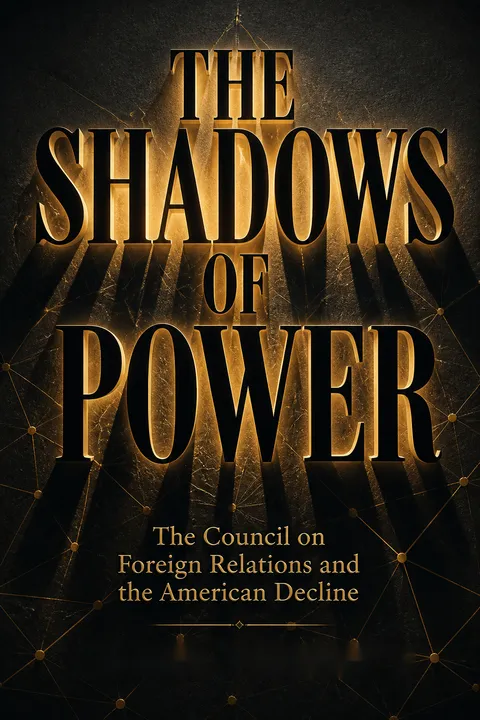


Key Takeaways
Trace the policy network, but do not mistake access for command.
A network with reach. Perloff presents the Council on Foreign Relations, or CFR, as a meeting ground for influential figures in finance, law, media, academia, and government. Membership was by invitation, and the Council hosted off-the-record discussions, published Foreign Affairs, and organized policy study groups. The book emphasizes that many senior officials belonged to it: in 1987, it reported 318 members serving in government.
Access is the evidence. Perloff argues that shared membership and professional ties helped shape policy and staffing across administrations. He cites officials who recruited colleagues from the Council into government roles. This establishes proximity to decision-making, but it does not by itself show that the organization issued orders or acted as a unified command.
What's striking is the book's focus on recruitment and relationships, not merely formal institutions. Political scientists use the idea of an “epistemic community” to describe specialists whose shared assumptions can influence policy across agencies and administrations. That is a useful lens for the CFR: a network can narrow the range of ideas considered without secretly dictating every decision. The distinction matters. Membership lists and hiring patterns are evidence of access and affinity; demonstrating coordinated control requires records of decisions, competing explanations, and proof that alternatives were excluded.
Follow the money, while testing each link in the chain.
Finance as leverage. Perloff connects the 1913 Federal Reserve Act and federal income tax to a larger expansion of government borrowing. In his account, a central banking system gave financial institutions influence over credit and money, while income taxes gave the government a broader means to repay debt. He places these changes beside the outbreak of World War I, which drove federal borrowing sharply higher.
A disputed causal story. The book portrays the Federal Reserve as a privately controlled instrument designed by bankers, and describes the 1907 panic as deliberately engineered to prepare the public for it. Those are Perloff's interpretations, not neutral descriptions of settled history. The institutional structure of the Fed is more complex than the book's account suggests, and chronology alone cannot establish a plot.
The strongest general insight is that financial systems shape political choices: the cost and availability of credit can affect which programs governments pursue and who benefits. This is a familiar concern in political economy, where public and private power often overlap. But a persuasive account needs more than a sequence of events and prominent names. It must show mechanisms, documentation, and plausible alternatives. The book is most useful here as a prompt to examine who controls credit and how institutions are governed, not as final proof that a particular crisis was manufactured.
Treat sovereignty as the central fault line in the book.
A recurring argument. Perloff reads the CFR's internationalist outlook as a push toward world government and reduced national sovereignty. He points to early Foreign Affairs essays criticizing isolationism, a 1944 CFR publication that discussed public resistance to a superstate, and a 1974 essay by Richard Gardner advocating gradual change rather than a direct assault on national authority. In Perloff's account, international bodies and regional alliances can become steps toward a more centralized order.
The underlying question. The book asks who should make binding decisions: voters within nations, or international institutions with broader jurisdiction. It treats proposals to expand the authority of the United Nations and international courts with particular suspicion, linking them to diminished national self-rule.
Sovereignty is not simply a choice between independence and cooperation. International agreements can help countries manage problems that cross borders, while also shifting decisions away from voters who can directly hold leaders accountable. The useful question is therefore not whether cooperation is good or bad, but what powers are delegated, under what limits, and with what democratic oversight. Perloff's suspicion of gradual institutional change draws attention to the cumulative effects of small transfers of authority. His case is less convincing when it treats any international coordination as evidence of a single destination.
Read wartime planning as influence, not proof of a master plan.
A policy pipeline. After World War II began in Europe, the CFR and the State Department established the War and Peace Studies Project. Perloff reports that it held 362 meetings and prepared 682 papers for government officials, with Rockefeller Foundation support. The project examined wartime policy and postwar arrangements. The book links this work to planning for the United Nations, the World Bank, and the International Monetary Fund.
Ideas entered government. This is among the book's clearest examples of organized policy access: outside experts produced research that officials could use. Perloff interprets the resulting institutions as parts of a globalist program. The documented advisory relationship, however, does not prove that the CFR alone designed or controlled the postwar order, which involved governments, diplomats, and other interests.
The episode illustrates how policy can be shaped before the public sees a proposal. Research groups define problems, develop options, and give officials ready-made language and plans. In organizational sociology, this is a form of agenda-setting power: influence may lie in deciding which choices appear practical, rather than issuing commands. That makes the project worth examining closely. At the same time, expert participation is common in democratic government and does not itself establish capture. A full assessment would ask who selected the advisers, what alternatives they considered, and how decision-makers responded.
Separate documented policy failures from claims of deliberate sabotage.
A revisionist reading. Perloff interprets several Cold War-era episodes as evidence that U.S. officials enabled Communist gains. He argues that American policy helped the Chinese Communists defeat Chiang Kai-shek, that U.S. decisions contributed to the Korean War's conditions, and that Washington had warning of Japan's attack on Pearl Harbor but failed to alert commanders. He cites government records, testimony, and earlier books to support these claims.
Evidence needs sorting. The book's examples vary in strength. The existence of warnings, policy disputes, and failed decisions is not the same as proof that officials intended the outcomes. Perloff generally reads ambiguous evidence in the direction of deliberate betrayal. Readers should distinguish documented decisions from the author's claims about motive and coordination.
The book's revisionist method can be valuable when it sends readers back to records that conventional narratives overlook. Its central risk is inferential: a disastrous outcome plus prior knowledge can suggest negligence, but does not automatically prove intent. Historians assess such claims by comparing independent sources, testing rival explanations, and looking for evidence that would disconfirm the preferred account. That standard is especially important for Pearl Harbor, where the stakes of the allegation are immense. Scrutiny should remain open-minded without treating suspicion as a substitute for proof.
Ask who set the limits when a war could not be won.
Vietnam's constraints. Perloff argues that Washington restricted U.S. forces in Vietnam through rules limiting targets, pursuit, and the use of air power. He contends that these constraints made military victory unattainable. He also notes that the Johnson administration eased export controls on hundreds of goods to the Soviet bloc while the USSR and its allies supplied North Vietnam.
The decision-makers matter. The book highlights a 1968 meeting at which Johnson's senior advisers, whom he called the Wise Men, shifted from supporting escalation to urging disengagement. Perloff treats this reversal as evidence that elite advisers shaped the war's direction while avoiding public responsibility for its outcome.
Vietnam shows why civilian control and military effectiveness must be analyzed separately. Political leaders can impose limits for diplomatic, legal, or escalation concerns; those limits may still produce an incoherent strategy. The book's account usefully asks whether stated aims matched the means provided. Its explanation becomes less secure when restrictive decisions are presented as proof that officials wanted defeat. A stronger analysis would compare the strategic reasoning offered at the time with the battlefield consequences and consider whether policymakers misjudged the conflict rather than deliberately prolonging it.
Judge presidents by appointments and outcomes, not campaign branding.
Continuity across parties. Perloff traces Council members and internationalist advisers through the administrations of Eisenhower, Kennedy, Nixon, Carter, and Reagan. He argues that presidents who campaigned as outsiders or conservatives often appointed officials drawn from the same elite networks. He also describes the Trilateral Commission, founded by David Rockefeller and Zbigniew Brzezinski, as a broader grouping of North American, European, and Japanese leaders.
Promises versus record. The book contrasts campaign rhetoric with policies such as Nixon's opening to Communist China, Carter's recognition of Beijing and handling of Nicaragua, and Reagan's continued trade with Communist states. Perloff presents these as evidence of a persistent policy direction, though the examples do not all carry the same meaning or establish a common plan.
Personnel choices can reveal a president's governing coalition more clearly than campaign slogans. This fits the principal-agent problem: voters select a leader, but policy is implemented by advisers and officials who shape what the leader hears and what agencies can do. Still, continuity has multiple explanations. Shared expertise, institutional routines, and geopolitical constraints can produce similar policies without a hidden coordinating body. The book's comparison across administrations is valuable as a research question, but its conclusions require case-by-case testing rather than assuming that similar appointments imply identical motives.
Question media silence, but demand evidence beyond a blackout.
A media critique. Perloff argues that major newspapers and broadcasters downplayed the CFR and favored Establishment interpretations of foreign policy. He points to media executives and journalists who belonged to the Council, and to reporting disparities on human rights abuses in Cambodia and Chile. He also recounts Anastasio Somoza's claim that a Sixty Minutes interview was edited to make him appear in a particular light.
Affiliation is not control. The book treats professional ties and uneven coverage as evidence of a coordinated media blackout. Those details can raise questions about ownership, access, and editorial judgment, but do not alone prove that the CFR directed newsrooms. Its case would be stronger with systematic comparisons of coverage, editorial instructions, and evidence of deliberate suppression.
Media criticism is most persuasive when it measures patterns rather than inferring intent from individual affiliations. Agenda-setting research asks which stories receive attention, how often, and in what frame; those choices can shape public understanding even without explicit censorship. Perloff's examples point toward useful questions about access and selection. But the same standard should apply to every source: a politician's account of an edited interview is evidence to investigate, not an independent verdict. A rigorous media audit would compare outlets, time periods, and competing explanations for coverage differences.
Defend constitutional checks before crisis makes sweeping changes attractive.
A warning about reform. Perloff ends by arguing that proposals to restructure the Constitution could weaken electoral accountability and the balance among branches of government. He discusses the Committee on the Constitutional System and its proposals to alter Congress and the treaty process. The book reports that, by early 1988, 32 states had called for a constitutional convention, often in the name of a balanced budget.
His civic prescription. Perloff urges readers to scrutinize convention proposals, question expanded international authority, and press elected representatives on defense, spending, and foreign policy. He presents the Constitution's division of powers as protection against concentrated authority. His prediction of a coming crisis and a global merger is a warning, not a demonstrated outcome.
Constitutional design is a practical problem of limiting power while enabling government to act. The book correctly emphasizes that reform can have consequences beyond its stated purpose, especially when a convention's scope is disputed. Yet constitutional change is not inherently illegitimate, and existing institutions can also fail or entrench unfairness. The relevant test is transparent deliberation: clear rules, public participation, and careful analysis of how each proposed change shifts authority. Perloff's strongest civic lesson is to inspect institutional details before endorsing a reform by slogan.
Analysis
The Shadows of Power is a revisionist political history organized around a single institution, the Council on Foreign Relations, and a larger claim: that a durable internationalist elite has influenced American policy across party changes and crises. Its storytelling gains momentum by connecting banking reform, world wars, the United Nations, the Cold War, Vietnam, media coverage, and constitutional reform. The repeated pattern invites readers to see continuity where conventional accounts often emphasize separate events.
The book's most solid contribution is its attention to networks. Membership, recruitment, study groups, publications, and informal access are concrete mechanisms through which ideas circulate. Its historical inventory can prompt useful questions about who advises presidents, how policy agendas are formed, and whether the public can scrutinize decisions made in private settings.
Its central weakness is that it often moves from evidence of access to conclusions about coordinated intent. A Council member's appointment, a poor policy outcome, or a favorable relationship with a foreign regime may support investigation, but none alone proves that the Council directed the decision. The narrative tends to interpret ambiguous episodes as parts of one design and gives limited space to competing explanations, internal disagreement, or contrary evidence. That makes careful attribution essential, especially around allegations concerning Pearl Harbor, financial manipulation, and deliberate military defeat.
Published in 1988, the book is also a document of its era: it reflects intense Cold War fears and interprets international cooperation through the threat of centralized power. Its best use is neither as a neutral institutional history nor as a settled account of conspiracy, but as a provocative map of elite influence claims. Readers can preserve its valuable questions while testing each answer against primary sources, institutional context, and alternative hypotheses.
People Also Read

Glossary
Council on Foreign Relations
Foreign policy membership organizationA U.S. membership organization founded in 1921, based in New York, that hosts discussions, publishes Foreign Affairs, and organizes study groups on international issues. Perloff presents it as a major channel linking business, academic, media, and government elites. Membership and policy influence are documented subjects; claims that the organization centrally directs U.S. policy are the author's interpretation.
Trilateral Commission
Three-region policy organizationAn organization founded in 1973 by David Rockefeller and associated with political scientist Zbigniew Brzezinski. It brought together influential participants from North America, Western Europe, and Japan to discuss international cooperation. Perloff treats it as an expanded internationalist network and emphasizes the participation of its members in Jimmy Carter's administration.
War and Peace Studies Project
Wartime policy research programA research effort organized by the Council on Foreign Relations in cooperation with the U.S. State Department after World War II began in Europe. The project studied wartime diplomacy and postwar policy. Perloff reports that it held 362 meetings and prepared 682 papers, and argues that it helped shape planning for postwar institutions.
Establishment
Interconnected power elitePerloff uses this term for an influential, largely northeastern network spanning finance, business, government, law, academia, media, and major foundations. In his account, its members share institutions and access that allow them to influence policy across administrations. The term describes a broad social and political network, not a formally constituted body with a single membership list or command structure.
containment
Limiting Communist expansionA Cold War strategy associated in the book with diplomat and CFR member George Kennan. It sought to prevent the expansion of Soviet influence rather than immediately overthrow Communist governments. Perloff argues that containment became a rationale for policies that accepted Communist control in some places while promoting broader international arrangements; the strategy's meaning and results remain subjects of historical debate.
Download PDF
Download EPUB
.epub digital book format is ideal for reading ebooks on phones, tablets, and e-readers.








