

Key Takeaways
Use the Source Field as a unifying hypothesis, not a settled fact
One proposed substrate. Wilcock calls the Source Field an invisible, supposedly intelligent energy that generates space, time, matter, life, and consciousness. He uses it to connect research on plants and human cells with pyramids, ancient calendars, and reports of time anomalies. The book presents this as a scientific synthesis, while also giving the idea spiritual meaning: reality is not inert matter but an interconnected whole.
A sweeping explanation. The argument ranges from claims that Russian researchers had published thousands of related papers to reports of distant mind-to-mind effects. Yet the book does not establish that these findings share one cause, or that the proposed field exists. Its central contribution is therefore a bold organizing hypothesis, not a demonstrated physical theory.
What's compelling is the ambition to connect questions that are usually kept in separate boxes: consciousness, biology, physics, and spiritual meaning. A unifying model can generate useful questions. The risk is that a model broad enough to explain every anomaly can become difficult to disprove. Its value depends on measurable predictions that distinguish it from coincidence, experimental error, or known mechanisms. Readers can take the hypothesis seriously as a prompt for inquiry without treating its widest claims as established science.
Ask what evidence would distinguish shared consciousness from coincidence
From plants to people. Wilcock opens with Cleve Backster, a polygraph researcher who reported that a plant's electrical readings changed when he merely thought of burning a leaf. Backster extended the claim to bacteria, eggs, and human cells, including cells monitored after their donor had travelled away. Wilcock pairs these stories with experiments by William Braud and Jacobo Grinberg, which he interprets as evidence that separated people can affect or register one another's physiological states.
Numbers with caveats. In one staring experiment described in the book, a subject's skin response occurred during 59 percent of trials when another person watched remotely, versus a 50 percent chance baseline. Grinberg reported simultaneous brainwave responses in 25 percent of trials. These are claims from selected studies, not proof of telepathy or a non-electromagnetic field.
The strongest feature of this material is its focus on measurable outcomes rather than private conviction alone. Physiological readings offer a clearer test than anecdotes about intuition. But a result modestly above chance is only as persuasive as the controls, analysis choices, and independent replication behind it. The book often moves quickly from an unusual reading to a universal explanation. A careful reader can preserve the interesting question while separating three steps: an effect was reported, the effect is reliable, and the proposed cause is correct.
Practice coherence as an ethic, while testing extraordinary causal claims
Inner work, outer hope. Wilcock argues that people are linked through a shared mind, so love, attention, and forgiveness may affect others as well as oneself. He cites group meditation studies that reportedly coincided with sharp reductions in violence, including a claimed 72 percent drop in worldwide terrorism during periods when about 7,000 people meditated. He also describes therapist Hew Len's Ho'oponopono practice, in which a person repeats statements of love, apology, forgiveness, and gratitude while reflecting on distress.
A personal experiment. The book presents lucid dreaming as another way to explore awareness. Stephen LaBerge's Mnemonic Induction of Lucid Dreaming, or MILD, uses the intention to recognize a dream while falling back asleep. Wilcock treats such experiences as clues to a wider mind, though they can also be approached as exercises in attention and self-understanding.
The ethical case does not depend on accepting remote influence. Forgiveness and deliberate attention can change how people relate, even if a meditation group cannot be shown to alter global crime rates. That distinction protects a humane practice from an evidentiary burden it may not meet. The book is most useful here when it translates cosmic interconnectedness into responsibility toward others. Its causal claims about distant effects deserve separate testing from the value of the practices themselves.
Read ancient cycles as cultural clues, not precise forecasts
The long clock. The book links the precession of the equinoxes, a slow change in the direction of Earth's axis, to a cycle of roughly 25,800 years. Wilcock argues that myths from different cultures encode this cycle and its transitions between eras of hardship and renewal. He also interprets measurements of the Great Pyramid as references to the length of a year and the precession, and connects its unfinished top to the capstone on the Great Seal of the United States.
A date window. Wilcock combines Maya calendar cycles with Hindu and classical prophecies to identify 2012 to 2014 as a likely turning point. He reads destructive prophecies largely as metaphors for social and inner change, not literal predictions of human extinction. The connections are suggestive to him, but shared symbols and numerical matches alone cannot prove a common source or an accurate forecast.
The book's best historical instinct is to treat myth as a possible record of careful observation rather than dismissing it as meaningless. Cycles in the sky can shape calendars, architecture, and stories. The harder step is inferring that similar images must encode identical knowledge, or that a numerical fit proves design. Interpretation is strongest when it preserves context and compares multiple explanations. Ancient symbolism can be meaningful without functioning as a hidden timetable for modern events.
Treat pyramid effects as testable claims, not inherited miracles
A revived experiment. After popular stories about pyramid-shaped containers preserving food, Wilcock turns to Russian engineer Alexander Golod's pyramid projects. The book reports experiments in which seeds stored in pyramids produced 20 to 100 percent more crops, and claims that pyramid-treated solutions improved medicine or helped vulnerable premature babies. It also describes a Czech patent for a pyramid-shaped razor-blade sharpener and a later report of measurable changes to a blade's edge.
The proposed mechanism. Wilcock suggests that pyramid geometry organizes an underlying energy field, improving health, agriculture, and even weather. These claims are extraordinary, and the book acknowledges that much of the Russian work lacked mainstream publication. A reported result is not the same as a robust demonstration. The central question is whether independent teams can reproduce the effects under controlled conditions.
Pyramid claims are unusually well suited to rigorous testing because the shape, materials, and outcomes can be specified in advance. That makes the reported lack of broad, independent confirmation especially important, rather than a reason to assume suppression. The book's strongest practical suggestion is to investigate promising effects instead of dismissing them on sight. The same principle cuts both ways: a treatment that might help people deserves careful study, and claims of dramatic benefit require unusually careful evidence.
Separate real biological mysteries from the book's speculative DNA theory
Light and living tissue. Wilcock draws together Hans Driesch's embryo observations, Alexander Gurwitsch's plant experiments, Fritz-Albert Popp's reports of light emissions from living organisms, and Peter Gariaev's claimed DNA Phantom Effect. In Gariaev's account, DNA drew in light and left a detectable pattern for up to 30 days after the sample was removed. Wilcock proposes that an unseen template stores biological information and can guide growth or healing.
A leap beyond the data. The book extends this theory to rapid species change, regeneration, and a possible energetic basis for evolution. It uses these claims to challenge standard accounts of inheritance and natural selection. But observed biological responses, unusual light measurements, and a field that rewrites DNA are separate claims. The text treats them as links in one chain without showing that each link is independently established.
The appeal of a biological template is clear: organisms develop as coordinated wholes, not as a simple pile of parts. That question is scientifically fertile. The weakness is the jump from unexplained development or light emission to a specific hidden information field. A mystery is not itself evidence for a preferred answer. Readers can value the book's insistence that biology still contains open questions while resisting its tendency to present speculative mechanisms as replacements for established explanations.
Use geometry as a map, not proof of hidden time dimensions
A new physics story. Wilcock combines Simon Shnoll's reports of recurring patterns in physical measurements with Nikolai Kozyrev's experiments on time-sensitive devices. He then draws on Dewey Larson's Reciprocal System, which proposes a parallel reality called time-space, where time has three dimensions and ordinary space is its counterpart. In this model, gravity and time flow from one underlying motion, and geometry shapes how matter and energy behave.
From model to marvel. The book uses this framework to interpret reports of levitation, teleportation, and time slips, as well as alleged vortex zones on Earth. It proposes that planets and ancient monuments align with geometric patterns that open passages through time and space. The framework may organize disparate stories, but the reported anomalies do not by themselves demonstrate three-dimensional time, portals, or a new law of gravity.
Mathematical structure can reveal connections that ordinary description misses, and geometry is a useful way to formulate physical models. Yet a striking pattern is not automatically a causal mechanism. When many cycles, measurements, and alignments are compared, the number of possible matches grows quickly. The book's model becomes persuasive only if it makes predictions that could fail, not merely if it can reinterpret events after they occur. Its imaginative reach is real; its evidentiary reach is narrower.
Let the Golden Age inspire action, not certainty about 2012 disclosure
A participatory prophecy. The book recasts the 2012 prophecies as an invitation to a Golden Age, not a guaranteed apocalypse. Wilcock interprets Zoroastrian, Hindu, Egyptian, and other traditions as visions of humanity becoming more compassionate and capable. He connects this transformation to the Rainbow Body, a reported spiritual achievement in which practitioners' physical remains are said to shrink or disappear, and to claims of extraterrestrial contact and hidden technologies.
Hope with a date attached. The book places major change around 2012 to 2014 and entertains forecasts of public disclosure, new abilities, and contact with other civilizations. Its practical conclusion is less dependent on those predictions: people should build a better future through forgiveness, care, and cooperation. The predictions and extraordinary testimonies remain claims, not established events or evidence of a coming transformation.
The hopeful ending gives the book a moral center: humanity should not wait passively for rescue, but change how it treats others. That lesson survives even if its forecasts about dates, visitors, or new powers do not. The tension is that prophetic certainty can encourage readers to interpret every anomaly as confirmation. A grounded reading keeps the ethical invitation and places the extraordinary predictions under the same demand for evidence as any other claim.
Analysis
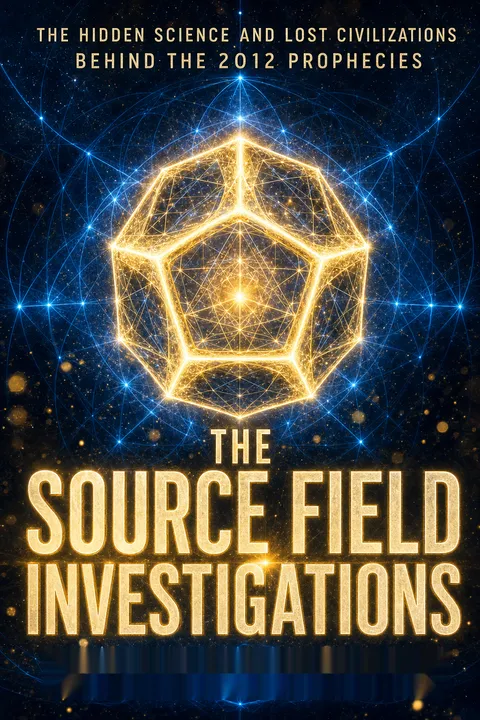
The Source Field Investigations is a sprawling synthesis of spirituality, speculative physics, ancient history, and paranormal testimony. Its 173,000-word structure moves by accumulation: an unusual experiment suggests a hidden field, the field is used to connect biology and consciousness, and the proposed model then expands to pyramids, planetary cycles, time travel, and extraterrestrial disclosure. The narrative engine is the promise that disconnected anomalies are pieces of one lost science. This makes the book vivid and difficult to compress, but also means its central claims depend on a long chain of inferences.
Its most constructive impulse is methodological in spirit, if not consistently in execution. Wilcock repeatedly asks whether phenomena dismissed as impossible might instead deserve investigation. He also gives the reader a humane conclusion: reduce fear, practice forgiveness, and treat the future as something people help create. These ideas have value independently of the book's cosmology.
The main weakness is the uneven treatment of evidence. Peer-reviewed papers, historical symbols, personal accounts, patent claims, and anonymous testimony appear in a continuous stream, although they do not carry equal evidentiary weight. An observation can be intriguing without being replicated; a correlation can be real without proving the proposed cause; and a symbolic resemblance cannot establish a shared ancient doctrine. The book often presents these distinctions less sharply than its argument requires.
A careful adaptation therefore preserves the architecture of the author's vision while marking its epistemic boundaries. The Source Field is best understood here as Wilcock's unifying hypothesis, not as a demonstrated scientific entity. The reader can appreciate the synthesis, the questions it raises, and its ethical aspiration without accepting its claims about healing, gravity, evolution, or 2012 as fact. That balance retains the book's imaginative force while avoiding the mistake of confusing confidence with confirmation.
Review Summary
The Source Field Investigations received mixed reviews. Many readers praised its mind-expanding concepts and scientific approach to exploring consciousness and the universe. They found it thought-provoking and well-researched, appreciating Wilcock's ability to connect diverse scientific findings. However, some critics dismissed it as pseudoscience, lacking proper evidence for extraordinary claims. Skeptics argued that the book misrepresents scientific data and relies on flawed reasoning. Despite the polarized opinions, many readers found the book fascinating and challenging to conventional thinking about reality and human potential.
People Also Read






Glossary
Source Field
proposed universal substrateWilcock's name for a proposed underlying field from which space, time, matter, energy, biological life, and consciousness emerge. He treats it as intelligent and non-electromagnetic, and uses it to connect reports of mind-to-mind effects, biological light, pyramid activity, and unusual physical events. The book's use of the term is a hypothesis, not an established scientific finding.
Backster Effect
claimed plant response to intentThe name given to Cleve Backster's reported observation that a plant connected to a polygraph showed electrical changes when he thought of harming it. Backster interpreted the response as evidence that plants sensed human intention. Wilcock extends the idea to other organisms and cells, but the reported effect does not by itself establish telepathy or the proposed Source Field.
DNA Phantom Effect
claimed persistent DNA light patternPeter Gariaev's reported finding that a DNA sample absorbed and organized light, with a detectable pattern remaining after the physical sample was removed. Wilcock interprets this persistence as evidence for an energetic duplicate or template that stores biological information. The book uses the claim to support theories of healing and inheritance, though the proposed mechanism is not established by the report alone.
morphic fields
shared patterns of informationRupert Sheldrake's term for proposed organizing fields that retain information from past instances of a pattern and influence similar systems. Wilcock invokes the idea to explain claims that learning, habits, or discoveries become easier when widely repeated. The book treats these fields as a possible route for shared information, but they are not interchangeable with a demonstrated physical mechanism.
Global Consciousness Project
network tracking random-number changesA project described in the book that gathered data from random-number generators around the world and looked for statistical deviations during major shared events. Wilcock interprets reported deviations during tragedies and celebrations as evidence that collective attention can affect physical systems. The project provides a named body of claims, but the interpretation and cause remain distinct from the measured data.
Reciprocal System
space-time exchange modelDewey B. Larson's proposed physics model, in which space and time have reciprocal roles and the universe is fundamentally composed of motion. Wilcock adapts it to describe a parallel reality called time-space, where time has three dimensions. The model is used to interpret quantum behavior and reports of time travel, but the book does not demonstrate that these interpretations are correct.
Temporary Local Risk (TLR) factor
proposed moving risk zoneA pattern proposed by Grazyna Fosar and Franz Bludorf after comparing several aircraft incidents and their dates and locations. They suggested that an invisible zone moved across Earth and was associated with malfunctions or accidents. Wilcock links the proposed cycle to Maya calendar periods and portals into time-space. The connection is speculative and does not establish that the zone exists.
Cavity Structural Effect
claimed effect of repeated cavitiesViktor Grebennikov's term for an alleged physical effect produced by repeating cavity structures, first noticed while examining insect shells and honeycombs. He claimed the effect could cause unusual sensations, influence living organisms, and even support a levitating platform. Wilcock interprets it as an interaction with gravity and the Source Field, while the extraordinary claims remain unverified in the book.
Mnemonic Induction of Lucid Dreaming
intention-based lucid dream practiceStephen LaBerge's technique, abbreviated MILD, for becoming aware that one is dreaming. After waking from a dream, the practitioner rehearses the intention to recognize the next dream and imagines becoming lucid within it. Wilcock describes lucid dreaming as a direct way to explore awareness, while treating its possible connection to an external parallel reality as an interpretation rather than a necessary conclusion.
time-space
proposed parallel time realityWilcock's term for a proposed parallel reality in which the three dimensions of time correspond to the three dimensions of space in ordinary reality. Drawing on Larson's Reciprocal System, he suggests matter may move between space-time and time-space, enabling levitation, teleportation, or time travel. The book uses this model to explain anomalies, but the existence of this parallel realm is not established.
Ho'oponopono
self-reflection and reconciliation practiceA Hawaiian spiritual practice that Wilcock discusses through therapist Hew Len's account. Len reportedly worked with patients' case files by repeating expressions of love, apology, forgiveness, and gratitude, and attributed improvements in a psychiatric ward to this inner practice. The book presents the story as evidence of interconnected consciousness, but it does not establish that the practice alone caused the reported institutional changes.
FAQ
What is The Source Field Investigations by David Wilcock about?
- Exploration of a Universal Energy Field: The book investigates the existence of the Source Field, a hidden, non-electromagnetic energy that underlies space, time, matter, biology, and consciousness.
- Synthesis of Science and Ancient Wisdom: Wilcock combines modern scientific research with ancient spiritual traditions, suggesting that lost civilizations understood and harnessed this field for healing, evolution, and transformation.
- Connection to 2012 Prophecies: The narrative ties the Source Field to the 2012 prophecies, interpreting them as a signal for a coming Golden Age and a major evolutionary leap for humanity.
Why should I read The Source Field Investigations by David Wilcock?
- Bridges Science and Spirituality: The book offers a comprehensive synthesis of cutting-edge science and ancient wisdom, challenging conventional paradigms and providing a hopeful vision for humanity’s future.
- Reveals Suppressed Knowledge: It uncovers overlooked research and technologies, especially from Russian scientists, that could revolutionize our understanding of consciousness, healing, and energy.
- Empowers Personal and Global Transformation: Readers are encouraged to recognize their role in co-creating reality, with practical insights on how collective consciousness can influence global events and usher in a new era.
What are the key concepts and takeaways from The Source Field Investigations by David Wilcock?
- Source Field as Universal Matrix: The Source Field is described as a fundamental energy matrix connecting all matter and consciousness, responsible for phenomena like telepathy, healing, and time manipulation.
- Consciousness Interacts with Reality: Human consciousness is shown to influence DNA, health, and even physical matter, suggesting a direct mind-matter connection.
- Ancient Knowledge Rediscovered: The book argues that ancient civilizations encoded advanced knowledge of cosmic cycles, energy fields, and transformation in their monuments and myths, now being validated by modern science.
How does David Wilcock define the Source Field in The Source Field Investigations?
- Non-Electromagnetic Universal Energy: The Source Field is a hidden energy field that creates and connects space, time, matter, energy, biology, and consciousness.
- Holographic and Coherent Nature: It is described as a holographic matrix, meaning every part contains the whole, enabling phenomena like telepathy and remote healing.
- Scientific and Spiritual Evidence: Wilcock presents both scientific experiments and ancient teachings to support the existence and influence of the Source Field.
How does The Source Field Investigations by David Wilcock explain the connection between consciousness and the universe?
- Consciousness as a Universal Mind: The book posits that consciousness is not limited to the brain but is a fundamental, energetic phenomenon woven into the fabric of the universe.
- Scientific Validation: Experiments in hypnosis, remote viewing, and brainwave synchronization are cited as evidence for mind-to-mind communication and consciousness persisting beyond physical death.
- Ancient Wisdom Correlation: These findings resonate with spiritual teachings, such as “As Above So Below,” suggesting the visible world is a manifestation of a higher, unseen consciousness.
What is the significance of the pineal gland in The Source Field Investigations by David Wilcock?
- Physical “Third Eye”: The pineal gland is described as a biological “third eye,” historically revered as the seat of the soul and a receiver of telepathic and spiritual information.
- Energetic and Biological Functions: It contains piezoelectric microcrystals that may transduce photons, potentially linking it to the Source Field and enabling psychic vision and spiritual experiences.
- Health and Spirituality: The book discusses how calcification of the pineal gland impairs melatonin production and spiritual awakening, emphasizing the importance of decalcification for consciousness expansion.
How does The Source Field Investigations by David Wilcock describe pyramid power and its role in human evolution?
- Ancient Advanced Technology: Pyramids are presented as sophisticated structures designed to harness the Source Field, encoding precise measurements and cosmic cycles.
- Healing and Environmental Effects: Russian pyramid experiments demonstrated benefits such as improved health, water purification, reduced crime, and environmental stabilization.
- Catalyst for Golden Age: Pyramid power is proposed as a key technology to facilitate humanity’s transition into a Golden Age by enhancing healing, consciousness coherence, and planetary stability.
What evidence does David Wilcock present in The Source Field Investigations for time portals, vortexes, and time slips?
- Documented Phenomena: The book references numerous cases of time slips, disappearances, and objects moving mysteriously, often associated with spherical vortexes or vacuum domains.
- Vortexes as Gateways: These vortexes are described as natural portals between space-time and time-space, capable of altering gravity, time flow, and matter states.
- Physical and Physiological Effects: Witnesses report sensations like numbness, slow motion, and electromagnetic disturbances during such events, supporting the theory of quantum-level interactions with time-space.
How does The Source Field Investigations by David Wilcock challenge traditional views of evolution and DNA?
- Rapid and Cyclical Evolution: Fossil records and experiments suggest species appear in sudden bursts, influenced by cosmic or energetic cycles rather than random mutation.
- Energetic DNA Transformation: Research shows DNA can be reprogrammed by coherent light frequencies, enabling healing and even species transformation without genetic mutation.
- Consciousness-DNA Interaction: Human thoughts and intentions, especially coherent and loving ones, can physically alter DNA structure and function, indicating a direct mind-matter connection.
What is the DNA Phantom Effect and its implications in The Source Field Investigations by David Wilcock?
- Energetic DNA Duplicate: Dr. Peter Gariaev’s research found that DNA stores and organizes photons of light, and even after removal, a “phantom” energy field persists for weeks.
- Holographic Body Concept: This suggests every living organism has an energetic holographic duplicate that may survive physical death, supporting ideas like reincarnation.
- Mind-Matter Connection: Experiments show that human thoughts can influence DNA structure, reinforcing the concept of consciousness interacting with the Source Field.
How does The Source Field Investigations by David Wilcock explain the 25,920-year precession cycle and its importance?
- Earth’s Axis Wobble: The precession of the equinoxes is a 25,920-year cycle dividing history into twelve astrological Ages, encoded in ancient myths and monuments.
- Ancient Prophecies: Many cultures predicted a period of destruction followed by a Golden Age, linked to the culmination of this cycle.
- Modern Relevance: The book highlights that this cycle’s end, around 2012–2014, marks a pivotal time for human evolution and consciousness awakening.
What does The Source Field Investigations by David Wilcock say about the Golden Age and the Rainbow Body phenomenon?
- Golden Age as Transformation: The Golden Age is described as a period of humanity’s evolution into a higher state of being, involving immortality, healing, and expanded consciousness.
- Rainbow Body in Tibetan Buddhism: The book details the phenomenon where practitioners dissolve their physical bodies into light after death, with over 160,000 cases documented.
- Spiritual and Scientific Synthesis: Wilcock connects mystical traditions with scientific concepts of coherence and energy fields, suggesting the Golden Age involves merging physical and energetic bodies, enabled by the Source Field and cosmic cycles.
About the Author
Other books by David Wilcock

Download PDF
Download EPUB
.epub digital book format is ideal for reading ebooks on phones, tablets, and e-readers.








