

Key Takeaways
When the top 1% takes 23.5% of income, democracy is at risk
Inequality changes the rules. Sanders argues that extreme concentration of wealth is not only unfair; it can also concentrate political influence and weaken the middle class that sustains broad economic demand. Citing 2007 figures, he says the top 1 percent received 23.5 percent of national income, more than the bottom half combined, and held more wealth than the bottom 90 percent. These are historical figures from the speech, not current measurements.
Money seeks political power. Sanders links wealth to campaign spending and lobbying. He cites $3.47 billion in lobbying expenditures in 2009 and warns that wealthy donors can help elect officials who favor their interests. His central concern is a feedback loop: wealth buys influence, and influence can protect the policies that concentrate wealth.
What's striking is the argument's two-sided account of inequality. A large wealth gap can damage democratic equality while also weakening the purchasing power of ordinary households. The political feedback loop makes the issue more than a dispute over who deserves what: it raises the question of whether citizens have comparable influence over public decisions. Still, a disparity in income does not by itself prove that policy was captured by wealthy interests. The book's figures make the concern vivid, while establishing the mechanism requires examining specific laws, political spending, and whose priorities they serve.
Don't finance tax breaks for the wealthiest with debt passed to children
Examine the whole bargain. Sanders's speech opposes a 2010 tax agreement that extended tax cuts for high earners and lowered estate taxes while adding to a national debt he described as $13.8 trillion. He argued that the benefits were tilted upward: the estate tax change applied to only a small fraction of families, while the costs would be borne more broadly over time. He predicted that temporary tax provisions would be renewed rather than allowed to expire.
Relief had worthwhile parts. Sanders supported continuing tax cuts for most workers, extending unemployment benefits, and preserving earned-income, child, and college tax credits. His objection was to bundling these measures with additional benefits for the wealthiest. He contrasted the proposed tax breaks with a failed $250 payment for seniors and disabled veterans who had gone two years without a cost-of-living increase.
The useful lesson is to assess a fiscal package by distribution, timing, and alternatives, rather than by its headline label. The speech makes intergenerational fairness concrete: borrowing for benefits concentrated among the wealthy shifts costs toward people who did not choose the policy. Yet debt is not automatically irresponsible, especially during a recession, and targeted tax relief can serve different economic purposes. The relevant questions are who receives the benefit, who bears the eventual cost, and whether the spending or tax change plausibly addresses the immediate problem.
Judge a bailout by its conditions, not merely the cash it delivers
Rescue requires accountability. Sanders distinguishes the public debate over the Treasury's TARP program from Federal Reserve emergency lending, whose details were disclosed only after a provision he supported required an audit. He cites the release of records covering more than 21,000 Fed transactions and describes assistance to major banks, corporations, and foreign institutions. His concern is not simply that public money was used to prevent financial collapse, but that aid came without enough transparency or obligations to support employment and lending.
Attach public purpose. Sanders proposed making assistance conditional on steps such as lending to small businesses, reducing mortgage burdens, and limiting excessive executive compensation. He also questioned whether some low-interest loans could be used for profitable financial trades rather than productive investment. His wider warning: banks rescued as too large to fail emerged even larger, leaving taxpayers exposed to another rescue.
Emergency lending presents a real tension: stopping a financial panic may protect people far beyond the institutions receiving funds, but opaque rescue can reward risk-taking and weaken public trust. Separating the question of whether intervention was necessary from the question of its terms clarifies the debate. Conditions can make public support more accountable, though conditions must be designed so they do not obstruct the immediate stabilization that a crisis response is meant to achieve. The speech's strongest demand is therefore institutional: disclose the flows, identify conflicts, and explain what the public receives in return.
Invest in public assets when firms sit on cash and demand is weak
Build what lasts. Sanders argues that public investment in roads, bridges, rail, water systems, broadband, and energy infrastructure can create jobs while improving the economy's long-term capacity. He cites an American Society of Civil Engineers estimate that the country needed $2.2 trillion over five years to address infrastructure needs, and says one in four bridges was structurally deficient or functionally obsolete. A Vermont mayor showed him a water pipe dating to the Civil War, a memorable example of maintenance postponed for generations.
Contrast cash with capacity. The speech cites a 2010 report that nonfinancial businesses held $1.93 trillion in cash, while household finances and consumer demand remained weak. Sanders argues that infrastructure spending would create more jobs per dollar than some corporate tax cuts and leave behind useful assets. He also points to China's heavier investment in rail and other infrastructure as a warning about falling behind.
Infrastructure joins short-term employment to long-term productivity: a repaired bridge or updated water system serves people after the construction work ends. That makes it a different kind of economic intervention from a tax reduction whose effects depend on how recipients use the money. The case is persuasive as a reason to compare public investment with tax incentives, not as proof that every public project is worthwhile. Project selection, maintenance, and oversight matter. The Civil War-era pipe also reveals a political challenge: infrastructure is easy to neglect precisely because its best outcome is often a failure that never happens.
Treat factory closures as losses of bargaining power, not just production
Work carries security. Sanders links manufacturing jobs to wages, benefits, pensions, and a route into the middle class. He cites a decline from about 17 million manufacturing jobs to fewer than 12 million, and says roughly 42,000 factories had closed since 2001. He points to new auto workers earning about $14 an hour beside experienced workers earning $28, interpreting the wage gap as evidence of diminished security for future workers.
Trade rules shape choices. Sanders argues that deals such as NAFTA and trade relations with China encouraged companies to move production to places where wages were far lower, then sell goods back in the United States. He recounts asking a Walmart executive in China what share of the American brands there were made in the United States. The answer, he says, was about 1 percent. His proposed response is to change trade policy and encourage domestic investment.
This account usefully treats a job as more than a line in national output. Work can provide income, benefits, social standing, and bargaining leverage, so a community can lose much more than a factory when production moves. The book's emphasis on workers' experience complements arguments about aggregate trade gains by asking how those gains are distributed. At the same time, the speech's figures do not isolate trade from automation, recessions, or other causes of industrial decline. A durable response needs to address both the gains from international exchange and the concentrated costs workers face.
Protect Social Security's payroll foundation when offering workers temporary tax relief
Preserve the program's structure. The 2010 agreement proposed temporarily lowering workers' Social Security payroll tax from 6.2 percent to 4.2 percent, a change Sanders said would divert about $120 billion in contributions. Supporters said general revenues would replace the money. Sanders worried that relying on the general fund could make Social Security more vulnerable to future political pressure and weaken its identity as an earned benefit funded through payroll contributions.
Distinguish risk from certainty. Sanders cited figures from that period showing a $2.6 trillion Social Security surplus and the ability to pay full benefits for 27 years. He opposed the payroll tax holiday partly because he feared a temporary reduction would be extended and eventually used to justify broader cuts or privatization. His argument is about the program's financing and political design, not a claim that the one-year proposal immediately made benefits insolvent.
The debate highlights how a program's financing can shape its public meaning. Dedicated contributions may help beneficiaries see Social Security as an earned insurance system rather than a discretionary budget item. But the key practical question is whether replacement revenues are guaranteed and sustained, not simply whether they come from payroll taxes or general funds. A temporary tax cut with full replacement differs from an unfunded cut. The speech is strongest when it asks lawmakers to make those commitments explicit instead of assuming that a temporary provision will remain temporary.
Treat early education as economic infrastructure, not optional social spending
Invest before problems compound. Sanders places childcare and education alongside roads and bridges as foundations of national capacity. He argues that children who receive early intellectual and emotional support are better positioned to succeed in school, while inadequate support can contribute to school failure and later social costs. The speech notes that state pre-kindergarten programs served only 24 percent of four-year-olds and 4 percent of three-year-olds at the time.
Compare prevention with repair. Sanders cites a claim that 82 percent of people in prison were high school dropouts, and argues that investments in childcare, schools, and college access are wiser than paying to incarcerate people whose opportunities were limited. He also says about 170,000 high school graduates a year were prepared for college but could not afford to attend. These historical claims support his case for treating education as an investment rather than merely a cost.
Calling education infrastructure shifts attention from immediate budget categories to the capabilities a society builds in its people. The frame also links early care to later outcomes, which helps explain why educational opportunity can have economic as well as social value. But a statistic connecting dropout status and incarceration does not establish a simple causal path. Poverty, health, school quality, and local conditions can shape both. The argument is most persuasive when it supports high-quality, accessible early education and college pathways, not when it treats any single program as a guaranteed cure for later hardship.
Cap predatory credit costs before emergency borrowing becomes a debt trap
Distress can be expensive. Sanders describes households using credit cards to pay for necessities such as food and fuel, then struggling under high interest charges. He says more than a quarter of cardholders were paying rates above 20 percent and cites one card with a rate approaching 80 percent. He calls this usury, meaning excessive interest charged to people with few alternatives, and argues that lenders benefiting from public support should not be free to impose such costs.
Use a workable limit. Sanders points to credit unions, which he says were subject to a 15 percent cap and continued to operate successfully. He proposes similar limits for private banks and notes that a 1978 Supreme Court ruling, known as the Marquette case, allowed banks to use the interest-rate rules of their home state when lending elsewhere. He sees that ruling as weakening state efforts to restrict rates.
The argument draws attention to a sharp asymmetry: people with the least financial flexibility can face the highest borrowing costs. A rate cap is appealing because it sets a clear boundary on what lenders may charge, rather than relying only on disclosure that borrowers may not be able to act on. But a cap also needs to be assessed alongside borrowers' need for emergency credit and the availability of safer alternatives. The strongest policy question is not only how low a rate should be, but how to prevent desperate households from being left with no workable source of short-term funds.
Turn public anger into organized pressure, even when one vote is lost
A speech is a beginning. On December 10, 2010, Sanders spoke on the Senate floor for eight and a half hours against the tax agreement. He says he had no fully prepared script, drawing instead on earlier speeches, articles, and books, and repeated his main themes because few listeners would hear the whole address. The bill passed despite his effort, but his offices received thousands of calls and emails, and the speech drew extensive public attention.
Participation must continue. Sanders argues that elected officials respond when constituents call, write, and organize beyond Washington. In the 2015 introduction, he connects that idea to campaign crowds and small donations, presenting collective action as a counterweight to wealthy donors and corporate interests. The speech's immediate legislative defeat does not erase its value in creating public discussion, but attention alone is not the same as policy change.
The speech offers a practical model of political communication: one person uses a legislative platform to make an argument, then invites people outside the institution to apply pressure. Its repetition is functional, not merely stylistic, because different listeners encounter different portions of a long address. The limitation is equally important: calls and crowds show engagement, but they do not necessarily represent the whole electorate or guarantee a legislative result. Public attention becomes durable influence only when it is organized, sustained, and connected to decisions officials can actually make.
Analysis
The book is best understood as a political argument staged as a legislative performance, not as a comprehensive economics textbook. Its central move is to connect three subjects that are often debated separately: the distribution of income and wealth, the influence of money on government, and the material security of working families. The 2010 tax agreement serves as the immediate case. Sanders uses its provisions to argue that fiscal choices reveal whose interests government prioritizes, while the long Senate speech itself demonstrates his faith in public argument as a form of political pressure.
The book's most memorable evidence is concrete: a Civil War-era water pipe, a family choosing between heating fuel and diapers, a worker facing an eight-mile walk, and a bank rescue followed by renewed executive rewards. These scenes give human scale to statistics about jobs, income, debt, and infrastructure. Their persuasive power comes from the way they make policy consequences imaginable. Their limitation is that testimony and selected figures illustrate a case but do not, by themselves, establish every causal claim. The speech sometimes moves quickly from correlation, such as inequality preceding economic crises, to a policy explanation.
That distinction matters because the book combines moral judgments with empirical claims. It argues that very large fortunes should carry greater public obligations, then also claims that more equal purchasing power and investment in infrastructure would improve economic performance. The moral case can stand even when the precise economic effects of a particular tax or trade policy remain disputed. Conversely, a policy's good intentions do not settle questions of cost, design, or effectiveness.
Its lasting analytical contribution is a test for public policy: Who benefits, who bears the risk, what capacity is built, and who gets to influence the decision? The speech's call for mobilization follows from that test. It presents democracy not as a guarantee that the public will win, but as a process that fails when ordinary people stop making their interests visible. Readers should also keep the historical frame in view: the figures and proposals describe the economic and political debate of 2010, with a 2015 introduction about Sanders's campaign.
Review Summary
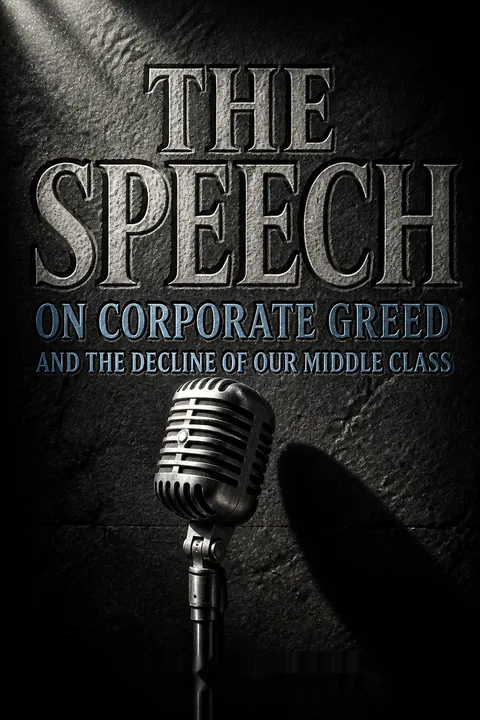
The Speech receives mostly positive reviews for Bernie Sanders' passionate critique of economic inequality and corporate greed. Readers appreciate his consistency, facts-based arguments, and advocacy for the middle class. Many find it eye-opening and relevant, despite its repetitive nature as a filibuster transcript. Some critics note the lack of detailed solutions and repetitiveness. Overall, reviewers see it as an important look at Sanders' political philosophy and a call to action, though its readability as a book is debated.
People Also Read





Glossary
trickle-down economics
Wealth-first growth theoryAn economic approach that expects tax cuts or other benefits for wealthy people and businesses to encourage investment, growth, and jobs that spread through the wider economy. Sanders uses the term critically, arguing that the approach failed to improve conditions for the middle class and instead increased deficits and inequality.
Too Big to Fail, Too Big to Exist Act
Breakup plan for giant firmsA bill Sanders proposed to identify financial institutions and insurance companies whose failure could threaten the broader economy, then require their breakup. In the speech, the Treasury secretary would identify such firms within 90 days, with a year to break them up. The proposal responds to the risk that taxpayers may be asked to rescue institutions considered systemically important.
payroll tax holiday
Temporary payroll tax reductionThe temporary cut in workers' Social Security payroll tax proposed in the 2010 tax agreement. The rate would fall from 6.2 percent to 4.2 percent for a year, putting more money in workers' paychecks. Sanders objected that diverting contributions could weaken the program's dedicated financing, especially if the reduction were extended or not fully replaced.
usury
Excessive interest on loansA term Sanders uses for charging borrowers very high interest, particularly when they are financially desperate and have few alternatives. He connects the idea to longstanding religious objections to exploitative lending and applies it to credit card rates above 20 percent. His proposed remedy is a legal cap on interest, modeled in part on limits he says apply to credit unions.
Citizens United Supreme Court decision
Ruling on political spendingThe Supreme Court decision Sanders cites as enabling corporations and other organizations to spend heavily on political campaigns by treating independent political expenditures as protected speech. He emphasizes the danger that wealthy interests can use campaign spending to support candidates who favor their agenda. The speech also raises concerns about undisclosed spending, a related issue rather than the ruling's entire legal effect.
Marquette case
Ruling on interstate interest ratesThe 1978 Supreme Court case Sanders identifies as allowing a national bank to charge customers the interest rate permitted in the state where the bank is based, even when it lends in states with stricter limits. He argues that this ruling weakened state usury caps by making it possible for banks to operate from states with few or no interest-rate restrictions.
FAQ
What is "The Speech: A Historic Filibuster on Corporate Greed and the Decline of Our Middle Class" by Bernie Sanders about?
- Focus on economic inequality: The book is a transcript and expansion of Bernie Sanders' historic Senate filibuster, highlighting the growing concentration of wealth and power among the richest Americans.
- Critique of policy and politics: Sanders examines how tax policies, deregulation, and corporate influence have contributed to the decline of the middle class and the rise of economic injustice.
- Call to action: The book urges readers to mobilize for a political revolution that demands a government serving all citizens, not just the wealthy elite.
Why should I read "The Speech" by Bernie Sanders?
- Insight into economic justice: The book offers a passionate, detailed critique of economic policies that exacerbate inequality, providing a clear understanding of the challenges facing the American middle class.
- Historical significance: It captures a pivotal moment in U.S. Senate history, revealing the political and economic forces shaping national policy.
- Practical perspective: Sanders presents concrete alternatives and solutions, making the book relevant for anyone interested in economic reform and social justice.
What are the key takeaways from "The Speech" by Bernie Sanders?
- Economic inequality is rising: Sanders documents the widening gap between the wealthy and the rest, with the top 1% owning more than the bottom 90%.
- Corporate and political power: The book exposes how corporate money and lobbying have shaped policies that favor the rich.
- Need for systemic change: Sanders calls for investment in infrastructure, education, and fair trade, and for a mass movement to reclaim democracy for working families.
What are the best quotes from "The Speech" by Bernie Sanders and what do they mean?
- "There is a war going on in this country, and I’m not referring to the war in Afghanistan or Iraq. I’m talking about a war being waged by some of the wealthiest and most powerful people in this country against the working families of the United States." This quote encapsulates Sanders' central argument about class conflict and economic injustice.
- "Social Security has nothing to do with the deficit." Sanders emphasizes the importance of protecting Social Security from political attacks and false narratives.
- "We need a political revolution." This recurring phrase underscores his belief that only mass mobilization can counteract entrenched corporate interests.
How does Bernie Sanders in "The Speech" define and critique corporate greed and its impact on the middle class?
- Corporate greed as central threat: Sanders argues that unchecked corporate power and profit-seeking have led to job losses, wage stagnation, and declining living standards for the middle class.
- Influence on policy: He details how corporations use lobbying and campaign contributions to secure favorable tax breaks and deregulation.
- Social consequences: The book links corporate greed to the erosion of public infrastructure, education, and social safety nets.
What are Bernie Sanders' main criticisms of U.S. tax policy in "The Speech"?
- Tax breaks for the wealthy: Sanders opposes extending Bush-era tax cuts and lowering estate taxes, arguing these primarily benefit the richest Americans.
- Impact on national debt: He warns that such policies increase the deficit and divert resources from critical investments.
- Moral and economic argument: Sanders contends that fair taxation is essential for funding education, infrastructure, and social programs that benefit all.
How does "The Speech" by Bernie Sanders address the decline of American infrastructure and its economic consequences?
- Crumbling infrastructure: Sanders highlights the poor state of U.S. roads, bridges, and public transit, citing high costs from congestion and disrepair.
- Missed investment opportunities: He criticizes legislation that fails to allocate funds for infrastructure, missing a chance to create jobs and boost competitiveness.
- Comparison with other nations: The book contrasts U.S. underinvestment with countries like China, urging America to catch up in infrastructure development.
What does Bernie Sanders say about the state of education in "The Speech" and its role in economic opportunity?
- Declining global rankings: Sanders points out that U.S. students lag behind peers in math and science, threatening future competitiveness.
- Barriers to higher education: He stresses that high college costs prevent many qualified students from attending, wasting national potential.
- Call for investment: The book advocates for increased funding in early childhood and higher education to restore the "great equalizer" role of schools.
How does "The Speech" by Bernie Sanders critique trade policies and outsourcing?
- Job loss from trade deals: Sanders blames agreements like NAFTA and trade with China for the loss of millions of manufacturing jobs.
- Race to the bottom: He warns that outsourcing to low-wage countries depresses American wages and working conditions.
- Advocacy for fair trade: Sanders calls for trade policies that protect American workers and promote global development without sacrificing the U.S. middle class.
What are Bernie Sanders' views on Social Security and the payroll tax holiday in "The Speech"?
- Strong defense of Social Security: Sanders sees Social Security as a vital, successful program that must be protected.
- Critique of payroll tax holiday: He argues that diverting funds from Social Security threatens its long-term viability and sets a dangerous precedent.
- Sustainable solutions: Sanders supports lifting the payroll tax cap on high incomes to strengthen the program rather than cutting contributions.
How does "The Speech" by Bernie Sanders address the power of Wall Street and the problem of "too big to fail" banks?
- Concentration of financial power: Sanders notes that the largest banks now hold assets exceeding half of U.S. GDP, posing systemic risks.
- Call for breaking up banks: He advocates for breaking up "too big to fail" institutions to reduce risk and increase competition.
- Critique of bailouts and lobbying: The book exposes how Wall Street's influence has blocked meaningful reform and enabled risky practices.
What personal stories and real-life examples does Bernie Sanders include in "The Speech" to illustrate economic hardship?
- Letters from struggling Americans: Sanders shares stories from constituents facing challenges like heating their homes, affording food, and managing debt.
- Emotional and social impact: These accounts highlight the dignity lost when families can't provide basic needs or send children to college.
- Contrast with wealth: Sanders juxtaposes these hardships with the privileges of billionaires receiving tax breaks, emphasizing the disconnect in political priorities.
About the Author
Other books by Bernie Sanders
Download PDF
Download EPUB
.epub digital book format is ideal for reading ebooks on phones, tablets, and e-readers.








