

Key Takeaways
Treat the slow civil war as a condition, not a future event
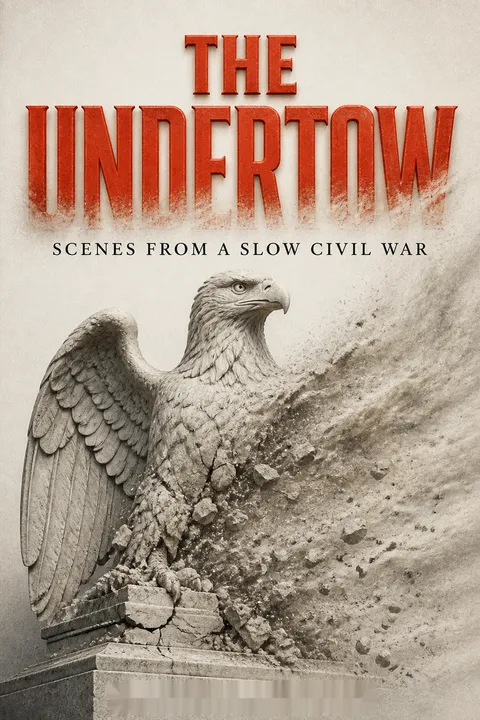
A current beneath events. Sharlet uses the undertow as a metaphor for forces drawing people toward political fracture: racial myths, conspiracy, fear, and losses that go unacknowledged. The violence is not limited to spectacular moments such as January 6. It also surfaces in ordinary talk, armed postures, and the stories people tell about who threatens their way of life.
Watch what gathers force. The book moves among rallies, churches, militias, and the memories of people who have died. Their stories show how private grief can be redirected into public fury, while climate damage and political breakdown make the sense of loss tangible. Calling this a condition, rather than a short-lived crisis, asks readers to notice how it shapes daily life before another dramatic rupture.
The metaphor is strongest when it explains accumulation rather than predicting an inevitable collapse. Political violence often depends on ordinary preparation: repeated narratives, permission to distrust institutions, and the growing visibility of weapons. That framing shifts attention from a single villain or decisive date toward the social environment that makes escalation imaginable. It also carries a risk: treating a broad national mood as one current can blur important differences among communities and motives. The book's scenes help resist that flattening by showing how the same atmosphere is experienced, and acted upon, in sharply different ways.
Make familiar songs carry meanings power would rather ignore
Pop with a hidden edge. Harry Belafonte understood that a song could reach listeners who would never attend a political meeting. His 1956 recording of “Day-O” made him a star, but he treated its familiar sound as a doorway into the history of labor and slavery. In a 1959 television special, he replaced safe entertainment with chain-gang songs, gospel, and performances by artists such as Odetta.
Choose the terms. Belafonte used metaphor to get radical material past commercial gatekeepers, but refused to let Revlon dictate racial segregation among performers. He walked away from future specials, while his pay-or-play contract still secured his fee. The lesson is not simply to hide a message. It is to use access without surrendering control over what the audience is invited to see.
Belafonte's example connects art to a longstanding problem of communication under unequal power: direct speech can be censored, dismissed, or packaged into harmless slogans, while music can create attention before argument begins. The performance also asks audiences to do interpretive work rather than receive a finished political lesson. That ambiguity is an advantage, but it is not a guarantee. A popular song can be stripped of its history, as Belafonte's own hit became familiar novelty. Cultural reach matters most when artists retain the power to shape the context around it.
Build democracy through shared rituals, not only political demands
Democracy in the body. Occupy Wall Street gathered people in a privately owned plaza in 2011, held nightly assemblies, and made no formal list of demands. Its library offered thousands of donated books for free. Its human microphone, a crowd repeating a speaker's words so everyone could hear without amplification, made listening and speaking visibly collective.
Practice a different time. Sharlet describes Occupy as more than protest: a temporary experience of people making decisions, sharing space, and creating abundance together. He uses the religious term kairos for time experienced as charged with memory and possibility, rather than as a routine sequence of minutes. Police eventually cleared the plaza and destroyed much of the encampment, but the experiment showed democracy as something people can rehearse together.
Occupy's rituals resemble what political theorists call prefigurative politics: movements try to embody the relationships they want, instead of waiting for power to grant them. The library and human microphone made abstract values tangible, which helps explain why participants could feel the movement's significance even when its goals seemed unclear. Yet shared procedure is not automatically shared power. Consensus can exhaust participants, amplify the most persistent voices, or fail to scale. The book's account is most useful as a demonstration of possibility, not proof that one assembly model can govern a whole society.
See Trump's rallies as a prosperity gospel built from anger and longing
Winning as deliverance. Sharlet links Trump's appeal to the prosperity gospel, a religious outlook in which faith is expected to bring tangible success in this life. Trump inherited the influence of Norman Vincent Peale's positive-thinking message, then fused wealth, strength, and national restoration into a political spectacle. His gold-heavy plane made those promises visible before he spoke.
Give frustration a hero. At a Youngstown rally, supporters spoke of wanting better wages, roads, and the return of steel jobs. Some knew the mills were unlikely to return, but Trump's promise still offered the pleasure of believing in a winner who could reverse decline. His rallies made anger feel like solidarity and confidence feel like victory. The attraction was not just a policy program. It was a staged escape from humiliation and want.
The account clarifies why fact-checking a promise can miss the emotional function of the promise. A political performance can offer recognition, status, and a feeling of agency even when its proposed remedy is implausible. Research on group identity likewise suggests that shared symbols can make personal frustrations feel collectively understood. Still, this explanation should not turn every Trump supporter into a passive consumer of spectacle. Economic interests, racial commitments, and local political histories differ. The book's rally scenes are valuable precisely because they show these motives overlapping without pretending they are identical.
Ask who gets left outside when faith is staged as fun
A polished spiritual product. Pastor Rich Wilkerson Jr.'s Miami church used celebrity connections, stylish clothes, pop music, and carefully staged services to attract young, affluent guests. Its meeting place was a middle school in a poor neighborhood, yet few neighborhood residents attended. The church's language emphasized happiness and personal lifestyle more than poverty, social justice, or the hard demands of religious belief.
Compare the performance with care. A volunteer named Brandon described a city without debt or poverty, where everyone was cared for. His vision contrasted with the church's controlled interviews and a laundromat outreach that assumed customers needed donated quarters and evangelizing. The gap is not simply between sincere and insincere believers. It is between a faith presented as attractive experience and the material needs that might test its claims.
The chapter anticipates a familiar problem in institutional design: organizations can optimize the experience of service while making the people they claim to serve peripheral. Aesthetic accessibility can lower barriers, but it can also disguise the absence of accountability or contact across class lines. Brandon's humane vision shows that followers may imagine a more demanding ethic than their leaders promote. That tension matters more than judging a church by its clothes or music alone. The sharper question is whether its practices redistribute attention, resources, and decision-making toward the neighbors it invokes.
Take men's hardship seriously without letting misogyny explain it
Real pain, false culprit. The manosphere is a loose online network focused on men's grievances, especially around relationships, custody, and changing gender roles. Many members describe a red-pill moment, their term for waking up to what they see as women's power over men. Some bring genuine hardship: men face high suicide rates, workplace risks, and limited support as victims of abuse.
Follow the explanation. At a men's-rights conference, those concerns repeatedly turned into claims that feminism had made women dominant and men disposable. The rhetoric could excuse harassment and violence, even as some participants said the movement had helped them survive suicidal despair. Sharlet's challenge is to hold both facts together: listen to unmet needs, but do not accept scapegoating as an analysis of their causes.
This distinction is essential for avoiding two failures at once: dismissing male suffering as inherently reactionary, or treating suffering as evidence that women are to blame. A serious account can examine economic precarity, social isolation, family-court conflicts, and gaps in services without endorsing a gender-war narrative. Online communities can provide recognition and mutual aid, while also rewarding increasingly extreme explanations. The book's encounters make that contradiction visible. A limitation is that vivid examples of misogyny can overshadow the quieter, legitimate needs that initially draw people into these spaces.
Treat conspiracy theories as belonging systems, not merely false claims
Clues create a circle. QAnon followers treated cryptic posts, Trump speeches, and even capital letters as coded messages meant for people capable of seeing hidden truth. The belief offered a shared identity: insiders understood the danger, while outsiders were deceived. Some claims borrowed real events or statistics, then joined them to fabrications about a secret child-trafficking network.
Belief can move bodies. Evelyn, a woman in Texas, became consumed by QAnon during pandemic isolation. After days without sleep, she drove around believing she had found children to rescue and repeatedly rammed a student's vehicle. The supposed rescue was false; the danger she caused was real. The episode shows how a conspiracy can turn uncertainty into a mission, and how online conviction can spill into physical violence.
A conspiracy theory can function as a social relationship as much as a factual proposition. It provides a community, a role, and a way to interpret ambiguous events, making correction feel like an attack on identity. That insight helps explain why a list of debunked claims may not loosen someone's attachment. It does not mean evidence is irrelevant or that all suspicion is irrational. Institutions do sometimes conceal information. The crucial distinction is whether a claim remains open to correction, or whether every contradiction becomes further proof that the hidden enemy is winning.
Don't let Ashli Babbitt's martyr myth erase the person who died
A life turned into evidence. Ashli Babbitt was a 35-year-old Air Force veteran who believed the 2020 election had been stolen and joined the January 6 assault on the Capitol. She was shot by a Capitol Police officer while trying to climb through a broken window toward a barricaded area. Her supporters quickly recast her as a martyr, often presenting her death as proof of a wider plot.
Restore the difficult details. Babbitt was neither an uncomplicated innocent nor merely a symbol. She had family, military service, debts, political convictions, and a life beyond the final video of her death. Sharlet shows how supporters used her image to claim victimhood and demand vengeance, while others dismissed her killing as deserved. Remembering her as a person does not excuse the insurrection or settle the question of the shooting.
Martyr-making converts an individual death into a portable political symbol. The dead cannot correct the story told in their name, so the living can use that story to define enemies, sanctify violence, or simplify a complicated event. Keeping biography alongside accountability resists both sentimental innocence and dehumanizing contempt. The chapter also exposes an asymmetry in public mourning: whose death is made nationally legible, and whose is treated as background. A fuller memory does not require equivalence between Babbitt and those harmed by the attack. It requires refusing to let political usefulness replace the facts of a life.
Name what is lost before the loss becomes someone else's weapon
Grief has many sources. The book places political rupture beside intimate deaths, including Sharlet's father and stepmother, Fiona. It also records losses that are easy to call small: a winter festival canceled because a pond no longer freezes reliably, or land and history erased by national myths. In Wisconsin, the overturning of Roe changed the choices available to a woman undergoing fertility treatment, even though she hoped to become a parent.
Do not confuse mourning with surrender. Sharlet argues that grief can become fury, denial, or conspiracy when people cannot name what has vanished. He also refuses to treat every loss as interchangeable: the past of Indigenous dispossession, political rights, loved ones, and a changing climate have distinct histories. Naming those differences makes it harder to turn pain into a vague story of enemies stealing an imagined golden age.
The chapter's attention to loss connects political analysis with ecological grief, a response to environmental change that includes mourning places, species, and futures. Naming loss can make collective action more grounded because it identifies what is threatened and who bears the cost. But grief is not automatically morally clarifying. It can intensify attachment to a lost hierarchy as readily as it can motivate care. The book's insistence on distinguishing losses is therefore important: shared sorrow does not erase unequal histories, and empathy should not become a shortcut to false equivalence.
Keep singing through defeat without confusing endurance with victory
A song survives its moment. Lee Hays, a labor organizer and singer with the Weavers, helped carry political meaning through folk songs. In 1949, a mob attacked a concert organized for Paul Robeson in Peekskill, New York. The Weavers later sang about holding the line, but the attackers had driven people from the road and burned their songbooks. Hays's hit recording of “Goodnight, Irene” carried a quieter kind of mourning after political defeat.
Solidarity is practice. Hays found comfort in singing with others, even when the words were old and the future uncertain. Decades later, teenagers in Black River Falls protested the loss of abortion rights, arguing about what resistance might require. Their courage did not guarantee a win. It showed that care, shared speech, and organized presence can keep political possibility alive without pretending history rewards every good fight.
The closing argument is neither optimism nor an instruction to romanticize failure. Collective singing synchronizes people, lends private fear a public form, and makes participation possible without requiring agreement on every belief. Similar functions appear in labor chants, worship, and protest. Yet solidarity can become exclusionary when a group mistakes unity for moral innocence. Hays's example matters because it holds vulnerability alongside commitment: the song offers company, not proof that victory is near. That is a modest but durable basis for political life.
Analysis
The book's central achievement is to treat political extremism as both a set of beliefs and a lived atmosphere. Sharlet moves from a television performance by Harry Belafonte to Occupy Wall Street, Trump rallies, online men's-rights communities, QAnon believers, January 6, and ordinary conversations on a cross-country drive. The structure refuses a single explanatory villain. Instead, it traces how performance, religious longing, racial identity, economic frustration, and grief can reinforce one another.
That method is also an ethical wager. Sharlet spends time with people whose claims are false or whose politics are dangerous, attempting to show how their stories work without granting those stories factual authority. The result can be unsettling: close attention risks lending charisma to figures who use attention as power. The book counters that risk through verification, context, and repeated attention to consequences, especially the people harmed by fantasies of rescue, purity, and civil war.
Its strongest insight is that symbolic politics does not become harmless just because it is theatrical. A joke, a song, a flag, or a rally can create shared feeling, and shared feeling can prepare people to act. Yet emotional explanation has limits. Economic decline and social isolation help illuminate why certain promises resonate, but they do not dissolve responsibility for racism, misogyny, or violence. The book is careful to hold pain and culpability together, though its large cast of scenes sometimes makes causal claims feel more suggestive than systematically demonstrated.
The narrative's counterweight to conspiracy is not simply factual correction. It is an alternative practice of attention: listen closely, remember bodies and histories, distinguish losses, and notice acts of care without inflating them into guarantees. That approach makes the book less a forecast of civil war than an inquiry into the stories that make conflict feel inevitable. Its hope is deliberately modest. Shared songs and small solidarities cannot restore every lost possibility, but they can resist the conversion of grief into a license for revenge.
Review Summary
Reviews of The Undertow are largely positive, averaging 4.01/5. Admirers praise Sharlet's lyrical, poetic prose and his empathetic, non-condescending approach to interviewing far-right subjects. Many call it essential, even frightening, journalism capturing America's political fractures. Critics, however, find it overlong, lacking analytical depth, and directionless, arguing Sharlet documents alarming anecdotes without sufficient context or thesis. The bookending essays on Harry Belafonte and Lee Hays are widely praised. Most agree the book is unsettling and important, though some wished for more structured analysis beyond vivid, atmospheric reportage.
People Also Read






Glossary
The Undertow
Pull toward political dissolutionSharlet's central metaphor for the accumulating social and political forces drawing people toward conflict. It includes racial myths, conspiracy, grievance, fear, and unprocessed loss. The undertow is not a single event or an inevitable civil war. It is a condition that shapes ordinary perceptions and choices, making rupture seem increasingly plausible.
The Trumpocene
Trump-era political conditionA term used in the book for the period and atmosphere shaped by Donald Trump's political influence. It describes more than a presidency: conspiracy, spectacle, Christian nationalism, racial grievance, and the blurring of joking performance with sincere belief. The term situates these forces within a wider period of American political and social instability.
Whiteness
Historically constructed racial identitySharlet capitalizes Whiteness to make visible a racial identity often treated as neutral or unmarked. In the book, it is not simply a skin color or a synonym for every White person. It names a historical system of power and belonging that can disguise itself as universal innocence, while drawing political meaning from the exclusion or imagined threat of others.
human microphone
Crowd-repeated public speechA communication practice used by Occupy Wall Street after police restricted amplified sound. A speaker delivers a short phrase, and people nearby repeat it so the words travel through the crowd. The method allows a large group to hear without electronic equipment and makes collective participation part of the act of speaking.
kairos
Time charged with significanceA theological term for time experienced as distinct from ordinary chronological sequence. Sharlet uses it to explain how Occupy participants could experience a shared political moment as holding past struggles and imagined futures together. A holiday is one familiar example: a recurring occasion felt as both the present event and a return of remembered ones.
prosperity gospel
Faith linked to worldly successA religious outlook that treats faith as connected to measurable well-being in this life, such as health, wealth, or deliverance from hardship. In Sharlet's account, it helps explain Trump's appeal as a figure of visible success and promised restoration. The idea can turn belief into a transaction, with prosperity serving as evidence of divine favor.
manosphere
Online men's grievance networkA broad collection of websites, forums, and communities focused on men's issues, often especially on conflict with women and feminism. It includes groups with different aims, from men's-rights advocates to pickup artists and men seeking separation from women. Sharlet examines how genuine concerns can coexist with misogyny and conspiratorial explanations.
red pill
Claimed awakening to hidden powerA term drawn from the film The Matrix, where taking a red pill means awakening to a concealed reality. In the manosphere, it describes a supposed moment of discovering that society is structured against men and in women's favor. The phrase gives personal disappointment the form of revelation and membership in an insider community.
zipper songs
Songs with replaceable political lyricsLee Hays's term for songs adapted by fitting new political words into familiar religious melodies. He used the technique at secret labor-organizing meetings in Arkansas, where singers could switch back to conventional hymn lyrics if threatened. The method made a familiar song carry a political message while preserving a cover story.
accelerationism
Hastening political breakdownA political idea associated in the book with speeding up crisis and social decay rather than pursuing gradual reform. It has appeared in different ideological settings, including leftist theory and far-right movements. Sharlet focuses on its destructive appeal: the belief that intensifying disorder will bring down the existing system and make room for a new one.
Download PDF
Download EPUB
.epub digital book format is ideal for reading ebooks on phones, tablets, and e-readers.








