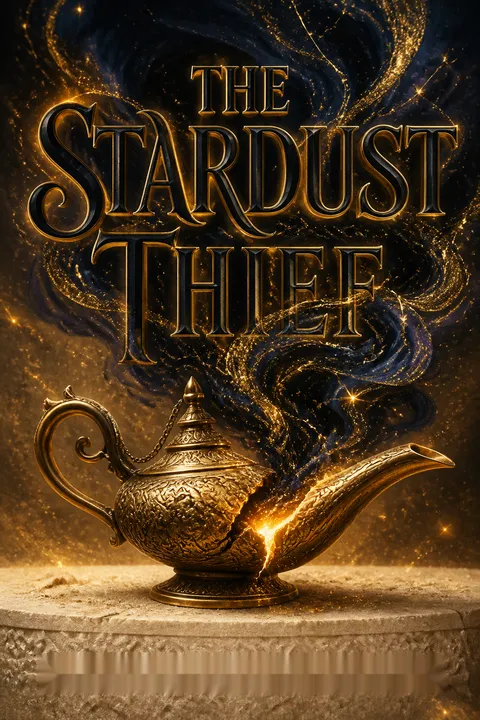


Plot Summary
Prologue
The desert’s creation story says seven jinn kings destroyed the old world and were buried beneath the Sandsea; humans came after, and their rulers learned to turn jinn blood into water, trees, and healing. Loulie al-Nazari was raised to remember that not every jinn is evil.
Then her tribe was slaughtered, and she buried her birth name, Layla, along with her family and her past. One thing she could not bury was the compass her father left her, a relic that would lead a lost jinn to her.
The opening legend gives the novel its central moral contradiction before its characters encounter it: the human kingdom depends on the life it extracts from jinn, yet tells itself that the sacrifice is righteous. Loulie’s mother’s warning survives her family’s destruction, but it cannot shield Loulie from grief or from the politics built around that history. Her buried name suggests that survival has required self-invention. The compass complicates that retreat: an object she does not understand becomes the instrument that ties her chosen identity to the past she has tried to leave behind.
Silver Medicine, Shadowed Souk
Loulie al-Nazari, known in the Night Market as the Midnight Merchant, sells the One-Eyed Merchant a vial of jinn blood that restores his sight. Returning to Madinne, she overhears that the sultan wants a legendary relic from the lost city of Dhahab. Meanwhile, Prince Mazen slips out of the palace to hear a storyteller and is drawn after a beautiful stranger who is really a shadow jinn.
Loulie follows them into an abandoned place of worship, where the jinn nearly suffocates her and mistakes Mazen for a hunter. The sun breaks her hold when Mazen opens the doors, but Loulie has seen the jinn’s fury and the prince’s vulnerability. Her curiosity about him becomes impossible to dismiss.
The opening joins two forms of concealment. Loulie hides her past behind a merchant’s name, while Mazen hides his royal identity to experience the city without its expectations. Their disguises make contact possible, but neither is simply a lie: each protects a fragile self from a world that has already assigned it a role. The restored eye also introduces the economy underlying Madinne’s prosperity. A human’s healing is purchased with jinn blood, a miracle whose cost remains conveniently out of sight until Loulie and Mazen are forced to confront it.
The Feast Goes Dark
At a palace feast, the shadow jinn possesses Mazen and turns the diwan’s shadows against its guests. The sultan’s guards raid the Night Market to seize Loulie, whose relic-selling makes her useful to the crown.
She agrees to enter the darkened hall because the trapped guests will otherwise be burned with the market’s other criminals. The possessed prince attacks her, but her words about the value of every life briefly break the jinn’s control.
With Qadir’s fire guiding her, Loulie fights the shadow creature until Omar, the sultan’s eldest son and celebrated jinn hunter, makes it solid with a black knife and kills it. The sultan uses the dead jinn’s blood to close Mazen’s wound, leaving Loulie alive, indebted to no one, and newly entangled with the royal family.
Loulie’s intervention is neither a sudden conversion into a conventional hero nor a rejection of her mercantile instincts. She acts because the threatened crowd includes people who would not hesitate to condemn her, and because she refuses to let the sultan decide whose lives count. The scene makes that refusal materially consequential: her choice saves Mazen, while the royal family’s use of the dead jinn’s blood exposes the violence beneath their language of protection. Omar’s efficient killing and the sultan’s healing belong to the same system, even as each claims a different purpose.
The Lamp's Royal Price
The sultan reveals the family legend of Amir, a human ruler who trapped a jinn king in a lamp and used its power to build Madinne. He wants Loulie to find the lamp so he can command its captive to destroy the jinn. She accepts because refusing would mean prison or death, and the sultan assigns Omar to watch her.
Omar privately blackmails Mazen into taking his place, using ancient bangles that let the brothers exchange appearances. Aisha bint Louas, Omar’s guarded and formidable thief, accompanies the expedition to protect the disguised prince. As they leave Madinne beneath public cheers, Loulie is displayed as a royal asset, Mazen becomes a hunter he is not, and Aisha must keep the substitution secret.
The quest begins as a political transaction disguised as an honor. The sultan controls Loulie through threat, Omar controls Mazen through blackmail, and Aisha’s loyalty is treated as a resource to deploy. The brothers’ exchanged faces make that arrangement literal: the state values the role of the hunter more than the person performing it. Mazen’s disguise offers the freedom he wants, but it also asks him to embody the violence he rejects. Loulie’s public departure similarly turns a hard-won independent reputation into a tool of royal spectacle.
A Crown Beneath Sand
A violent sandstorm separates Aisha from the group and drives Mazen and Loulie toward shelter. A strange voice draws each traveler into buried ruins, where the dead appear in familiar faces and an old song clouds their judgment. Loulie resists the illusion by recognizing Qadir’s tune and uses it to guide herself and Aisha through the shifting halls.
Mazen reaches a bone circlet that looks like a crown, but recognizes its danger just before it can close around his neck. The relic awakens the ghouls buried beneath the ruins; Aisha takes the circlet, and the structure begins to collapse. They flee through falling sand, unaware that their escape has released the powerful being that had been trapped inside.
The ruins turn memory into an instrument of coercion. Mazen is offered the return of his dead mother, while Loulie is led by the image of a father whose voice represents safety and home. Their private grief becomes a vulnerability that an ancient power can exploit. Loulie’s escape depends not on dismissing memory but on identifying its source: Qadir’s song gives her a path through the illusion. Mazen’s refusal of the circlet is a small but decisive act of self-recognition. He does not yet know what power he wants, but he knows he will not accept it by surrendering himself.
Dhyme's Bloody Supper
In Dhyme, Loulie reunites with Ahmed bin Walid, the wali who has asked her to marry him, and joins a gathering of jinn hunters. The collar taken from the ruins reaches Ahmed, who is possessed by the being inside it. He turns on the hunters, killing several as Loulie falls under its song and relives a jinn’s memories.
Mazen arrives in time to stop Ahmed from killing her, and Loulie fights back with Qadir’s firelit dagger. Aisha wrests away the collar, but Mazen gets it from her and returns it to Loulie. Qadir later binds its magic. The attack leaves Ahmed grieving the dead, Loulie shaken by memories that are not hers, and the travelers carrying a relic they can no longer mistake for harmless merchandise.
The possession scene reverses the moral arrangement of the hunter’s gathering: the men who make a living by killing jinn become victims of a jinn’s power. That reversal does not make their deaths just or erase their past crimes. Instead, it exposes the inadequacy of a system that recognizes harm only when it reaches human bodies. Loulie’s involuntary access to another life unsettles her assumption that relics are tools. Ahmed’s horror afterward also complicates her attraction to him: he is both a hunter implicated in the kingdom’s violence and a man grieving people he could not protect.
Souls Inside the Relics
After the attack, Qadir tells Loulie that relics are not merely enchanted objects. Some contain the souls of jinn, preserved in items they valued so their magic and memory can guide the living. He had kept that truth from her while using the compass to find relics and give them new homes. Loulie feels she has been selling imprisoned lives, and her trust in him fractures.
Qadir explains that he hoped to preserve the jinn who had fled their own world, not exploit them. On the journey onward, he shares more of his shame and the history of Khalilah, the compass’s guide. Loulie forgives him, but only after recognizing that their partnership must be built on chosen trust, not secrets disguised as care.
The revelation changes the ethical meaning of Loulie’s livelihood without making her past choices simple to condemn. She has treated magic as a practical resource because that is what human society taught her it was; Qadir’s secrecy let him benefit from that ignorance. His motive is protective, but protection without informed consent repeats the very paternalism he hopes to resist. Their argument therefore marks a shift in intimacy: closeness no longer means being spared difficult truths. Loulie’s forgiveness matters because it follows confrontation, not because it erases the breach.
Imad Finds His Prey
As the travelers continue across the desert, ghouls track the magic in their possession. Qadir uses his fire to divert an attack, but a concealed iron pit catches him and leaves him impaled and badly wounded. Before Loulie can reach him, Imad, a scarred former royal thief, and his men seize the survivors.
Imad recognizes Loulie’s Najima robes and reveals that his band once attacked her tribe while hunting a powerful relic. Loulie is chained and interrogated; Mazen is imprisoned separately, and Aisha is also held. The truth connects the old slaughter to the sultan’s secret ambitions, but it offers no comfort. Loulie’s past has not merely returned as memory. The man who helped destroy her family is standing over her again.
The ambush makes the group’s dependence on Qadir visible at the exact moment his body can no longer protect them. Loulie has built an identity around competence and self-sufficiency, yet the trap forces her to confront what she cannot control. Imad’s account also recasts the massacre as an operation authorized by political secrecy, not an isolated eruption of cruelty. That explanation sharpens rather than settles her anger: her family’s deaths were considered an acceptable cost of acquiring power. The scene leaves Loulie facing the central temptation of revenge, which promises agency while threatening to reduce her to the logic that destroyed her home.
Mazen Steals His Shadow
Imad questions Mazen about the ancient bangle and his brother’s collection of relics, then leaves him guarded by a ghoul. Mazen discovers that the shadow attached to him can peel away and hide his body from view.
He uses it to escape rather than wait for rescue, then finds Aisha captive and wounded. To create a distraction, he imitates the eerie signs of a ghost, giving Aisha an opening to break free. She fights beside him, and the two move through the ruins toward Loulie’s screams.
Their escape depends on Aisha’s experience with weapons and Mazen’s willingness to act despite his fear. By the time they reach Imad’s treasure chamber, Mazen has begun to understand that courage is not the absence of panic, but a choice made while panic remains.
Mazen’s shadow gives him a power associated with hiding, but he uses it to return to danger rather than disappear from it. That choice marks a change in how he understands courage: he remains frightened and unskilled, yet he stops treating those facts as proof that he has no agency. Aisha’s response is equally important. She has spent years translating grief into discipline and contempt for weakness; helping Mazen begins to unsettle that armor. Their alliance is not founded on shared temperament, but on complementary capacities and the recognition that neither can survive alone.
The Sandsea Takes Them
Mazen and Aisha reach Loulie in Imad’s treasure chamber and fight their way out, but the escape ends at a dead end. Imad’s men cut Aisha’s throat, and a collapse sends Loulie and Mazen plunging beneath the Sandsea. There, Qadir returns as a damaged, smoky presence, and Imad follows them into the shifting tunnels.
Loulie kills the man who ordered her family’s slaughter, striking until his body crumbles without blood. Her revenge is complete, but it brings no relief. Qadir fades away after saving her, while Aisha remains dead above. Alone with Mazen, Loulie has gained the answer she wanted about her family and lost the people who helped her endure the search.
The climax of Loulie’s personal revenge is deliberately emptied of triumph. She succeeds in destroying Imad, but the act cannot restore her family or undo the cost of reaching him. Her violence is understandable, even necessary to survive, yet its aftermath leaves her with grief rather than release. Qadir’s fading presence intensifies the loss: the companion who once found her when she was alone may now be beyond her reach. The Sandsea functions as both a physical descent and a collapse of the life Loulie had constructed, forcing her to continue without the certainty that strength can prevent loss.
A Bargain with Death
Near death in the desert, Aisha accepts a bargain with the jinn whose collar she had carried. The jinn restores her body in exchange for sharing it, while promising not to override her will. Aisha returns with new power and an uneasy voice inside her. Qadir also reforms, and the travelers reunite before continuing toward Ghiban.
There, he explains that the seven feared jinn kings were called ifrit, beings capable of multiple kinds of magic. Humans once entered their world, exploited their blood and relics, and drove the jinn to bury their homeland beneath the Sandsea. Qadir admits that he helped sink it and has spent centuries avoiding his past. Loulie learns that the conflict is older, and more entangled, than the human legends admit.
Aisha’s bargain complicates the easy opposition between human and jinn without pretending their histories are interchangeable. She chooses survival, but survival carries a cost to her sense of bodily autonomy and to the certainty of her hatred. Qadir’s account similarly replaces a simple origin myth with a history of fear, exploitation, and flight. The jinn did not vanish because humans defeated an evil species; they withdrew after human violence made coexistence untenable. By linking these histories to the characters’ present bargains, the novel asks whether cooperation is possible without denying injury or surrendering agency.
Ghiban's Open Secret
In Ghiban, Loulie dives into a lake to recover a ring that lets its wearer breathe underwater, but a blood-changed dendan nearly drags her under before Qadir rescues her. The group then sees Tawil, one of Omar’s thieves, kill a young jinn in the public souk while citizens applaud. Aisha hates the spectacle, and Mazen begins to understand what the hunters’ heroic reputation conceals.
To earn money, Mazen tells stories under the name Yousef, with Loulie collecting payment and Qadir manipulating the lantern flame. Their performance gives Mazen a role built from his own gifts rather than his brother’s identity. Aisha also steals relics from Tawil’s cache, quietly preparing to take something valuable from the man she despises.
Ghiban puts violence and storytelling in the same public space. Tawil turns a child’s death into civic entertainment, while Mazen uses performance to gather a crowd without killing or commanding anyone. These are competing ways of shaping communal belief. Aisha’s theft is less a clean rejection of her profession than an early crack in her obedience: she still moves through the thieves’ world, but begins redirecting its resources. Loulie’s rescue by Qadir also challenges her belief that needing help makes her weak. The scene offers a fragile alternative to royal power: a small audience held by stories rather than fear.
A Prince Becomes Wanted
At the last outpost before the Sandsea, Mazen finds a wanted notice accusing him of murdering the sultan. Aisha has disappeared, and mercenaries soon identify him and move to arrest him. Loulie creates a distraction with a false fire, then helps Mazen escape on horseback.
Qadir returns with news: Omar has staged a coup, the sultan is dead, and Ahmed was killed during the turmoil, though the reports disagree about how he died. Hakim has vanished. Mazen is devastated by the loss of his father and by the knowledge that his brother has made him the scapegoat. Loulie mourns Ahmed, then chooses to continue toward the lamp with Mazen and Qadir, because Omar must not be allowed to claim its power.
The coup turns Mazen’s long-standing fear of being controlled into a public accusation he cannot answer from within the kingdom. His brother has taken not only the throne but the story of what happened, casting Mazen as the criminal and himself as the rightful ruler. Ahmed’s death makes that political struggle intimate for Loulie, whose grief arrives alongside the discovery that the past has caught up with the present. Their decision to keep going is not confidence in a clean victory. It is a refusal to let Omar monopolize the future simply because he controls the official version of events.
The Lamp Opens
As Loulie, Mazen, and Qadir cross the Sandsea, Aisha leaves them and rejoins Omar, carrying the collar of the resurrecting jinn. Qadir burns a passage through the sand while Loulie follows the compass to the lamp.
Mazen finds an unremarkable copper vessel among the treasures and realizes it is the object they crossed the desert to recover. Omar arrives with Aisha and armed allies, and iron arrows wound Qadir before he can intervene. Omar cuts his hand, speaks the binding command, and releases Rijah, the jinn imprisoned in the lamp.
He orders Rijah to kill Qadir. The discovery is therefore not a simple recovery: the lamp has fallen into the hands of a prince already building an army, and the jinn it contains is treated as a weapon from the first moment of freedom.
The lamp’s plain appearance exposes the gap between an object’s market value and its moral significance. Mazen finds no visible grandeur, only a vessel that carries centuries of captivity. Omar’s first act after opening it is to recreate that captivity through command, making the family legend’s founding violence present again. Aisha’s return to Omar is framed as a choice shaped by loyalty and grievance, not a sudden change of heart. Yet her position beside him does not mean she is free of manipulation. The scene sets the final conflict around a question more difficult than who possesses the lamp: whether power can be used without repeating its original abuse.
The Mystic's Mask Falls
The battle reveals that Tawil and many of Omar’s thieves are jinn, recruited to help him seize ifrit relics. Aisha recognizes the betrayal and kills Tawil. The Resurrectionist helps her expose Aliyah, the sultan’s first wife and an ifrit whose illusions enabled Omar’s deception.
Mazen learns that their father killed Aliyah and that Omar later murdered him, then framed Mazen. As Rijah fights the attackers, Mazen uses Amir’s bloodline to command the lamp and stop Rijah’s assault on Qadir.
Loulie spots the real Omar among his illusions by watching which image casts a reflection, then tears the illusion-making earring from his ear. Omar’s grip on the battle breaks, but his army still closes in. Qadir sends Loulie and Mazen away with Rijah while he stays behind to hold the attackers back.
The revelation of Aliyah’s identity makes royal history less a chain of private misfortunes than a system in which violence is inherited, concealed, and then repeated. Omar’s resentment has real roots, but the truth of his mother’s murder does not absolve the massacre, coup, or manipulation he commits afterward. Mazen’s authority over Rijah also carries a troubling echo of the original lamp legend: he can command the jinn, yet must decide whether to use that power as anything other than domination. Loulie’s use of reflection defeats Omar’s performance by attending to evidence rather than reputation. The victory remains incomplete because stopping an illusion does not dissolve an army.
A World Below Them
Qadir offers Loulie and Mazen escape through a collapsing passage into the jinn world, where Omar’s army cannot immediately follow. Loulie resists leaving him, but accepts when he promises to find her again.
Mazen asks Aisha to come with them; she turns back toward her undead army instead, choosing to pursue her own confrontation with Omar. Rijah carries the two fugitives down through the Sandsea as it seals behind them. In the cold cave below, Rijah explains that Qadir is not merely a powerful jinn but the Inferno, the king who once ruled the seven ifrit.
Loulie and Mazen emerge into a world with an ocean above the sky, waterfalls, and shining cities. They have escaped capture, but Qadir remains behind, and Loulie waits for him to return.
The ending resolves the immediate choice between capture and escape, but deliberately withholds the comfort of reunion. Loulie must trust Qadir’s plan without being able to accompany him, a sharper test of their bond than any earlier confession. Mazen’s invitation to Aisha is an offer of solidarity, while her refusal asserts a separate will rather than reducing her to either ally or enemy. The revealed world reverses the human map: the impossible landscape is not a myth but a home. Its beauty cannot erase the history that drove the jinn beneath the sand, or the dangerous power now waiting above.
Analysis
The Stardust Thief builds its fantasy world around a brutal contradiction: Madinne’s green gardens, restored bodies, and royal wealth depend on the blood of the jinn, while its official stories cast humans as the rightful heirs of a world the jinn ruined. Loulie’s work as a relic merchant initially appears to place her outside this political order, but the discovery that relics can preserve jinn lives forces her to question the difference between commerce and captivity. Her conflict with Qadir is therefore ethical as well as intimate. His protective secrecy resembles the paternal control she resists, even when his motives are compassionate.
Mazen’s development runs in parallel. He begins as a prince who mistakes inaction for harmlessness, then learns that refusing responsibility does not prevent others from suffering. His storytelling gives him an alternative to the violence embodied by Omar, but the lamp tests whether he can hold power without repeating the old command structure. Aisha’s bargain with the Resurrectionist further unsettles the human-jinn divide. Her hatred has been shaped by genuine loss, yet the jinn’s memories reveal that grief and cruelty exist on both sides of the boundary.
The novel’s stories are not decorative interludes. They are competing versions of political history, each preserving some truths and disguising others. The human legend of Amir celebrates a founder; Qadir’s account describes a people fleeing exploitation. Omar’s account of his family reveals real injustice but cannot make his own violence just. By the ending, Loulie and Mazen have escaped into the jinn world, but the kingdom’s conflict remains unresolved. Their survival depends on new forms of trust, and the story leaves open whether such trust can endure where power has so often meant possession.
Review Summary
People Also Read






Characters
Loulie al-Nazari
The relic-running merchantLoulie is a Bedouin-born merchant who makes her living finding and selling magical relics. She uses sharp observation, practical bargaining, and a carefully guarded identity to remain independent in a kingdom that treats women and jinn as objects of exchange. Her lost family remains the private wound beneath her public confidence. She is curious enough to interfere in other people’s danger, but reluctant to admit how deeply she depends on Qadir or how much she wants intimacy with Ahmed. Loulie’s central psychological struggle is not whether she can survive alone, but whether accepting help will cost her the autonomy she has fought to build.
Mazen bin Malik
The sheltered storytellerMazen is the sultan’s youngest son, raised within the palace and hungry for the world beyond its walls. He loves stories because they let him imagine lives beyond the narrow role his family has assigned him. Unlike his hunter brother, Mazen is disturbed by violence and inclined to empathize with people his society calls monsters. His anxiety and avoidance are real limitations, not a lack of feeling; he is often painfully aware of the gulf between good intentions and useful action. Storytelling gives him a way to make meaning without wielding a weapon, while his journey tests whether he can act before fear has passed.
Qadir
The guarded fire jinnQadir is Loulie’s longtime companion and bodyguard, a reserved jinn whose shapeshifting, fire magic, and knowledge of relics keep their travels alive. His dry humor hides a deep attachment to the past and a habit of withholding painful truths until he believes disclosure is safe. That protective instinct can become controlling, especially when it shapes Loulie’s choices without her knowledge. He is loyal without being uncomplicated: grief, shame, and fear of returning to his own history govern much of his silence. His relationship with Loulie depends on a delicate balance between guarding her and recognizing that she must choose her own risks.
Aisha bint Louas
The scarred royal thiefAisha is one of Omar’s Forty Thieves, a skilled fighter whose disciplined reserve protects an older grief. She grew up in a village destroyed by jinn and turned survival into a lifelong pursuit of revenge. Her loyalty to Omar rests on the fact that he gave her a place and a purpose when she had lost both, but she is not naturally submissive: she distrusts court politics and prefers the clarity of a blade. Aisha’s scars and henna make visible the tension between what she has endured and what she chooses to remember. She is most vulnerable when compassion challenges the rules that have kept her moving.
Omar bin Malik
The celebrated jinn hunterOmar is the sultan’s eldest son and leader of the Forty Thieves, a charismatic hunter whose polished manners make his capacity for violence easier to overlook. He values control, effectiveness, and power, and treats loyalty as something he can demand from those who owe him. His relationship with Mazen is shaped by rivalry and an older family imbalance: Omar carries the authority of the heir, while Mazen remains sheltered and underestimated. Omar is persuasive because he can make ruthless choices sound necessary. His charm is not a mask that conceals ambition so much as the instrument through which he advances it.
The Sultan
The ruthless desert rulerThe sultan rules Madinne through wealth, fear, and a public claim to protect his people. He is the father of Omar and Mazen and the former husband of Shafia, whose stories once softened his rule. His interest in the lamp is driven by fear of jinn and a desire to secure his family and kingdom, but he is willing to threaten and sacrifice others to achieve that security. His tenderness toward Mazen coexists with coercive control, making paternal love difficult to separate from political authority.
Hakim
The imprisoned mapmakerHakim is Mazen’s older half-brother in title, though not by blood, and a gifted cartographer confined to the palace. Mazen once asked for him to be brought into the royal household, and their closeness carries both affection and an unresolved burden: Hakim has paid for the younger prince’s childhood wish with a life of restricted movement. He is perceptive, patient, and more willing than Mazen to name the consequences of their choices. His maps make the desert legible, even as his own world remains frustratingly small.
Ahmed bin Walid
The conflicted waliAhmed is the wali of Dhyme, a politically powerful host and a jinn hunter who is drawn to Loulie’s independence and restless curiosity. He presents wealth and warmth with practiced ease, but his affection for Loulie is unusually sincere, and he hopes she will choose a shared life with him. His faith in duty complicates that desire: he remains part of a system whose violence Loulie cannot accept. Ahmed’s charm is both his strength and his defense, allowing him to move through politics without revealing how much he fears losing people.
Dahlia bint Adnan
The black-market hostDahlia owns the tavern where Loulie lives and operates the underground Night Market inherited from her father. She is a shrewd businesswoman, generous in practical ways, and alert to the vulnerabilities that others try to conceal. Her teasing about Loulie’s romantic life is balanced by genuine concern, though she often disguises it as financial self-interest. Dahlia offers Loulie a rare form of home: not sentimental or unconditional, but built from routine, favors, and the expectation that she will return.
Rijah
The disputed jinn legendRijah is a figure at the center of the royal story about Amir’s lamp, feared in human accounts as a force capable of reshaping the world. Their mercurial pride and shifting form resist the human habit of fixing jinn into a single identity or moral category. Rijah’s long captivity gives their anger a history, while their dealings with the living reveal how easily power turns a person into an instrument. They are dangerous, but not reducible to the role assigned to them by the kingdom’s legends.
Aliyah
The forgotten first wifeAliyah is the sultan’s first wife, remembered at court as an absence rather than as a person. Her place in the family’s history is obscured by secrecy, fear, and the stories others tell about her. As a mother, she leaves a legacy that shapes both of the sultan’s sons, though neither can fully know her through the version preserved by the palace. Her character embodies the danger of allowing a powerful family to control the account of its own past.
Shafia
The sultan's storytellerShafia is Mazen’s mother and a Bedouin storyteller whose fables are remembered as a turning point in Madinne’s history. She approaches power through attention and narrative rather than force, using stories to make a ruler consider experiences outside his own. For Mazen, she is both a lost parent and the source of his belief that words can change how people see one another. Her legacy complicates the family’s official histories, because her lessons survive in the son who is least suited to the throne.
Imad
The exiled veteran thiefImad is a scarred former member of the royal thieves, hardened by defeat and convinced that his grievances entitle him to control others. He pursues hidden jinn magic with patience, using ghouls and old connections to track his targets. His past links him to the kingdom’s secret violence, while his present cruelty shows how a victim of power can reproduce its methods. Imad’s fixation on revenge makes him a dark counterpoint to Loulie, who must decide what her own anger will permit.
Tawil
The theatrical hunterTawil is one of Omar’s thieves, a boastful hunter who turns jinn killings into public spectacles. He enjoys the admiration of crowds and treats violence as a performance that proves his status. His rivalry with Aisha is sharpened by her contempt for his showmanship and his impatience with her independence. Tawil’s confidence reflects the culture that rewards hunters as heroes while making the suffering of their targets easy to ignore.
Rasul al-Jasheen
The grateful relic buyerRasul is a wealthy merchant whose restored sight makes Loulie’s business memorable to the royal court. His willingness to betray her confidence comes from loyalty to his own tribe, not simple greed, revealing how fear can turn a favor into political leverage.
Khalilah
The compass's quiet guideKhalilah is a jinn associated with the compass that guides Loulie and Qadir through the desert. Her gift for finding people and glimpsing possible futures gives the travelers direction when maps fail. Her connection to Qadir is deeply personal, and his care for the compass is one of the earliest signs that relics carry meanings beyond their practical use.
Old Rhuba
The keeper of desert talesOld Rhuba is a traveling storyteller whose accounts of jinn and desert history inspire Mazen and shape what the city believes. His performances make legends feel immediate, while their shifting details remind listeners that a story can preserve truth and distort it at the same time.
Junaid
The discreet thief messengerJunaid is one of Omar’s thieves, a quiet courier who passes reports between members of the group. His knowledge of relics and his careful loyalty show the operational network that supports the princes’ private ambitions.
Samar
The teasing fellow thiefSamar is one of Omar’s thieves and a familiar presence in Aisha’s life. His teasing offers brief warmth in the palace’s hostile corridors, while his own injuries reveal the bodily risks hidden beneath the thieves’ reputation.
Plot Devices
Khalilah's compass
A guide through uncertaintyThe compass points toward people, objects, and destinations its bearer seeks, though its direction can become ambiguous or erratic in places saturated with magic. Loulie relies on it to find relics and guide the expedition across shifting desert routes. Qadir’s attachment to it hints that it is more than a useful instrument, and its power eventually connects the travelers to jinn histories that human maps cannot record. The compass makes direction feel like a relationship rather than a neutral calculation: its guidance carries memory, loyalty, and a sense of destiny.
Jinn relics
Magic with a human costRelics are objects connected to jinn magic, and their uses vary from small conveniences to powers capable of altering a battle. Human merchants treat them as trade goods, while hunters seek them as weapons and the royal family hides especially valuable examples. Their nature challenges Loulie’s belief that magical objects are simply tools: some carry histories and lives that the human market has stripped away. Relics also create recurring ethical choices, because acquiring one may offer safety or profit while continuing the kingdom’s exploitation of jinn.
Amir's lamp
A king's power in a vesselThe lamp is the legendary relic at the center of the royal quest. In the tale passed down by Madinne’s rulers, Amir used it to bind a jinn king and command the magic that built the city. The sultan wants it as a weapon against all jinn, while Loulie and Qadir understand that recovering it may mean handing a captive being to another ruler. Its modest appearance contrasts with its political and magical importance. The lamp turns an old family story into an immediate test of who has the right to command power.
The two-faced coin
A test for truthLoulie’s coin has a human face on one side and a jinn face on the other. When she flips it, the result answers a question about truth, though its simple yes-or-no guidance cannot resolve what a person ought to do. Loulie uses it to test claims, including whether a customer’s payment is honest and whether a danger is real. The coin reflects the story’s two-sided worldview: human and jinn realities are entangled, but a binary answer cannot contain the moral complexity between them.
The royal bangles
A borrowed face and identityA pair of ancient bangles lets Mazen and Omar exchange appearances, allowing Mazen to travel in his brother’s place while Omar remains in Madinne. The switch gives Mazen access to the desert and disguises his identity from companions who believe they are following the high prince. It also deepens the story’s question of whether a role can become more powerful than the person wearing it. The illusion is practical, but it carries emotional consequences: Mazen must impersonate a hunter, while others respond to the authority and reputation attached to Omar’s face.
The Sandsea Trilogy Series
Download PDF
Download EPUB
.epub digital book format is ideal for reading ebooks on phones, tablets, and e-readers.








