

Key Takeaways
Treat strategy as a route for shaping the future, not a document.
Strategy connects means to ends. It begins with a desired future, asks what resources and actions could make it possible, and considers what to stop doing along the way. A plan can help, but a plan alone is not strategy: circumstances change, and planned actions may never happen as expected.
Google gave engineers room to experiment, and their work helped the company recognize the importance of online video. The lesson was not simply to plan harder. It was to notice what an experiment revealed and act on the opportunity, including buying YouTube. Strategy combines analysis of the current position with imagination about what people may want and what the organization can contribute.
What's distinctive is the definition's emphasis on shaping, not merely forecasting. A forecast asks what is likely; strategy asks which actions might make a more desirable outcome likelier. That distinction connects business strategy to fields such as design, where prototypes are used to discover needs rather than just confirm predictions. It also widens the purpose of competition: an organization can create value, not only take share from a rival. The limit is that a desirable future can mean different things to employees, customers, and owners, so strategy must make its priorities explicit.
Think expansively before plans turn possibilities into commitments.
Make room for alternatives. Planning organizes work, assigns responsibilities, and sets practical steps. Strategic thinking should come first, while the problem and possible destinations are still open. Asking why a practice exists, what would happen if its assumptions changed, or what customers might value can reveal options that routine planning would overlook.
Mark Zuckerberg built Facemash as a quick experiment at Harvard. After it was shut down, he pursued a different idea and launched Facebook from his dorm room. The point is not that every fast experiment succeeds. It is that a question or rough test can expose a possibility before a detailed plan locks resources into a familiar answer. Invite varied perspectives, then test the assumptions behind the leading options.
This sequence resembles divergent and convergent thinking: first widen the set of possibilities, then narrow it with evidence and commitment. The separation matters because early evaluation can make people defend the first workable answer instead of exploring better ones. Yet unstructured brainstorming can become a comfortable way to postpone decisions. A useful discipline is to give exploration a clear question and a defined end point, then require the strongest ideas to face practical tests. Imagination and execution are not rivals; they are different stages of making an idea credible.
Keep the direction steady, but let events revise the route.
A plan is a hypothesis. The book distinguishes intended strategy, the direction an organization sets out to follow, from realized strategy, the pattern of actions that actually occurs. Emergent strategy is a lasting pattern that develops through responses and experiments rather than being fully designed in advance.
IKEA's model grew through a chain of reactions. Local furniture makers resisted its sales, so the company developed its own furniture. A table that would not fit into a car helped inspire flat-pack design. High customer demand led to self-service. These were not random deviations: each response helped address a practical problem while reinforcing a recognizable way of serving customers. Keep the larger purpose visible, but treat new information as a reason to review methods and sometimes objectives.
The distinction between intended and emergent patterns is useful because it brings everyday decisions into the strategic picture. It also gives frontline employees' observations a legitimate role in shaping direction. In organizational learning, feedback is only valuable when it can influence action, rather than disappearing into reports. Still, not every improvised fix deserves to become strategy. Local responses can conflict or create hidden costs. A shared purpose, plus a process for evaluating and coordinating experiments, helps preserve adaptability without turning the organization into a collection of unrelated initiatives.
Make uncertain bets where learning can close the capability gap.
Risk is a mismatch to manage. The capability gap is the distance between what an organization hopes to achieve and what its skills, resources, and willingness to act can support. Avoiding every risk can be dangerous too: a company may lose ground by refusing to invest or change. The aim is to understand uncertainty, identify what is controllable, and prepare for what is not.
Lego faced serious losses and narrowed its scattered projects to a clearer focus on creative construction. Designers were asked to create with fewer colors and components, while working more closely with enthusiasts. Scenario planning, a method for exploring several plausible futures and preparing responses, can help teams test assumptions without pretending to predict one certain outcome. A sound bet has an attractive purpose, a credible path, and room to adapt if evidence changes.
The capability gap is a practical bridge between ambition and risk. It prevents the conversation from collapsing into either enthusiasm without capacity or caution without opportunity. This also resembles the logic of real options: small, informative steps can preserve the chance to invest more once uncertainty falls. Not every major move can be staged, and competitors or crises may force rapid commitment. Even then, teams can ask which assumptions are most fragile and what signals would justify changing course. Numerical forecasts can clarify choices, but they cannot remove judgment from uncertain decisions.
Build an advantage customers value and competitors struggle to copy.
Choose how to be worth choosing. Porter’s framework distinguishes competing through a lower cost structure, distinctive value, or concentrated service to a narrower group. These are strategic directions, not labels to paste onto a company. The customer must value the difference, and the organization must be able to deliver it profitably.
Aldi builds around simplicity: it relies heavily on its own brands, limits store roles, and competes on straightforward low prices rather than a clutter of promotions. Toyota used a different strength when entering luxury cars, applying its production capabilities rather than merely imitating Mercedes. Core competencies are combinations of organizational skills, knowledge, and routines that can support an advantage. The strategic question is how to use such strengths in ways that matter to customers, while avoiding dependence on a single advantage that rivals can quickly match.
This is where strategy becomes a set of reinforcing choices rather than a slogan. A low-price promise, for example, has implications for product range, operations, and customer experience. The resource-based view adds a useful question: what can this organization do unusually well because of how its capabilities fit together? But strengths can become traps when leaders repeat yesterday's formula after customer needs change. An advantage is not valuable simply because it is rare or difficult to copy. It must solve a real customer problem, and the organization must keep renewing the capabilities that support it.
Create new market space instead of fighting only on familiar ground.
Competition's boundaries can move. An organization can seek new customers, address needs existing suppliers overlook, or change how a familiar service is delivered. Blue Ocean Strategy is a named approach to finding less contested market space by redesigning what an offer provides, rather than competing only on the industry's usual terms.
Zipcar combined features of car rental and ownership: members paid to use vehicles by the hour without taking on the usual burdens of owning a car. That design appealed to people who wanted access without a long-term commitment. New-market thinking also means checking whether the opportunity fits the organization's skills, whether customers genuinely want it, and how incumbents might respond. Adding features is not the same as creating value. Sometimes simplifying an offer or changing its business model opens more room than piling on options.
The key shift is from asking how to beat current rivals to asking which customer problem the existing category leaves unresolved. That perspective connects strategy to service design, where the unit of analysis is often the whole experience rather than a single product. It also makes non-customers informative: their reasons for staying away may expose assumptions that insiders take for granted. However, new space rarely stays empty once its value becomes clear. A novel market is an opening, not a permanent moat, so early insight must be paired with the ability to deliver and keep improving.
Renew your model before yesterday's success becomes tomorrow's constraint.
Growth changes the problem. Products, industries, and organizations move through different phases, from early development and expansion toward maturity or decline. The right structure and capabilities can change with each phase. A method that helped a company grow may become a source of delay when it needs more autonomy or a new offer.
Oracle extended growth beyond its original database business through acquisitions, new expertise, and movement into cloud services. International expansion can also create new opportunities, but it is not a simple copy-and-paste exercise. Vodafone used partnerships and acquisitions to expand across countries; Walmart found that its established formula did not work equally well in every market. Growth decisions should weigh local differences, available capabilities, and the cost of staying put. A strategy needs renewal, not just a larger version of its past.
This view treats organizational age as less important than strategic fit. A young product inside a mature company may need different investment and decision rules from a profitable legacy business. Portfolio tools can make those tensions visible, though tidy categories can conceal political choices about which teams receive resources. International expansion raises a related point: scale may bring purchasing power and learning, while local adaptation adds complexity. The useful question is not whether growth is good in itself, but whether the new activity strengthens a coherent purpose and can be supported without weakening the existing business.
Turn strategy into shared action, not a memo people ignore.
People make strategy real. A strategy has to be understood by leaders, employees, partners, and customers who are expected to support it. Selling it means building a conversation around its logic and relevance, not manipulating people into agreement. Clear principles, stories, and practical choices help people see how their work connects to the direction.
McDonald's Plan to Win fit its strategy onto one page and shifted attention from opening more locations toward improving the customer experience. The company changed food, coffee, interiors, and Wi-Fi, and then recorded years of sales growth. A balanced scorecard is a way to track progress across financial results, customers, internal processes, and organizational learning, rather than judging strategy by money alone. Measures should clarify what matters, not bury people in reporting.
The book's insistence on communication is more than a presentation tip. It treats strategy as shared sensemaking: people need enough common understanding to make compatible decisions without waiting for instructions. That principle aligns with research on distributed knowledge, where people closest to a problem often possess information senior leaders lack. Participation, however, does not automatically mean consensus or good strategy. Leaders still have to make choices, explain tradeoffs, and say what will not be pursued. A vivid mission can orient effort, but only credible decisions make the mission believable.
Treat failure signals as evidence, not insults to leadership.
Diagnose before decline hardens. Organizations can miss warning signs because they dismiss weak performance as temporary, avoid difficult decisions, or lack a clear response. Scenario planning can surface assumptions and possible disruptions; regular reviews can test whether those assumptions still hold. Double-loop learning goes beyond correcting an action. It also asks whether the goals, rules, or beliefs that produced the action need revision.
Shell used scenarios to prepare for a possible oil supply crisis, helping it respond when a crisis arrived. Ford's turnaround began with an unusually direct discussion of its losses. The company reduced costs, formed partnerships, and sold non-core businesses, returning to profit within a year, according to the book. Neither case makes foresight perfect. The point is to notice, discuss, and respond before denial or delay leaves fewer options.
This is a governance lesson as much as a planning technique. A warning system works only if people can report bad news without being treated as disloyal, and if leaders have authority to act on it. Double-loop learning is especially demanding because it questions the assumptions behind past success, not just the latest execution error. Metrics can help reveal drift, but they can also encourage teams to protect the score rather than examine the underlying business. Resilience depends on combining honest diagnosis with choices that preserve enough resources and flexibility to recover.
Analysis
The book's strongest contribution is its refusal to treat strategy as a contest between planning and improvisation. It presents strategy as an ongoing relationship between intention, action, and interpretation. Leaders imagine a desirable direction, make choices with limited knowledge, and then use events to revise their understanding. This is more realistic than treating a plan as a prediction that the organization must obey.
The narrative moves from the strategist's habits of mind to competitive choices, organizational execution, and a toolkit of models. That arc matters: tools such as SWOT, the five forces, scenario planning, or a balanced scorecard do not constitute strategy by themselves. Their value depends on the questions they help people ask and the actions they enable. Used mechanically, they can create a false sense of control; used as shared prompts, they make assumptions discussable.
A second strength is its democratic view of strategic knowledge. Senior leaders may see the portfolio and external trends, while frontline employees see customer friction and operational failure. A strategy process that excludes either perspective loses information. Yet participation must not be confused with equal authority over every decision. Inclusive discussion is most productive when it clarifies who decides, what evidence matters, and how dissent can change the proposal.
The cases also invite caution. Famous companies are vivid teaching devices, but success stories can make uncertain outcomes look more orderly in hindsight. A clever reaction may be remembered as foresight, while failed experiments disappear from the narrative. Readers should therefore use the examples as sources of questions, not proof that a particular recipe guarantees results.
The practical synthesis is demanding but clear: set a direction, understand the capabilities and competitive context, make choices that reinforce one another, communicate them in usable terms, and keep testing whether reality still supports them. Strategy is neither a prophecy nor a slogan. It is disciplined agency under uncertainty, with learning built into the work.
Review Summary
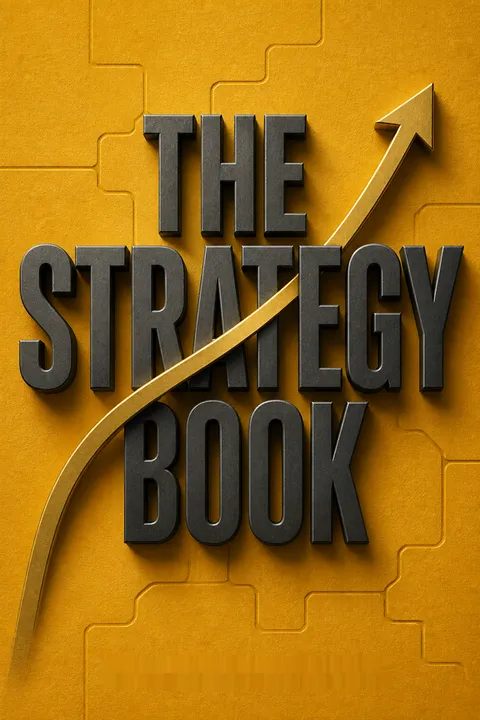
The Strategy Book receives mixed reviews, with an average rating of 3.55/5. Readers appreciate its practical approach, useful tools, and accessible writing style. Many find it helpful for business leaders and strategists, praising its bite-sized concepts and real-world applicability. However, some criticize its shallow treatment of topics, lack of depth, and repetitive content. The book is seen as a good introduction to strategy for beginners, but more experienced readers may find it lacking in advanced concepts and detailed examples.
People Also Read






Glossary
Emergent strategy
Strategy formed through actionA durable pattern of decisions and actions that develops over time, often through local initiatives or reactions to events, rather than being fully specified in an original plan. It may become part of the organization's deliberate direction if leaders recognize its value and choose to reinforce it.
Scenario planning
Preparation for plausible futuresA method for exploring several possible futures instead of relying on a single forecast. Teams identify important assumptions, consider how trends or shocks might combine, and prepare responses. The purpose is not to predict exactly what will happen, but to make uncertainty discussable and improve readiness to adapt.
Capability gap
Distance between ambition and abilityThe difference between what an organization aspires to accomplish and what its current resources, skills, processes, and culture can deliver. A large gap can increase the risk of a strategy failing. Leaders can respond by developing capabilities, acquiring them, changing the ambition, or choosing a more credible route.
Core competencies
Distinctive organizational capabilitiesA combination of an organization's skills, knowledge, routines, resources, and relationships that enables it to perform valuable activities particularly well. Core competencies can support competitive advantage when they matter to customers and are difficult for rivals to reproduce. They should guide opportunity seeking without trapping the organization in familiar work.
Blue Ocean Strategy
Create less contested market spaceAn approach associated with W. Chan Kim and Renée Mauborgne that seeks growth by changing the value offered to customers and reaching people not well served by existing providers. Rather than competing only on established industry factors, an organization examines what to remove, reduce, increase, or introduce in its offer.
Double-loop learning
Question actions and assumptionsA form of organizational learning that examines not only whether actions achieved their intended results, but also whether the goals, beliefs, or rules guiding those actions remain sound. It contrasts with learning that merely corrects an execution error while leaving the assumptions that caused it unchanged.
Porter’s 5 forces of competition
Map pressures on competitionA framework for examining competitive pressures from existing rivals, potential entrants, substitutes, suppliers, and buyers. It helps a company assess how the structure of its market affects profitability and where strategic responses may matter. It describes the competitive context, not a complete strategy or a guaranteed prescription.
Balanced scorecard
Track strategy across key dimensionsA performance measurement approach associated with Robert Kaplan and David Norton. It links an organization's strategy to indicators across financial results, customer outcomes, internal processes, and learning or development. Its purpose is to make progress visible beyond short-term financial figures, while avoiding the mistake of treating measurement itself as strategic success.
FAQ
What's The Strategy Book by Max McKeown about?
- Focus on Strategy: The book is about understanding and applying strategic principles to shape the future of organizations, moving from current to desired states using available means.
- Practical Application: It provides tools and frameworks to help readers become effective strategic thinkers and leaders, making complex leadership situations more manageable.
- Real-World Examples: Numerous examples illustrate how companies have successfully implemented strategic principles, offering insights into real-world applications.
Why should I read The Strategy Book by Max McKeown?
- Accessible Content: Designed to be easy to read and understand, it suits both novices and experienced strategists, avoiding jargon while providing deep insights.
- Comprehensive Toolkit: Offers strategic models and frameworks like SWOT analysis and Porter’s Five Forces, applicable in various business contexts.
- Enhance Leadership Skills: Helps develop strategic thinking and leadership skills, enabling effective shaping of an organization’s future.
What are the key takeaways of The Strategy Book by Max McKeown?
- Dynamic Strategy: Strategy is a living process requiring continuous adaptation to changing circumstances and competitive environments.
- Importance of Thinking: Emphasizes that strategic thinking is as crucial as planning, encouraging creative thinking before detailed planning.
- Engagement is Crucial: Successful strategy involves engaging others, ensuring organizational understanding and support for the strategic direction.
What are the best quotes from The Strategy Book by Max McKeown and what do they mean?
- “However beautiful the strategy, you should occasionally look at the results.”: Highlights the importance of evaluating strategy effectiveness beyond its design.
- “Strategy is about moving from where you are to where you want to be.”: Captures strategy as a journey requiring clear objectives and actionable steps.
- “The future cannot be predicted, but futures can be invented.”: Suggests that while outcomes are uncertain, strategic actions can shape the future.
How does The Strategy Book by Max McKeown define strategy?
- Shaping the Future: Strategy is the process of shaping the future by achieving desirable ends with available means, involving decisions on actions to take or avoid.
- Connection of Actions: Emphasizes linking past, present, and future actions to react intelligently to events and opportunities.
- Balancing Creativity and Analysis: Effective strategy balances creative thinking with analytical approaches, adapting to both stable and dynamic market conditions.
How does one become a strategic thinker according to The Strategy Book by Max McKeown?
- Open Your Mind: Involves seeing the bigger picture beyond immediate tasks and asking challenging questions.
- Engage with Others: Collaboration with team members and stakeholders generates diverse ideas and perspectives, enhancing strategic thinking.
- Continuous Learning: Strategic thinking is developed through practice, reflection, and learning from successes and failures.
What tools and models does The Strategy Book by Max McKeown include?
- SWOT Analysis: Identifies strengths, weaknesses, opportunities, and threats, providing a comprehensive view of the strategic landscape.
- Porter’s Five Forces: Analyzes competitive forces within an industry, helping strategists understand market dynamics.
- Balanced Scorecard: Measures performance beyond financial metrics, incorporating customer, internal process, and learning perspectives.
How does The Strategy Book by Max McKeown suggest managing change effectively?
- Understanding Change Dynamics: Emphasizes understanding change nature and its impact on strategy, encouraging proactive leadership.
- Engaging Stakeholders: Involves engaging all stakeholders to ensure understanding and support for change.
- Flexibility and Adaptation: Encourages organizations to remain flexible and adapt strategies as new information arises, fostering continuous improvement.
What is the significance of competitive advantage in The Strategy Book by Max McKeown?
- Foundation of Strategy: Central to strategy, determining how an organization can outperform rivals by delivering unique customer value.
- Types of Advantage: Discusses cost leadership, differentiation, and focus as competitive advantages to achieve strategic goals.
- Sustaining Advantage: Emphasizes continual innovation and adaptation to maintain competitive advantage in a changing market.
How can one apply the concepts from The Strategy Book by Max McKeown in real-world scenarios?
- Practical Application: Encourages applying strategic tools and frameworks to specific business contexts, tailoring them to unique challenges.
- Scenario Planning: Suggests using scenario planning to anticipate future developments and prepare strategic responses.
- Iterative Process: Views strategy as iterative, where feedback and results inform ongoing adjustments to the strategic plan.
What is the importance of understanding the corporate lifecycle in The Strategy Book by Max McKeown?
- Identifying Growth Stages: Helps strategists identify organizational stages—startup, growth, maturity, or decline—to tailor strategies accordingly.
- Strategic Renewal: Discusses the need for innovation and adaptation to transition successfully between lifecycle stages.
- Avoiding Pitfalls: Recognizing lifecycle stages helps avoid common pitfalls, allowing for informed decision-making.
How does The Strategy Book by Max McKeown define strategic renewal?
- Continuous Improvement: Defined as continuously adapting and innovating to meet changing market demands and internal capabilities.
- Proactive Change Management: Encourages seeking renewal opportunities proactively to stay ahead of competitors.
- Engagement Across Levels: Requires engagement from all organizational levels, fostering a culture of innovation and responsiveness.
Download PDF
Download EPUB
.epub digital book format is ideal for reading ebooks on phones, tablets, and e-readers.








