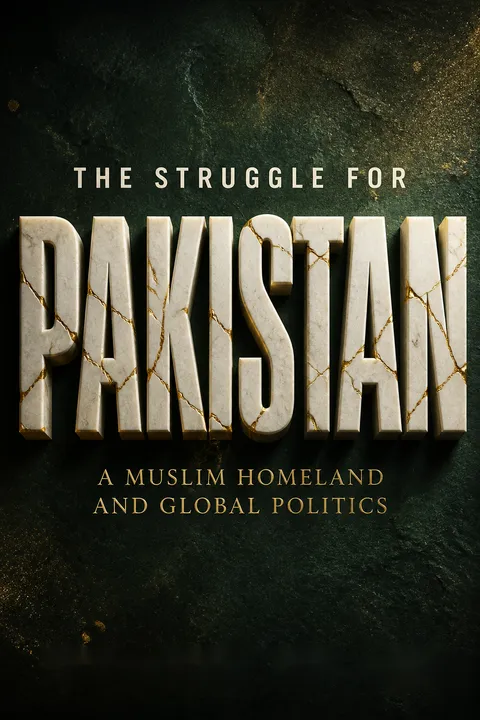


Key Takeaways
Read Pakistan's founding demand as a bid for shared power, not a fixed theocracy.
The demand stayed open. In 1940, the Muslim League called India’s Muslims a nation entitled to political power on equal terms with Hindus. Its Lahore resolution proposed autonomous Muslim-majority regions but did not specify a single sovereign Pakistan or demand partition. Jinnah’s aim was to secure leverage in negotiations over India’s future, including protections for Muslims who would remain outside the proposed homeland.
Ambiguity was strategic. Jinnah could appeal to minority-province Muslims seeking parity at the center and majority-province politicians seeking autonomy. The strategy unraveled as Congress and the British refused the power-sharing arrangements he wanted, while regional interests diverged. Partition produced a smaller state than Jinnah had sought, not the clean fulfillment of a settled plan.
What's striking is how political ambiguity can create a coalition before it creates a constitution. The League’s shifting language held together groups with different interests long enough to negotiate, but it could not guarantee that those interests would remain compatible once power was at stake. This resembles a familiar problem in coalition politics: broad promises recruit partners, while vague terms postpone the hardest disputes. The account also cautions against reading a state’s eventual ideology backward into its founding demand. Political movements often win through flexibility, then inherit the cost of what they left undefined.
A Muslim homeland left millions outside it, so faith could not settle citizenship.
Borders split the nation. Pakistan’s new boundaries left almost as many Muslims in India as in the areas claimed for Pakistan. Its two wings, East and West Pakistan, were separated by Indian territory and shared little beyond Islam. The state therefore faced a basic contradiction: a homeland described as representing all Muslims could not include all Muslims, while its own citizens spoke different languages and belonged to distinct regional cultures.
Memory exposed the gap. In Saadat Hasan Manto’s story “Toba Tek Singh,” a Sikh asylum inmate refuses transfer to India after learning that his hometown is in Pakistan, then dies in the strip between the two countries. The story makes place and lived attachment as visible as religious identity. Jinnah, meanwhile, had called for equal citizenship regardless of creed, a principle later national narratives often obscured.
The story’s power comes from refusing to make identity tidy. Political borders sort people into categories, but family ties, language, home, and memory do not obey the same map. This is a useful distinction for understanding citizenship: a shared religious label may help people imagine solidarity, yet it cannot by itself settle who belongs, what rights they hold, or how regions share power. Manto’s fiction supplies a kind of evidence that official archives rarely capture, namely the emotional absurdity experienced by ordinary people. Its limit is deliberate too: literature reveals human consequences, not the full institutional chain that produced them.
When the 1970 majority won, refusing its mandate turned federation into war.
The crisis had a long fuse. Bengali protests against making Urdu the sole state language began before the first military coup. Bengali politicians also objected to political and economic arrangements that favored the western wing. In 1970, the Awami League won almost every seat in East Pakistan on a platform demanding extensive provincial autonomy. A devastating cyclone and the central government’s weak response deepened distrust.
Power was not transferred. Yahya Khan postponed the National Assembly’s meeting, and negotiations between the Awami League, Bhutto’s PPP, and the military regime failed. Bhutto resisted accepting the Awami League’s program, but the decisive institutional failure was the military regime’s refusal to transfer power to the election winner. On March 25, 1971, the army launched a crackdown. Civil war, Indian intervention, and military defeat followed, ending in Bangladesh’s independence.
The central lesson is not that elections automatically resolve conflict. They do so only when political actors accept that a vote can change who governs. The 1970 result gave the Awami League democratic legitimacy, but the state’s security establishment treated its program as a threat to its own institutional position. This is a classic credible-commitment problem: one side cannot trust promises of future autonomy when the other controls the coercive apparatus and can delay the transfer of power. The account also resists a single-villain explanation. Bhutto’s choices mattered, but they operated within a crisis the military regime had the power to resolve or escalate.
Treat military dominance as a political construction, not Pakistan's cultural destiny.
Scarcity made defense dominant. At independence, Pakistan received about 17.5 percent of British India’s financial assets and 30 percent of its defense forces, but less than 10 percent of its industrial base. The Kashmir conflict soon intensified defense costs. Leaders who feared collapse leaned on the army and bureaucracy to centralize resources, while neglecting party-building and provincial consent.
The Cold War accelerated it. Senior officials pursued US military and economic support, culminating in Pakistan’s entry into American-backed security pacts in the 1950s. The alliance strengthened the military’s position and gave its leaders leverage at home. In 1958, the army took power. Jalal’s point is not that these pressures made dictatorship inevitable. Rather, state weakness, regional conflict, elite choices, and international patronage reinforced one another until civilian institutions struggled to compete.
This interpretation avoids two easy explanations: that Pakistan’s diversity made democracy impossible, or that foreign influence alone created military rule. Instead, it shows how external resources can reshape domestic institutions. In political-economy terms, a state that funds defense through outside assistance may face less pressure to bargain with citizens and provinces for revenue. That can make coercive capacity grow faster than representative capacity. Still, scarcity is not destiny. The comparison with India in the book makes clear that similar colonial inheritances produced different outcomes, reminding readers that institutions are built through choices as well as constraints.
Turn religion into a citizenship test, and unity becomes exclusion.
Faith became a state question. The 1949 Objectives Resolution promised Islamic principles alongside democracy, equality, and minority rights, leaving room for competing interpretations. Religious parties used that ambiguity to demand a state that would define proper belief. In 1953, an anti-Ahmadi campaign turned violent and brought Pakistan’s first martial law. In 1974, Parliament declared Ahmadis a non-Muslim minority.
Zia made the turn sharper. His military regime presented Islamization as a remedy for political disorder. Its Hudood laws imposed religiously framed punishments and helped expose women and minorities to unequal treatment. The larger pattern was political: governments invoked Islam to claim legitimacy, while religious movements used the state’s promises to demand more power. A faith shared across regions was increasingly recast as a test of who counted as a full citizen.
The distinction between religion as lived faith and religion as a legal sorting device is crucial here. Once the state claims authority to define the boundaries of belief, disagreement can become a question of citizenship rather than theology alone. That shift is especially dangerous for minorities, who lack the numbers and political leverage to defend themselves. The account does not imply that Islam inherently produces exclusion. It shows how rulers and movements can instrumentalize religious identity in contests over power. A further question is how a state can protect religious practice without appointing itself the final judge of religious belonging.
Bhutto's reforms raised expectations, but coercion hollowed out his democratic promise.
Populism brought real change. After the 1971 defeat, Bhutto promised to rebuild Pakistan. His government nationalized major industries, introduced labor protections, and lowered landholding ceilings. The 1973 constitution was a major achievement, negotiated with opposition parties and designed as a parliamentary framework. These measures gave workers and poorer citizens a stronger sense that government might act on their behalf.
Power remained personal. Bhutto also relied on the bureaucracy, intelligence agencies, police, and Federal Security Force to manage opponents. His government used force in Balochistan and made concessions to religious parties, including Parliament’s 1974 decision on Ahmadis. The reforms did not create strong democratic institutions capable of surviving their leader. In 1977, a disputed election and growing opposition helped open the way for Zia’s coup, followed by Bhutto’s execution.
Bhutto’s record illustrates the difference between redistributing benefits and redistributing power. Economic reforms can give marginalized groups immediate gains, but without durable institutions and internal party democracy, those gains remain vulnerable to the leader’s changing alliances and the next seizure of power. The account also makes room for both sides of his legacy: the constitution and reforms mattered, while coercion and centralization damaged the democratic project. This is a useful corrective to histories that reduce populism either to heroic inclusion or to demagoguery. In practice, it can contain both impulses at once.
A proxy war can outlive its sponsors and hollow out the state that hosts it.
The Afghan war remade Pakistan. During Zia’s rule, Pakistan’s military and intelligence services supported Afghan fighters against the Soviet occupation, with assistance from the United States and Saudi Arabia. The ISI became a powerful institution, while the country absorbed millions of Afghan refugees. Arms, drug networks, and militant organizations spread beyond the war zone, weakening the state’s control over violence.
The networks persisted. After the Soviet withdrawal, Pakistan’s military continued backing favored Afghan groups, including the Taliban, to pursue regional aims. After 2001, the alliance with the United States returned, but the military’s ties to militants did not simply disappear. Some groups attacked Pakistan itself. The result was a state caught between fighting militants, tolerating selected networks, and trying to persuade citizens that the war served their interests.
This is a vivid case of principal-agent risk. A government can arm and fund an intermediary for a narrow objective, yet the intermediary develops its own interests, resources, and networks. Ending the original conflict does not automatically dissolve them. The account also stresses that blowback was not a mysterious accident: officials built institutions and incentives that made militant activity useful, then found it difficult to control. The nuance is that proxies do not operate independently of local politics. Their power depends on state tolerance, regional rivalries, and the economic networks that sustain them.
Elections cannot democratize a state where generals, courts, and parties all compete to rule.
Civilian rule kept restarting. From 1988 to 1996, elected governments were repeatedly dismissed, often under the president’s power in Article 58(2b). Corruption allegations were real political weapons, but they also served as convenient justifications for removing governments. The military remained powerful, while courts sometimes legitimized coups and at other moments challenged executive authority.
Continuity mattered in 2013. Despite Taliban threats and serious security concerns, voter turnout reached 55 percent. The PML-N won, and a civilian government completed its term before handing power to another elected administration for the first time in Pakistan’s history. The 18th Amendment strengthened Parliament and provincial autonomy. These were gains, not a completed democratic settlement: military influence, weak governance, and party patronage remained powerful constraints.
The book treats democracy as a repeated institutional contest, not a prize delivered on election day. Elections create authorization, but courts, parties, bureaucracies, and militaries still shape what elected officials can do. The 2013 transition mattered because it established a precedent for civilian succession, yet the poor performance of elected governments also left citizens vulnerable to anti-democratic arguments promising order. Political science distinguishes electoral competition from liberal accountability; Pakistan’s experience shows why both matter. A vote can open the door, but credible administration and lawful limits determine whether citizens keep faith with it.
Treat Afghanistan, Kashmir, and federal autonomy as connected security problems.
Security does not stop at borders. Pakistan’s military treated India as its central threat, used Kashmir to justify defense priorities, and sought influence in Afghanistan as strategic depth. That approach linked external policy to domestic choices, including support for militants and the concentration of power at the center. It also left regional grievances in Balochistan and the northwest vulnerable to being dismissed as security threats rather than addressed politically.
The endgame exposes the link. As US forces prepared to leave Afghanistan, Jalal argued that Pakistan’s stability depended on relations with its neighbors, a viable federal compact, and a reduction in military dominance. These issues cannot be solved in isolation. Nor does interdependence make every dispute interchangeable: Kashmir, Afghan politics, and provincial autonomy each involve distinct actors and claims. But treating them as unrelated files can reproduce the insecurity that connects them.
The strategic insight is one of interdependence: policy on one border changes the calculations of actors elsewhere, while domestic centralization can intensify the regional grievances that security policy claims to contain. This resembles the security-dilemma concept in international relations, where steps taken for protection can make neighbors feel less secure and prompt countermeasures. The framework is useful, but it should not erase the agency of Afghans, Kashmiris, or Pakistan’s provinces. A coherent strategy requires negotiation across linked problems, not reducing every political claim to a military calculation.
Analysis
Jalal’s history challenges the idea that Pakistan can be explained by Islam, geography, or the army alone. Its central argument is interactional: a homeland demanded as a means of sharing power became a truncated state; the weak center then relied on military and bureaucratic institutions; Cold War alliances strengthened those institutions; and state efforts to impose unity intensified regional dissent. The chain is not presented as inevitable. At several turning points, political actors had alternatives, but short-term security and power repeatedly narrowed the space for negotiation.
The book’s most consequential correction is to treat Pakistan’s military dominance as a historical outcome rather than a cultural trait. The army’s authority grew through institutional advantage, external patronage, and the disorganization of civilian parties. Yet the explanation also resists treating the army as a foreign implant: Pakistani political elites repeatedly cooperated with it, and elected governments sometimes used coercion, patronage, and religious appeals themselves. The result is a more demanding account of responsibility than a simple story of soldiers versus civilians.
Jalal also reframes Islam’s political role. The problem is not a timeless incompatibility between Islam and democracy, but the state’s recurring attempt to use religious identity as a substitute for political consent. That maneuver could provide symbolic unity while making citizenship conditional and empowering actors the state could not reliably control. The history of Ahmadis, women, and regional movements shows how abstract claims about national identity acquire concrete legal and bodily consequences.
The narrative’s great strength is its connected scale: constitutional disputes, provincial grievances, global alliances, and individual stories illuminate one another. Its emphasis on military institutions and elite decisions can, however, make popular life appear more reactive than it was. Manto, regional cultural movements, protest, and the 2013 vote provide important counterevidence. The book’s final implication is that resilience is not proof that the state is sound. Pakistan has survived repeated crises, but survival has often postponed the political settlement needed to make its diversity governable.
Review Summary
The Struggle for Pakistan is a comprehensive history of Pakistan from pre-partition to 2014. Readers praise Jalal's well-researched analysis, insightful commentary, and balanced critique of military and political leadership. The book covers key events, cultural aspects, and challenges faced by Pakistan. While some find the writing style complex and occasionally lacking detail in recent history, many consider it essential reading for understanding Pakistan's political landscape. Critics argue it whitewashes certain historical events, but overall, it's regarded as a valuable resource for those interested in Pakistan's development.
People Also Read





Glossary
two nation theory
Muslim nationhood claimThe political claim that Muslims in British India formed a nation distinct from Hindus and therefore deserved political arrangements protecting their collective interests. Jalal emphasizes that the claim did not begin as a settled demand for a separate theocratic state. It developed amid disputes over power-sharing, provincial autonomy, and the future structure of an independent India.
state of martial rule
Military-shaped political orderJalal’s term for Pakistan’s recurring condition in which military influence shapes the state even when a general is not openly governing. It includes direct coups, civilian governments constrained by military power, and institutional arrangements that preserve the armed forces’ influence over security and politics. The phrase highlights an enduring structure, not just isolated periods of martial law.
Basic Democracies
Controlled local electoral systemThe system introduced by Ayub Khan in 1959, built around locally elected representatives called Basic Democrats. They formed the electoral college for the president and national and provincial assemblies, while civil officials closely monitored the system. It presented a controlled form of representation that bypassed mass party politics and strengthened central authority.
Objectives Resolution
Foundational constitutional preambleA resolution presented by Prime Minister Liaquat Ali Khan in 1949 and used as the preamble to Pakistan’s constitutions before becoming part of the constitution. It described Pakistan as sovereign while grounding political authority in Islamic principles and promising democracy, equality, tolerance, social justice, and minority rights. Its combination of commitments left room for competing interpretations of the state.
functional inequality
Growth before redistributionA development rationale that treats unequal outcomes as acceptable, or even necessary, if investment and production grow quickly. In Pakistan, this reasoning supported policies that concentrated economic gains and resources, especially between the eastern and western wings. Jalal shows how growth-oriented claims could obscure regional discrimination and weaken political legitimacy.
strategic depth
Influence beyond western borderA Pakistani military objective of securing influence in Afghanistan so the country would not face hostile pressure on both its eastern and western fronts. The idea shaped support for Afghan factions and later the Taliban. Jalal connects this pursuit to Pakistan’s India-centered security thinking and to the instability that followed from sponsoring armed groups.
Islamization
State-led Islamic policyThe use of laws, institutions, education, public symbols, and official rhetoric to make the state and society appear more Islamic. In the book, the term is especially associated with Zia-ul-Haq’s military regime, which introduced religiously framed laws and promoted public piety. Jalal stresses that Islamization also served political purposes, including legitimizing military rule.
awam
The peopleAn Urdu term meaning the people, used prominently in Pakistan’s political language and in Bhutto’s populist appeal. It represented ordinary citizens as the rightful source of political authority, in contrast to military rulers, bureaucrats, and established elites. Jalal also shows the tension between invoking the awam and actually building institutions that let citizens govern and hold leaders accountable.
FAQ
What's The Struggle for Pakistan about?
- Comprehensive History: The book provides a detailed history of Pakistan from its creation in 1947 to modern times, focusing on political, social, and economic challenges.
- Political Dynamics: It examines the interplay between military and civilian governance, highlighting the military's significant influence on Pakistan's political landscape.
- Cultural Context: Ayesha Jalal explores the cultural and religious dimensions, particularly the impact of Islam on Pakistan's identity and governance.
Why should I read The Struggle for Pakistan?
- In-depth Analysis: The book offers a nuanced perspective on Pakistan's history, essential for understanding South Asian politics.
- Contemporary Relevance: It addresses current issues like terrorism and international relations, providing insights relevant to today's geopolitical climate.
- Engaging Narrative: Jalal combines scholarly rigor with engaging storytelling, making the book accessible to both academic and general audiences.
What are the key takeaways of The Struggle for Pakistan?
- Military Influence: The book highlights the military's dominance in politics, often undermining democratic processes.
- Identity Crisis: Jalal discusses the struggle to reconcile Pakistan's Islamic identity with modern nation-state realities, leading to internal conflicts.
- Geopolitical Challenges: The narrative emphasizes Pakistan's complex relationships with neighboring countries and their impact on domestic policies.
What are the best quotes from The Struggle for Pakistan and what do they mean?
- "Pakistan will never surrender": Reflects the resilience and determination of the Pakistani state, emphasizing its commitment to sovereignty.
- "Speak, for your lips are free": A call for freedom of expression and the importance of voicing dissent, highlighting struggles for democracy.
- "A truncated... moth-eaten state": Captures the disillusionment with Pakistan's formation, suggesting the reality fell short of its founders' aspirations.
How does Ayesha Jalal define nationalism in The Struggle for Pakistan?
- Complex Identity: Nationalism in Pakistan is multifaceted, shaped by historical grievances and the quest for a distinct Muslim identity.
- Political Instrument: It is used by leaders to mobilize support, often at the expense of genuine democratic engagement.
- Regional Tensions: Nationalism has exacerbated regional disparities, particularly between East and West Pakistan.
What role does the military play in Pakistan's politics according to The Struggle for Pakistan?
- Institutional Dominance: The military is a central institution, often overshadowing elected governments and civilian authority.
- Crisis Management: It acts as a stabilizing force during political turmoil, but this often leads to authoritarian rule.
- Geopolitical Strategy: The military's role is tied to foreign policy, influencing decisions on national security.
What are the implications of the 1971 civil war as discussed in The Struggle for Pakistan?
- National Trauma: The civil war and creation of Bangladesh are profound national traumas affecting Pakistan's identity and politics.
- Failure of Governance: The war highlighted the state's failure to address regional disparities and diverse aspirations.
- Legacy of Division: The events left a lasting legacy of division and mistrust among ethnic and regional groups.
How does The Struggle for Pakistan address the issue of democracy in the country?
- Fragile Institutions: Democratic institutions are often undermined by military interventions and political corruption.
- Public Disillusionment: Repeated failures of democracy have led to public disillusionment, hindering stable political culture.
- Potential for Change: Opportunities for democratic renewal exist, driven by civil society and popular movements.
What does Ayesha Jalal say about the relationship between Islam and the state in The Struggle for Pakistan?
- Islam as Identity: Islam is a basis for national identity but complicates governance in a diverse society.
- Political Manipulation: Leaders manipulate religious sentiments to consolidate power, leading to sectarian tensions.
- Struggle for Interpretation: Ongoing debates about Islam's role in public life shape state policies.
How does The Struggle for Pakistan depict the impact of global politics on Pakistan?
- Cold War Dynamics: Cold War politics influenced Pakistan's foreign relations, particularly its alignment with the US against India.
- Economic Dependencies: Reliance on foreign aid shaped economic policies, often compromising sovereignty.
- Geopolitical Challenges: Pakistan's strategic location impacts its internal stability and external relations.
What are the historical roots of Pakistan's political struggles as outlined in The Struggle for Pakistan?
- Colonial Legacy: Political struggles trace back to colonial rule, which established a centralized state marginalizing regional identities.
- Partition Trauma: The partition of India and creation of Pakistan set the stage for ongoing political and social conflicts.
- Ethnic and Regional Tensions: Historical grievances among ethnic groups contribute to nation-building challenges.
How does Ayesha Jalal view the future of democracy in Pakistan?
- Cautious Optimism: Jalal expresses hope for democracy, particularly after the 2013 elections marking a power transition.
- Need for Institutional Reform: Strengthening institutions and ensuring accountability are crucial for democracy to thrive.
- Public Engagement: Civic engagement and activism are vital for shaping a democratic future, requiring vigilance and active demand for rights.
Download PDF
Download EPUB
.epub digital book format is ideal for reading ebooks on phones, tablets, and e-readers.








