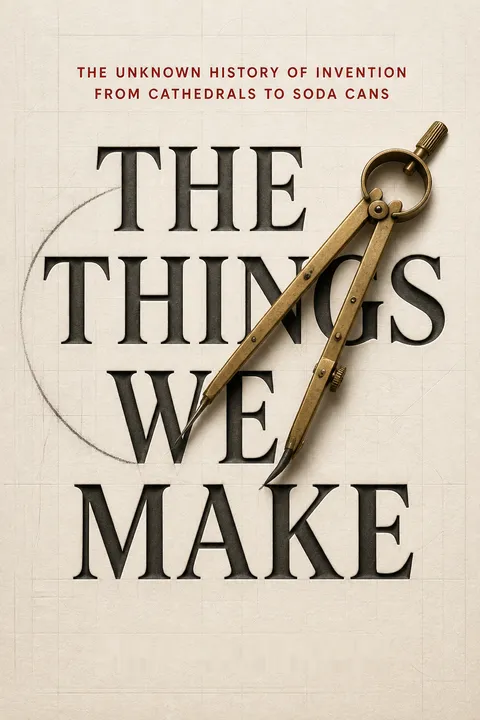


Key Takeaways
Build with workable rules, not a fantasy of complete understanding
Experience can substitute for theory. The book calls a rule of thumb, or heuristic, a practical guide that speeds a search for a solution without guaranteeing success. Medieval master masons used proportions, ropes, templates, and judgment about stone to build cathedrals without modern mathematics or structural science. A rule that helped size an arch’s supporting walls emerged from generations of building experience, not from a written formula.
Results can arrive before explanations. Niels Christensen tested rubber rings in different piston grooves until he found a dependable seal. His O-ring worked for decades before researchers understood how its shape and motion helped it seal. The lesson is not to guess blindly, but to test useful ideas and learn from what happens.
What's striking is how this account treats practical knowledge as more than an inferior draft of formal theory. It resembles bounded rationality: when time and information are limited, people use compact rules that work well enough in a defined setting. Such rules can preserve hard-won experience that no single person could derive from first principles. Their weakness is equally important. A heuristic that works for stone arches may fail disastrously in a steel tower. Reliability depends on keeping track of the conditions under which the rule earned trust.
Define best around actual users, resources, and the society involved
There is no context-free winner. Industrial designer Henry Dreyfuss replaced the idealized proportions of Leonardo’s Vitruvian Man with measured figures representing typical users. Those measurements informed objects from telephones to tractors. The same principle explains why the Egyptians’ labor-intensive cloth press for grapes and the Arawak’s woven tipití press for poisonous manioc could both be good designs: each suited its people’s skills, materials, and labor supply.
Design choices distribute benefits. Kodak’s color film and printing standards favored pale skin, making darker skin harder to reproduce accurately. Male-centered crash-test dummies and office temperature formulas likewise left some users less protected or comfortable. “Best” describes performance against chosen requirements. If those requirements overlook people, the design can succeed on paper while failing them in practice.
This idea connects engineering to the politics of measurement. Averages are useful for designing products at scale, but they can turn a common user into a supposedly universal one and make everyone else appear exceptional. The corrective is not to abandon standards, which can improve affordability and consistency, but to ask whose experience supplied the data and who bears the costs of error. A diverse design team can notice neglected needs, although representation alone cannot settle competing priorities. The requirements themselves still need public scrutiny.
Treat uncertainty as terrain to navigate, not a reason to stop
Useful devices can outpace explanation. A bicycle can remain upright without either wheel’s gyroscopic effect or the steering geometry often offered as a complete explanation. Engineers still make bicycles work by adjusting interacting features. Osborne Reynolds took a similar practical route with fluid flow. He injected dye into a glass pipe and described when smooth, orderly flow gave way to turbulence using a small set of measurable variables, even though the underlying phenomenon remained poorly understood.
Workarounds can be deliberately probabilistic. Ethernet, the computer network method developed by Bob Metcalfe, detects a signal collision, waits a random interval, and tries again. It does not require perfect knowledge of every other computer’s activity. In each case, the engineer makes uncertainty manageable enough to act, rather than pretending it has vanished.
The chapter’s examples distinguish uncertainty from chaos. A designer can isolate a system, identify variables that matter for a particular purpose, and build a method that remains dependable despite missing explanations. This is close to robust design, where performance across varied conditions matters more than a perfect account of every component. Still, working around uncertainty is not always safe. For systems with catastrophic failure modes, such as aircraft or medical devices, the acceptable margin for trial and error must be much narrower than for a network retry.
Let materials, energy, and know-how shape the design
Resources are part of the design. Mesopotamian merchants sent wine down the dangerous Euphrates on keleks, disposable rafts made from local timber and inflated goatskins. The current made an upstream return impractical, so the crew dismantled the raft at its destination and sold the wood. Its form followed not just the cargo, but the river, material supply, and return journey.
Energy changes the machine itself. Al-Jazarī’s clock used a burning candle to regulate a falling weight, which moved a figure and released metal balls to mark time. Centuries later, engineer Yvonne Brill combined chemical and electrically heated rocket thrust in one satellite propulsion system to save scarce mass and fuel. These designs show that material, energy, and accumulated knowledge are not interchangeable accessories. Each can determine what a technology can become.
Thinking in resources broadens innovation beyond the familiar question of which material is used. Energy infrastructure, maintenance capacity, labor, and tacit skill all constrain what can work at scale. The kelek is a vivid reminder that apparent waste can be rational when reuse or transport is more valuable than keeping an object intact. Brill’s career also raises a social question: expertise is a resource, but institutions decide whose expertise gets used. Excluding qualified people can narrow the solution space before technical work even begins.
Turn failed prototypes into recorded knowledge, not repeated guesswork
Good trial and error is systematic. Josiah Wedgwood wanted a fine, pale ceramic for ornaments, but early mixtures cracked, melted, or changed color in the kiln. He numbered samples, recorded ingredients and firing conditions, and changed parameters in light of each result. After thousands of trials, he developed jasperware, a smooth, stone-like ceramic with a distinctive matte finish.
Three habits made the search productive: testing variations instead of relying on a single hunch, preserving useful knowledge from earlier work, and accepting trade-offs when no design could satisfy every wish. Wedgwood’s final technique used a robust inner body and a fine outer layer, rather than forcing one material to provide both qualities. The breakthrough came from combining imperfect options into a workable whole.
A laboratory notebook turns failure into shared memory. Without records, experimentation can collapse into a costly cycle of rediscovery; with them, each test narrows the possibilities and gives later workers something to build on. This is also a practical model for learning in organizations, where teams often lose insight when projects or personnel change. Yet orderly experiments can only explore the parameters someone thought to vary. Documentation improves learning, but it does not eliminate blind spots in the original question or guarantee that the chosen target is worth pursuing.
Use science to narrow the search, not dictate the invention
Scientific knowledge can prune possibilities. Charles Parsons wanted to build a steam turbine, but earlier designs failed because fast-moving steam destroyed their machinery. Measurements of steam by Henri-Victor Regnault and calculations developed by William Rankine helped Parsons estimate how steam would behave as its pressure fell. He used those estimates to divide the drop across thirty sets of turbine blades, producing a workable engine after years of development.
Data did not contain the design. The scientific work helped Parsons rule out unpromising choices and make better starting estimates; it did not specify the arrangement of the turbine. Parsons still had to imagine, build, test, and refine it. Science equips engineers with stronger guides, but turning those guides into a device requires choices that the equations alone cannot make.
This account offers a useful correction to the popular picture of invention as science followed by routine application. Scientific models often act more like maps: they compress observations and help identify promising paths, while leaving the destination and route to human judgment. That relationship also explains why public support for basic research matters even when immediate products are not visible. A caution remains: models can be incomplete or inappropriate outside the conditions in which they were developed. Engineering judgment includes knowing when a powerful map no longer represents the terrain.
Use statistics for safety, while remembering forecasts are provisional
Safety requires estimates of rare events. Engineers cannot size a skyscraper using average wind. They need an estimate of extreme gusts, often drawn from decades of incomplete records. Statistician H. C. S. Thom used methods developed for extreme values to estimate that Fort Wayne could experience a wind of about 71 miles per hour on a roughly hundred-year timescale. The estimate informed maps used in building design.
A forecast is a tool, not a promise. Extreme-value methods can guide decisions about buildings, floods, and equipment failure, but their results depend on assumptions and data. Weather patterns can change, making historical records less useful. Statistics can also be misused to lend false authority to prejudiced conclusions, as the history of eugenics shows. Numerical precision does not remove the need to question the purpose and assumptions behind a calculation.
Risk analysis converts uncertainty into a decision aid, not certainty. That distinction matters because people often hear a return period as a schedule, when it is better understood as a probabilistic estimate under specified conditions. The method’s usefulness depends on transparent assumptions, updated data, and a clear account of who accepts residual risk. The eugenics example adds an ethical warning: statistical techniques do not choose their own aims. A calculation can be rigorous in form and still serve a distorted question or a harmful policy.
Credit invention to the chain of builders who make it reproducible
A prototype is not yet a public technology. Many inventors worked on incandescent lamps before Thomas Edison became their best-known name. Hiram Maxim improved carbon filaments, while Lewis Latimer devised methods that made filaments less likely to break during manufacture and improved their electrical connections. Later, William Coolidge and a large team made brittle tungsten suitable for use as a flexible filament. Each contribution addressed a different obstacle between a promising lamp and reliable production.
Manufacturing is part of invention. A device that works once may not solve a problem if it cannot be made consistently, affordably, and in useful quantities. The lone-inventor story is memorable, but it hides the accumulated labor, craft knowledge, and less celebrated contributors that make a technology dependable and widespread.
This account shifts attention from the dramatic moment of conception to the less glamorous work of repeatability. That shift matters for how societies distribute credit, funding, and professional recognition. It also makes invention easier to understand as collective problem solving rather than a rare personality trait. There is a tension, however: individual stories remain powerful ways to teach complicated histories. The task is not to discard notable inventors, but to place their achievements within the network of workers, institutions, suppliers, and prior designs that made success possible.
Treat technology as a human choice, not an inevitable force
The microwave’s origin story hides its real development. Percy Spencer did not simply notice a melted candy bar and immediately invent a kitchen appliance. His work began with the wartime cavity magnetron, and his redesign helped Raytheon manufacture it at scale for radar. The first commercial microwave ovens were huge, expensive machines intended for restaurants. Later, Japanese-designed components helped make smaller, cheaper household models practical.
The final product was not predetermined. Engineers made choices about size, power, price, and users, and those choices reflected postwar expectations about household work. The book argues that understanding how technologies develop helps the public judge their benefits, costs, and alternatives. Engineering can change the world, but it cannot decide by itself what changes are desirable or who should bear their consequences.
The microwave’s uneven path makes technological history less like a ladder toward an obvious destination and more like a set of choices shaped by institutions, markets, and social expectations. That perspective strengthens civic agency: people can debate which problems deserve investment and whose needs define success. It also discourages both technological fatalism and easy utopian promises. A technology may create new options without changing the distribution of labor or power on its own. Public oversight and cultural change are part of the system, not afterthoughts.
Analysis
The book’s central achievement is to make engineering visible as a way of thinking, not merely a collection of finished objects. Its historical cases range from medieval stonework to radar and household appliances, but the recurring pattern is consistent: people pursue a desired change with incomplete knowledge, available resources, practical rules, and judgment about what counts as good enough. The contrast with science is illuminating when it separates the aims of explanation and solution. It becomes less useful if treated as a hard boundary, since the Parsons turbine shows scientific measurement and engineering invention working together. The distinction is best understood as different priorities, not sealed intellectual worlds.
The strongest narrative choices make abstract ideas tangible. A rope used to guide cathedral construction, dye revealing turbulence, and a candle regulating an elaborate clock all show knowledge embedded in practice. The cases also correct histories that over-credit famous inventors and understate manufacturing, collaboration, and marginalized contributors. That correction is not simply about fairness. It changes the theory of innovation by showing that dependable production, not just a first working demonstration, is often the decisive achievement.
The book’s account of “best” is especially valuable because it connects technical design to social assumptions. Yet engineering’s adaptability should not be mistaken for moral neutrality. A heuristic may be efficient while serving a narrow constituency, and a quantified risk may conceal contested assumptions. The book’s own examples suggest a needed discipline: make requirements visible, examine who benefits and who absorbs failure, and revise rules when conditions change. The resulting view is neither anti-technology nor blindly celebratory. It treats engineering as human creativity under constraint, powerful precisely because it can act before certainty, and accountable because its choices become part of everyday life.
Review Summary
The Things We Make offers an engaging exploration of engineering history and methodology. Hammack illuminates the distinction between science and engineering, showcasing inventions from cathedrals to microwaves. Readers appreciate the accessible writing and fascinating stories, though some find certain sections overly technical or repetitive. The book challenges popular misconceptions about lone inventors, emphasizing collaborative efforts. While praised for its insights into engineering thinking, some reviewers critique Hammack's stance on engineering versus science and his treatment of social issues in design.
People Also Read






Glossary
engineering method
Practical problem-solving under uncertaintyA way of creating devices, processes, or systems by using practical rules and available resources to produce a desired change when information is incomplete. It does not require a fixed sequence of steps or a complete scientific explanation. Its success depends on context, judgment, and whether the solution works for the people and conditions it is meant to serve.
rule of thumb
A useful, non-guaranteed guideA heuristic: an experience-based or otherwise practical guide that reduces the time and effort needed to solve a problem. It can make success more likely without guaranteeing it, may coexist with other guides, and is useful only in relevant circumstances. Engineering draws on rules of thumb from craft, observation, accumulated practice, science, and mathematics.
phenomenologically
By describing observable behaviorAn approach that characterizes what a phenomenon does and under what conditions, without requiring a fundamental explanation of why it happens. Reynolds used observable flow patterns and a small set of variables to help engineers anticipate turbulence. This kind of description can support practical design even when the underlying physical process remains incompletely understood.
directed evolution
Guided selection of useful mutationsFrances Arnold’s engineering approach for developing enzymes by repeatedly creating variants, testing their performance, and selecting the most useful results for further rounds. Inspired by natural evolution, it uses iterative mutation and selection to produce traits suited to a chosen industrial or chemical task, even when the exact workings of the resulting enzyme are not fully understood.
extreme value theory
Statistics for rare extremesA family of statistical methods used to estimate the likelihood and magnitude of unusually large or small events, such as severe winds, floods, or material failures. Engineers can use limited historical samples to inform safety decisions, but estimates depend on the data and assumptions used. They are revisable guides, not guarantees about future events.
engineering mindset
Iterative, historically informed designThe habits that help engineers turn incomplete knowledge into workable designs. In the book, these include systematically testing variations, retaining useful knowledge from previous work, and balancing competing qualities through trade-offs. The mindset is not random tinkering: intuition and records guide experiments, while past solutions constrain the search and help make failures informative.
FAQ
What is The Things We Make by Bill Hammack about?
- Exploration of engineering method: The book delves into the unique mindset and approach engineers use to solve problems, emphasizing creativity, flexibility, and working with incomplete information.
- Historical and modern examples: Hammack illustrates his points with stories ranging from medieval cathedrals to soda cans, showing how engineering has shaped the world across eras and cultures.
- Contrast with science: The narrative distinguishes engineering from science, highlighting that engineering is about creating solutions, not just discovering knowledge.
- Demystifying technology: The book aims to reveal the invisible processes behind everyday inventions, helping readers understand how technology is developed and used.
Why should I read The Things We Make by Bill Hammack?
- Demystifies engineering: The book uncovers the hidden creativity and complexity behind engineering achievements, challenging common myths about invention and innovation.
- Informs technological understanding: Readers gain insight into how technologies evolve, the societal and cultural factors at play, and the importance of diverse perspectives in engineering.
- Empowers critical thinking: Understanding the engineering method equips readers to critically assess technological progress and its ethical implications.
- Accessible and engaging: Hammack’s storytelling makes complex concepts approachable, making it valuable for both technical and non-technical audiences.
What are the key takeaways and themes from The Things We Make by Bill Hammack?
- Engineering as creative problem-solving: Engineering is a pragmatic, iterative process that uses heuristics to address real-world challenges under uncertainty.
- Best is context-dependent: Solutions are judged by how well they fit cultural, material, and societal contexts, not by universal standards.
- Human and ethical dimension: Engineering reflects human values and biases, highlighting the need for diversity and ethical reflection in technological development.
- Science and math as tools: While science and mathematics provide powerful heuristics, they do not replace the creative, adaptive nature of engineering.
- Societal empowerment: Demystifying engineering enables society to better engage with and guide technological change.
How does Bill Hammack define the engineering method in The Things We Make?
- Rules of thumb at the core: The engineering method is defined as “solving problems using rules of thumb that cause the best change in a poorly understood situation using available resources.”
- Embracing uncertainty: It is a flexible, creative approach that works with incomplete information, rather than waiting for full scientific understanding.
- Mindset, not a process: Hammack describes it as an attitude or mindset, where engineers combine heuristics and adapt to context.
- Distinct from science: Unlike the scientific method, the engineering method is not a fixed sequence of steps but a pragmatic, context-driven approach.
How does The Things We Make by Bill Hammack distinguish engineering from science?
- Different goals: Science seeks to uncover universal truths, while engineering aims to create specific, workable solutions to real-world problems.
- Methodological differences: The scientific method follows a prescribed process, whereas the engineering method is flexible and relies on heuristics and trade-offs.
- Coexistence of rules: Engineering rules of thumb can coexist and be applied pragmatically, even as scientific theories evolve or are replaced.
- Examples in practice: The book uses examples like medieval cathedrals and the steam turbine to illustrate how engineering operates independently of complete scientific knowledge.
What role do "rules of thumb" play in the engineering method according to The Things We Make?
- Heuristics as shortcuts: Rules of thumb are experience-based, imprecise guidelines that help engineers solve problems efficiently when full information is lacking.
- Three classes of rules: These include encapsulated knowledge (like safety factors), traditional or unarticulated knowledge (like recipes), and problem-solving strategies (like “freeze the design”).
- Context-dependent and flexible: Rules of thumb are judged by their effectiveness in context, not by absolute correctness, and can even contradict each other.
- Foundation of engineering: They are essential for navigating uncertainty and making progress when scientific certainty is unavailable.
What are the three key strategies of the engineering mindset in The Things We Make by Bill Hammack?
- Trial and error: Systematic experimentation, guided by intuition and record-keeping, allows engineers to explore design spaces and learn from failures.
- Building on past knowledge: Engineers use institutional memory, historical insights, and established heuristics to avoid reinventing the wheel and to guide problem-solving.
- Accepting trade-offs: Engineering involves balancing conflicting goals and constraints to find the best compromise for a given context.
- Iterative improvement: These strategies collectively enable engineers to refine solutions over time, adapting to new challenges and resources.
How does The Things We Make by Bill Hammack explain the concept of "best" in engineering solutions?
- Relative, not absolute: “Best” is defined by how well a solution balances constraints and parameters unique to its cultural, material, and societal context.
- Cross-cultural examples: The book uses cases like Egyptian grape juice extraction and Arawak manioc detoxification to show that “best” varies with available resources and needs.
- Bias and inclusivity: Engineering solutions can reflect cultural biases, such as gender-biased crash test dummies, underscoring the importance of diversity in design.
- Continuous evaluation: What is “best” can change as contexts and available resources evolve.
How does The Things We Make by Bill Hammack illustrate the relationship between science and engineering?
- Science as a source of heuristics: Scientific discoveries provide improved rules of thumb that guide engineering but do not dictate solutions.
- Engineering applies creatively: Engineers use scientific knowledge alongside intuition, trial and error, and practical constraints to create workable solutions.
- Example of steam turbine: Charles Parsons combined scientific data with practical engineering to invent the steam turbine, showing science as a tool, not a blueprint.
- Independence from science: Engineering often advances even when scientific understanding is incomplete or absent.
How does The Things We Make by Bill Hammack describe the role of mathematics in engineering?
- Mathematics as a heuristic tool: Mathematics provides powerful rules of thumb, especially through probability and statistics, rather than exact theorems.
- Risk assessment and prediction: Engineers use statistical methods like extreme value theory to predict rare events and design safe structures.
- Pragmatic application: Mathematical models are used as approximations, acknowledging uncertainty and changing conditions such as climate change.
- Not a substitute for creativity: Mathematics supports, but does not replace, the creative and adaptive aspects of engineering.
What historical examples does The Things We Make by Bill Hammack use to illustrate the engineering method?
- Medieval cathedrals: The construction of Gothic cathedrals without mathematics or science, relying on rules of thumb and templates, exemplifies creative problem-solving.
- O-ring invention: Niels Christensen’s intuitive and trial-and-error approach to inventing the O-ring seal demonstrates practical engineering under uncertainty.
- Josiah Wedgwood’s ceramics: Wedgwood’s systematic experimentation and acceptance of trade-offs in creating jasperware highlight the engineering mindset.
- Steam turbine development: Charles Parsons’s integration of scientific data and practical knowledge showcases the interplay between science and engineering.
How does The Things We Make by Bill Hammack challenge common myths about engineering and invention?
- Myth of the lone inventor: The book shows that invention is a cumulative, collaborative process involving many contributors, not just a single genius.
- Engineering as applied science: Hammack argues that engineering is not merely the application of science, but a creative discipline that thrives on uncertainty.
- Linear progress fallacy: The narrative rejects the idea of a straight path from idea to solution, emphasizing the iterative and complex nature of engineering development.
- Highlighting hidden contributors: The book brings attention to overlooked figures, such as Lewis Latimer in the development of the light bulb, to illustrate the importance of diverse contributions.
What are the best quotes from The Things We Make by Bill Hammack and what do they mean?
- “Engineering is using rules of thumb to solve problems with incomplete information.” This quote encapsulates the core of the engineering method, emphasizing pragmatism and adaptability.
- “Best is not absolute, but relative to context.” Hammack highlights that engineering solutions must fit their specific cultural, material, and societal circumstances.
- “Science provides gold-plated, grade A, supremo rules of thumb.” This phrase illustrates how scientific knowledge enhances, but does not replace, the practical heuristics engineers use.
- “Engineering is more closely related to art than science.” The book argues that engineering, like art, involves creativity, intuition, and working with ambiguity.
- “Demystifying technology empowers society.” Hammack’s message is that understanding how things are made enables people to engage with and shape technological progress responsibly.
Download PDF
Download EPUB
.epub digital book format is ideal for reading ebooks on phones, tablets, and e-readers.








