

Key Takeaways
Treat your twenties as a transition, not a test you should have passed
Adulthood is a process. Researcher Jeffrey Jensen Arnett calls the years from the late teens through the twenties “emerging adulthood,” a period marked by identity exploration, changes in work and location, and the feeling of being neither a teenager nor fully settled. Uncertainty is part of the landscape, not proof that someone has failed. The book describes many young adults juggling temporary jobs, new cities, and unanswered questions about what they want.
Build from where you are. Some people live with parents while saving money or finding their footing. In the book, 55 percent of people aged eighteen to twenty-four lived in their parents’ homes. The useful question is not whether life matches an old timetable, but what step toward independence makes sense now.
The value of this framing is that it replaces a rigid milestone checklist with a developmental one: learning to choose, adapt, and take responsibility. That can ease shame without pretending that every delay is voluntary. Economic insecurity, disability, family obligations, and unequal access to opportunity shape how much room a person has to explore. A compassionate account of transition should normalize uncertainty while still recognizing that some people carry heavier constraints than others.
Turn a new city into home through routines, curiosity, and local ties
Start with the familiar. Moving means losing routines and people as well as changing an address. One newcomer in the book found local versions of home comforts, such as a pizza place and a library, but treated them as stand-ins rather than replacements. A few reliable places can soften homesickness while a new life takes shape.
Then explore beyond them. Learn the practical basics, such as where to shop, get prescriptions, find a doctor, and take public transit. After that, try a farmers’ market, local event, volunteer group, or neighborhood walk. The book even suggests learning whose land and histories shaped the city. These small acts turn an unfamiliar place into somewhere with stories, habits, and people attached to it.
A sense of place grows through repeated contact, not simply through positive thinking. Local routines provide predictability, while exploration creates opportunities to notice what a place offers beyond its first impressions. The invitation to learn local history also matters: belonging need not mean treating a city as a blank canvas for newcomers. Curiosity can make attachment deeper and more respectful, especially when it includes the people and histories that were already there.
Practice the small domestic skills that make independence feel manageable
Competence accumulates. Cooking, cleaning, and sharing space are learnable skills, not personality traits. The book recommends starting with achievable kitchen basics, such as cooking rice, making eggs, and sautéing vegetables. Planning a few meals, using leftovers, and preparing food ahead can reduce both cost and the hungry scramble at the end of a long day.
Make shared life explicit. Roommates may have different standards for dishes, quiet, guests, pets, and bills. Discuss expectations before frustration builds, divide chores clearly, and speak up instead of silently taking on the work. For cleaning, a short timed session or one manageable task a day can be more realistic than waiting for motivation to tackle the entire apartment. A functional home is built through repeated small efforts.
Domestic skills are often treated as trivial until their absence creates stress, expense, or conflict. The book usefully presents them as practical infrastructure for autonomy. Small routines also reduce decision fatigue: when a meal plan or chore agreement already exists, fewer everyday choices must be renegotiated. The same structure should remain flexible, though. A routine that helps one household may not fit a person’s health, schedule, or available resources.
Read the lease, inspect the costs, and document every housing agreement
Rent is more than rent. Before choosing a place, account for deposits, utilities, parking, laundry, transportation, and renter’s insurance. The book notes that landlords commonly expect applicants to earn three times the monthly rent, while the standard advice is to keep housing near one third of income. Those guidelines can be difficult to meet in expensive areas, so roommates, a smaller space, or a different neighborhood may be necessary.
Keep a paper trail. Read the lease before signing, clarify responsibilities in writing, and photograph the apartment’s condition before moving in. Save messages about repairs and payments. Tenant protections vary by location, so check local rules rather than assuming the same rights apply everywhere. If something seems suspicious, ask questions, speak with other tenants, and do not hand over money before verifying the apartment and landlord.
Housing decisions combine financial arithmetic with legal power differences. Documentation is not needless suspicion; it creates a shared record when memories or incentives diverge. The book’s practical advice is especially useful because first-time renters may not know what questions they are entitled to ask. Still, rules and rental markets are local. General benchmarks can orient a search, but they cannot substitute for checking current law or recognizing that affordable options may be scarce.
Make money visible before fixed costs and credit quietly corner you
Track the real picture. A budget begins with realistic income and an honest record of spending, including irregular expenses such as annual bills, travel, or car repairs. The book offers two useful reference points: aim to save at least 10 percent when possible, and avoid spending more than 30 percent of income on housing. If those targets are out of reach, they are prompts for planning, not reasons for self-blame.
Protect future choices. Pay bills on time, build even a modest emergency cushion, and use credit cards only for purchases that can be paid off in full. The book advises keeping credit use below 30 percent of available limits. If debt becomes difficult to manage, options include contacting creditors, seeking reputable credit counseling, or asking a qualified professional about next steps.
Financial visibility can convert vague dread into specific decisions. Automatic savings and bill reminders are useful not because they solve low income, but because they reduce the chance that preventable fees or impulse spending worsen the squeeze. The advice also needs a structural caveat: budgeting cannot make an inadequate paycheck cover an impossible rent. Practical financial habits help preserve agency, but they should not be mistaken for a complete remedy to economic conditions.
Let work fund your life without forcing it to define your purpose
A job is not an identity. The book reports that nearly 80 percent of surveyed workers in their twenties wanted to change careers. It also cites research finding that only 36 percent of young adults aged eighteen to twenty-four felt their career matched their life purpose, while 69 percent would accept lower pay for more meaningful work. These findings capture the tension between earning a living and seeking work that feels significant.
Learn the workplace deliberately. Ask interviewers about training, supervision, and the role’s challenges. Once hired, take notes, clarify expectations, own mistakes, and find a mentor when possible. Rejection does not reveal the full story behind a hiring decision. If a job is mainly a source of income for now, meaning can also come from relationships, service, interests, and commitments outside work.
Separating purpose from job title protects people from the idea that every occupation must express a complete identity. It also recognizes that meaningful work is unevenly available and that financial security matters. The book’s practical career advice complements that broader view: questions and mentorship help workers navigate institutions rather than simply hoping to find a perfect fit. Purpose can guide choices without requiring a person to sacrifice basic stability to prove devotion.
Build nearby friendships through repeated invitations and practical reciprocity
Connection needs action. A Cigna survey discussed in the book found that nearly half of adults sometimes or always felt alone or left out. The author cautions against blaming social media alone and emphasizes regular, meaningful, in-person contact. Join an activity that brings people together, such as a sports group, class, volunteer project, or arts organization, then invite someone to meet again.
Let acquaintance become mutual support. A recurring dinner or game night removes the need to invent plans each time. Friendships can deepen through ordinary help: sharing a meal, feeding a pet, or assisting with a move. These exchanges create trust and make it easier to ask for help in return. The book also notes that friendships change as people’s jobs, relationships, and family responsibilities diverge; staying connected may require new ways of spending time together.
Friendship is often described as spontaneous, but adult life offers fewer settings where the same people meet repeatedly without effort. Regular activities create that missing structure. Reciprocity also makes connection concrete: people learn that they can rely on one another through small, low-stakes exchanges. The challenge is that not every group feels safe or welcoming. A useful search for community considers not only shared interests, but also whether newcomers can participate and belong.
Choose relationships deliberately, with consent, honesty, and room to remain yourself
Decide what you want. Dating is optional, and people can want casual connection, a serious partnership, or no relationship at all. Being clear with oneself makes it easier to be honest with someone else. The book warns against treating physical intimacy as proof of emotional commitment. As a relationship becomes sexual, seek an explicit, enthusiastic yes and take boundary violations seriously.
Keep a life beyond the couple. Friends, family, personal interests, and time alone help each partner remain a distinct person. If a relationship becomes serious, discuss difficult practical matters too, including what would happen if a couple moved in together and later separated. A relationship can offer support, but it should not require one person to surrender all independence or become the other’s entire support system.
The emphasis on explicit consent and personal boundaries makes affection more trustworthy, not less romantic. Clear expectations also help distinguish genuine compatibility from the intensity of early attraction. The book’s approach avoids treating partnership as the default measure of adult success. One useful nuance is that people’s needs for closeness vary; healthy boundaries are not a fixed formula, but agreements that protect each person’s agency and safety.
Change habits by starting small, then notice when a habit becomes harm
Make change manageable. Instead of trying to transform an entire messy room, the book suggests beginning with one small area, such as keeping a nightstand clear for a week. The same idea can apply to sleep, spending, or procrastination. When a habit is difficult to change, pause and notice what feeling may be driving it. Procrastination, for example, can be a way to avoid an unpleasant emotion rather than simply a failure to organize time.
Watch for impairment. A troublesome habit becomes more serious when it is compulsive, hard to control, and continues despite damage to health, relationships, work, or finances. Addiction is not just an annoying routine. It may call for professional support, particularly when anxiety, depression, or trauma is involved. Setbacks do not erase progress; the book encourages continuing to seek a safer replacement and appropriate help.
Small changes are useful because they reduce the emotional cost of beginning and provide evidence that change is possible. The distinction between habit and addiction is equally important: calling every unwanted behavior an addiction can overstate the problem, while dismissing escalating harm as a bad habit can delay care. A careful response asks what the behavior is doing for the person and whether its costs have become difficult to control.
Treat mental health struggles and grief as reasons to seek support, not hide
Notice disruption. The book describes mental health concerns as significant when mood, thinking, or behavior interferes with daily life and relationships. It notes that one in five American adults experiences mental illness each year. A doctor, therapist, campus service, or workplace employee assistance program can help someone find an assessment or treatment. Sleep, food, movement, supportive people, and manageable routines can help, but they do not replace professional care when needed.
Give grief its own timetable. Loss may mean a death, breakup, illness, job, or life someone expected to have. Grief can return after a period of feeling better, perhaps around a holiday or anniversary. The book recommends support groups, therapy, time with trusted people, and practical help. Friends can offer specific assistance, such as bringing food or helping with errands, instead of relying only on a general offer to help.
Mental health and grief can both disrupt ordinary functioning, yet they are often judged as private failures rather than experiences that deserve care. The book’s practical suggestions lower the threshold for asking for help and for offering it. Its advice also avoids prescribing a single grieving style. Support should respond to the person’s needs, while serious or persistent symptoms warrant qualified care rather than reliance on routines alone.
Apologize directly, but do not confuse forgiveness with tolerating harm
Take responsibility clearly. A useful apology names what happened, acknowledges its effect, and expresses regret without attaching a defensive “but.” A gift or completed chore may be thoughtful, but it does not replace words. The other person may not be ready to forgive, and an apology is still worthwhile when it is offered honestly rather than as a demand for immediate absolution.
Repair has limits. Family relationships often carry old hurts, so a present disagreement may touch a much longer history. Calm conversations, listening, and boundaries can help create a more adult relationship. But repeated apologizing to avoid conflict may signal manipulation or abuse, not a need to try harder. In unsafe relationships, apology alone cannot repair the underlying pattern, and distance or outside support may be necessary.
A direct apology is a small act of accountability with a larger relational effect: it tells the injured person that their experience has been understood. The important distinction is between taking responsibility and performing submission. Repair requires participation from both sides, while safety may require a boundary rather than reconciliation. This keeps forgiveness from becoming an excuse to minimize repeated harm.
Make your values visible through inclusion, service, and a revisable sense of purpose
Let values guide choices. The book presents purpose as knowing what a person is trying to accomplish and why it matters. That purpose need not come from a career; relationships, service, community, and creative work can also express values. Asking what a person loves, what they are willing to work at, and how they spend their time can reveal priorities that a job title alone may not show.
Practice openness to difference. The book argues that inclusion requires deliberate effort, not good intentions alone. Learn from people with different experiences, join organizations doing change-making work, and accept correction when a mistake occurs. Cultural humility means recognizing the limits of one’s knowledge and remaining willing to learn. A sense of purpose can change as experience changes; revising a direction is not the same as abandoning one’s values.
This ending joins inner reflection to public behavior. Purpose becomes more than personal satisfaction when values shape how someone treats people who have less power or whose lives differ from their own. The invitation to learn through mistakes is constructive, provided that people most affected by exclusion are not expected to provide endless instruction. Meaning is not a fixed destination; it is repeatedly tested against conduct, relationships, and changing circumstances.
Analysis
The book’s central achievement is to treat adulthood as both a practical education and a social transition. Its advice ranges from checking a lease to grieving a death, but the subjects share a common problem: young adults are asked to assume responsibility while often lacking experience, stable resources, or reliable instruction. The handbook responds with concrete steps and a reassuring premise that confusion is common, not disqualifying.
Its structure is deliberately broad rather than tightly theoretical. That breadth is a strength for readers who need a usable reference across housing, work, money, relationships, health, and purpose. The recurring contributions from young adults also prevent the advice from sounding like an expert issuing rules from above. Their varied experiences show that there is no single route through the decade.
The book’s most important distinction is between independence and isolation. It encourages readers to handle their own decisions while also building friendships, accepting help, and remaining connected to communities. This is a more realistic picture of adulthood than the ideal of total self-sufficiency. The advice about budgeting, household skills, and workplace conduct gives independence practical form; its sections on mutual support, family boundaries, and inclusion show why responsibility is relational too.
The handbook is strongest as a starting point, not a substitute for specialized advice. Tenant law varies by location, financial rules depend on circumstances, and mental health concerns may require professional assessment. Its general guidance helps readers know what questions to ask and when to seek more specific help. The resulting message is both modest and useful: a life is assembled through ordinary decisions, honest relationships, and a willingness to adjust course when reality changes.
Review Summary
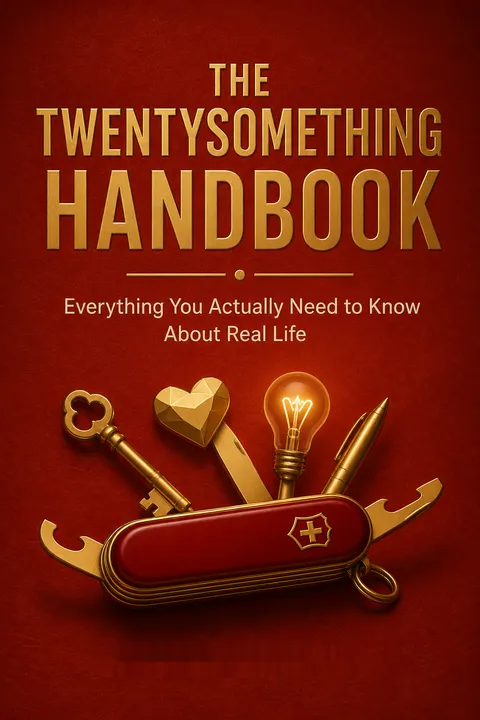
The Twentysomething Handbook receives mixed reviews, with an average rating of 3.62/5. Many readers find it helpful for young adults navigating independence, offering practical advice on various aspects of adult life. Some praise its friendly tone and mental health focus. However, others feel the content is too basic or aimed at a younger audience. Several reviewers recommend it as a gift for high school or college graduates. The book's broad coverage of topics like budgeting, relationships, and self-care is appreciated, though some wish for more in-depth financial advice.
People Also Read










Glossary
Emerging adulthood
transition into adult lifeA developmental period described by researcher Jeffrey Jensen Arnett, extending from the late teens through the twenties. It can involve identity exploration, instability in work and residence, increased self-focus, feeling between adolescence and adulthood, and a sense of possibility. The term frames uncertainty as part of a life stage rather than evidence that someone has failed to mature.
Purpose mindset
purpose with a clear whyAn approach to purpose associated in the book with researcher Christine Whelan. It involves identifying what a person is trying to accomplish in life and understanding why that aim matters. Purpose can be expressed through work, but it can also come from relationships, service, community, or other commitments.
Artificial affluence
borrowed sense of wealthThe feeling of having more spending power than one can actually sustain, often because family members have covered major costs while a young adult’s own income went toward discretionary spending. Once independent expenses begin, the person may feel deprived even while basic needs are met. The book presents this adjustment as a reason to reassess wants, needs, and saving.
Intentional community
shared life by agreementA living arrangement in which residents deliberately build more than a practical roommate relationship. They identify common values, agree on ways to communicate and handle conflict, and may share meals or offer one another help. The book describes possibilities ranging from informal household agreements to established forms such as cohousing or communal living.
Cultural humility
awareness of knowledge limitsA continuing practice of recognizing that one’s understanding of other people’s cultures and experiences is limited. Rather than assuming expertise after a brief exposure, a person stays open to learning, examines their own perspective, and listens to people whose lives differ from their own. The book presents it as a useful complement to learning cultural knowledge.
Intersectionality
overlapping social identitiesThe way social identities, such as race, gender, class, religion, sexual orientation, or gender identity, interact to shape a person’s experiences and opportunities. The book includes the term in its discussion of diversity and inclusion to emphasize that people may face distinctive barriers or advantages through combinations of identities, rather than through one category alone.
No Martyrs, No Mind Readers
speak needs, share the workTwo household rules for preventing resentment among roommates. No Martyrs means not silently doing everyone else’s share while becoming angry about it. No Mind Readers means stating preferences and concerns directly instead of expecting others to notice or infer them. Together, the rules encourage clear requests and shared responsibility before frustration turns into conflict.
Download PDF
Download EPUB
.epub digital book format is ideal for reading ebooks on phones, tablets, and e-readers.








