

Plot Summary
A Song Through the Rain
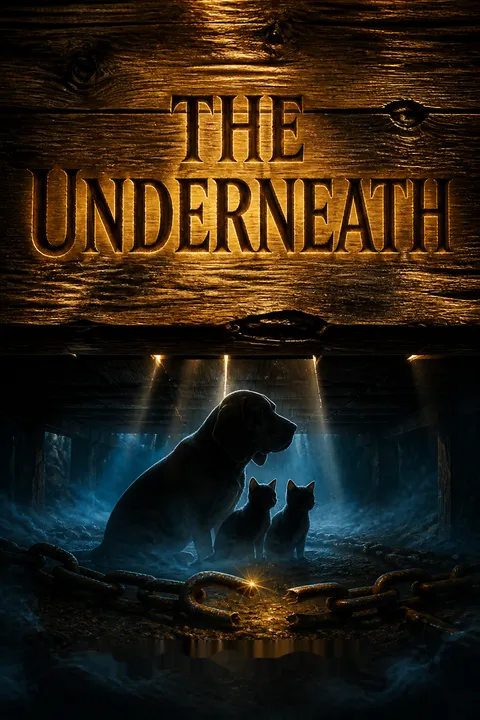
A calico cat, abandoned in the East Texas woods while pregnant, follows a bloodhound's aching bay to a sagging shack. Ranger is chained at the porch, his old gunshot wound and the animal skins around the house warning her what Gar Face does to creatures he catches. Ranger knows the trapper may shoot her or use her as alligator bait, yet her loneliness leaves her with nowhere safer to go.
He guides her beneath the porch, where Gar Face cannot see them. The dog and cat find in each other a fellow castaway, and the calico settles beside him rather than fleeing. The Underneath becomes their shelter, but its safety depends on the kittens never crossing into the open yard.
The first bond forms not through trust earned over time, but through recognition between two abandoned creatures. Ranger's warning is practical, yet his willingness to let the cat stay also exposes his need for companionship. The porch's shadow offers genuine safety from Gar Face, but it is a refuge with a boundary, not a home without danger. The cat enters because loneliness has made the risk of approaching a chained dog smaller than the certainty of being alone. Their new family begins as an improvised answer to neglect.
A Family Under the Porch
The calico gives birth beneath the porch beside Ranger, who watches over the silver twins as if they were his own. The family names the girl Sabine, after the nearby river, and the moon-marked boy Puck. Ranger bathes them, guards them, and makes a nightly song part of their small life together.
Their mother and Ranger teach the kittens that Gar Face's yard is dangerous and that the Underneath is the only safe place. They also explain the warning in practice: the trapper's rifle can kill anything that crosses its path. Puck and Sabine are too young to understand the man as more than heavy boots overhead, while the warmth and games under the house make the forbidden Open seem increasingly inviting.
The family is made by care rather than blood: Ranger assumes a father's work, while the calico trusts him with her young. Yet their tenderness depends on a rule imposed by the violence outside. For the kittens, the Underneath is both playground and world, and their limited understanding makes danger abstract. Puck's curiosity is not framed as wickedness or foolishness; it grows naturally from a childlike desire to test the edge of a known life. The rule protects them, but it cannot teach them what the Open means until one of them crosses it.
Gar Face's First Wound
Gar Face's cruelty began long before the shack. As a boy in Houston, he watched his father drink and beat him, while he poisoned his mother's birdbath and laughed when she mourned a dead cardinal. After his father struck his face with a rifle butt, the boy took the gun and walked into the forest. He survived by killing a deer, then claimed the woods as his own.
Years later, he hunted with Ranger until the hound stepped between his rifle and a bobcat. Gar Face shot Ranger by mistake, blamed the dog, and chained him to the porch. Now he traps animals for skins, but the enormous Alligator King has become his obsession. He believes killing it will force other hunters to respect him.
Gar Face turns humiliation into a private law: whoever can injure or dominate another will never be vulnerable again. His scarred face becomes the visible emblem of a wound he refuses to understand, while his cruelty toward animals repeats the violence he experienced and chose to perpetuate. Even his desire for the Alligator King is less about money than recognition from men who dismiss him. Ranger's injury shows how this logic operates: Gar Face interprets an accident as betrayal because he cannot tolerate dependence or ambiguity. His need for respect fuels the danger surrounding the animal family.
Night Song Finds Hawk Man
A thousand years earlier, Grandmother Moccasin, an ancient lamia, believed herself alone until a serpent daughter appeared and called her mother. Grandmother named her Night Song and treasured her wordless, enchanting music. As Night Song grew restless, she met Hawk Man, a copper-feathered shapeshifter drawn to her song.
They took human forms and left Grandmother to join a Caddo village, where their daughter was born. Night Song became a potter and made the girl a large clay jar marked with a hundred crescent moons and an image of Grandmother. The jar was meant as a loving gift, but its likeness stirred Night Song's longing for the mother she had left behind. Across the centuries, that same vessel would become a prison.
Night Song's departure is a movement toward adulthood, not a rejection of love. She wants experience beyond the world Grandmother has made for her, and the village offers kinship without requiring her to abandon her mixed nature. The jar gathers these relationships into one object: Night Song's craft, her bond with her child, and her unresolved attachment to Grandmother. Its beauty carries affection, but also makes the past tangible again. The episode establishes that longing can be both a bridge between generations and an opening through which old pain returns.
The Jar Seals a Family
When Grandmother finds Night Song living happily with Hawk Man and their glimmering daughter, jealousy overwhelms her. She summons Night Song to the creek but conceals the rule that a shapeshifter who returns to animal form can never become human again.
Night Song enters the water and changes into a serpent, then fades from grief when she cannot return to her husband and child. Their daughter crosses the creek searching for Grandmother, becomes lost, and ultimately discovers her own bird form.
Hawk Man confronts Grandmother and forces her into the daughter's pottery jar, but her venom wounds him. He waits in human form for his child and dies before she returns. The lightning-struck pine's roots eventually close around the buried jar, holding Grandmother for a thousand years.
Grandmother's betrayal grows from a real attachment, but she treats love as a claim of ownership. By withholding the cost of transformation, she deprives Night Song of an informed choice and turns reunion into irreversible separation. The daughter's search repeats the adults' confusion: she follows a family bond into a world whose dangers she does not understand. The jar then becomes a material record of damage passed between generations. Its maker intended it to hold gifts and provisions; Hawk Man uses it to contain the creature who shattered his family. The tree's roots preserve the consequence long after the people are gone.
Puck Crosses the Boundary
One morning, while the calico and Ranger sleep, Puck slips out from beneath the porch to feel the sun. Delighted by the warmth, he runs back toward the Underneath to show Sabine, but Gar Face catches him. The mother cat charges after her son, and Gar Face stuffs both into a burlap sack, drives them to the creek, and throws them into the water.
Trapped in the sack, the calico pushes Puck toward an opening and urges him to swim. The string catches on her paw in the mussel beds, holding her below as Puck escapes. Before the water takes her, she makes him promise to return for Sabine and Ranger and free Ranger's chain. Puck reaches shore alone, carrying a duty much larger than himself.
Puck's brief pleasure in the sun becomes the hinge of the plot, but the resulting catastrophe is Gar Face's deliberate violence, not a moral punishment for curiosity. The mother cat recognizes that her son's survival now depends on action, so she turns grief into an urgent promise. Her final instruction gives Puck a direction when he has lost every familiar guide, while also burdening a kitten with a task he cannot yet perform. The creek becomes a physical divide between safety and loss, and Puck's escape begins a long journey toward keeping faith with those still behind.
Two Kittens Learn Loss
Back at the shack, Ranger's desperate pull against his chain fails, and Gar Face kicks him for losing the cat and kitten. Sabine stays beside the wounded hound, then realizes she must hunt for both of them. Across the creek, Puck wakes in a hollow beneath the old pine, cold, mud-caked, hungry, and unable to find his family.
Hiccups and inexperience make hunting difficult, but he gradually catches small prey. A sudden scream frightens a large bird into dropping a mouse, giving him a meal. He tries to cross the creek on a floating limb, falls in, and reaches the bank again with his coat clean but his family still unreachable. At night he watches a possum mother groom her young and feels the full weight of what he has lost.
The separation forces each kitten into a different form of maturation. Sabine's grief turns outward into practical care: she replaces her mother as provider for Ranger. Puck, by contrast, must first learn the body's elementary demands, from washing mud away to finding food. His failures matter because they are concrete, not symbolic; he cannot fulfill his promise until he can keep himself alive. The bird's dropped mouse gives him help without erasing his struggle. Watching the possum family sharpens his awareness that survival alone is not the same as belonging.
Ranger Becomes the Bait
Gar Face notices Sabine leaving the Underneath to hunt and decides she could serve as bait for the giant alligator. He waits until she sits beside Ranger in the rain, then grabs her by the neck. Ranger, whose voice has been nearly silenced by neglect, lunges and bites Gar Face's leg. The surprise gives Sabine time to escape into the brush.
Gar Face beats Ranger with a board, unhooks his chain, and drags him toward the bayou instead. Sabine follows at a distance, unwilling to abandon him. Gar Face ties the bloodied hound beside the water and falls asleep beneath a cypress, expecting the Alligator King to take the bait. Ranger lies battered, while Sabine curls beneath his ear and purrs.
Ranger's attack marks a change in what the chain has meant. For years it enforced Gar Face's control; now the hound risks what strength remains to protect Sabine. His bite is an act of attachment, precisely the kind of motive Gar Face cannot recognize. Sabine's escape is not abandonment: she hides, then follows the chain's trail because loyalty and self-preservation must coexist. Gar Face's bait scheme reduces Ranger to a tool, but the animal's bond with Sabine disrupts that calculation. His cruelty draws the family toward the bayou, where his own hunt is waiting.
The Pine Becomes a Bridge
As a storm swells the Little Sorrowful, Puck tries to cross through the trees. A rifle blast startles him from a branch, and he falls hard beside his den. Rain softens the ground until the old loblolly pine topples across the creek. Its roots wrench Grandmother Moccasin's jar from the earth; the jar cracks, and she slips free after a thousand years underground.
Puck uses the fallen trunk as a bridge before the rising water can cover it. On the far bank, he follows Ranger's distant howl to the shack. The Underneath is empty, but blood stains Ranger's food bowl and leads away from the yard. Puck recognizes Ranger's scent and follows the trail toward the meeting of the bayous.
The storm joins the book's two timelines through physical cause: rain topples the tree, the tree exposes the jar, and its trunk gives Puck a way across. The old pine has carried both imprisonment and shelter, so its fall ends one confinement while opening a path for another. Puck's return is not enabled by sudden strength but by attention to the sounds and traces he has been learning to read. Blood replaces Ranger's song as his guide. The plot turns on the forest's material memory, where old harm and present need occupy the same ground.
The Bayou Takes Gar Face
At the bayou, Puck finds Gar Face asleep beside the chained Ranger, with Sabine hidden nearby and the rifle within reach. As Gar Face wakes and aims toward Sabine, Puck yowls from the cypress branches. Gar Face jerks the rifle upward and fires. Puck drops onto his face, clawing hard enough to make him release the gun.
Enraged and blinded by pain, Gar Face grabs Puck and steps into the Bayou Tartine to wash his wounds. The Alligator King rises and drags Gar Face under. Puck sinks too, but hears Sabine calling him and swims toward her voice. When he reaches the bank, he and Sabine find one another again beside the battered Ranger.
Puck fulfills his promise through the same trait that once led him into danger: curiosity has matured into alertness and decisive action. His cry interrupts Gar Face's aim and gives Sabine a chance, while the Alligator King turns the hunter's chosen arena against him. The ending does not make violence clean or triumphant. Gar Face dies, but the family first has to survive the water and the damage he caused. Sabine's call becomes the counterforce to the creek that separated the twins. Puck returns not by mastering nature, but by listening to someone who loves him.
Grandmother Breaks the Chain
With Gar Face gone, Grandmother sees Puck, Sabine, and the battered Ranger bound together by care. Instead of claiming the kittens as she once tried to claim Night Song, she turns her attention to the rusted chain and snaps it with her jaws. The act frees Ranger, but Gar Face's bullet has wounded Grandmother.
As she retreats toward the cypress, the hummingbird who has watched over the animals identifies herself as Grandmother's granddaughter, the glimmering child of Night Song and Hawk Man. Grandmother recognizes her at last. The serpent dies with the bird beside her, having used her strength to release a family rather than possess it. Above them, a hawk crosses the sky.
Grandmother's final act answers the central error of her past. She once confused love with keeping someone near, and that attempt destroyed the family she meant to recover. Faced with another small family, she chooses to remove a restraint rather than impose her own desire. The broken chain is therefore more than a practical rescue; it is a reversal of the control that shaped her history and Ranger's. Her reunion with the granddaughter arrives too late to repair the past, but it allows recognition without ownership. The hummingbird's presence binds the generations in a final, quiet act of witnessing.
A New Forest Home
After Grandmother's sacrifice, Ranger, Puck, and Sabine walk away from the bayous and the shack where Gar Face kept them trapped or threatened. The old house does not become a refuge again: lightning strikes it, and fire reduces it to blackened remains. The loblolly pine washes downstream, carrying the last trace of the buried jar toward the sea.
The three survivors remain in the forest, together and no longer bound to Gar Face's porch. Ranger's family is now the two kittens he guarded from their first days, and the siblings have crossed the creek that once divided them. Their lives continue among the trees, beyond the reach of the ruined house.
The ending resolves the opening's central image of abandonment by giving Ranger and the kittens a chosen family and a place beyond the shack's control. The house's destruction prevents the old setting from being mistaken for a home worth reclaiming; safety requires departure. The pine's passage to the sea releases the story's oldest physical burden, while the animals stay rooted in the living forest. Their future is not presented as a return to innocence. They have been marked by loss, but their bonds now rest on mutual care rather than confinement.
Analysis
The Underneath makes family less a matter of origin than of repeated acts of care. Ranger is not the kittens' biological parent, yet he feeds, guards, and sings to them; Sabine becomes a provider when her mother is gone; Puck's journey is organized around a promise to return. These bonds are tested by physical barriers, especially the porch, creek, chain, and jar. Each begins as protection or containment, then acquires a different meaning as the characters change.
The parallel histories of Grandmother Moccasin's family and the cats' family sharpen the novel's account of love. Grandmother's grief is genuine, but she turns it into possession and conceals the cost of Night Song's return. Gar Face likewise converts injury into domination, treating dependence as a threat. Their actions differ in scale and motive, yet both confuse control with safety. The animal family offers another model: affection does not prevent danger, but it creates reasons to act for someone beyond oneself.
The forest is not a benign backdrop. Its predators kill, its water separates, and its quicksand punishes mistakes. Yet the trees remember, the storm loosens the buried jar, and a fallen pine becomes a bridge. Nature can shelter and destroy without moral judgment; meaning arises through the characters' responses to it. Puck's growth depends on learning the forest's signals rather than conquering it. The final movement away from Gar Face's house therefore does not promise a world without loss. It offers something more credible: survivors who have learned that love is not the refusal to let go, but the choice to protect another without making that life one's possession.
Review Summary
The Underneath receives mixed reviews. Many praise its lyrical writing, emotional depth, and ability to weave together multiple storylines. Readers appreciate the book's exploration of themes like love, cruelty, and redemption. However, some find the content too dark for children, with descriptions of animal abuse and death. The repetitive writing style and slow pacing are criticized by some. Overall, the book is seen as a powerful, beautifully written story that may not be suitable for all young readers.
People Also Read

Characters
Puck
Moon-marked curious survivorPuck is the silver male kitten marked by a crescent of white fur on his forehead. Playful, impulsive, and fascinated by whatever lies beyond the familiar, he tests boundaries before he understands their cost. His bond with his twin Sabine is central to his sense of home, while Ranger's protection gives him a model of care beyond blood relation. Puck's early confidence comes from being sheltered; his deeper resourcefulness emerges when he must find food, read the forest, and act without adult guidance. He is not fearless. He learns to move forward while frightened, and his curiosity gradually becomes a capacity to notice, adapt, and take responsibility.
Sabine
The watchful twin hunterSabine is Puck's silver-furred twin, rounder and quieter than her brother, with the instincts of a patient hunter. She notices danger quickly and is more attentive than Puck to the lessons their mother tries to teach. Her loyalty is practical rather than showy: she learns to find food and cares for Ranger when the family is divided. Sabine's steadiness does not mean she feels less fear or grief; she keeps moving because others depend on her. Her relationship with Puck is built through play, shared childhood, and a powerful sense of kinship. She represents the watchfulness that helps a vulnerable family endure.
Ranger
The chained singing guardianRanger is an aging bloodhound whose hunting life has been reduced to a short chain and a porch post. He carries an old bullet in his leg and has learned the rhythms of Gar Face's comings and goings, but his defining quality is his capacity for attachment. The calico's arrival draws him out of isolation, and he becomes a gentle guardian to her kittens. His songs give the animals a way to feel protected even when he cannot move far enough to shield them. Ranger's loyalty is complicated by the history of abuse that has taught him to endure pain quietly, yet he remains capable of defending those he loves.
Mama
The abandoned calico motherMama is a pregnant calico cat left in the woods by the people who once cared for her. She is cautious enough to recognize the danger around Gar Face's shack, but loneliness and need lead her to approach Ranger. Her maternal care is tender and firm: she protects the kittens, teaches them to hunt, and insists that the Underneath is safer than the open yard. She trusts Ranger because his gentleness is consistent, not because he can promise perfect safety. Mama's defining strength is her ability to make a family in hostile circumstances and to prepare her children for a world she cannot control.
Gar Face
The scarred bayou trapperGar Face is a solitary trapper with a damaged face, a rifle, and a house that seems to sink into the forest. His childhood was shaped by an abusive father and his own contempt for his mother's tenderness; as an adult, he repeats violence rather than examining it. He kills and skins animals for trade, drinks heavily, and treats dependence as weakness. His interest in the Alligator King is tied to a hunger for recognition from other hunters who look down on him. Gar Face is frightening not because he is mysterious, but because he has built a coherent private world in which cruelty seems like strength and every act of care appears to him as betrayal.
Grandmother Moccasin
The ancient serpent matriarchGrandmother Moccasin is a lamia, an ancient being with serpent and human ancestry, and one of the last of her kind. She has lived among the bayous for ages and knows the forest's paths, creatures, and hidden dangers. Her bond with Night Song gives her life a focus after a long period of loneliness, and her stories carry memories of places and peoples far beyond the local woods. Beneath her formidable knowledge is a deep fear of being left behind again. That fear can tighten into possessiveness, especially when she mistakes a loved one's independence for abandonment. Grandmother's power is inseparable from her vulnerability to grief.
Night Song
The siren-voiced lamia daughterNight Song is Grandmother Moccasin's daughter, a lamia whose wordless singing can reach across the forest. She loves the mother who raised her, but her curiosity and desire for a life of her own draw her toward Hawk Man and the Caddo village. As a partner and mother, she learns human crafts and makes pottery, finding a way to join her enchanted inheritance with ordinary family life. Night Song is not simply torn between two worlds; she seeks the freedom to belong to both. Her story shows how a choice made without full knowledge can turn longing into a painful trap.
Hawk Man
The listening hawk shapeshifterHawk Man is a shapeshifter who first encounters Night Song through her music. His unusual gift is attentive listening: he hears the forest, its people, and the signals other beings overlook. He gives up his hawk form to live with Night Song among humans, where he becomes a partner and father as well as a trusted member of the Caddo village. His devotion is quiet and patient, expressed through presence and care rather than possession. The tension in his life comes from balancing his enchanted nature with his commitment to his human family.
The Glimmering Daughter
The radiant lost childThe daughter of Night Song and Hawk Man is a Caddo child whose skin glimmers in changing colors. She is curious about the family history her mother speaks of only in fragments and feels drawn to the image of Grandmother Moccasin on her birthday jar. Her parents' love gives her a secure beginning, while her inherited enchantment connects her to both water and sky. She is brave enough to act when the adults around her are overwhelmed, though she cannot yet understand the full consequences of her choices. Her presence links the ancient story to the later lives of the forest animals.
The Alligator King
The bayou's ancient rulerThe Alligator King is a massive, patient predator who has lived in the Bayou Tartine for centuries. He and Grandmother Moccasin have long regarded each other as siblings, sharing the swamp without claiming ownership of one another. He understands danger and consequence, and he cautions Grandmother when her longing threatens to become coercion. Gar Face sees him as a prize that might buy respect, but the alligator's world is older and less interested in human status. His presence gives the forest a force that cannot be mastered by a rifle or a boast.
The Hummingbird
The messenger between worldsThe hummingbird moves between the living world and the world of the dead, appearing at moments when someone is near a crossing. She is quick enough to be missed and persistent enough to return, carrying comfort and recognition where ordinary voices cannot reach. Her role is not to erase grief or reverse every loss; she accompanies those who need help making sense of separation. The hummingbird's presence connects the old story of Night Song's family to the animals' later ordeal, making her a small but consequential witness to lives unfolding across generations.
Plot Devices
The Underneath and the Open
Safety with a boundaryThe space beneath Gar Face's porch gives Mama, Ranger, Puck, and Sabine a hidden place to sleep and play, while the Open represents the yard and forest beyond their limited protection. The rule to stay underneath is sensible because Gar Face hunts and shoots animals, but it cannot eliminate curiosity or prepare the kittens for danger. Puck's brief step into sunlight brings the family into Gar Face's reach. Later, the idea of crossing out of shelter becomes a measure of growing courage, as Puck and Sabine must move beyond the places that once kept them safe.
The Mother's Promise
A duty across separationAs the calico drowns, she asks Puck to find Sabine and Ranger and to free Ranger from his chain. The promise gives Puck an aim after his family disappears, but it also tests his ability to survive before he can help anyone else. He remembers it through hunger, failed attempts to cross the creek, and the sound of Ranger's distant howl. The promise binds the cat family across physical distance and becomes the reason Puck returns toward the danger he once escaped.
The Crescent-Moon Jar
A gift turned prisonNight Song shapes the clay jar for her daughter and decorates it with crescent moons and an image of Grandmother Moccasin. The object holds the tenderness of a mother making a gift, but Hawk Man later uses it to imprison Grandmother after she destroys his family. Buried beneath the old pine, the jar connects the ancient Caddo village to Puck's present-day shelter. When the tree falls during the storm, its roots pull the jar free, releasing Grandmother and creating a bridge across the flooded creek.
The Shapeshifter's Law
A one-way transformationEnchanted beings can change between animal and human forms, but once they return to their animal shape they cannot become human again. Grandmother knows the cost and hides it when she summons Night Song back to the water. The law turns Night Song's trust into irreversible separation from her husband and daughter. It also shapes Hawk Man's choices, since he remains human while hoping to be reunited with his child. This rule gives transformations emotional stakes beyond their physical magic: changing form can mean surrendering a life and the relationships built within it.
The Forest's Messengers
Memory carried by natureThe trees preserve events across centuries, while the hummingbird moves between the living and the dead. Their guidance is indirect: Puck must interpret a fallen tree, a blood trail, and Ranger's howl rather than receive a map or explanation. The trees' long memory allows the reader to follow Grandmother, Night Song, and Hawk Man alongside the animal family, and the hummingbird marks passages where ordinary understanding fails. Together, these devices make the forest an active witness, capable of linking distant generations and opening paths without controlling what the characters choose.
FAQ
Synopsis & Basic Details
What is The Underneath about?
- Unlikely Family Forms: The story centers on an abandoned calico cat, pregnant with kittens, who finds refuge and companionship with a chained hound named Ranger beneath the porch of a cruel man known as Gar Face in the East Texas bayou.
- Sanctuary and Peril: This hidden space, "the Underneath," becomes a fragile sanctuary where the cat gives birth to twins, Puck and Sabine, forming an unconventional family unit constantly threatened by Gar Face's violent nature and obsession with hunting, particularly a legendary Alligator King.
- Promise and Journey: When curiosity leads to tragedy, separating the family, the story follows the journey of one kitten, Puck, driven by a promise to his mother to return and free his sister and Ranger, intertwining their fate with ancient magic and the forest's deep history.
Why should I read The Underneath?
- Lyrical and Evocative Prose: Kathi Appelt's writing is frequently praised for its poetic quality and sensory descriptions, drawing readers into the humid, mysterious world of the bayou and making the natural setting a character in itself. As noted in praise, it "reads like a ballad sung" and has a "fresh beauty of its author's voice."
- Deep Emotional Resonance: The novel explores powerful themes like loneliness, love, sacrifice, betrayal, and the enduring strength of family bonds, even among different species, offering a deeply moving and often heartbreaking emotional journey. Reviewers highlight its "heartrending and magical tale that speaks to love and hope, loneliness and loss."
- Myth and Mystery: Blending realistic animal survival with elements of ancient magic, shape-shifting, and timeless legends kept by the forest's trees, the story offers a unique, layered narrative that feels both grounded and mythical, appealing to readers who enjoy fantasy with strong natural underpinnings.
What is the background of The Underneath?
- East Texas Bayou Setting: The story is deeply rooted in the specific geography and atmosphere of the piney woods and bayous of East Texas, near the Louisiana border, featuring its unique flora, fauna (alligators, snakes, specific trees), and humid climate. The text mentions the Sabine River and the Gulf of Mexico as significant geographical markers.
- Cultural Echoes: The narrative incorporates elements inspired by the history and legends of the Caddo people, who once inhabited the region, referencing their pottery, village life along the creek, and connection to the land, adding a layer of historical and cultural depth to the magical elements.
- Themes of Isolation and Cruelty: The human element, primarily through Gar Face, reflects a harsh, isolated existence often found in remote, impoverished areas, contrasting sharply with the natural world and the bonds formed by the animals, highlighting the destructive potential of human cruelty stemming from past trauma.
What are the most memorable quotes in The Underneath?
- "There is nothing lonelier than a cat who has been loved, at least for a while, and then abandoned on the side of the road.": This opening line immediately establishes the theme of loneliness and abandonment that drives the initial plot and introduces the calico cat's plight, setting a poignant tone for the story.
- "Stay in the Underneath. You'll be safe in the Underneath.": This repeated phrase becomes a central rule and motif, representing the fragile boundary between safety and danger, the known and the unknown, and the protective instincts of the mother cat and Ranger.
- "Promise you'll go back for your sister... Promise you'll break the chain.": These urgent commands from the dying mother cat to Puck encapsulate the core promises that fuel his journey and become the driving force behind the novel's climax and resolution, highlighting themes of duty and liberation.
What writing style, narrative choices, and literary techniques does Kathi Appelt use?
- Lyrical and Sensory Prose: Appelt employs a highly descriptive and poetic style, using rich imagery and sensory details to immerse the reader in the bayou environment, often personifying natural elements like trees and water. Phrases like "blue and tender, slipping through the branches" describe Ranger's song, showcasing this style.
- Multiple Perspectives and Time Shifts: The narrative fluidly shifts between the perspectives of the animals, Gar Face, and ancient magical beings, often jumping between the present events and a thousand-year-old backstory, creating a layered, complex structure that reveals thematic connections across time.
- Symbolism and Anthropomorphism: The book heavily utilizes symbolism (the chain, the Underneath, the jar, the creek, the hummingbird) and anthropomorphism, giving animals and even trees human-like thoughts, emotions, and narrative voices to explore complex themes from non-human viewpoints.
Hidden Details & Subtle Connections
What are some minor details that add significant meaning?
- The Pine Cone's Journey: A seemingly insignificant detail of a pine cone being brushed into the hole where Grandmother's jar is buried (Chapter 84) gains profound significance as it grows into the very tree that eventually falls and frees her a thousand years later, symbolizing the deep, slow cycles of nature and fate.
- Gar Face's Face and Name: The description of Gar Face's broken face resembling a "prehistoric fish... half fish, half alligator. A gar" (Chapter 6) is a subtle detail that foreshadows his eventual demise in the jaws of the Alligator King, linking his physical appearance, chosen name, and ultimate fate to the very creatures he hunts.
- The Hummingbird's Consistent Presence: The hummingbird appears at key moments of transition, loss, and guidance – after the mother cat drowns (Chapter 35), when Puck is lost (Chapter 60), when Hawk Man is dying (Chapter 90), and finally to Grandmother (Chapter 123) – subtly suggesting its role as a messenger or intermediary, strongly implied to be the transformed daughter of Hawk Man and Night Song.
What are some subtle foreshadowing and callbacks?
- Lightning Strike Echoes: The initial lightning strike that loosens the jar's hold (Chapter 3) is echoed by the lightning during the final storm (Chapter 100, 104), which seems to charge the air and precede Ranger's crucial howl, linking ancient magic and natural forces across time.
- The Creek's Salty Tears: The description of the Little Sorrowful Creek being salty because it's "made of tears" (Chapter 37) foreshadows the many moments of grief and loss that occur along its banks, from Puck's despair after losing his mother to Hawk Man's sorrow and the eventual naming of the creek.
- Night Song's Jar Etching: Night Song etching Grandmother Moccasin's image onto her daughter's jar (Chapter 58) serves as a powerful callback when Grandmother finds the jar a thousand years later (Chapter 84), recognizing herself and her daughter's artistry, which momentarily softens her anger before Hawk Man intervenes.
What are some unexpected character connections?
- Grandmother Moccasin and Ranger: The most unexpected connection is Grandmother Moccasin, the ancient lamia driven by vengeance, ultimately choosing compassion and breaking the physical chain binding Ranger, directly fulfilling one of the mother cat's dying wishes and linking the ancient magical plotline directly to the animal survival story (Chapter 123).
- The Alligator King and Grandmother Moccasin: The revelation that the fearsome Alligator King is Grandmother Moccasin's ancient friend and "Brother" (Chapter 20, 24, 56, 108) is surprising, showing that even the most formidable creatures have deep, long-standing relationships that predate human understanding.
- Hawk Man and the Hummingbird: The strong implication that Hawk Man's daughter, who transformed into a bird (Chapter 91), becomes the recurring hummingbird messenger creates a poignant connection, suggesting she continues to watch over and guide those in the forest, including Puck and Ranger.
Who are the most significant supporting characters?
- The Trees: Functioning as ancient narrators and keepers of memory ("Trees are the keepers of stories," Chapter 2), the trees are vital supporting characters. They witness events across millennia, offer subtle warnings ("Beware the Tartine sisters!" Chapter 67), and even intervene with magic (Zephyrs of Sleep, Chapter 44, 119; the falling tree bridge, Chapter 106), connecting the past, present, and magical elements.
- The Alligator King: More than just Gar Face's prey, the Alligator King represents the ancient, untamed power of the bayou. His interactions with Grandmother Moccasin reveal his wisdom and patience (Chapter 56), and his role in Gar Face's death (Chapter 116) signifies the natural world's ultimate dominance over human cruelty.
- The Hummingbird: This recurring figure acts as a subtle guide and symbol of hope and transition. Its appearances often coincide with moments of loss or crucial decisions, hinting at a benevolent presence watching over the characters and bridging the gap between different realms or states of being.
Psychological, Emotional, & Relational Analysis
What are some unspoken motivations of the characters?
- Gar Face's Need for Respect: Beyond simple cruelty or greed for alligator skins, Gar Face's relentless pursuit of the Alligator King is deeply motivated by a desperate, unspoken yearning for respect and recognition, stemming from the trauma of his father's abuse and the resulting disfigurement and social isolation (Chapter 9, 26, 74). He believes capturing the legendary beast will finally earn him the admiration he craves from others, particularly the men at the tavern.
- Ranger's Desire for Family: Ranger's immediate and profound bond with the calico cat and kittens is driven by years of deep, unspoken loneliness and isolation while chained. His protective instincts and joy in their presence reveal a powerful, unmet need for connection and belonging that the cat family fulfills (Chapter 7, 12).
- Grandmother Moccasin's Longing for Adoration: While initially fueled by vengeance for the "theft" of her daughter, Grandmother Moccasin's underlying motivation is a deep, ancient longing for the companionship and adoration she experienced with Night Song, which she hopes to recapture by taking the granddaughter (Chapter 81). Her eventual change of heart is prompted by witnessing the pure, simple love of Puck, Sabine, and Ranger, reminding her of what she truly missed.
What psychological complexities do the characters exhibit?
- Gar Face's Cycle of Trauma and Abuse: Gar Face's character is a study in how trauma (his father's violence, Chapter 6) can manifest as outward cruelty and a distorted worldview. His inability to form healthy bonds and his projection of hatred onto animals and the world around him reveal a deeply damaged psyche trapped in a cycle of pain and vengeance.
- Ranger's Resilience and Adaptation: Ranger demonstrates psychological resilience, adapting from a proud hunting dog to a chained alarm, and finally finding purpose and emotional fulfillment in his role as protector and adoptive father to the kittens, showcasing the capacity for love and loyalty to endure despite hardship and betrayal.
- Grandmother Moccasin's Transformation: Grandmother's journey from ancient, vengeful lamia to an entity capable of compassion reveals a complex inner struggle. Her thousand years of isolation and anger are powerful forces, but the sight of pure, vulnerable love ultimately triggers a profound psychological shift, allowing her to break the cycle of vengeance she embodied.
What are the major emotional turning points?
- The Calico Cat's Sacrifice: The mother cat's decision to push Puck towards the surface while she drowns (Chapter 34) is a pivotal emotional turning point, demonstrating the ultimate act of maternal sacrifice and imprinting Puck with the weight of her final promise, fundamentally altering his path and motivations.
- Ranger's Howl of Fury and Sorrow: Ranger's pained, furious howl after Gar Face attacks Sabine (Chapter 103) marks a significant emotional release after years of silenced suffering. It signals his breaking point and, crucially, serves as the beacon Puck needs to find his way back, transforming Ranger's despair into a catalyst for reunion.
- Grandmother Moccasin's Choice: Grandmother's decision, after a thousand years of planning vengeance, to break Ranger's chain instead of harming the animals (Chapter 123) is the story's ultimate emotional climax, signifying her liberation from hatred and her embrace of love, resolving the ancient conflict in a surprising act of grace.
How do relationship dynamics evolve?
- Ranger and Calico's Bond: Their relationship evolves from shared loneliness and cautious cohabitation ("an unlikely pair," Chapter 1) to a deep, trusting partnership and the foundation of a family unit ("loved the calico cat straightaway," Chapter 7), demonstrating how companionship can transform isolation.
- Ranger and the Kittens' Family: Ranger's role shifts from protector of the mother cat to adoptive father figure for Puck and Sabine. He initially sees them as "mewls and milk" but quickly becomes fiercely proud and devoted ("No father has ever been prouder," Chapter 12), their bond deepening through shared hardship and his unwavering presence.
- Puck and Sabine's Twin Connection: Their relationship, initially characterized by playful kitten games (Chapter 23), is tested by separation and loss. Puck's journey is driven by his promise to return for Sabine, and their reunion (Chapter 118) reaffirms their deep, almost telepathic twin bond, highlighting the strength of sibling connection.
Interpretation & Debate
Which parts of the story remain ambiguous or open-ended?
- The Hummingbird's Identity: While strongly suggested to be the transformed daughter of Hawk Man and Night Song (Chapter 91, 123), the text never explicitly confirms this, leaving a slight ambiguity that allows for interpretation regarding the nature of her transformation and continued presence as a guiding spirit.
- The Exact Nature of Enchantment: The rules and origins of the shape-shifters (lamia, bird people) are presented as ancient mysteries ("Some mysteries are hard to divine," Chapter 25), leaving the reader to ponder the full scope and limitations of their magic and how it interacts with the natural world.
- The Family's Future: The final chapter states that Puck, Sabine, and Ranger are "here" in the forest, having found a "new one" (Chapter 124), but their specific location, daily life, and long-term future are left open-ended, allowing the reader to imagine their continued journey and freedom.
What are some debatable, controversial scenes or moments in The Underneath?
- Gar Face's Death: The scene where Gar Face is killed by the Alligator King (Chapter 116) could be debated. While his cruelty is undeniable, some readers might question the narrative choice of his violent end, particularly whether it serves as justified comeuppance or simply another act of brutality in a harsh world.
- Grandmother Moccasin's Deception: Grandmother's deliberate choice not to tell Night Song the rule about irreversible transformation (Chapter 56, 64) is highly debatable. Was this act driven solely by selfish desire to reclaim her daughter, or was there a complex mix of love, desperation, and perhaps a belief that Night Song would eventually prefer her ancient form?
- The Mother Cat's Sacrifice: While portrayed as a heroic act of maternal love, the mother cat's sacrifice (Chapter 34) could be debated in terms of its necessity or effectiveness. Could there have been another way for Puck to survive? Did her death place an unfair burden of promise and guilt on a young kitten?
The Underneath Ending Explained: How It Ends & What It Means
- Cycles Broken, Freedom Gained: The climax sees Gar Face killed by the Alligator King, ending his reign of cruelty. Simultaneously, the ancient tree falls, freeing Grandmother Moccasin from her jar. In a pivotal act, Grandmother chooses compassion over vengeance, using her power to break Ranger's chain, fulfilling the mother cat's dying wish and liberating the animal family (Chapter 116, 106, 123).
- Reunion and New Beginning: Puck, guided by Ranger's howl and his promise, finds his way back to the bayou just as Ranger and Sabine are freed. The family is reunited, leaving behind the site of their suffering (the tilting house, which is destroyed by lightning, Chapter 124) and the fallen tree/broken jar.
- Enduring Love and Place: The ending signifies the triumph of love and connection over cruelty and isolation. The animal family finds a new life "here" in the forest, suggesting they have found their true place within the natural world, free from human tyranny, while the ancient magical elements (Grandmother, the Alligator King, the implied hummingbird) return to their own cycles within the forest's timeless existence.
Download PDF
Download EPUB
.epub digital book format is ideal for reading ebooks on phones, tablets, and e-readers.








