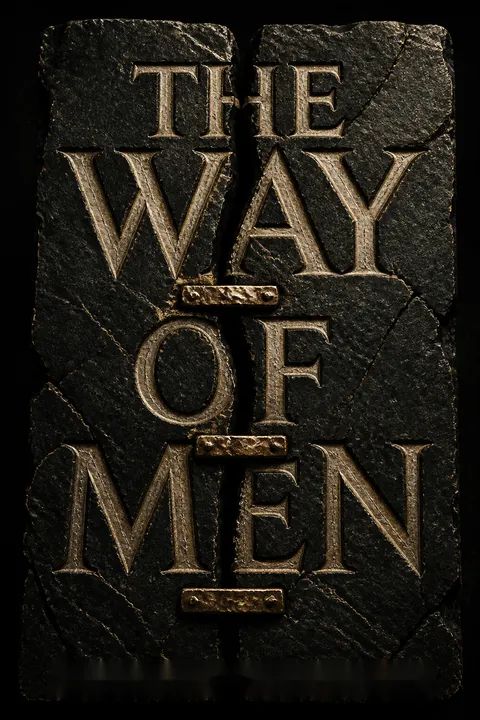


Key Takeaways
See masculinity as a role tested among men, not private virtue.
Start with the crew. Donovan asks what men have in common beneath changing customs and competing ideals. His answer is a small group facing danger: men earn respect by being useful, dependable, and valued by other men. In this account, masculinity is less about pleasing women or obeying a moral code than about proving a place among male peers. The book calls this basic arrangement the way of the gang, meaning a close male group organized around shared interests and external pressures.
A survival lens. Donovan imagines a band needing food, protection, and trust. The scenario helps explain why he sees male solidarity and competition as central, but it is a model, not a complete account of every society or every man's life.
What's useful here is the shift from an individual checklist to a social question: who recognizes a person's contribution, and what does that group need? That perspective can illuminate why work teams, sports clubs, and friendships shape identity. The survival scenario, however, is designed to foreground conflict and male bonding. It can make cooperation with women, caregiving, or peaceful forms of contribution seem secondary by construction. The model is strongest as a way to examine one influential ideal of manhood, not as a universal definition.
Trust concentrates in small crews; build dependable ties beyond your household.
Scale changes loyalty. Donovan describes a party-gang structure: people gather in larger groups when useful, then rely on smaller teams for close cooperation. He cites military units, sports teams, and Robin Dunbar's estimate that people can maintain meaningful relationships with roughly 150 others. Inside that wider circle, the number of people trusted with an emergency or a major loan is smaller still. In his account, close male groups offer the trust and accountability that huge institutions cannot supply personally.
Boundaries create belonging. A perimeter marks who is trusted and who remains outside. The Robbers Cave Experiment, in which boys assigned to competing groups became hostile, illustrates how quickly an us-versus-them identity can form. Shared goals later helped those groups cooperate. The boundary can create solidarity, but it can also create enemies.
The distinction between a broad network and a small circle of practical trust is valuable well beyond this book's gender argument. A contact list is not the same as people who will share risk, time, or responsibility. The Robbers Cave example also supplies an important counterweight: group identity is not fixed, and cooperation can expand when people face a common task. Perimeters may support commitment, but treating outsiders as threats can turn social cohesion into suspicion. Strong groups need boundaries that do not make hostility their glue.
Measure capability through strength, nerve, skill, and loyalty under pressure.
Four practical tests. Donovan calls strength, courage, mastery, and honor the tactical virtues: physical capacity, willingness to face risk, competence in useful skills, and commitment to a group's esteem and reputation. In a survival band, a strong body alone is not enough. A capable hunter must take risks, know how to do the work, and be trusted by teammates. The four qualities reinforce one another, while weakness in one area may be offset by valuable expertise in another.
The standard is functional. The virtues are amoral in the book's framework: they describe capacities that can help a group prevail, not proof that its cause is just. A skilled, courageous person can serve a worthy cause or a destructive one. Donovan's model explains what a team may prize without deciding what it should prize.
This framework is memorable because it joins physical ability to competence and reliability. It also corrects the idea that courage is mere fearlessness: risk matters, but so does what a person can actually do. The crucial qualification is the author's distinction between effectiveness and goodness. Tactical qualities do not settle whether a group's goals deserve support. A useful application is to ask both questions separately: can this person contribute under pressure, and are the group's aims and methods defensible?
Treat honor as peer-tested reputation, not universal applause.
Status depends on an audience. Donovan defines honor as concern for one's reputation for strength, courage, and competence within a male honor group. He distinguishes the immediate impulse to answer an insult or threat from broader cultural codes that define acceptable conduct. In a small group, reputation can signal whether someone is dependable, and a group's reputation may deter challengers. Honor therefore has a practical side, but its meaning depends on which peers are doing the judging.
Rank is built in comparison. The book argues that honor must involve differences in esteem: if everyone receives identical regard regardless of contribution, the word loses its status function. That makes honor motivating, but it also makes it selective. A group's standards can reward skill and commitment, or reward retaliation and exclusion. The idea describes social ranking; it does not make every ranking fair.
The insight that reputation is audience-specific helps explain why people can seem honorable in one community and untrustworthy in another. Peer accountability can make promises consequential because the same people remember whether they were kept. Yet a reputation system can become a contest in which visible toughness matters more than sound judgment. The book's focus on status makes that danger especially clear. Honor is most constructive when a group admires restraint, competence, and repair as well as the ability to stand firm.
Separate moral goodness from competence at the role a culture assigns men.
Two judgments, not one. Donovan separates being a good man from being good at being a man. The first concerns moral conduct, such as honesty or compassion. The second concerns whether a person can fulfill the practical expectations attached to manhood in a particular setting. A man might be ethically admirable yet lack skills his community expects of men; another might be exceptionally capable while behaving cruelly. Popular stories about gangsters and outlaws help make the distinction visible: audiences may admire their nerve or expertise without approving their actions.
The job description varies. A hunter, mechanic, soldier, or provider may each fit a different cultural ideal. Donovan argues that capability has recurring themes, while moral codes change. His distinction is clarifying, but it can also make cultural expectations appear more natural or inevitable than they are.
Separating competence from character prevents a common confusion: success at a role is not evidence of virtue, and virtue does not automatically confer technical skill. The distinction also invites scrutiny of who writes the role description and who benefits from it. A community may need courage and expertise while revising expectations that exclude people unnecessarily. The book is persuasive when it refuses to label every immoral but capable man unmanly. It is less persuasive when a contested social role is treated as if its requirements follow directly from biology.
Safety turns masculine action into simulation, spectatorship, and competition by proxy.
Action gets rerouted. Donovan groups modern substitutes for direct struggle into three forms: simulated masculinity, such as military service or sports participation; vicarious masculinity, such as watching games or reading heroic stories; and intellectualized masculinity, such as economic rivalry, political debate, or self-discipline. These forms let people experience competition and demonstrate valued qualities without routinely confronting survival-level danger. As societies become safer and work less physically demanding, he argues, these substitutes take on greater importance.
A proxy has limits. The book points to sports, films, games, and exercise as outlets, then asks whether they can replace meaningful responsibility. Its answer is doubtful: entertainment can imitate risk, but it cannot always give a person real accountability or consequences. This is a provocative diagnosis, though it can undervalue the genuine skill, effort, and community built through nonviolent activities.
The distinction among participation, spectatorship, and abstraction is a useful way to ask what an activity actually provides. Watching a competition may offer excitement, while playing or organizing can add practice, obligation, and relationships. The author's strongest point is not that simulation is worthless, but that it can leave people hungry for consequential roles. The limitation is a tendency to equate consequence with danger. Teaching, caregiving, and skilled work can demand judgment and responsibility without resembling combat.
Read Rome and Gilgamesh as stories about civilization's bargain with male restlessness.
A city begins in a story. Donovan retells Rome's founding myth: Romulus and Remus grow up among shepherds, gather followers, overthrow a king, and establish a new settlement. Their band builds an identity and a hierarchy, then uses force to secure its future. The story includes the seizure of Sabine women, which the book treats as part of Rome's foundation. That episode makes plain how heroic founding narratives can present coercion as necessary to collective survival.
Comfort has a cost. In the Epic of Gilgamesh, the hero and his companion leave the city to seek dangerous work and lasting renown. Donovan reads these stories as evidence of a recurring tension: civilization offers safety and abundance, but can leave people restless for meaningful challenge. Myths reveal cultural ideals, though they do not by themselves prove that all men share one nature.
The paired stories make the book's argument vivid: order is not simply the opposite of danger, because societies are built through conflict and then try to contain it. The Rome myth is particularly revealing when read critically, since the founding of a community is tied to taking power and bodies from others. Myth can explain what a culture wants to believe about itself; it cannot establish that the actions it celebrates were necessary or universally characteristic. That distinction preserves the stories' interpretive value without treating them as evidence of destiny.
Use chimpanzee and bonobo comparisons as prompts, not proof of destiny.
Two primate contrasts. Drawing on Richard Wrangham and Dale Peterson, Donovan contrasts chimpanzees, where males form coalitions and compete with neighboring groups, with bonobos, where female alliances have more influence and sexual behavior helps ease social tensions. He presents the chimpanzee pattern as closer to the human history of male bonding and coalitionary violence, while the bonobo pattern becomes a metaphor for a comfortable, female-influenced society.
The analogy has limits. The book's point is that social arrangements respond to ecological conditions, including food and competition. But its comparison also supports a sweeping political story about modern humans. The primate examples can suggest questions about cooperation, competition, and group structure; they cannot by themselves prove that a particular human political order is natural, inevitable, or desirable.
Comparative animal behavior can unsettle the assumption that social life has only one possible form. The contrast also highlights how resources and reproduction may shape group dynamics. The risk lies in turning resemblance into prescription: even a close biological relative is not a blueprint for human institutions. The bonobo analogy is similarly vulnerable to selective use, because a society's preferred traits can be read into the animal chosen to represent it. These comparisons work best as lenses that generate hypotheses, not verdicts that close debate.
Give men consequential work and fellowship, without romanticizing gangs or collapse.
The book's prescription. Donovan argues that men need more than comfort and entertainment: they need work with visible consequences, peers they trust, and a meaningful place in a group. He urges men to cultivate close male friendships through shared activity and practical cooperation. At the same time, his conclusion goes much further, imagining that weakened states and social disorder could allow gangs to rebuild local communities. He acknowledges that real gangs can be brutal, yet presents their social form as a route to renewed male identity.
Keep the useful, reject the perilous. The case for dependable friendships and purposeful work does not require criminal organization, political collapse, or treating women as adversaries. The book's own distinction between contribution and morality helps readers separate the needs it identifies from the dangerous political solution it favors.
The enduring question is whether people can have belonging, useful responsibility, and earned respect without making an enemy the price of membership. The book correctly recognizes that institutional convenience is not the same as personal connection. But a gang organized against outsiders can concentrate power, normalize coercion, and expose its members and neighbors to harm. The constructive insight is narrower and stronger: build communities where people depend on one another, practice real skills, and remain accountable to shared standards without glorifying violence or state failure.
Analysis
The Way of Men is a polemical work of social philosophy organized around a survival thought experiment. It begins with a small band facing scarcity, derives a model of male identity from that scene, and carries the model through classical stories, primate comparisons, and arguments about modern life. Its central move is to define masculinity relationally: men become legible as men through the esteem of other men, especially when they demonstrate capacity and loyalty under pressure. The four tactical virtues give this thesis a memorable structure, while the distinction between moral goodness and role competence prevents a simplistic equation of virtue with masculinity.
The thought experiment is powerful precisely because it narrows the field. It makes strength, risk, skill, and trust appear urgent. But an imagined emergency cannot settle how ordinary societies should distribute work, authority, or esteem. The text frequently moves from a plausible observation about group behavior to a broad claim about male nature, then from that claim to a political recommendation. Those steps require different kinds of evidence. A myth about Rome can illuminate how a culture narrates power; it cannot establish a universal social law. Chimpanzees and bonobos can prompt comparison; they cannot determine human political ethics.
The book is most useful as a diagnosis of alienation: people can have comfort without agency, networks without dependable relationships, and entertainment without responsibility. Its least defensible move is to treat these losses as reasons to romanticize gangs or weakened institutions. Local groups can create care and mutual aid, but they can also make loyalty conditional on exclusion and force. The humane synthesis is not passivity or violent revival. It is purposeful work, practiced competence, close friendships, and accountability bounded by ethical rules. That keeps the book's demand for consequential lives while refusing its assumption that danger and domination are the only reliable sources of meaning.
Review Summary
The Way of Men received mixed reviews. Some praised its insights into masculinity and the "gang" concept, while others criticized it as misogynistic, homophobic, and promoting toxic behaviors. Supporters found value in its discussion of male virtues and societal roles, while detractors felt it encouraged outdated and harmful views. The book's controversial nature sparked debates about modern masculinity, gender roles, and societal structures. Many readers acknowledged thought-provoking elements but disagreed with the author's conclusions and tone.
People Also Read





Glossary
The Way of the Gang
Male group survival ethosDonovan's central model of masculinity: men form close groups to pursue shared interests, protect one another, and compete with outside groups. In this model, a man's standing depends substantially on how other men judge his usefulness and loyalty. The term describes the author's thesis, not a recommendation that readers join criminal gangs.
party-gang
Flexible group organizationA social structure in which a larger group can gather for particular purposes while smaller, more cohesive teams handle close cooperation. Donovan applies the idea to chimpanzees and humans, arguing that small groups create stronger bonds and practical trust than large affiliations. The term helps explain why people may feel loyalty to a squad more strongly than to a whole institution.
The Perimeter
Boundary of group trustDonovan's image for the boundary separating trusted members of a group from outsiders. In a survival scenario, the perimeter represents both a physical defensive line and a social distinction between us and them. It can organize protection and belonging, but the same boundary can also encourage suspicion, exclusion, and conflict.
tactical virtues
Four capacities for group survivalThe four qualities Donovan identifies as central to his model of masculinity: strength, courage, mastery, and honor. They refer respectively to capacity, willingness to risk, practical proficiency, and concern for standing among one's peers. The author calls them tactical because they describe what a group may need to prevail, rather than a complete moral code.
honor group
Peers who confer esteemThe community of people whose judgment determines whether someone is respected, trusted, or regarded as honorable. Donovan emphasizes male peer groups because, in his account, a reputation for strength, courage, and competence matters most among men who depend on one another. Honor therefore varies with the group and its standards.
simulated, vicarious, and intellectualized masculinity
Indirect outlets for masculine drivesDonovan's categories for ways people experience or express traits associated with direct struggle when survival work is limited. Simulated forms involve participation in activities such as sport or military service; vicarious forms involve watching or reading about them; intellectualized forms redirect competition into areas such as business, politics, debate, or self-discipline. The categories describe different degrees and settings of involvement.
male demonism
Coalition against an outside enemyA term Donovan borrows from Richard Wrangham and Dale Peterson for male groups that define an external enemy, strengthen internal bonds, and may patrol, raid, or attack. Donovan presents the pattern as an evolved social tendency that can appear across different kinds of group boundaries. The label is descriptive and carries an explicitly negative moral association.
Robbers Cave Experiment
Study of group conflictA social psychology experiment discussed by Donovan in which boys were divided into groups that developed hostility while competing. When researchers introduced goals requiring cooperation, the groups were able to work together. The study illustrates how group boundaries and rivalry can form, and how shared tasks can sometimes reduce antagonism.
FAQ
What's "The Way of Men" by Jack Donovan about?
- Core Theme: The book explores the concept of masculinity, focusing on what it means to be a man in a primal, survival-based context.
- Gang Mentality: Donovan argues that the essence of masculinity is rooted in the gang, emphasizing strength, courage, mastery, and honor.
- Crisis of Masculinity: The book discusses the perceived crisis of masculinity in modern society, where traditional male roles are being challenged.
- Survival and Identity: It delves into how men can reclaim their identity by understanding their roles in survival scenarios and within male groups.
Why should I read "The Way of Men"?
- Understanding Masculinity: It provides a unique perspective on masculinity, challenging modern societal norms and offering a return to primal values.
- Cultural Critique: The book critiques contemporary culture's impact on male identity, making it relevant for those interested in gender studies.
- Practical Insights: Donovan offers practical advice on how men can cultivate traditional masculine virtues in today's world.
- Thought-Provoking: It encourages readers to question societal expectations and consider what it truly means to be a man.
What are the key takeaways of "The Way of Men"?
- Tactical Virtues: The book identifies four key virtues—strength, courage, mastery, and honor—as essential to masculinity.
- Role of the Gang: It emphasizes the importance of male bonding and the gang as a fundamental social unit for men.
- Crisis and Identity: Donovan discusses the crisis of masculinity and how men can reclaim their identity by embracing traditional roles.
- Survival Ethos: The book suggests that understanding masculinity requires a return to survival-based values and roles.
How does Jack Donovan define masculinity in "The Way of Men"?
- Strength and Courage: Masculinity is defined by physical strength and the courage to face danger and take risks.
- Mastery and Honor: It involves mastering skills and maintaining a reputation for strength and reliability within a male group.
- Primal Role: Donovan sees masculinity as rooted in the primal role of men as protectors and providers in a survival context.
- Group Dynamics: Being a man is about succeeding within male groups and earning the respect of other men.
What are the Tactical Virtues according to "The Way of Men"?
- Strength: Physical power and the ability to exert one's will over oneself, nature, and others.
- Courage: The will to risk harm for oneself or others, demonstrating a willingness to face danger.
- Mastery: The desire and ability to cultivate skills and expertise that aid in exerting one's will.
- Honor: A concern for one's reputation within a group of men, reflecting loyalty and reliability.
How does "The Way of Men" address the crisis of masculinity?
- Cultural Shift: The book argues that modern society's shift away from traditional male roles has led to a crisis of masculinity.
- Identity Loss: Men are losing their sense of identity as traditional roles are devalued or dismissed.
- Return to Roots: Donovan suggests that men can overcome this crisis by returning to primal values and roles.
- Reclaiming Masculinity: The book encourages men to embrace the tactical virtues and redefine their roles in society.
What is the significance of the gang in "The Way of Men"?
- Social Unit: The gang is seen as the fundamental social unit for men, where they bond and establish their identity.
- Role of the Gang: It provides a context for men to demonstrate and cultivate the tactical virtues.
- Survival and Identity: The gang is essential for survival, offering protection and a sense of belonging.
- Cultural Critique: Donovan uses the gang to critique modern society's individualism and lack of male bonding.
How does Jack Donovan view modern society in "The Way of Men"?
- Critique of Modernity: Donovan criticizes modern society for undermining traditional male roles and values.
- Loss of Identity: He argues that men are losing their identity due to societal changes that devalue masculinity.
- Return to Primal Values: The book advocates for a return to primal, survival-based values to reclaim masculinity.
- Cultural Discontent: Donovan expresses discontent with the way modern culture handles gender roles and expectations.
What are the best quotes from "The Way of Men" and what do they mean?
- "The Way of Men is the way of the gang." This quote encapsulates the book's central thesis that masculinity is rooted in male bonding and group dynamics.
- "Strength, Courage, Mastery, and Honor are the alpha virtues of men all over the world." It highlights the universal nature of these virtues as essential components of masculinity.
- "Being good at being a man is about showing other men that you are the kind of guy they’d want on their team if the shit hits the fan." This emphasizes the importance of reliability and competence in male groups.
- "The crisis of masculinity is the ongoing and ever-changing struggle to find an acceptable compromise between the primal gang masculinity and the level of restraint required of men to maintain a desirable level of order in a given civilization." It reflects the book's exploration of the tension between traditional masculinity and modern societal expectations.
How does "The Way of Men" suggest men can reclaim their identity?
- Embrace Tactical Virtues: Men should focus on cultivating strength, courage, mastery, and honor.
- Form Male Bonds: Building strong relationships with other men is crucial for identity and support.
- Reject Modern Constraints: Donovan encourages men to challenge societal norms that devalue traditional masculinity.
- Return to Primal Roles: By understanding and embracing their primal roles, men can reclaim their identity and purpose.
What is the role of women in "The Way of Men"?
- Complementary Roles: The book acknowledges that masculinity and femininity are complementary but focuses primarily on male roles.
- Cultural Influence: Donovan critiques how modern culture, influenced by feminist ideals, has impacted traditional male roles.
- Separate Worlds: He emphasizes the importance of men having their own space and identity separate from women.
- Survival Context: In survival scenarios, the book suggests that traditional gender roles are more pronounced and necessary.
How does "The Way of Men" relate to historical and cultural perspectives on masculinity?
- Historical Context: The book draws on historical examples of male bonding and survival to illustrate its points.
- Cultural Universals: Donovan identifies universal aspects of masculinity that transcend specific cultures and eras.
- Critique of Modernity: He contrasts traditional views of masculinity with modern societal changes and critiques their impact.
- Return to Roots: The book advocates for a return to historical and cultural roots to understand and reclaim masculinity.
Download PDF
Download EPUB
.epub digital book format is ideal for reading ebooks on phones, tablets, and e-readers.








