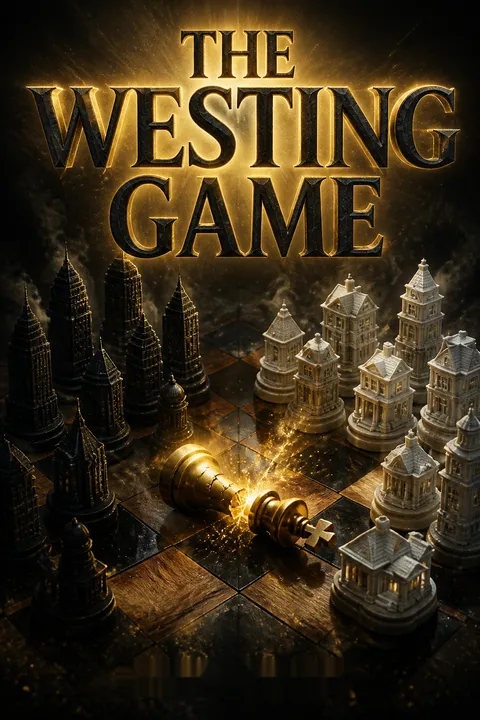


Plot Summary
The Wrong-Facing Towers
On the Fourth of July, a buck-toothed rental agent calling himself Barney Northrup persuades six carefully selected households to move into Sunset Towers, an east-facing apartment building with no actual towers. Among them are the Wexlers, the Theodorakises, the Hoos, Judge J.
J. Ford, dressmaker Flora Baumbach, secretary Sydelle Pulaski, and cleaning woman Berthe Erica Crow. The tenants bring their private hungers with them: Grace Wexler wants status, James Hoo resents a business defeat, and young Turtle Wexler hides ambition beneath her unruly manners.
By Halloween, Chris Theodorakis has seen a limping stranger enter the deserted Westing mansion, and smoke rise from its chimney. The building's carefully assembled residents have become witnesses to a mystery they do not yet know they are in.
The opening makes the apartment building both a setting and an instrument. Its mismatched name, orientation, and tenants announce that appearances will be unreliable, while the deliberate selection of residents suggests someone has arranged a human experiment. Each neighbor arrives with a social identity they hope to strengthen: Grace wants refinement, Hoo wants recognition, and Turtle wants independence. The first disturbance is not a crime but an unexplained visitor, seen by Chris, whose attention to birds and small movements gives him evidence others overlook. The mystery therefore begins in a community where people are visible to one another but rarely truly observed.
Turtle Finds the Body
Turtle accepts a bet from track star Doug Hoo and enters the Westing mansion on Halloween, expecting to earn money by staying inside. A whispered summons draws her to a bedroom, where she finds a white-bearded man lying in bed, her mother's missing silver cross between his hands. She bolts down the stairs and tells Doug what she saw, but the next morning the newspaper reports that Samuel Westing has been found dead without explaining who discovered him.
Turtle recognizes the dead man and keeps quiet about her visit, the sandwiches she dropped, and the cross. Then delivery boy Otis Amber brings letters summoning sixteen heirs to the mansion for the reading of Westing's will. The private fright has become a public inheritance mystery.
Turtle's discovery converts rumor into physical evidence, but the newspaper's version of events immediately competes with what she experienced. Her silence is not simply childish fear: she knows she entered illegally and has left traces behind, so telling the truth could expose her to consequences. The missing details in the news story deepen the uncertainty, especially because the body was supposedly found without any account of the finder. The inheritance summons expands the mystery from one girl's encounter to a group of strangers, while Turtle's secret gives her an unacknowledged connection to the house before the others arrive.
Sixteen Heirs Accused
At the will reading, the heirs see a body in an Uncle Sam costume and learn that Westing claims one of them killed him. His will divides the sixteen into eight pairs, gives each attending pair ten thousand dollars, and assigns them separate clue sets.
The winner must identify the supposed murderer and inherit Westing's fortune. Turtle is paired with Flora, Chris with intern Denton Deere, Judge Ford with doorman Sandy McSouthers, Grace with James Hoo, Crow with Otis Amber, Theo with Doug, and Angela with Sydelle.
Jake Wexler and Madame Hoo miss the meeting, leaving their pair without its money. The clues are printed on paper products, and Westing warns that the players must discover who their partners really are. No one leaves knowing whether the accusation is a genuine murder case or another of Westing's games.
Westing's rules turn suspicion into a social structure. Pairing people who would not ordinarily choose one another forces cooperation, while the shared check makes trust financially risky. The absent pair demonstrates that participation itself has a cost, and the clue scraps make ordinary objects carry institutional authority. Most unsettling is the instruction to discover each other's real identities: the game challenges not just what the heirs know, but the labels they use to understand one another. Their occupations, reputations, and family roles become provisional, and the accusation of murder gives every interaction a second, potentially incriminating meaning.
Snowbound Clue Hunters
A blizzard cuts off Sunset Towers, and the heirs work their clues behind apartment doors while Turtle sells handmade candles to her frightened neighbors. Some clues seem to point toward people, others toward stocks, and no pair can tell which interpretation is sound.
Turtle invests her and Flora's money in companies suggested by their scraps, confident that the market will reveal Westing's intention. Sydelle and Angela make the rounds, hoping to combine what they have heard, but someone steals Sydelle's shorthand notebook, which contains her copy of the will.
At a crowded party hosted by Judge Ford, Angela retreats from her mother's plans and weeps in the kitchen, where Crow quietly comforts her. Meanwhile Sydelle's attempts to provoke talk of twins bring little clarity, though the gathering exposes how much each heir has mistaken a neighbor's appearance for character.
The storm makes the building a closed social system: the heirs cannot escape one another, yet they still guard information as though isolation could protect them. Turtle's stock-market theory translates the game into action and risk, revealing her appetite for competence in a household that treats her as a nuisance. Sydelle's stolen notes show how badly the group wants certainty, but the party exposes a different kind of knowledge: Angela's private distress becomes legible only when Crow offers care without demanding a clue in return. The scene contrasts evidence gathered for advantage with attention given generously, a distinction the game will repeatedly test.
The Coffee Shop Blast
Theo calls the heirs together in the Theodorakis coffee shop, hoping that pooled clues will reveal a single message. Sydelle admits she wrote her notes in Polish shorthand, and James Hoo returns her notebook, explaining that he found it in his restaurant rather than stealing it.
The group still cannot agree to share clues; Judge Ford cautions them against treating reluctance as proof of guilt. Then cans of tomato sauce explode in the kitchen, covering Catherine Theodorakis and the room in red splatter.
The tenants mistake the mess for blood before realizing that no one has been seriously hurt. The police and fire inspector call it a gas accident. The heirs leave with a new fear, a damaged business, and no official confirmation that anyone is planting bombs.
The first explosion makes the game's metaphorical violence briefly look literal. Red sauce imitates blood, so the tenants experience how readily fear supplies a story before evidence does. Their response also reveals competing habits: Theo seeks collective reasoning, Hoo protects his own interpretation, and Ford insists on a distinction between suspicion and proof. Sydelle's notebook, meanwhile, is neither the transparent key the others imagine nor a wholly private possession. The incident cannot settle what is happening, but it changes the cost of uncertainty. From this point, every unexplained accident may be either ordinary failure or deliberate warning.
Fireworks in Hoo's Kitchen
With the coffee shop closed for repairs, James Hoo opens his nearly empty restaurant to the tenants, and Grace takes charge of seating. A timed firework hidden among the kitchen supplies detonates while everyone is dining.
Hoo is soaked by the sprinkler system, but Sydelle Pulaski is struck by the blast and carried to hospital with a fractured ankle. The authorities again describe the event as an accident, though the heirs now recognize the pattern. Angela stays beside Sydelle at the hospital rather than obeying her mother's expectation that she return to her fiancé.
The episode gives the secretary the attention she has long craved, but it also turns her performed disability into a real injury. The tenants' suspicions intensify, while the official explanation continues to leave them on their own.
The second blast makes harm undeniable without making its source knowable. Sydelle's injury is especially complicated because she had already staged a limp to attract notice; the real fracture does not erase the loneliness that motivated her deception, but it changes how others must respond to her. Angela's decision to accompany her friend marks a quiet break from her mother's control. The authorities' repeated accident explanation further isolates the residents, leaving them to interpret danger without reliable public validation. Suspicion now has a practical function: it is how the tenants try to protect one another, even as it risks making every neighbor seem guilty.
Angela's Bridal Shower Bomb
At Angela's bridal shower, the guests surround her with gifts chosen to prepare a doctor's wife for domestic entertaining. Turtle kneels to inspect a tall package, but Angela yanks it toward herself just before its hidden fireworks detonate.
The blast burns Angela's hands and cuts her cheek; Turtle is spared. In hospital, Angela cannot remember the moment clearly, and Sydelle pretends to sleep while recognizing that her gentle partner was the bomber. Turtle understands that Angela may have acted to protect her and begins guarding the secret.
The attack also sharpens Angela's unease about a marriage and future chosen largely by Grace. Her injury is physical, but the interrupted bridal ritual leaves her with a chance to question the obedient role everyone expects her to accept.
The explosion makes Angela's apparent perfection materially costly: she takes the blast meant to reach Turtle, then lies in a hospital bed with a scar that cannot be polished away. Her protective action complicates the idea that she is merely passive, while the bomb itself suggests a desperate attempt to disrupt a life arranged by others. Sydelle's recognition creates an ethical problem, not just a clue: exposing Angela could bring punishment, but concealing the truth leaves a dangerous pattern unexplained. The bridal gifts, symbols of a predetermined domestic future, become the setting for Angela's first unmistakable act of choice.
The Elevator's Fourth Bomb
Judge Ford investigates the heirs' histories and uncovers their links to Westing: James Hoo once sued him, George Theodorakis loved Westing's daughter Violet, and Sandy lost his mill job after organizing workers. Judge Ford suspects Crow may be connected to the old Westing family, while Theo's attempt to decode a chemical formula points him toward Otis.
Chris receives experimental medical treatment and gains steadier control of his movements. Then a firework rigged in the elevator blasts past Theo and burns five inches from Turtle's braid.
Turtle claims responsibility, although she planted the elevator fireworks only to divert suspicion from the earlier attacks. She also admits entering Westing's house, allowing Judge Ford to hear about the body and consider whether it was a wax dummy. Turtle's loyalty now places her in the game's legal crosshairs.
Investigation produces both genuine connections and seductive misreadings. The heirs' pasts touch Westing in different ways, but the chemical clue's apparent solution is not yet reliable, and the judge's concern for Crow risks becoming another premature conclusion. Chris's treatment offers a counterpoint to the puzzle: practical care can improve a life without pretending to solve every uncertainty. Turtle's false confession is the clearest expression of her loyalty to Angela, but it also repeats the book's central danger: a convincing appearance can misdirect an entire community. Her account of the corpse finally makes the question of Westing's death concrete enough to challenge the premise of the game.
Every Answer Fails
At the next meeting, each pair offers an answer: some name the lawyer, some give a sum of money, and Chris argues that Westing wanted the heirs to help one another. Sydelle and Angela arrange the fragments into the words of America the Beautiful, then identify the missing words as Berthe Erica Crow's name.
Crow accepts that she is the answer, not that she murdered anyone, and offers half her inheritance to Otis for the soup kitchen and half to Angela. Before the promised winner is announced, Sandy drinks from the flask Crow has filled and collapses.
Doctor Sikes cannot save him. Because Crow has served the drink and the will has named her, suspicion swings toward her, and she is arrested. The heirs are left with a solved word puzzle and a death they cannot explain.
The song transforms scattered clues into a name, but the apparent solution is morally incomplete. Crow's willingness to accept the answer and redirect the money toward others resists the game's competitive logic, yet the others still confuse being named with being guilty. Sandy's sudden death makes that error dangerous: the crowd's desire for closure presses a person into the role the puzzle has prepared for her. The scene separates three questions that the heirs have treated as one: who fits the clues, who caused a death, and what Westing intended. The book's suspense depends on their failure to keep those questions distinct.
Turtle Puts Westing on Trial
At Judge Ford's makeshift hearing, Turtle calls witnesses to reconstruct the mystery. Chris identifies the limping visitor to the Westing house as Dr. Sikes, and Otis Amber reveals he is a private investigator hired by Westing, Barney Northrup, and Judge Ford.
Turtle establishes that the body she saw may have been a wax figure and that Sandy showed signs of a fatal heart condition, not poisoning by Crow. She then argues that Sandy was Samuel Westing in disguise, using false teeth, a damaged appearance, and a medicine-filled flask.
Westing had not been murdered; his life had been taken in the figurative sense when he assumed Sandy's identity. The coroner confirms a natural death, Crow is released, and the heirs see that their hunt for a killer was built on a false premise.
Turtle's trial is an act of interpretation rather than a conventional prosecution. She gathers fragments that others dismissed, then tests whether the original premise can survive scrutiny. Her willingness to distinguish a wax body, a staged identity, and a real death shows a new form of maturity: she no longer treats cleverness as winning a contest but as finding the right question. The reveal also reframes Westing's language without making it harmless. He engineered confusion and used the heirs as pieces, yet his apparent murder was a constructed puzzle, not an actual crime. Crow's release depends on evidence replacing the social appetite to blame her.
The Fourth Identity
The final will reveals that Sam Westing was born Windy Windkloppel and distributes Sunset Towers, modest checks, and special payments rather than the fortune the heirs expected. Westing's fireworks then ignite the mansion, turning his elaborate Fourth of July tradition into a final public spectacle.
The next morning, Turtle follows the clue about finding the fourth identity: Westing, Barney Northrup, and Sandy McSouthers point toward the directions west, north, and south.
She visits Julian Eastman, chairman of Westing Paper Products, and recognizes him as Sandy beneath a new face and name. By identifying the fourth identity, Turtle wins the game. She keeps the discovery private, accepting not only the prize but a continuing relationship with the man who has tested her mind.
The final identity turns the puzzle's geography into a method: the names are not merely disguises but directional instructions. Turtle wins because she combines details others treated separately, including the fake teeth, the different faces, and the clue about a fourth person. Yet her silence afterward matters as much as her solution. She does not use the discovery to claim public dominance or expose Westing's vulnerability; she preserves a private bond built through the game. The mansion's destruction closes the old stage, while the inheritance's smaller-than-promised rewards expose the gap between monetary victory and the more durable forms of connection the players have acquired.
A Game Passed On
The heirs receive shares in Sunset Towers, while Crow and Otis marry and use their inheritance to expand the soup kitchen. Angela postpones marriage, returns to college, and eventually becomes a doctor; she and Denton later marry.
Grace and Jake repair their marriage, and Grace turns her social ambition toward running restaurants. Flora becomes the affectionate adult Turtle calls Baba, while Chris's treatment allows him to study and pursue ornithology. Years later, Doug wins Olympic gold, Theo writes, and Judge Ford advances in her legal career.
As Julian Eastman nears death, Turtle tells him how the others have fared and stays with him through his final morning. She then returns to her Saturday chess game with her niece Alice, carrying the game forward without surrendering its secrets.
The ending measures inheritance less by the fortune Westing withheld than by what the neighbors make possible for one another. Hoo's invention and Grace's restaurant career give ambition practical outlets; Chris receives treatment and education; Angela chooses medicine over the marriage expected of her. Turtle's affection for Baba and her private chess lessons show that chosen kinship can outlast the apartment building that first assembled the group. Eastman's death closes the cycle without resolving it into a public legend, because Turtle protects the secret. The final game with Alice makes inheritance an act of transmission: knowledge, attention, and play pass to the next generation.
Analysis
The Westing Game treats mystery as a problem of perception before it treats it as a problem of evidence. The heirs arrive already sorted by class, race, occupation, age, disability, and family reputation, and these categories shape what they believe about one another. A limping secretary seems fraudulent, an eccentric delivery boy seems stupid, and a cleaning woman seems sinister. The game exploits those shortcuts, then forces the players to discover that social legibility is not the same as truth.
Westing's clues make absence active. The players are instructed to notice what they do not have, and their failures often arise because they force fragments into a story that confirms their existing suspicions. The puzzle's solution identifies Crow, but the group's mistake is treating a name as proof of guilt. Turtle's later hearing corrects that error by returning to physical details, testing assumptions, and separating a staged death from a real one. Her intelligence is not simply a talent for riddles; it becomes an ethical practice, a refusal to sacrifice a person for a satisfying answer.
The novel also contrasts inheritance as property with inheritance as care. The heirs expect two hundred million dollars, but their deeper gains come through relationships: Flora becomes a source of maternal tenderness for Turtle, Denton learns to treat Chris as a partner, and Angela begins to choose a life beyond her mother's design. Westing's manipulations are not absolved by these outcomes. He subjects vulnerable people to danger and suspicion, and the game repeatedly risks turning play into coercion. Yet its paired structure creates unlikely contact, making the players confront neighbors they once ignored.
Turtle's final success depends on combining analytical rigor with attachment. She sees what the others miss because she has watched people closely, not because she stands outside their needs. The closing chess game passes this habit to another child. The inheritance that lasts is not a fortune or a solved puzzle, but a way of attending to people without mistaking their roles for their whole selves.
Review Summary
The Westing Game is a beloved children's mystery novel that has captivated readers for decades. Many praise its clever puzzles, diverse characters, and intricate plot twists. Readers appreciate the book's ability to engage both children and adults, with its witty humor and complex mystery. Some find the narrative style challenging, with frequent perspective shifts and dated language. While most reviewers highly recommend it, a few criticize its confusing plot and outdated elements. Overall, it remains a cherished classic that continues to surprise and delight readers of all ages.
People Also Read







Characters
Tabitha-Ruth Wexler
Restless young strategistKnown as Turtle, she is Grace and Jake Wexler's younger daughter, a sharp-minded junior high student who kicks shins when she feels cornered. Her interest in money and puzzles gives her an independent life inside a family that favors her more polished sister. Turtle often disguises vulnerability as defiance, but she is fiercely loyal and unusually observant. She notices details adults overlook and learns to test conclusions rather than accept the first clever answer. Her relationship with Flora Baumbach gives her a form of affection she rarely receives at home, while the Westing game gives her a demanding arena in which intelligence, courage, and self-command can grow together.
Samuel Westing
Mysterious paper magnateA wealthy industrialist whose deserted mansion and eccentric will shape the lives of Sunset Towers' residents. Westing built a paper-products empire and became famous for elaborate Fourth of July pageants, chess, and a public image of discipline. His daughter Violet's troubled history shadows the inheritance game, while his repeated emphasis on play suggests that he sees people as both opponents and pieces. The heirs know him first through rumors, newspaper reports, and legal documents, so they must decide whether to regard him as a benefactor, a manipulator, or something less easily classified.
Angela Wexler
The perfect daughterGrace and Jake's elder daughter is admired for her beauty, composure, and helpfulness. Engaged to intern Denton Deere, Angela has been trained to make other people comfortable and to accept the future her mother has planned for her. Her careful embroidery and quiet manner conceal uncertainty about what she wants beyond being a bride. She is perceptive and compassionate, especially with Chris and Sydelle, but often hesitates to act for herself because she fears disappointing her family. Angela's partnership with Sydelle and growing friendship with Theo place her in situations where obedience is no longer the same as kindness.
Theo Theodorakis
A brother with ambitionsTheo is a high school senior who works in his family's coffee shop and hopes to become a writer. He loves his younger brother Chris, yet feels the strain of being treated as Chris's caretaker and giving up college to help pay for medical treatment. His intelligence shows in his interest in chess and his persistence with the clues, though his first interpretations are not always correct. Theo's quiet attraction to Angela grows alongside his responsibility to his family. He wants a life of his own, but his empathy keeps him attentive to the costs that his choices might place on others.
Chris Theodorakis
The watchful bird studentTheo's fifteen-year-old brother uses a wheelchair and lives with a progressive condition that affects his speech and movement. He is a devoted bird-watcher whose patience lets him notice small details, including a limping visitor near the Westing house. Chris dislikes being treated as an infant or reduced to his disability; he wants conversation, meaningful work, and companions who will take his ideas seriously. His bond with Theo is loving but complicated by his brother's fatigue and guilt. Chris's partnership with Denton gives him a chance to participate in the game as an equal rather than as someone being managed.
Flora Baumbach
A patient dressmakerA gentle, round-shouldered dressmaker who lives and works in Sunset Towers. Flora makes Angela's wedding gown and approaches neighbors with a kindness that can look like timidity. Her cheerful manner conceals grief for Rosalie, her daughter, and years of loneliness after her husband left. Flora does not force affection or demand that others perform gratitude; she offers steady care through practical gestures, careful sewing, and patient listening. Her partnership with Turtle draws out both women's capacity for attachment, allowing Flora to mother again and Turtle to accept tenderness without having to earn it through achievement.
Judge J. J. Ford
The disciplined investigatorA respected Black woman judge who lives at Sunset Towers and has spent her life earning authority in institutions that rarely offered it freely. Ford values evidence, self-control, and professional distance, yet Westing's game unsettles her confidence because it touches her childhood and her debt to his influence. She investigates the heirs with a judge's attention to records and motive, while trying to protect people she believes may be in danger. Her partnership with Sandy tests her instinct to control a case through reason alone. Beneath her severity is a capacity for care she does not easily show.
Berthe Erica Crow
The devout cleaning womanCrow works as the building's cleaning woman and leads a soup kitchen for people living in poverty. She dresses in black, speaks in religious terms, and carries the weight of a difficult past with sternness that others mistake for hostility. Her faith gives shape to her efforts at sobriety and service, but it can also make her see suffering as deserved punishment. Crow rarely explains herself, which leaves neighbors to project guilt or menace onto her. Her quiet bond with Angela shows a gentler instinct, while her partnership with Otis reveals that she is not as isolated as she appears.
Grace Windsor Wexler
The aspiring social climberGrace is the Wexler family's image-conscious mother, intent on a stylish home, a prestigious address, and a successful marriage for Angela. She presents herself as a decorator and assumes she will inherit Westing's fortune, but her confidence often rests on appearances and wishful family history. Grace favors Angela's conventional beauty and struggles to understand Turtle's stubborn independence. Her social ambition can make her vain and dismissive, yet she is not without warmth or the capacity to reconsider herself. Her marriage to Jake has been strained by status anxiety and unspoken resentments that the game brings into view.
Jake Wexler
The genial family doctorA podiatrist and father of Angela and Turtle, Jake is practical, humorous, and more accepting of people than his wife can be. He keeps a private bookmaking business, a secret that complicates his respectable professional identity. Jake recognizes that Grace's ambitions and the girls' needs have left their marriage strained, but he often avoids confrontation until a crisis forces honesty. His easy manner makes him a bridge between neighbors, including the Hoos, and his affection for his family survives their disagreements.
Sandy McSouthers
The battered doormanThe stocky, cheerful doorman greets residents, trades stories, and makes himself useful around Sunset Towers. Sandy was fired from the Westing mill and has struggled to support a large family through odd jobs and boxing. His broken nose, taped glasses, and quick willingness to flatter the powerful make him seem harmless, but he listens closely to the tenants and understands how to keep a conversation moving. He wants security for his family and a little dignity after years of being pushed aside. His easy humor often masks a sharp awareness of how people judge one another.
Otis Amber
The eccentric delivery boyOtis is a sixty-two-year-old delivery boy with an aviator's helmet, a bicycle, and a taste for spooky stories. The tenants dismiss him as foolish, and he encourages their assumptions with exaggerated antics. He is often seen carrying letters or groceries, but he also spends time with Crow and helps her soup kitchen. Otis's apparent simplicity makes him easy to underestimate; his role in the building's life depends on moving between residents without drawing much scrutiny. His loyalty to Crow is deeper than his comic manner first suggests.
Sydelle Pulaski
The overlooked secretaryA secretary who has spent decades being overlooked, Sydelle moves into Sunset Towers hoping to find a more elegant social life. She wears conspicuous glasses and jewelry, invents a muscular illness, and uses painted crutches to make people notice her. Her deception is comic, but its source is painfully ordinary: loneliness and the wish to matter to someone. Sydelle is observant, ambitious, and capable of clever work, including her shorthand record of Westing's will. Her partnership with Angela gives her the companionship she wants, while also forcing her to see that attention gained through performance is not the same as intimacy.
James Shin Hoo
The resentful inventorJames Hoo owns an expensive Chinese restaurant that struggles to attract customers. He once challenged Westing over the disposable diaper and believes the settlement left him cheated. Hoo is irritable, proud, and quick to judge his son Doug, whom he pushes toward study and discipline. His appetite and business worries reveal a man who feels repeatedly denied the recognition he deserves. Despite his suspicion of others, he has an inventive streak and a practical interest in improving everyday products.
Madame Sun Lin Hoo
A homesick new arrivalJames Hoo's much younger second wife, Sun Lin came to the United States from Hong Kong and speaks little English. She is quiet in the restaurant and longs for China, where her childhood memories remain vivid. Other tenants often treat her silence as evidence that she cannot understand them, but she learns words quickly when people speak to her with patience. Her relationship with Jake offers a rare exchange without condescension. Sun Lin's private attachments, including treasured keepsakes, show how migration can make familiar objects carry the weight of home.
Doug Hoo
The driven track starJames Hoo's son is a high school runner whose athletic ability has earned him serious prospects. Doug values training, competition, and physical achievement, and he initially treats the Westing game as a distraction from the track. His teasing of Turtle can be cruel, though it also reflects the careless confidence of a teenager accustomed to winning. He is ambitious but not wholly self-centered; his partnership with Theo and his family's expectations force him to consider what kind of success he wants.
D. Denton Deere
The ambitious young internDenton is a hospital intern engaged to Angela and eager to establish himself as a doctor. He likes to diagnose and display expertise, sometimes speaking with more certainty than his experience warrants. His schedule and ambition leave little room for Chris at first, but the game makes him confront what partnership requires beyond sharing money. Denton is not a villain; he is a young professional still learning to distinguish competence from authority, and to ask Angela what she wants rather than assuming her future will follow his.
Edgar Jennings Plum
The nervous estate lawyerPlum is the young attorney appointed to administer Westing's unusual will. His throat-clearing, fumbling papers, and uncertainty make the heirs question why he was entrusted with an estate of such scale. He follows the instructions he has been given, though he often cannot explain their purpose. His awkward presence becomes part of the game's theater, reinforcing the sense that even its legal machinery may be an act.
Dr. Sidney Sikes
The Westing family doctorSikes was Westing's friend, physician, and a witness to the will. He is associated with the old automobile accident that injured both men and later appears in the mystery surrounding the mansion. His limp and medical authority make him a consequential but elusive figure. Sikes represents the boundary between trustworthy expertise and information withheld for a larger purpose.
Julian R. Eastman
The paper company chairmanEastman is the polished chairman of Westing Paper Products, a powerful executive whose public life contrasts with the humble origins attributed to the company's founder. His business position connects the inheritance mystery to the paper empire at its center. He appears distant and formal, yet the book's final movement invites a closer look at what a public identity can conceal.
Violet Westing
The absent Westing daughterViolet is Samuel Westing's only daughter, remembered through newspaper reports, old photographs, and the people who knew her. She was engaged to marry a politician but had once loved George Theodorakis. Her death before the wedding casts a long shadow over the Westing family and helps explain why the past remains active in the tenants' present.
Plot Devices
The Westing inheritance game
Turns neighbors into rivalsWesting's will divides sixteen heirs into pairs, gives each attending pair ten thousand dollars, and assigns them a separate set of clues. Each pair must submit an answer, but the rules withhold the documents that would explain what the clues mean. The game pressures people to cooperate with partners they did not choose while suspecting every other tenant. It also transforms ordinary details, including names, occupations, and scraps of household paper, into possible evidence. The device drives the plot while testing whether competition will make the heirs less perceptive or more attentive to one another.
Clue fragments and the song
Makes absence meaningfulThe heirs receive words printed on Westing paper products, including fragments that seem to point toward people, stocks, or locations. Their difficulty is not simply solving an anagram: the clues can be misleading when read alone, and the will emphasizes that what is missing matters as much as what is present. As the pairs compare scraps, the fragments align with the patriotic song America the Beautiful. The resulting pattern supplies a name, but naming someone does not establish that person committed a crime. This device turns reading itself into a test of patience, context, and the difference between a correct pattern and a correct accusation.
The striped candles
Turn games into timed dangersTurtle makes candles whose colored bands mark time, then sells them to neighbors during the blizzard. The simple homemade objects return in the explosions, where a candle can serve as a fuse for fireworks hidden in kitchens, a gift box, or an elevator. Because the tenants have already seen Turtle selling them, the candles create a trail of possible explanations without immediately identifying a culprit. They connect her entrepreneurial streak to the physical danger inside the building and allow small pranks to escalate into attacks that injure residents.
Invented identities
Make appearances unreliableFrom the false rental agent to the doorman and delivery boy, the novel repeatedly encourages residents to judge people by the roles they perform. Westing's history of acting in elaborate Fourth of July pageants prepares the reader to question names and faces, while false teeth, altered appearances, and occupations become relevant clues. The device works on both plot and character: the heirs have to reconsider who their neighbors are, but they also have to confront how quickly they dismiss people as foolish, weak, or unimportant. Its final meaning depends on details introduced much earlier.
The stock market
Measures risk in real timeTurtle and Flora interpret their clue set as stock symbols and invest their ten thousand dollars. Their holdings fall sharply before Turtle redirects the money into Westing Paper Products, which rises in value. The stock market makes the game's financial stakes visible in daily price changes, but it also gives Turtle a practical arena where she can make decisions and learn from losses. Her investments do not independently solve the murder puzzle; instead, they reveal her discipline, Flora's trust in her, and the gap between the fortune promised by the will and the smaller sum the heirs actually receive.
FAQ
Synopsis & Basic Details
What is The Westing Game about?
- Intriguing Inheritance Game: The Westing Game centers around sixteen individuals, all tenants of Sunset Towers, who are unexpectedly named as potential heirs in the will of the eccentric millionaire Samuel W. Westing.
- Murder Mystery Unfolds: The will reveals that Westing believes he was murdered by one of the heirs, setting off a complex game where the heirs are paired and given clues to solve the mystery and win his fortune.
- Secrets and Deception: As the game progresses, the heirs uncover secrets about each other and Westing, leading to a web of suspicion, alliances, and betrayals, all while trying to decipher the cryptic clues.
Why should I read The Westing Game?
- Engaging Mystery Plot: The book offers a compelling mystery with twists and turns that keep readers guessing until the very end, making it a page-turner for mystery enthusiasts.
- Complex Character Dynamics: The diverse cast of characters, each with their own unique personalities and motivations, creates a rich tapestry of relationships and conflicts that are both entertaining and thought-provoking.
- Themes of Identity and Justice: Beyond the mystery, the novel explores deeper themes of identity, prejudice, and the search for justice, making it a story that resonates with readers on multiple levels.
What is the background of The Westing Game?
- Post-Industrial Setting: The story is set in a fictional town called Westingtown, which is heavily influenced by the paper industry founded by Samuel Westing, reflecting a post-industrial American landscape.
- Social Commentary: The diverse group of characters, including immigrants, minorities, and people from different social classes, provides a commentary on American society and its complexities in the late 20th century.
- Game Theory Influence: The structure of the plot, with its clues, pairings, and strategic elements, suggests an influence from game theory, adding a layer of intellectual engagement to the narrative.
What are the most memorable quotes in The Westing Game?
- "It is not what you have, it's what you don't have that counts.": This quote, a recurring theme in the will, highlights the importance of looking beyond the obvious and considering what is missing or hidden, a key to solving the mystery.
- "The solution is simple if you know whom you are looking for.": This quote emphasizes the importance of understanding the characters and their motivations, suggesting that the answer lies in the people rather than the clues themselves.
- "May God thy gold refine.": This quote, a seemingly religious phrase, is actually a reference to a line from "America the Beautiful," subtly hinting at the patriotic and American themes woven into the story.
What writing style, narrative choices, and literary techniques does Ellen Raskin use?
- Multiple Perspectives: Raskin employs a shifting third-person point of view, allowing readers to see the story through the eyes of various characters, creating a sense of mystery and suspense as each character's thoughts and actions are revealed.
- Foreshadowing and Red Herrings: The narrative is filled with subtle foreshadowing and red herrings, which mislead the reader and create a sense of uncertainty, making the mystery more engaging and challenging to solve.
- Wordplay and Puzzles: Raskin uses wordplay, puzzles, and cryptic clues as central elements of the plot, encouraging readers to actively participate in solving the mystery alongside the characters, adding an interactive dimension to the reading experience.
Hidden Details & Subtle Connections
What are some minor details that add significant meaning?
- The One-Way Glass: The one-way glass in Sunset Towers, initially presented as a luxury, symbolizes the characters' isolation and the hidden nature of their lives, as they can observe others without being seen, reflecting the theme of secrets.
- The Color Purple: The recurring motif of the color purple, particularly in Sydelle Pulaski's attire and the "purple waves" clue, foreshadows her connection to the mystery and her role as a key observer, adding a layer of symbolic depth.
- The Chess Game: The ongoing chess game between Theo and an unknown opponent in the game room subtly mirrors the larger game of strategy and deception being played by Westing, highlighting the theme of manipulation and control.
What are some subtle foreshadowing and callbacks?
- The "Boom!": Otis Amber's repeated "Boom!" foreshadows the explosions that occur later in the story, creating a sense of unease and hinting at the danger lurking beneath the surface of the seemingly harmless game.
- The Missing Cross: The disappearance of Grace Wexler's silver cross, which later appears on Westing's corpse, foreshadows the connection between the Wexler family and the mystery, adding a layer of intrigue and suspicion.
- The "Purple Waves": The phrase "purple waves," initially dismissed as nonsense, becomes a crucial clue, connecting Sydelle Pulaski to the mystery and highlighting the importance of paying attention to seemingly insignificant details.
What are some unexpected character connections?
- Crow and Westing: The revelation that Berthe Erica Crow is Samuel Westing's ex-wife is a major twist, adding a layer of complexity to her character and highlighting the theme of hidden connections and past relationships.
- Judge Ford and Westing: The connection between Judge Ford and Westing, revealed through her past as a servant in his household and his funding of her education, adds a layer of personal history and motivation to her actions in the game.
- Theodorakis and Westing: The connection between George Theodorakis and Violet Westing, revealed through old photographs and gossip, adds a layer of tragedy and lost love to the story, highlighting the impact of Westing's actions on others.
Who are the most significant supporting characters?
- Otis Amber: As a private investigator hired by multiple parties, Otis Amber plays a crucial role in gathering information and manipulating events, making him a key player in the unfolding mystery.
- Flora Baumbach: Her gentle nature and connection to the past, particularly her knowledge of Violet Westing, make her a significant figure in the story, providing a sense of empathy and understanding amidst the chaos.
- Dr. Sidney Sikes: As Westing's friend and the county coroner, Dr. Sikes's involvement in the will and his presence at the Westing house add a layer of medical and legal intrigue to the plot, making him a key figure in the mystery.
Psychological, Emotional, & Relational Analysis
What are some unspoken motivations of the characters?
- Grace Wexler's Social Climbing: Grace's unspoken motivation is her desire for social status and wealth, which drives her actions and her treatment of her daughters, revealing her insecurities and superficiality.
- Angela Wexler's Need for Independence: Angela's unspoken motivation is her desire for independence and self-discovery, which is masked by her outward compliance and beauty, highlighting her internal conflict and struggle for autonomy.
- Theo Theodorakis's Guilt: Theo's unspoken motivation is his guilt over his brother's condition and his desire to provide for him, which drives his actions and his involvement in the game, revealing his sense of responsibility and compassion.
What psychological complexities do the characters exhibit?
- Turtle's Defensiveness: Turtle's psychological complexity is evident in her defensive behavior and her tendency to push people away, which masks her vulnerability and her need for connection, highlighting her internal struggle for acceptance.
- Sydelle's Attention-Seeking: Sydelle's psychological complexity is evident in her attention-seeking behavior and her fabricated illness, which masks her loneliness and her desire to be noticed, revealing her insecurities and need for validation.
- Judge Ford's Internal Conflict: Judge Ford's psychological complexity is evident in her internal conflict between her sense of justice and her debt to Westing, which drives her actions and her desire to uncover the truth, highlighting her moral dilemma and struggle for integrity.
What are the major emotional turning points?
- Turtle's Grief for Sandy: Turtle's emotional turning point is her grief over Sandy's death, which leads her to question the game and her own actions, revealing her capacity for empathy and her deep connection to others.
- Angela's Rejection of Marriage: Angela's emotional turning point is her rejection of her engagement, which marks her decision to take control of her own life and pursue her own path, highlighting her journey of self-discovery and independence.
- Crow's Confession: Crow's emotional turning point is her confession, which reveals her internal struggle with guilt and her desire for redemption, highlighting her journey of healing and reconciliation.
How do relationship dynamics evolve?
- Turtle and Flora's Bond: The relationship between Turtle and Flora evolves from a reluctant partnership to a genuine friendship, highlighting the importance of intergenerational connections and the power of empathy and understanding.
- The Wexler Family's Transformation: The relationship dynamics within the Wexler family evolve from superficiality and conflict to a deeper understanding and appreciation of each other, highlighting the transformative power of shared experiences and challenges.
- The Heirs' Collective Growth: The relationships among the heirs evolve from suspicion and competition to a sense of community and shared purpose, highlighting the importance of collaboration and the power of human connection in overcoming adversity.
Interpretation & Debate
Which parts of the story remain ambiguous or open-ended?
- Westing's True Motives: While the game's purpose is revealed, the true extent of Westing's motives and his feelings towards the heirs remain somewhat ambiguous, leaving room for interpretation and debate about his character.
- The Nature of the "Murder": The ambiguity surrounding whether Westing was actually murdered or if his death was a carefully orchestrated event leaves room for debate about the nature of truth and deception in the story.
- The Future of the Heirs: The ending provides a glimpse into the future of the heirs, but leaves their long-term relationships and personal journeys open-ended, allowing readers to imagine their continued growth and development.
What are some debatable, controversial scenes or moments in The Westing Game?
- Turtle's Bombing: Turtle's actions as the bomber, while presented as a way to protect her sister, are controversial, raising questions about the morality of her actions and the extent to which she is justified in her behavior.
- The Treatment of Crow: The treatment of Crow, particularly the suspicion and accusations she faces, is controversial, raising questions about prejudice and the dangers of jumping to conclusions based on appearances.
- Westing's Manipulation: Westing's manipulation of the heirs through the game is controversial, raising questions about the ethics of his actions and the extent to which he is justified in using others for his own purposes.
The Westing Game Ending Explained: How It Ends & What It Means
- Westing's Final Disguise: The ending reveals that Sandy McSouthers was Westing's final disguise, highlighting his ability to manipulate and control events even after his supposed death, emphasizing the theme of deception and hidden identities.
- Turtle as the Heir: Turtle's emergence as the true heir, not through wealth but through her understanding of Westing's game and her ability to see beyond the surface, emphasizes the importance of intelligence, empathy, and resourcefulness over material wealth.
- The Cycle of Life and Death: The ending, with its focus on the cycle of life and death, and the passing of the torch to a new generation, suggests that the game was not just about finding an heir but also about ensuring the continuation of Westing's legacy and the values he held dear.
Synopsis & Basic Details
What is The Westing Game about?
- Intriguing Inheritance Game: The Westing Game centers around sixteen individuals, all tenants of Sunset Towers, who are unexpectedly named as potential heirs in the will of the eccentric millionaire Samuel W. Westing.
- Murder Mystery Unfolds: The will reveals that Westing believes he was murdered by one of the heirs, setting off a complex game where the heirs are paired and given clues to solve the mystery and win his fortune.
- Secrets and Deception: As the game progresses, the heirs uncover secrets about each other and Westing, leading to a web of suspicion, alliances, and betrayals, all while trying to decipher the cryptic clues.
Why should I read The Westing Game?
- Engaging Mystery Plot: The book offers a compelling mystery with twists and turns that keep readers guessing until the very end, making it a page-turner for mystery enthusiasts.
- Complex Character Dynamics: The diverse cast of characters, each with their own unique personalities and motivations, creates a rich tapestry of relationships and conflicts that are both entertaining and thought-provoking.
- Themes of Identity and Justice: Beyond the mystery, the novel explores deeper themes of identity, prejudice, and the search for justice, making it a story that resonates with readers on multiple levels.
What is the background of The Westing Game?
- Post-Industrial Setting: The story is set in a fictional town called Westingtown, which is heavily influenced by the paper industry founded by Samuel Westing, reflecting a post-industrial American landscape.
- Social Commentary: The diverse group of characters, including immigrants, minorities, and people from different social classes, provides a commentary on American society and its complexities in the late 20th century.
- Game Theory Influence: The structure of the plot, with its clues, pairings, and strategic elements, suggests an influence from game theory, adding a layer of intellectual engagement to the narrative.
What are the most memorable quotes in The Westing Game?
- "It is not what you have, it's what you don't have that counts.": This quote, a recurring theme in the will, highlights the importance of looking beyond the obvious and considering what is missing or hidden, a key to solving the mystery.
- "The solution is simple if you know whom you are looking for.": This quote emphasizes the importance of understanding the characters and their motivations, suggesting that the answer lies in the people rather than the clues themselves.
- "May God thy gold refine.": This quote, a seemingly religious phrase, is actually a reference to a line from "America the Beautiful," subtly hinting at the patriotic and American themes woven into the story.
What writing style, narrative choices, and literary techniques does Ellen Raskin use?
- Multiple Perspectives: Raskin employs a shifting third-person point of view, allowing readers to see the story through the eyes of various characters, creating a sense of mystery and suspense as each character's thoughts and actions are revealed.
- Foreshadowing and Red Herrings: The narrative is filled with subtle foreshadowing and red herrings, which mislead the reader and create a sense of uncertainty, making the mystery more engaging and challenging to solve.
- Wordplay and Puzzles: Raskin uses wordplay, puzzles, and cryptic clues as central elements of the plot, encouraging readers to actively participate in solving the mystery alongside the characters, adding an interactive dimension to the reading experience.
Hidden Details & Subtle Connections
What are some minor details that add significant meaning?
- The One-Way Glass: The one-way glass in Sunset Towers, initially presented as a luxury, symbolizes the characters' isolation and the hidden nature of their lives, as they can observe others without being seen, reflecting the theme of secrets.
- The Color Purple: The recurring motif of the color purple, particularly in Sydelle Pulaski's attire and the "purple waves" clue, foreshadows her connection to the mystery and her role as a key observer, adding a layer of symbolic depth.
- The Chess Game: The ongoing chess game between Theo and an unknown opponent in the game room subtly mirrors the larger game of strategy and deception being played by Westing, highlighting the theme of manipulation and control.
What are some subtle foreshadowing and callbacks?
- The "Boom!": Otis Amber's repeated "Boom!" foreshadows the explosions that occur later in the story, creating a sense of unease and hinting at the danger lurking beneath the surface of the seemingly harmless game.
- The Missing Cross: The disappearance of Grace Wexler's silver cross, which later appears on Westing's corpse, foreshadows the connection between the Wexler family and the mystery, adding a layer of intrigue and suspicion.
- The "Purple Waves": The phrase "purple waves," initially dismissed as nonsense, becomes a crucial clue, connecting Sydelle Pulaski to the mystery and highlighting the importance of paying attention to seemingly insignificant details.
What are some unexpected character connections?
- Crow and Westing: The revelation that Berthe Erica Crow is Samuel Westing's ex-wife is a major twist, adding a layer of complexity to her character and highlighting the theme of hidden connections and past relationships.
- Judge Ford and Westing: The connection between Judge Ford and Westing, revealed through her past as a servant in his household and his funding of her education, adds a layer of personal history and motivation to her actions in the game.
- Theodorakis and Westing: The connection between George Theodorakis and Violet Westing, revealed through old photographs and gossip, adds a layer of tragedy and lost love to the story, highlighting the impact of Westing's actions on others.
Who are the most significant supporting characters?
- Otis Amber: As a private investigator hired by multiple parties, Otis Amber plays a crucial role in gathering information and manipulating events, making him a key player in the unfolding mystery.
- Flora Baumbach: Her gentle nature and connection to the past, particularly her knowledge of Violet Westing, make her a significant figure in the story, providing a sense of empathy and understanding amidst the chaos.
- Dr. Sidney Sikes: As Westing's friend and the county coroner, Dr. Sikes's involvement in the will and his presence at the Westing house add a layer of medical and legal intrigue to the plot, making him a key figure in the mystery.
Psychological, Emotional, & Relational Analysis
What are some unspoken motivations of the characters?
- Grace Wexler's Social Climbing: Grace's unspoken motivation is her desire for social status and wealth, which drives her actions and her treatment of her daughters, revealing her insecurities and superficiality.
- Angela Wexler's Need for Independence: Angela's unspoken motivation is her desire for independence and self-discovery, which is masked by her outward compliance and beauty, highlighting her internal conflict and struggle for autonomy.
- Theo Theodorakis's Guilt: Theo's unspoken motivation is his guilt over his brother's condition and his desire to provide for him, which drives his actions and his involvement in the game, revealing his sense of responsibility and compassion.
What psychological complexities do the characters exhibit?
- Turtle's Defensiveness: Turtle's psychological complexity is evident in her defensive behavior and her tendency to push people away, which masks her vulnerability and her need for connection, highlighting her internal struggle for acceptance.
- Sydelle's Attention-Seeking: Sydelle's psychological complexity is evident in her attention-seeking behavior and her fabricated illness, which masks her loneliness and her desire to be noticed, revealing her insecurities and need for validation.
- Judge Ford's Internal Conflict: Judge Ford's psychological complexity is evident in her internal conflict between her sense of justice and her debt to Westing, which drives her actions and her desire to uncover the truth, highlighting her moral dilemma and struggle for integrity.
What are the major emotional turning points?
- Turtle's Grief for Sandy: Turtle's emotional turning point is her grief over Sandy's death, which leads her to question the game and her own actions, revealing her capacity for empathy and her deep connection to others.
- Angela's Rejection of Marriage: Angela's emotional turning point is her rejection of her engagement, which marks her decision to take control of her own life and pursue her own path, highlighting her journey of self-discovery and independence.
- Crow's Confession: Crow's emotional turning point is her confession, which reveals her internal struggle with guilt and her desire for redemption, highlighting her journey of healing and reconciliation.
How do relationship dynamics evolve?
- Turtle and Flora's Bond: The relationship between Turtle and Flora evolves from a reluctant partnership to a genuine friendship, highlighting the importance of intergenerational connections and the power of empathy and understanding.
- The Wexler Family's Transformation: The relationship dynamics within the Wexler family evolve from superficiality and conflict to a deeper understanding and appreciation of each other, highlighting the transformative power of shared experiences and challenges.
- The Heirs' Collective Growth: The relationships among the heirs evolve from suspicion and competition to a sense of community and shared purpose, highlighting the importance of collaboration and the power of human connection in overcoming adversity.
Interpretation & Debate
Which parts of the story remain ambiguous or open-ended?
- Westing's True Motives: While the game's purpose is revealed, the true extent of Westing's motives and his feelings towards the heirs remain somewhat ambiguous, leaving room for interpretation and debate about his character.
- The Nature of the "Murder": The ambiguity surrounding whether Westing was actually murdered or if his death was a carefully orchestrated event leaves room for debate about the nature of truth and deception in the story.
- The Future of the Heirs: The ending provides a glimpse into the future of the heirs, but leaves their long-term relationships and personal journeys open-ended, allowing readers to imagine their continue
Download PDF
Download EPUB
.epub digital book format is ideal for reading ebooks on phones, tablets, and e-readers.








