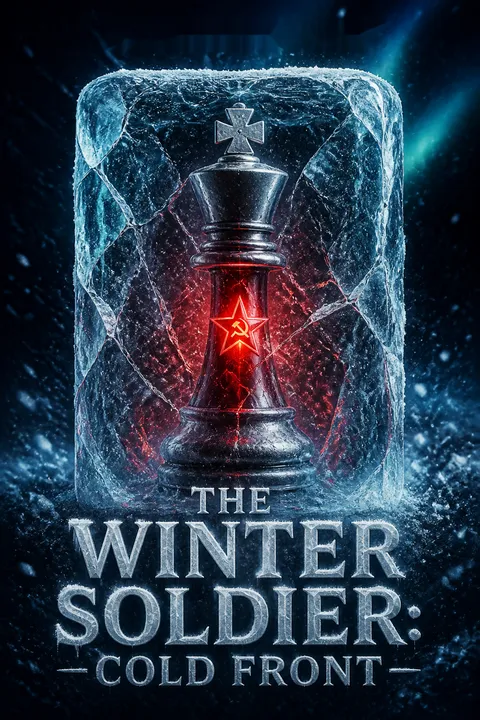


Plot Summary
Prologue
A nameless man2 wakes under blinding lights, his body cold and unfamiliar, one arm replaced by metal. Masked doctors ask who he is while drugs and memories collide inside him. He remembers falling through ice, but not the life that came before it.
When he finally admits he cannot name himself, the doctors welcome the answer as success. The opening leaves him suspended between survival and erasure, while the machinery around him begins another attempt to make his body serve a purpose.
The prologue makes memory loss physical before it makes it political. Cold, restraint, pain, and the strange hand give the reader a body to inhabit, while the missing name shows how thoroughly identity can be treated as a defect to correct. The doctors’ approval turns a human admission into a technical milestone. That inversion establishes the book’s central conflict: the institution sees a functioning weapon where the person inside experiences bewilderment and grief. The frozen water also anticipates a repeated pattern in which survival is mistaken for consent.
The Soldier’s Ghost Story
In 1954, Soviet operative Vronsky2 helps his handler, Rostova,4 interrogate Alexander Fedorov,12 a British spy caught undercover in Russia. Fedorov12 denies knowing his assignment, but Rostova’s4 pressure finally draws out a rumor about the Winter Soldier,2 an assassin2 said to be loyal beyond reason. Vronsky2 appears at the prisoner’s12 side, making the story terrifyingly concrete.
He cannot get a contact name, yet Fedorov12 repeats a phrase that sounds like Vida Metropole. Rostova4 dismisses it as too little to use. Vronsky2 insists the clue matters, and that stubbornness carries them toward a hotel in Riga and an operation that will unsettle everything he believes about himself.
The scene introduces Vronsky as both the object of a legend and a person with an unrecognized capacity for judgment. Fedorov’s terror confirms the power of the Soviet myth, but Vronsky’s attention to the failed interrogation’s leftover clue separates him from a merely obedient instrument. Rostova’s brisk dismissal reflects the pressure of intelligence work, where incomplete information often becomes expendable. His insistence is not yet rebellion; it is a small act of interpretation. The distinction matters because the story’s larger struggle begins when Vronsky treats his own perceptions as evidence rather than noise.
Bucky Wants the War
In 1941, sixteen-year-old James Barnes, called Bucky,1 lives near Camp Lehigh and wants to join the Army before he is old enough. Commander Nicholas Crawford,5 his late father’s closest friend and Bucky’s guardian,5 catches him running a library-coded delivery service for soldiers who want liquor, candy, and pinups.
Crawford5 closes the operation and directs the profits into defense bonds. Later, Bucky1 punches a classmate13 who mocks his schooling and questions his place at camp.
The resulting confrontation brings an unexpected visitor: Mr. Yesterday,9 a British intelligence recruiter seeking young Americans for covert work in Europe. Bucky’s1 languages, ingenuity, and hunger for action make him an unusually compelling candidate, despite Crawford’s5 warnings about the risks.
Bucky’s smuggling system is more than teenage mischief: it shows a mind that finds order, codes, and practical solutions where school has left him feeling deficient. His wish to enlist mixes patriotism with a need to prove that he matters. Crawford sees the danger in that mixture, especially because Bucky treats restraint as rejection. Their bond gives the recruitment scene emotional weight: the man trying to protect Bucky is also the one whose approval he most wants. The SOE offer appears to answer his restlessness, but its danger is hidden inside the very qualities that make him attractive to recruiters.
A Clue Becomes an Order
After the interrogation, Vronsky2 undergoes a routine medical exam and notices that the nurse is preparing something beyond ordinary treatment. Rostova4 interrupts a procedure she identifies as a blank-slate measure, then gets him to briefing before it can continue. Colonel Karpov6 explains that Fedorov12 meant the Hotel Metropole in Riga, where an MI5 contact expects a meeting.
The contact’s file lists Project Fugue, a detail that stirs an unfamiliar recognition in Vronsky.2 He blurts out the name Edward Fleming,10 then cannot explain where it came from. Karpov6 calls the lapse a sign of compromise but allows the mission to proceed. He gives Vronsky2 pills to keep him operational and orders him to replace Fedorov12 at the meeting.
The medical examination turns the body into a contested site: Vronsky is accustomed to procedures but begins to register that routine may conceal coercion. His unexplained naming of Edward Fleming is the first visible crack between his assigned identity and an older self. Karpov responds by tightening control, not investigating the memory, while Rostova intervenes just enough to preserve the mission. The pills embody this ambiguity. They are presented as support, yet their compulsory use makes care indistinguishable from management. Each institution claims to know what Vronsky needs, leaving his own account of himself almost irrelevant.
The Chessboard Turns Bloody
At a London chess tournament, Bucky1 sits opposite a sharp-tongued player who calls herself Gimlet3 and assumes he has wandered into the wrong match. Before either can sort out their purpose, they find a tournament registrar murdered in the washroom. The arbiter11 who tried to remove Gimlet3 appears with a knife, forcing them to flee through the museum’s service passages.
Bucky1 reaches his SOE contact by telephone, and the pair hide in a pub cellar while they wait for extraction. There, Gimlet3 teaches him chess and shares fragments of her life, including her father’s10 recent death and his work on memory research. Their wary banter gives way to a dance and a fragile closeness, but the next morning the waiting car takes Gimlet3 into custody.
The chess tournament gives Bucky a setting where he is visibly out of his depth, then turns that embarrassment into a survival test. Gimlet’s refusal to leave the board or accept the arbiter’s authority establishes her as a person who resists being repositioned by others. The murder binds them through danger before trust can develop, while the cellar creates an unusually intimate pause in a story driven by pursuit. Chess becomes their shared language: choices, sacrifices, and refusal to resign. Their closeness remains provisional, because the car that arrives to help Bucky also reveals how little control either young person has over the people claiming to protect them.
The Contact Knows Him
At the Metropole, Vronsky2 waits for the MI5 contact while Rostova4 watches from a nearby rooftop. A coaster carries the information Fedorov12 was meant to receive, but the contact sees Vronsky’s2 face and panics, recognizing him as someone from before. Rostova4 orders Vronsky2 to abandon the meeting.
Instead, he crushes his earpiece, follows the fleeing man on a stolen motorcycle, and pursues him through Riga’s wet streets. When he catches up, the contact calls him Lieutenant and begins to identify him. Rostova4 shoots the man before he can finish. Vronsky2 is left wounded and with one certainty: the stranger recognized not the Winter Soldier,2 but the person1 Vronsky2 had been.
The drop’s failure is not caused by technical incompetence but by recognition. Vronsky’s trained body can perform the cover, yet another person’s response makes that performance impossible to sustain. His choice to pursue the contact disobeys Rostova, but it also exposes a need that his conditioning cannot explain: he wants an answer about himself more than he wants approval. Rostova’s shot protects the mission and removes the only witness who might have supplied that answer. The act leaves Vronsky with the emotional force of recognition but none of its content, a painful asymmetry that propels the investigation forward.
The Book Changes Hands
At the SOE office, Bucky1 learns that Gimlet3 is Imogen Fleming,3 daughter of chemist Edward Fleming,10 and that British intelligence considers her a fugitive with valuable secrets. She will cooperate with questioning only if Bucky1 conducts it through chess. Their game is interrupted when she accuses Mr. Yesterday9 of killing her father.10
In the corridor, Bucky1 recognizes the tournament arbiter11 among the SOE staff. The man11 privately threatens him and claims control over Imogen,3 but Bucky1 keeps quiet because he lacks proof. At the hotel, he discovers the chess book Imogen3 slipped into his jacket has a hollow compartment. Inside is a tiny bottle containing one white pill, a clue he does not yet understand.
Bucky’s first serious lesson in intelligence work is that institutional affiliation does not guarantee trustworthiness. The arbiter’s presence inside the SOE makes the organization’s uniforms and procedures unreliable evidence of allegiance. Bucky’s decision not to accuse him immediately is a meaningful change from his earlier reflex to confront every insult: he now understands that timing and proof can matter more than bravado. Imogen’s chess book becomes both a gift and a burden. Its hidden compartment suggests that she is carrying a secret she may not fully understand, while Bucky’s choice to protect it creates a private responsibility beyond his assignment.
Coordinates on a Coaster
Back in Soviet custody, Rostova4 treats Vronsky’s2 bullet wound and tells him the dead MI5 contact carried coordinates to a mobile laboratory near Norway. The facility belongs to a hostile organization that avoids national jurisdiction by operating from a huge ship in international waters. Vronsky2 is ordered back into service despite his disobedience, and Rostova4 gives him a face mask meant to hide his identity.
She and Vronsky2 travel with former Red Army sniper Oksana Solovyova,7 who knows the Arctic coast and supplies a smaller boat. When they cannot board unseen, Vronsky2 proposes a distress call that will draw the ship’s crew to them. Rostova4 adds the Winter Soldier2 name to make the bait irresistible.
The coaster converts a failed exchange into a new mission, but the personal cost of the failure remains embedded in Vronsky’s wound and the mask imposed on him. Rostova’s continued protection is genuine in its actions, yet it operates within a system that requires her to keep him useful and concealed. Oksana complicates the pair’s closed world by speaking more freely about war, memory, and life after combat. Vronsky’s distress-call plan shows that strategic intelligence survives beneath his conditioning. The mask, meanwhile, gives the mission a literal image of the identity Karpov wants him to perform: recognizable only as a weapon.
A Pill Under Glass
After Imogen’s3 arrest, Bucky1 learns from Mr. Yesterday9 that her father’s10 research concerned treating shell shock and that the British government believes he tried to sell it. Bucky1 hides his doubts during questioning, then finds himself with Imogen’s3 pill and book.
At breakfast, Crawford5 explains that Bucky’s1 father once received experimental treatment intended to suppress combat memories. The revelation makes Bucky1 question whether governments may alter captured people’s minds. Crawford5 urges him to return to Virginia rather than enter a service that demands obedience.
Instead, Bucky1 asks a hotel worker known as Jane to analyze the pill. Her preliminary findings suggest it could interfere with memory formation. A radio alert about Imogen’s3 disrupted prisoner transfer sends Bucky1 searching for a motorcycle.
Bucky’s argument with Crawford shifts the story from adventure fantasy to ethical conflict. He has wanted a role in the war, but he now sees that service may require him to accept methods he considers violations of personhood. Crawford’s warning is both protective and compromised: he knows more than he initially admits, yet still treats institutional necessity as a reason to silence questions. Jane’s tentative analysis gives Bucky a material reason to investigate rather than merely a romantic one. The pill links Imogen’s private inheritance to the broader political problem of engineered memory, making Bucky’s next choice an act of conscience as well as loyalty.
The Memory in Her Head
Following the wrecked prisoner-transfer car into the woods, Bucky1 finds the arbiter11 holding Imogen3 in a ruined stone tower. He knocks the man11 down by steering a motorcycle into him, then frees her. Imogen3 explains that she knows little about the pill, but Bucky1 connects it to Jane’s theory about a protein inhibitor.
As they examine Edward Fleming’s10 marked chess book, Imogen3 realizes its underlined phrases may unlock information implanted in her mind. The arbiter’s11 notes reveal the name Hydra, identifying the group pursuing her. Bucky1 concludes that Imogen’s father10 encoded his research in her memory and left the pill as a way to erase it. He persuades her to seek help in America instead.
The rescue reverses the roles established at the tournament: Bucky’s impulsiveness now serves a clear purpose, while Imogen supplies the intellectual pattern that makes their escape meaningful. Her discovery that her father placed research inside her mind transforms the inherited book from a cipher into evidence of a profound violation. The pill offers a possible escape from that burden, but taking it could also erase her own continuity. Bucky’s proposal to flee to America does not solve the ethical problem; it recognizes that the institutions around them have competing claims on Imogen. Their alliance begins to rest on shared uncertainty rather than one person rescuing the other.
The Runway Breaks
Bucky1 and Imogen3 reach Stuart Airfield hoping Crawford5 will take her to the United States. Crawford5 refuses, intending to return her to the SOE and bring Bucky1 home. Their argument turns physical when Bucky1 blocks his path. The arbiter11 arrives and shoots Crawford,5 then fires again into his head. Trapped beneath the attacker’s11 truck with his foot crushed, Bucky1 refuses to reveal Imogen’s3 location.
Imogen3 climbs into Crawford’s5 Thunderbolt and uses it to ram the truck, creating a chance to take off. The plane cannot safely leave the runway while the arbiter11 still aims at its cockpit. Bucky1 retrieves Crawford’s5 pistol and shoots the arbiter,11 giving Imogen3 room to escape by air while he collapses on the tarmac.
The airfield destroys Bucky’s remaining assumption that Crawford’s protection can be separated from the state’s demands. Crawford’s refusal comes from fear and duty, but the arbiter’s violence makes the institutional system far more dangerous than Bucky had understood. Imogen’s piloting and Bucky’s final shot form a joint escape, yet survival requires separation: she gets away while he is left injured. The scene also transforms Bucky’s instinct to fight into a deliberate choice. He does not strike because he has been baited; he acts to stop a man from shooting Imogen. That distinction marks a hard-won shift in judgment.
A Soldier Called Rogers
Bucky1 spends weeks in a London hospital recovering from his shattered foot, then returns to Virginia and begins painful rehabilitation at Camp Lehigh. Crawford5 is gone, Imogen3 is absent, and Bucky1 cannot tell anyone the true story of the airfield.
He considers leaving the Army path altogether, partly because the work has forced him to question obedience and government experiments. In the recovery room he meets a broad-shouldered new recruit from Brooklyn, Steve Rogers,8 who recognizes Bucky’s1 stubbornness and advises him to think beyond simple categories of good and bad.
Steve8 connects him with Rex Applegate and William Fairbairn, instructors associated with a secret Army unit. A postcard from Imogen3 arrives, but the book does not reveal its message.
The aftermath refuses the easy reward of a completed mission. Bucky survives, but his body and loyalties are both damaged, and rehabilitation gives him time to examine the assumptions that drove him overseas. Steve’s advice does not erase Bucky’s moral unease; it reframes it as a necessary first step toward practical judgment. Their meeting offers a possible direction without restoring the lost certainty of heroism. The unreported contents of Imogen’s postcard preserve the relationship as unresolved rather than neatly consoling. Bucky’s story pauses at the edge of a new affiliation, with questions about service still alive.
A Mayday for Hydra
Near Svalbard, Oksana7 spots the floating base on radar, but the storm and its defenses make a direct approach impossible. Vronsky2 suggests using a distress signal in Russian to make the crew believe they are rescuing a stranded Soviet agent. Rostova4 agrees to identify him as part of the Winter Soldier2 Project.
When the ship answers, she injects Vronsky2 with a compound intended to make him appear gravely ill and sends Oksana7 below deck. The rescue crew boards their boat, finds Vronsky2 struggling to breathe, and carries him onto its vessel. A medic treats him while the crew questions his identity. His reaction worsens, and before he can use his own syringe, the crew sedates him and takes him to their base.
Vronsky’s plan uses the enemy’s curiosity about the Winter Soldier as an entry point, making his feared reputation a tool he can direct, however briefly. Rostova’s injection exposes the intimacy and danger of their partnership: she trusts him to endure a compound whose effects she cannot guarantee. The crew’s rescue turns apparent vulnerability into capture, while the Hydra emblem supplies the first visible identity for the force they are infiltrating. Vronsky’s bodily distress also echoes his earlier awakening, but this time he is acting with a purpose. He still cannot control the procedure performed on him, yet he has helped choose the doorway through which he enters.
The Name Beneath the Mask
Vronsky2 wakes shackled in Hydra’s infirmary, his metal arm disabled by a bolt attached to its diagnostic port. When the medic tries to force a breathing mask onto him, Vronsky2 fights back, uses a hidden syringe to incapacitate him, and escapes. He finds Oksana7 in the stairwell but detours to the electronics laboratory to remove the bolt.
There, he meets Imogen Fleming,3 who recognizes him and calls him Bucky.1 He denies knowing her, but her touch and the details she recalls begin to unlock memories of their 1941 meeting. Imogen3 explains that Soviet experiments have repeatedly erased his past, and Vronsky2 realizes that Rostova’s4 team came to extract Imogen,3 not a file or machine.
The laboratory encounter brings the novel’s two timelines into direct contact through recognition rather than explanation. Imogen’s familiarity unsettles Vronsky because it asks him to trust a relationship his conscious memory cannot verify. His initial refusal is not simply disbelief; it is the rational response of someone trained to survive by treating personal claims as threats. Yet the disabled arm, the mask, and his involuntary memories make that defense unstable. Imogen’s role as the extraction target also reframes the mission: what Vronsky thought was a search for information is actually a chance to recover a person and, through her, parts of himself.
The Files Beneath Svalbard
As Imogen3 recalls their past, Vronsky2 remembers Bucky Barnes,1 his American childhood, his service with Steve Rogers,8 and his relationship with Ginny. Rostova4 reaches the laboratory, where she finds Imogen3 dead and recovers the hidden bottle containing the memory-altering pill.
Vronsky2 and Rostova4 fight through Hydra guards and escape aboard Oksana’s7 plane, but Rostova4 suffers a serious head injury. Back at Svalbard, Vronsky2 discovers files documenting repeated cycles of drugging, electroshock, and cryostasis, each followed by renewed memory loss.
Karpov6 admits that he found Bucky1 dying in the ice and has spent years trying to erase his identity. The pill from Imogen’s3 book is the missing formula Karpov6 needs to make that erasure permanent.
The recovered memories do not simply restore a stable self; they reveal the machinery that has repeatedly interrupted its return. Karpov’s records make Vronsky’s lost time legible as a sequence of state actions, turning private confusion into documented abuse. Imogen’s death and the pill’s recovery sharpen the tragedy: the same object that might have protected memory is now intended to suppress it. Rostova’s head injury leaves Vronsky with little time and no reliable partner, even as his understanding grows. Knowledge arrives not as liberation by itself, but as an urgent obligation to act before the institution can use it against him again.
The Last Refusal
Vronsky2 escapes Karpov’s6 laboratory by rupturing a cryostasis line and crawling through the vents, then reaches the snow and steals a snowcat. A sniper wounds both his legs, and Rostova4 captures him before he can flee. He confronts her with the fact that she knew his memories kept returning. Under Karpov’s6 pressure, she gives him her real name, Masha,4 then shoots herself rather than continue serving the program.
Karpov6 orders Vronsky2 returned for another freeze. Strapped to the operating table, Bucky1 reaches for scissors and tries to attack Karpov,6 but doctors gas him before he can strike. As the countdown to cryostasis begins, he repeats the fragments of his name and life that he is afraid they will take again.
The final refusal is deliberately incomplete: Bucky does not escape the machinery, but he stops treating survival as sufficient. His recovered name becomes an act of self-definition, not a guarantee that he can defeat Karpov. Masha’s choice exposes the cost of her long complicity without resolving it into easy absolution; she has protected Bucky and helped imprison him. Her death leaves him facing the institution alone, where his resistance is reduced to a reach for a tool and the effort to remember. The countdown closes on a contest between imposed blankness and personal testimony, with the outcome withheld.
Analysis
The novel’s central question is not simply whether memory can be recovered, but whether a person can be reduced to memory at all. Karpov6 believes identity is a collection of recollections that can be removed until only useful reflexes remain. The story tests that theory through Bucky’s1 repeated return to habits and attachments: noticing a clue, resisting a command, recognizing a song, or responding to someone in danger before he can explain why. These moments suggest that the self persists in bodily skills and ethical impulses even when conscious memory has been damaged.
The paired timelines give that question an emotional structure. In 1941, Bucky’s1 desire to become a hero leads him into intelligence work before he understands its moral cost. In 1954, Vronsky2 already embodies the danger Bucky1 could not foresee: a soldier2 whose service has been made compulsory through the destruction of his past. Their connection makes the earlier story more than background. Bucky’s1 choices, including his insistence on helping Imogen,3 become traces that survive inside the later operative.2
Chess supplies the book’s most useful model of agency. A player cannot control every consequence, but each move still alters the field. The novel contrasts Imogen’s3 refusal to concede with institutions that treat people as pieces to be moved, stored, or sacrificed. The chess book itself becomes a container for both state secrets and personal trust, showing how objects can carry meanings their owners cannot safely speak.
The book does not offer a clean victory over coercion. Bucky1 recovers crucial truths, but the final procedure begins again, and memory remains vulnerable. The ending therefore refuses to equate revelation with rescue. Its harder claim is that remembering and resisting matter even when success is uncertain. A person’s name is not only a record of the past. It is also a choice to remain answerable to other people in the present.
Review Summary
The Winter Soldier: Cold Front receives mixed reviews, with many praising its exploration of Bucky Barnes' character and tragic story. Fans appreciate the dual timeline narrative and complex characters, particularly Imogen "Gimlet" Fleming. Some readers, however, express disappointment over differences from the MCU version of Bucky. The book is noted for its emotional impact, well-paced action, and historical elements. While some criticize the lack of Steve Rogers' presence, others commend the focus on Bucky's individual journey. Overall, the novel elicits strong emotional responses from readers.
Characters
James Barnes, Bucky
Restless young recruitBucky is a sharp, impulsive sixteen-year-old who feels stranded beside the Army camp where he longs to serve. His improvised smuggling business reveals practical intelligence, a taste for systems, and a need to prove that he is more capable than adults assume. He jokes when he feels cornered and often answers humiliation with his fists, but his loyalty is not merely bravado. The deaths of his parents have left him both fiercely independent and hungry for a dependable family. His conversations about wartime ethics show that he wants to do useful work without surrendering his own judgment.
Vronsky
Soviet field operativeKnown in the field as Vronsky, he is a formidable operative trained to follow orders, endure violence, and suppress questions about his work. Beneath that discipline, he notices discrepancies and persists when an answer feels incomplete. His metal arm makes him visibly powerful, while his uncertainty about the body and memories attached to it makes him profoundly vulnerable. He relies on Rostova4 as handler and companion, even as he begins to test the boundaries of that dependence. His gradual attention to his own perceptions suggests a person trying to distinguish chosen loyalty from behavior imposed on him.
Imogen Fleming
Defiant chess playerImogen, whom Bucky1 first knows as Gimlet, is an English chess player whose intelligence is matched by a sharp, combative sense of humor. She refuses to make herself agreeable for the comfort of men who underestimate her, and she studies people as carefully as she studies a board. Her relationship with her chemist father10 is complicated by distance and secrets, leaving her wary of both intimacy and authority. Imogen values self-direction, but the danger surrounding her forces her to consider what responsibility she has toward knowledge she may not fully understand.
Rostova, Masha
Battle-tested handlerRostova is a Soviet veteran and Vronsky’s2 handler, known for a sharp wit, a missing eye, and an ability to remain still under pressure. She trains him, watches his back, and makes decisions for him in a system that treats both of them as state property. Her care is practical rather than sentimental: she tends wounds, interrupts procedures, and insists on mission discipline. She understands the appeal of having a war to fight because combat gave her structure and purpose. Her humor often masks how much she fears losing the few relationships she has allowed herself to keep.
Nicholas Crawford
Guardian in uniformCrawford is Bucky’s guardian1 and his late father’s closest friend1, a commander who tries to balance affection with military responsibility. He understands Bucky’s1 appetite for action because he once shared it, but experience has made him wary of romantic ideas about war. His teasing and practical care give Bucky1 a kind of family life he resists admitting he needs. Crawford’s protective instincts can become controlling, especially when Bucky’s1 choices threaten to expose him to danger. He wants Bucky1 to grow up safely, even when Bucky1 experiences that protection as a refusal to take him seriously.
Colonel Karpov
Architect of complianceKarpov directs the Soviet program that controls Vronsky’s2 assignments and medical treatment. He presents coercion as pragmatism and survival, believing an effective soldier should have no loyalties outside the state. His composure makes his authority more frightening than open cruelty: he can discuss a person’s life as though reviewing equipment. Karpov’s conviction that ends justify the destruction of identity gives the story its clearest political antagonist.
Oksana Solovyova
Arctic smuggler and pilotOksana is a former Red Army sniper who now navigates Arctic waters and helps Rostova4 with dangerous work. She is blunt, playful, and less obedient to official hierarchies than either of her companions. Her stories about returning from war show how difficult it can be to build a life after the structure of combat disappears. Oksana’s warmth gives Vronsky2 a rare chance to speak without being immediately corrected, while her practical skills help turn a desperate plan into an operation.
Steve Rogers
Brooklyn recruitSteve is a new soldier Bucky1 meets during rehabilitation at Camp Lehigh. Tall and broad-shouldered, he carries himself with a calm that contrasts with Bucky’s1 restless defensiveness. He recognizes that Bucky’s1 moral doubts are not weakness and points him toward further training rather than trying to settle every question for him. Their brief meeting offers Bucky1 the possibility of a comrade who can challenge him without belittling him.
Mr. Yesterday
British intelligence recruiterMr. Yesterday is the British intelligence officer who recruits Bucky1 for an undercover program and later handles the Fleming3 case. Polite, precise, and difficult to read, he can make unsettling business sound like routine administration. He values talent and operational results, but his authority over young recruits and detainees carries an implicit threat. His carefully controlled manner complicates Bucky’s1 first impression of espionage as glamorous adventure.
Edward Fleming
Chemist with secretsEdward Fleming is Imogen’s father3, a chemist whose work spans government research and the treatment of traumatic memory. He is an important but largely absent presence in her life, and his limited explanations leave her to interpret the clues he leaves behind. His scientific interest in memory connects private grief with the state’s desire to manage soldiers’ minds. Imogen’s3 memories of him mix affection, disappointment, and unresolved questions.
The Arbiter
Chess-tournament pursuerThe arbiter first appears as an official at the British Museum chess tournament, where he tries to control which players remain at their tables. His precise appearance and formal manner conceal a readiness to use violence. He pursues Bucky1 and Imogen3 through London and beyond, turning the tournament’s rules and credentials into instruments of threat. His presence makes it difficult to tell whether authority is protection or camouflage.
Alexander Fedorov
Captured British spyFedorov is an MI5 operative living undercover in Russia as a student. His interrogation reveals that rumors about the Winter Soldier2 have spread beyond the Soviet program itself. The fragment he provides is incomplete, but it gives Vronsky2 a reason to follow a clue his superiors might otherwise discard.
Johnny Ripley
Schoolyard antagonistJohnny is one of Bucky’s1 former schoolmates, quick to exploit Bucky’s1 academic struggles and sensitivity about his place at Camp Lehigh. His taunts provoke Bucky1 into a public fight, exposing how easily shame can override his judgment.
Plot Devices
The marked chess book
Cipher and memory keyImogen’s3 chess manual serves first as a prop in her tournament life, then as a hiding place for a pill and a set of clues. Edward’s10 underlined phrases connect chess notation to information implanted in Imogen’s3 memory. The book also becomes a personal object passed between Imogen3 and Bucky1, making its coded function inseparable from their trust. Chess gives the story a vocabulary for sacrifice, strategy, and refusing to concede.
The memory-altering pill
Knowledge under threatA small bottle hidden inside the chess book contains a compound associated with controlled memory loss. Imogen3 does not initially know what it does, and Bucky’s1 inquiry connects it to wider government research. In the Soviet plot, the sample becomes a tool Karpov6 wants to reproduce so that Vronsky’s2 past cannot return. The pill therefore carries opposed possibilities: relief from dangerous implanted information, and a means of making coercive memory control permanent.
Cryostasis
A pause between identitiesThe Soviet program freezes Vronsky2 between rounds of treatment, using the extreme cold to preserve his damaged body while researchers revise their methods. Each return to consciousness can bring pain, confusion, or fragments of a previous life. Cryostasis gives Karpov6 a way to interrupt resistance and control the timeline of his asset’s recovery. It also makes cold a recurring bodily memory, linking the original fall through ice to the laboratory procedures that follow.
The Riga coaster
Dead drop to coordinatesThe hotel coaster carries a covert signal during the Riga meeting. When the British contact panics and flees, Vronsky2 pursues him, while Rostova4 recovers the coaster from the dead man. Its markings contain coordinates that point toward the offshore laboratory near Norway. The small object converts an operation that appears to have failed into the information needed for the next mission, while its mishandling shows how a successful exchange can be overtaken by recognition and fear.
Masks and codenames
Identity as equipmentThe story repeatedly uses assigned names, false identities, and physical masks to distinguish a person from the role an organization needs. Bucky1 enters intelligence work under his own name but borrows a chess-player cover; Imogen3 uses Gimlet3; Vronsky2 is given a mask intended to hide his face and limit recognition. These devices help characters survive surveillance, yet they also make intimacy harder. A name or uncovered face can become evidence that someone remembers a person beneath the cover.
FAQ
Synopsis & Basic Details
What is The Winter Soldier: Cold Front about?
- Dual Timeline Narrative: The story follows two parallel timelines: one in 1954 with the Winter Soldier, a Soviet asset known as Vronsky, undertaking missions and grappling with fragmented memories, and another in 1941 with James "Bucky" Barnes, a restless teenager at Camp Lehigh eager to join the war effort.
- Espionage and Identity Quest: In 1954, Vronsky is a highly effective but emotionally detached operative under handler Rostova, whose latest mission in Riga leads to a confrontation that triggers unsettling flashes of memory, hinting at a past life he doesn't recall.
- Origins of a Soldier: In 1941, Bucky's attempts to enlist are thwarted by his guardian, Commander Crawford, but his unique skills and rebellious nature attract the attention of British intelligence, potentially offering him a different path into the war's covert operations.
Why should I read The Winter Soldier: Cold Front?
- Deep Dive into Bucky's Psyche: The novel offers an intimate look at Bucky Barnes's internal world, exploring his motivations, fears, and the development of traits that would later define him, both before and during his time as the Winter Soldier.
- Intriguing Espionage Thriller: It weaves a compelling plot filled with covert missions, double agents, and scientific secrets, set against the backdrop of the Cold War and World War II, keeping the reader guessing about loyalties and hidden agendas.
- Exploration of Memory and Identity: The core theme revolves around the fragility of memory and the struggle to maintain or reclaim one's identity when external forces seek to erase or redefine it, offering a poignant commentary on the human cost of conflict and manipulation.
What is the background of The Winter Soldier: Cold Front?
- Post-WWII Cold War Setting: The 1954 timeline is set firmly in the early Cold War era, highlighting the tense geopolitical climate, the clandestine operations of intelligence agencies like the KGB and MI5, and the scientific arms race, particularly concerning human enhancement and control.
- WWII Homefront Context: The 1941 timeline provides a glimpse into the American homefront just before the US officially enters WWII, focusing on military training camps like Camp Lehigh and the societal pressures and patriotic fervor driving young men like Bucky to enlist.
- Marvel Universe Connections: The story is deeply embedded in the Marvel Universe lore, referencing key elements like Project Rebirth (the Super-Soldier program that created Captain America) and Hydra, providing context for the experimental science and covert organizations at play.
What are the most memorable quotes in The Winter Soldier: Cold Front?
- "When you wake, the only thing you remember is dying.": This opening line immediately establishes the Winter Soldier's state of being – a man defined by a traumatic near-death experience and the subsequent loss of his past, setting the tone for the themes of memory and rebirth.
- "There is no before, agent. There is only now. There is only this work.": Karpov's chilling declaration to Vronsky encapsulates the Soviet program's goal: to strip away the subject's past identity and purpose, reducing him to a compliant weapon solely focused on the mission.
- "As soon as you name something, you get attached to it.": Ginny's poignant observation to Bucky reflects her own guarded nature and the emotional cost of connection in a dangerous world, foreshadowing the potential pain of loss and forgotten relationships due to the memory manipulation projects.
What writing style, narrative choices, and literary techniques does Mackenzi Lee use?
- Alternating Timelines: Lee employs a dual narrative structure, shifting between 1941 (Bucky's youth) and 1954 (the Winter Soldier's missions), creating dramatic irony and slowly revealing the path from one identity to the other.
- First-Person Limited POV (Winter Soldier): The 1954 chapters are told from the Winter Soldier's perspective, often using "you," immersing the reader in his disoriented, fragmented state of mind and highlighting his lack of self-awareness and control.
- Third-Person Limited POV (Bucky): The 1941 chapters use a third-person perspective focused on Bucky, allowing insight into his thoughts, feelings, and interactions, contrasting sharply with the emotional detachment of his future self.
- Symbolism and Motif: Lee utilizes recurring symbols like chess (strategy, control, sacrifice), cold/ice (cryostasis, emotional numbness, death), and physical objects (the chess book, the mask) to represent deeper thematic elements like identity, manipulation, and the struggle for agency.
- Dialogue and Subtext: Character interactions, particularly between Vronsky and Rostova, and Bucky and Ginny/Crawford, are rich with subtext, revealing unspoken tensions, hidden motivations, and evolving relationship dynamics beneath the surface conversation.
Hidden Details & Subtle Connections
What are some minor details that add significant meaning?
- The Chess Book's Dual Purpose: Imogen's chess book, initially presented as a simple hobby item and later a hiding place for the memory-altering pill, is revealed to be a coded key to accessing the information her father implanted in her mind, symbolizing how seemingly ordinary objects can hold extraordinary secrets and serve as tools for both concealment and retrieval.
- Rostova's Eye Patch and Habits: Rostova's eye patch, a physical reminder of her past as a sniper, is often mentioned alongside her nervous habits like fiddling with it or chewing toothpicks/fingernails, subtly hinting at her own underlying trauma and the psychological toll of her work, mirroring the hidden damage beneath Vronsky's controlled exterior.
- The Recurring "Jane": The repeated appearance of receptionists/assistants named "Jane" at different SOE locations (Mr. Yesterday's office, the hotel) initially seems like a quirk but subtly reinforces the pervasive, almost anonymous nature of the intelligence network and the interchangeable roles within it, highlighting the vast, unseen machinery Bucky is interacting with.
What are some subtle foreshadowing and callbacks?
- Bucky's Contraband Operation: Bucky's elaborate system for smuggling goods into Camp Lehigh using library books and codes foreshadows his later skills in covert operations, infiltration, and developing complex plans, demonstrating that his aptitude for espionage existed long before his formal training.
- Crawford's War Trauma and Memory: Commander Crawford's casual mentions of his own struggles with war memories, insomnia, and experimental treatments (including a drug meant to suppress memories) subtly foreshadow the themes of psychological damage and memory manipulation that will become central to Bucky's story, hinting at the real-world context for Project Fugue.
- The Nightingale Song: The song "A Nightingale Sang in Berkeley Square," which Bucky and Ginny share a moment over, is later referenced by Imogen in the Hydra lab ("the one about the nightingale? Something about a kiss and a good-bye"), serving as a powerful, albeit fragmented, callback that helps trigger Bucky's buried memories of their time together, symbolizing the enduring power of personal connection against forced forgetting.
What are some unexpected character connections?
- Oksana and Rostova's Shared Past: The reveal that Oksana, the boat captain, is a former comrade of Rostova from the Red Army and the front lines adds an unexpected layer to Rostova's character, showing she has deep, personal loyalties and a history of shared trauma beyond her role as Vronsky's handler, complicating her later actions.
- Bucky's Connection to Project Rebirth UK: Bucky's accidental involvement with Imogen Fleming, daughter of a key scientist in the British attempt at Project Rebirth, unexpectedly links his personal journey directly to the origins of the Super-Soldier program and the subsequent memory research (Project Fugue), tying his past and future identities to the same scientific lineage.
- The Arbiter's True Allegiance: The chess tournament arbiter, initially appearing as a minor antagonist, is revealed to be a double agent working for Hydra, unexpectedly connecting the seemingly isolated murder at the museum to a much larger, insidious organization seeking Project Fugue's research, highlighting the pervasive reach of enemy forces.
Who are the most significant supporting characters?
- Rostova: As Vronsky's handler and constant companion in the 1954 timeline, Rostova is crucial to his missions and provides the primary human interaction that shapes his limited world, while her own hidden depths and ultimate actions are pivotal to the plot's climax and the exploration of loyalty and betrayal.
- Imogen Fleming (Ginny): Imogen is the catalyst for much of the plot in both timelines; her connection to Project Fugue and her accidental entanglement with Bucky drive the narrative forward, providing the key to unlocking secrets about memory manipulation and offering Bucky a chance at connection and a path toward reclaiming his identity.
- Commander Crawford: Serving as Bucky's guardian and a link to his father's past, Crawford represents a sense of home, safety, and moral guidance in the 1941 timeline, and his later confrontation with Bucky highlights the clash between personal loyalty and military duty, forcing Bucky to make a defining choice.
- Vasily Karpov: As the unseen architect of the Winter Soldier Project, Karpov embodies the cold, dehumanizing force behind Vronsky's existence, representing the ideological drive to create a perfect, compliant weapon and serving as the ultimate antagonist responsible for Bucky's trauma and memory loss.
Psychological, Emotional, & Relational Analysis
What are some unspoken motivations of the characters?
- Rostova's Protective Instincts: Despite her harsh demeanor and adherence to Soviet protocol, Rostova exhibits unspoken protective instincts towards Vronsky, lying to Karpov about the Riga incident and risking her own safety to retrieve him from the Hydra base, suggesting a deeper, perhaps maternal or comradely, bond that conflicts with her professional duty to treat him merely as an asset.
- Bucky's Search for Belonging: In 1941, Bucky's relentless drive to enlist and his entrepreneurial schemes at Camp Lehigh are fueled by an unspoken need for belonging and purpose after the loss of his parents, seeking validation and a place where his skills are valued, which later makes him vulnerable to the manipulation of the Winter Soldier program.
- Imogen's Need for Closure/Justice: Beyond simply protecting herself, Imogen's actions are driven by an unspoken need to understand her father's true legacy and potentially seek justice for his death and the unethical nature of his work, using the implanted information not just for survival but as a means to confront the truth about her family and the government projects.
What psychological complexities do the characters exhibit?
- Dissociation and Fragmented Identity: Vronsky/Bucky exhibits profound psychological complexity related to dissociation and fragmented identity, living as a highly capable operative in the present while his past self exists only in fleeting, disorienting flashes, highlighting the severe trauma and memory manipulation he has endured.
- Trauma and Coping Mechanisms: Rostova's harshness, dark humor, and nervous habits (like chewing her nails) can be interpreted as coping mechanisms developed from her experiences as a sniper on the front lines, demonstrating how past trauma continues to shape her personality and interactions in the present.
- Moral Conflict and Compliance: Vronsky's internal struggle, particularly after the Riga mission and discovering the truth about his past, reveals a growing moral conflict between his ingrained programming for compliance ("To comply") and the re-emergence of his inherent sense of right and wrong, showcasing the psychological battle for his own will.
What are the major emotional turning points?
- Vronsky's Recognition in Riga: The moment the MI5 agent recognizes Vronsky in the Riga bar is a major emotional turning point, shattering Vronsky's perception of himself as a faceless weapon and triggering a desperate need to understand his past, leading him to defy orders for the first time.
- Bucky Discovering the Dead Registrar: Stumbling upon the murdered registrar at the British Museum is a brutal emotional turning point for Bucky, forcing him to confront the deadly reality of the world he's trying to enter and marking the end of his naive view of espionage as a game.
- Imogen's Realization of Her Father's Betrayal: Imogen's dawning realization that her father implanted secrets in her mind and intended to "sell" her (or the information within her) to the Arbiter is a devastating emotional turning point, shattering her perception of her father and forcing her to confront a profound act of betrayal by the person she trusted most.
- Crawford's Death: Crawford's murder at the airfield is a pivotal emotional turning point for Bucky, representing the violent loss of his last father figure and a symbol of the past he is desperately trying to protect, propelling him into a direct confrontation with the forces that have shaped his life.
How do relationship dynamics evolve?
- Vronsky and Rostova: Handler to Complex Bond: The relationship between Vronsky and Rostova evolves from a seemingly purely professional handler-asset dynamic to one with underlying currents of care and loyalty, complicated by Rostova's knowledge of Vronsky's true identity and her role in his manipulation, culminating in a tragic, complex bond defined by sacrifice and betrayal.
- Bucky and Ginny/Imogen: Antagonism to Alliance to Intimacy: The dynamic between Bucky and Ginny transforms rapidly from initial antagonism and witty banter at the chess tournament to a forced alliance during their escape, deepening into unexpected intimacy and trust during their night in the pub cellar, and finally becoming a bond tested by separation, secrets, and the fight for survival.
- Bucky and Crawford: Guardian to Conflicted Authority: Bucky's relationship with Commander Crawford shifts from that of a rebellious ward and protective guardian to a clash of ideologies and authority, culminating in a tragic confrontation where their differing views on duty and Bucky's future lead to a fatal outcome.
Interpretation & Debate
Which parts of the story remain ambiguous or open-ended?
- The Full Extent of Memory Implantation/Suppression: While the book explains the mechanism of Project Fugue and the Soviet methods, the precise extent to which Bucky's memories have been altered, suppressed, or are genuinely lost remains somewhat ambiguous, leaving room for interpretation on how much of his past self truly survives.
- The Fate of Imogen Fleming: After her escape from the Arbiter and parting ways with Bucky, Imogen's ultimate fate is left open-ended. Whether she successfully evades capture, finds allies, or is eventually caught by the SOE or Hydra is not revealed, leaving her story unresolved.
- The Future of the Winter Soldier: The ending sees Vronsky/James Barnes escaping the bunker, but his future is uncertain. He is injured, alone, and on the run, with his memories partially restored but his identity still contested. The narrative concludes with him embracing his name but facing an unknown path, leaving his journey toward full recovery and purpose open to future interpretation.
What are some debatable, controversial scenes or moments in The Winter Soldier: Cold Front?
- The Ethics of Project Fugue and Winter Soldier Program: The core premise involving government-sanctioned memory manipulation and the creation of compliant soldiers is inherently controversial, sparking debate about the ethics of using scientific advancements to strip individuals of their identity and free will, even in the context of war or national security.
- Rostova's Final Actions: Rostova's decision to shoot herself rather than allow Karpov to recapture Vronsky/James is debatable. While it can be interpreted as a final act of protection or atonement, it also leaves James alone and still vulnerable, raising questions about whether her sacrifice was the most effective way to help him or simply an escape from her own complicity.
- Crawford's Confrontation with Bucky: Commander Crawford's forceful attempt to stop Bucky from helping Imogen and his willingness to draw a weapon on him is a controversial moment, challenging the reader's perception of Crawford as a purely benevolent figure and highlighting the harsh realities and moral compromises demanded by military loyalty.
The Winter Soldier: Cold Front Ending Explained: How It Ends & What It Means
- Escape from the Bunker: The Winter Soldier (Vronsky), triggered by fragmented memories and discovering files detailing his true identity as James Buchanan Barnes and the history of his manipulation by Karpov's Winter Soldier Project, orchestrates a violent escape from the Soviet bunker, fighting through guards and navigating the facility's ventilation system.
- Rostova's Sacrifice: Confronted by Karpov and Rostova in the Arctic tundra, James is cornered. Rostova, revealing her real name (Masha) and acknowledging her complicity in his suffering, shoots herself to prevent Karpov from recapturing James and subjecting him to further memory erasure, giving him a chance to escape.
- Reclaiming Identity, Facing Uncertainty: James is left alone in the Arctic, injured but free. He embraces his name, James Barnes, acknowledging his past identity despite the trauma and memory gaps. The ending signifies his first step towards reclaiming his autonomy and selfhood, but leaves his future uncertain as he is on the run from Karpov and the Soviet program, facing the daunting task of piecing together his life and finding a new path.
About the Author
Other books by Mackenzi Lee

Download PDF
Download EPUB
.epub digital book format is ideal for reading ebooks on phones, tablets, and e-readers.








