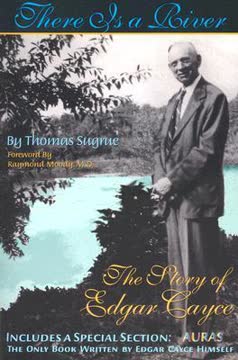
Key Takeaways
1. Edgar Cayce's Extraordinary Psychic Gift
The medical fraternity of the country is taking a lively interest in the strange power said to be possessed by Edgar Cayce of Hopkinsville, Ky., to diagnose difficult diseases while in a semiconscious state, though he has not the slightest knowledge of medicine when not in that condition.
Childhood visions. From a young age, Edgar Cayce exhibited unusual abilities, including childhood conversations with "hidden friends" and a profound connection to the Bible. A pivotal moment occurred when he discovered he could learn school lessons perfectly by sleeping on his textbooks, a phenomenon that baffled his family and teachers. This early display of an unconscious mind accessing information hinted at his future path.
Public recognition. Cayce's unique talent gained national attention in 1910 when The New York Times profiled him as an "Illiterate Man Becomes a Doctor When Hypnotized." At 33, he was a commercial photographer in Hopkinsville, Kentucky, delivering daily trance-based medical "readings" to people he had never met, diagnosing illnesses and prescribing natural cures. This coverage marked his rise to prominence as a new religious innovator.
Trance state mechanics. In his trance state, Cayce, often called the "sleeping prophet," would recline and, given only a subject's name and location, gain insight into their physical and psychological conditions. He had no conscious recollection of these sessions upon waking, and the information was meticulously recorded by a stenographer, Gladys Davis, amassing over 14,300 readings by his death in 1945.
2. Reconciling Faith and Clairvoyance
If it is a trick, doctor, I would like to know about it before I go too far and cause some harm.
Deep Christian faith. Edgar Cayce was a devout Christian, teaching Sunday school and reading the King James Bible annually, which formed the bedrock of his moral framework. He wrestled deeply with the source and implications of his psychic abilities, fearing they might be "of the devil" or lead him astray. This internal conflict was a constant companion throughout his life.
Seeking divine guidance. A childhood vision, where a feminine apparition promised his prayers to help others were heard, provided an early, if perplexing, validation for his gifts. He consistently attributed his information to a "Source" and used Gospel ethics as his moral vetting mechanism, believing that any true divine gift must align with God's will and produce good. His mother also reassured him, stating, "The devil cannot speak through a righteous man."
Moral compass. Cayce's personal integrity and commitment to Christian principles guided his use of the readings, ensuring they were solely for healing and spiritual guidance. He refused to use his powers for personal gain or public spectacle, always prioritizing the well-being of those seeking help. This unwavering moral stance was crucial in navigating the skepticism and sensationalism surrounding his work.
3. Pioneering Holistic Medical Diagnoses
He told us that on the day before she caught grippe she suffered an injury to her spine, and the grippe germs had settled in the spine, causing the attacks.
Accurate diagnoses. Cayce's early work primarily involved medical clairvoyance, where he accurately diagnosed complex illnesses for individuals he had never met. A notable case was the Dietrich child, suffering from convulsions and mental blankness, whom Cayce diagnosed with a spinal injury leading to grippe complications, prescribing osteopathic adjustments that led to a full recovery. Another significant case involved Carrie Salter House's baby, saved from convulsions by a reading-prescribed belladonna dose and peach-tree poultice, despite doctors' initial objections.
Diverse treatment modalities. The readings prescribed a wide array of holistic treatments, often combining various schools of medicine. These included:
- Osteopathy and chiropractic adjustments
- Electrical treatments (e.g., wet cell, radioactive appliances)
- Massage and hydrotherapy (e.g., castor oil packs, Epsom salts baths)
- Specific diets and herbal remedies
- Inhalants and compounds (e.g., Atomidine, animated ash)
Skepticism and validation. While many physicians were initially skeptical, the undeniable efficacy of the treatments often led to their cooperation, as seen with Dr. Wesley H. Ketchum and Dr. Thomas Burr House. Cayce's ability to identify obscure remedies, like "Oil of Smoke" or "clary water," which were later verified, further challenged conventional medical understanding and highlighted the unique nature of his insights.
4. The Revelation of Esoteric Truths
It’s Hermetic, it’s Pythagorean, it’s Jewish, it’s Christian!
Expanding the scope. In the 1920s, Cayce's readings expanded beyond physical ailments to include "life readings," exploring inner conflicts, past-life incarnations, and spiritual needs. This shift was largely influenced by Arthur Lammers, a wealthy Theosophist and printer from Dayton, Ohio, who urged Cayce to probe deeper into metaphysical questions. Lammers sought to understand the meaning of existence, ancient mysteries, and the nature of the soul.
Introducing new concepts. Through Lammers's inquiries, the readings introduced concepts previously foreign to Cayce, such as:
- Reincarnation and karma
- Astrology and numerology
- The Akashic records (a universal ether cataloging all human events)
- Lost histories of mythical cultures like Atlantis and Lemuria
- Hermetic and Pythagorean philosophies
Synthesizing wisdom. Despite his initial discomfort as a devout Christian, Cayce's trance state articulated a compelling theology that married Christian moral outlook with these esoteric ideas. Lammers enthusiastically declared that the doctrine synchronized great wisdom traditions, stating, "It not only agrees with the best ethics of religion and society, it is the source of them." This universal approach to religion became a hallmark of Cayce's later work, defining the parameters of New Age spirituality.
5. The Dream of a Healing Hospital
A hospital where we can give the kind of treatments the readings outline.
A vision for integrated healing. Cayce harbored a long-standing dream of establishing a hospital where the holistic treatments outlined in his readings could be systematically applied and studied. This vision was fueled by the frustration of patients struggling to get diverse treatments carried out by conventional medical practitioners. He envisioned a place where medical doctors, osteopaths, and other specialists could collaborate.
Virginia Beach's calling. Repeatedly, the readings insisted that Virginia Beach, Virginia, was the ideal location for this healing center. Reasons given included its proximity to large bodies of water, which was beneficial for Cayce's health and psychic abilities, and its accessibility for patients from major East Coast cities. The readings also suggested that traveling over water would put patients in the "right vibration" for cooperation.
Morton Blumenthal's backing. The dream gained momentum with the backing of Morton Blumenthal, a New York stockbroker and Cayce devotee, who pledged significant funds. In 1928, a thirty-bed hospital was built, designed not just for healing but also as a research center with a lecture hall, library, and vault for the readings. This marked a tangible realization of Cayce's long-held aspiration for a scientific and spiritual institution.
6. Overcoming Obstacles and Betrayals
I’ve been tested, and I’ve failed.
Financial setbacks. Despite the initial enthusiasm, the hospital faced immense financial challenges, exacerbated by the Great Depression. Previous ventures, such as the "Pit" card game and the Texas oil exploration, had also failed to secure lasting financial stability for Cayce's work. Morton Blumenthal, who funded the hospital from his market winnings, eventually withdrew support as his own finances dwindled.
The university's burden. Morton's ambition to establish Atlantic University alongside the hospital further strained resources, leading to internal conflicts and accusations of extravagance. The university, intended to integrate "new" philosophy with orthodox education, ultimately collapsed due to lack of funding. This left the hospital vulnerable and deeply in debt.
Legal challenges and personal toll. In 1931, Cayce, Gertrude, and Gladys Davis were arrested in New York for "fortunetelling" by undercover policewomen. Though acquitted, the experience was deeply distressing, highlighting the societal skepticism and legal risks associated with psychic work. These repeated setbacks and betrayals left Cayce feeling "tested" and "failed," questioning his path and the future of his mission.
7. The Power of Personal Integrity and Service
Every sincere try is counted to you for righteousness.
Unwavering commitment. Despite numerous personal and financial hardships, Edgar Cayce's commitment to helping others remained steadfast. He consistently refused to commercialize his gift, often forgoing payment or accepting only what was necessary to cover expenses. His integrity was a constant, even when others sought to exploit his abilities for profit.
Prioritizing genuine need. Cayce insisted that readings be given only for those genuinely in need of help and who approached the work with humility and prayer. He believed the effectiveness of the readings was tied to the sincerity of both the giver and the receiver. This principle ensured that the work remained aligned with its spiritual purpose, rather than becoming a mere commodity.
Living the ideal. Cayce embodied the "Law of One" philosophy that emerged from his readings, emphasizing love, kindness, and service to fellow man. He believed that personal virtue and living an exemplary life were paramount, stating, "If it makes you a better member of your church, then it’s good; if it takes you away from your church, it’s bad." This dedication to ethical living was his ultimate safeguard against misuse of his powers.
8. Rebuilding on a Foundation of Research
I think it would be wise if we stopped looking for large donations, stopped dreaming of another hospital, and concentrated on developing a little stock-in-trade.
Hugh Lynn's initiative. After the hospital's closure and the New York arrest, Edgar's son, Hugh Lynn Cayce, stepped forward to reorganize the work. He proposed a shift from grand projects to a focused, research-oriented approach, emphasizing systematic study and documentation of the readings. This pragmatic strategy aimed to build credibility and a solid foundation for future growth.
Systematic documentation. Hugh Lynn initiated the creation of study groups, published monthly bulletins, and meticulously compiled case studies, pamphlets, and yearbooks. This involved cross-indexing the vast archive of readings, extracting information on specific diseases, philosophical concepts, and historical periods. The goal was to create a comprehensive "stock-in-trade" of knowledge.
Historical validation. The discovery of Andrew Jackson Davis, the "Poughkeepsie Seer" of the 19th century, provided historical validation for Cayce's unique abilities. Davis, like Cayce, was an "intuitive somnambulist" who gave medical diagnoses in a trance state, demonstrating that such phenomena had historical precedent in America. This comparison bolstered the argument for the legitimacy and scientific study of Cayce's work.
9. A Universal Philosophy of Life and Healing
The ideals and purposes of the Association for Research and Enlightenment, Inc., are not to function as another schism or ism. Keep away from that!
Christianized mystery traditions. The philosophical system derived from the Cayce readings is a unique synthesis, presenting a Christianized version of ancient mystery religions. It positions Christ at the apex of this structure, fulfilling rather than abolishing ancient laws and wisdom. This framework sought to bridge the gap between esoteric knowledge and mainstream Christian belief.
Core tenets. Key philosophical concepts articulated in the readings include:
- Soul's Journey: Souls are created for companionship with God, embarking on cycles of experience across dimensions and incarnations to achieve perfection.
- Free Will & Karma: Man's free will shapes his destiny, with karma (cause and effect) influencing experiences, but never overriding choice.
- Purpose of Life: Each life is a purposeful experience, offering opportunities to work out faults and grow spiritually.
- Mind as Builder: "The spiritual is the LIFE; the mental is the BUILDER; the physical is the RESULT," emphasizing the power of thought in shaping reality.
Holistic well-being. The readings advocate for a holistic approach to life, integrating physical, mental, and spiritual health. They stress that true healing comes from addressing the root causes of imbalance, not just symptoms, and that personal transformation through living one's ideals is essential for both individual and collective progress.
10. The Enduring Impact of the Readings
All of this information makes clear the stature and the meaning of Edgar Cayce.
A vast legacy. Edgar Cayce left behind an unparalleled archive of over 14,000 psychic readings, a testament to his unique abilities and dedication. This extensive record continues to be a rich source for research, study, and personal guidance, making him a pivotal figure in the history of alternative spirituality and holistic health. The Association for Research and and Enlightenment (A.R.E.) continues to classify, compile, and disseminate this material.
Continued relevance. The readings offer insights into a wide range of human experience, from physical ailments and psychological challenges to spiritual development and universal laws. They provide a framework for understanding life's purpose, the interconnectedness of all things, and the potential for individual growth. Many individuals continue to find profound value in applying Cayce's teachings to their lives.
Founding voice of the New Age. Cayce's work, particularly his "life readings" and philosophical expositions, laid much of the groundwork for the New Age movement of the later 20th century. His synthesis of Eastern concepts like reincarnation with Christian ethics, and his emphasis on personal spiritual search and holistic healing, resonated deeply with a culture seeking broader expressions of faith and self-discovery. His legacy endures as a bridge between traditional spirituality and modern consciousness.
Last updated: