Key Takeaways
1. Venezuela: A Nation Forged and Fractured by Oil
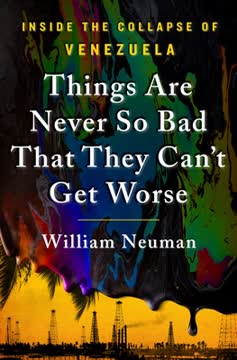
It’s not so much that Venezuela produced oil; it’s that oil produced Venezuela.
Oil's defining role. Venezuela's history, society, and political structures have been profoundly shaped by its vast oil reserves. From the first commercial well in 1914 to the nationalization of the industry, oil became the singular engine of the economy, overshadowing all other sectors. This created a unique "petrostate" where the government's primary function was to distribute oil wealth, rather than foster diverse economic activity.
The Resource Curse. This over-reliance on a single commodity led to the "Dutch Disease," where oil booms caused the local currency to rise, making other exports uncompetitive and flooding the market with cheap imports. When oil prices inevitably fell, the economy collapsed, leaving behind a stagnant non-oil sector and a populace accustomed to government handouts.
- 1928: Venezuela becomes world's top oil exporter.
- 1970s: Oil prices quadruple, leading to a "petro-delirium" and massive borrowing.
- 1980s: A "lost decade" of debt, mismanagement, and corruption.
The "Milk Cow" State. The government became seen as "an enormous distributive apparatus, a huge milk cow that benefited those who were able to suckle at her teats." This fostered a patron-client relationship, where citizens expected benefits as a birthright, regardless of economic conditions, and the state never developed a strong tax base or robust institutions beyond oil distribution. This ingrained expectation, exemplified by a woman demanding her government-built house be painted, highlighted a deep-seated belief that the state owed its citizens everything.
2. Chávez's Populist Illusion: The Eternal Revolution
Chávez’s greatest talent wasn’t inventing something new. It was just repackaging the old and pretending that he’d come up with it himself.
The "for now" promise. Hugo Chávez burst onto the national scene in 1992 with a failed coup, but his televised surrender, taking "responsibility for this Bolivarian military movement" and stating objectives were "not achieved, for now," instantly made him a celebrity. This blend of accountability and veiled promise resonated with a populace disillusioned by corruption and inequality, setting the stage for his presidential victory in 1998.
Television as governance. Chávez mastered the art of direct communication, using television as his primary tool for governance and connection. His show, "Aló Presidente," evolved from a call-in program to a dynamic platform where he issued orders, criticized ministers, and taunted enemies, often preempting all other broadcasts. This created a powerful, almost mystical bond with his supporters, who felt he spoke directly to them, while simultaneously demonizing his opponents.
- 2,377 preemptive broadcasts (1999-2012)
- 1,695 hours on air (1999-2012)
"Us vs. Them" polarization. Chávez's ideology, "Chavismo," was less about socialism and more about maintaining power through a "civilian-military union" and exploiting societal divisions. He polarized the country into "the pure people" versus "the corrupt elites," justifying any action in the name of revolution. This deeply conservative approach, rooted in a nostalgic vision of a "golden age" of Bolívar, masked a continuation of caudillismo and state control, rather than genuine innovation.
3. Maduro's Indecision and the Descent into Authoritarianism
One of the things that everyone noticed about Maduro, after he became president, was that he seemed to hate to make decisions.
A reluctant successor. Nicolás Maduro, Chávez's handpicked successor, inherited a nation on the brink. Known for his affability and loyalty to Chávez, Maduro struggled with indecisiveness, often deferring critical economic reforms like adjusting the fixed exchange rate or gasoline prices. This inaction, rooted in a belief in "predestination" and "signs," exacerbated the economic crisis, as markets perceived his inability to act decisively.
The "Little Bird" and mystical governance. Maduro's leadership was marked by a deep mysticism, famously recounting how a "little bird" embodying Chávez's spirit gave him a blessing. This fatalistic worldview, combined with a focus on short-term tactics over long-term strategy, meant that daily governance became a series of reactions to immediate obstacles, rather than proactive problem-solving.
- Maduro's 2013 election victory: less than 2% margin, far narrower than Chávez's.
- Accusations of illegitimacy fueled his insecurity.
From charisma to control. Unlike Chávez, who commanded through charisma and direct connection, Maduro relied on increasing repression to maintain power. He faced skepticism from within Chavismo and relentless opposition, leading him to prioritize "preserving the equilibrium" among factions and using force to quell dissent. This shift marked a transition from Chávez's populist appeal to a more overt authoritarianism, where the state's function increasingly became about control rather than distribution.
4. Systemic Corruption: An All-You-Can-Eat Buffet of Graft
The nation was an all-you-can-eat buffet and everyone was pushing to the front to fill their pockets with delicacies before they ran out.
The "bicycle" of corruption. Venezuela's fixed exchange rate system, established by Chávez in 2003, became a primary engine of systemic corruption. The vast gap between the official and black-market exchange rates allowed individuals to buy cheap dollars from the government and sell them for massive profits, often without importing any goods. This "bicycle" of currency manipulation became a pervasive way of doing business, incentivizing fraud and siphoning billions from state coffers.
- 2012: Official rate 4.3 bolivars/$1, black market 8.6 bolivars/$1.
- 2013: Black market rate 10x official rate (6.3 bolivars/$1).
- Profits of 400% or more on currency transactions.
PDVSA as a piñata. The state oil company, PDVSA, became a prime target for graft. U.S. investigations revealed schemes where businessmen paid bribes to secure contracts for equipment at hugely inflated prices, with the markups covering kickbacks to officials. This widespread pilfering, from top executives to procurement managers, contributed significantly to the company's decline and Venezuela's economic collapse.
- Roberto Rincón and Abraham Shiera: $1 billion in contracts, tens of millions in bribes.
- Leonardo Santilli: Sold 55-gallon drums for $9.2 million (worth $2 million), a 360% markup.
Erosion of morality. Corruption permeated all levels of society, from high-ranking officials receiving private jets and yachts to ordinary citizens selling their travel allowances for cheap dollars. This normalized dishonesty, destroying the sense of right and wrong and fostering a cynical view that anyone who didn't partake was "stupid and to be pitied." The corrupt, it seemed, wanted everyone else to be corrupt, erasing any moral high ground.
5. The Human Cost: Blackouts, Hunger, and a Mass Exodus
The inflation rate tells you about the evaporation of the buying power of the money in a person’s hand. The immigration numbers tell you about the evaporation of hope in a person’s heart.
A collapsing infrastructure. The country's economic free fall manifested in daily life through devastating infrastructure failures. Nationwide blackouts, like the one in March 2019, plunged cities into darkness for days, disrupting essential services and spoiling food. Maracaibo, the second-largest city, endured five-day outages, leading to widespread looting and a sense of utter abandonment.
- Maracaibo: Residents coped with blackouts and rationing for over a year before the 2019 national outage.
- "Zombies": People described themselves as "walking dead" or "zombies" due to hunger and sleep deprivation.
Food insecurity and desperation. Hyperinflation rendered wages worthless, making food unaffordable and scarce. Families like Hilda Solórzano's in Petare often ate only once or twice a day, subsisting on lentils and rice, with children suffering from malnutrition and dental decay. The desperation led to a breakdown of social norms, as people looted for survival, prioritizing immediate needs over long-held moral principles.
- 2019: One-third of the population had difficulty getting enough food.
- Minimum wage: Less than $1 a month (2020).
The great exodus. Millions, despairing of any future, fled Venezuela, creating one of the largest refugee crises in the world, second only to Syria. This human river, often traveling on foot across the Andes, reflected the "evaporation of hope" as political events like the blocking of recall referendums and the creation of the Constituent Assembly coincided with surges in migration.
- 5.4 million Venezuelans left the country by 2020 (one-fifth of pre-crisis population).
- Rumichaca border crossing (Colombia-Ecuador): 80,262 Venezuelans crossed in October 2018 alone.
6. Unfinished Dreams: A Landscape of Broken Promises
The great advantage of not finishing things was that you could come back every few years and announce them again: New Hospital Coming Soon!
White elephants of Chavismo. Venezuela's landscape is littered with the skeletal remains of ambitious, yet uncompleted, public works projects. Billions of dollars in oil wealth were squandered on grand schemes that never materialized, becoming symbols of waste and futility. These projects, often announced with great fanfare by Chávez, were rarely completed, serving instead as recurring political promises.
- National Rail Plan: Tens of billions for 5,300 miles of track; only 25 miles completed.
- Barinas Cancer Hospital: Announced in 2007, remained a concrete skeleton eight years later.
- Orinoco River Bridge: $2.8 billion budget, still unbuilt pilings.
"Showcialismo" over production. Chávez's "twenty-first-century socialism" prioritized the appearance of progress over actual delivery. Nationalized industries, like the Sidor steel mill, saw production plummet while payrolls swelled with loyalists. The focus was on acquiring "means without production," making Chávez "look like a socialist" rather than creating functional, productive enterprises.
- Sidor steel mill: Production fell from 4.3 million tons (2007) to zero (2019) after nationalization.
- Paper plant: $800 million invested, never produced a single roll of paper.
The "Coquivacoa Hole." In Maracaibo, a massive pit dug for a grand civic center in the 1970s remains an enduring monument to broken promises, now a garbage dump. This "Coquivacoa Hole" symbolizes decades of unfulfilled plans and stolen funds, a testament to a recurring pattern of grand visions collapsing into neglect and corruption, long before Chávez.
7. The Opposition's Flawed Strategy and External Dependence
These guys aren’t willing to go the distance,” she said. “They want to outsource everything.”
Internal divisions and lost momentum. Despite winning a supermajority in the National Assembly in 2015, Venezuela's opposition remained deeply fractured by clashing egos and strategic disagreements. Infighting over leadership and tactics, such as whether to pursue a recall referendum or boycott elections, squandered momentum and allowed Maduro to consolidate power. This internal disunity undermined their ability to present a credible alternative.
The "quiebre militar" fantasy. A central, yet flawed, tenet of the opposition's strategy was the belief in an imminent "break in the military" that would force Maduro's ouster. This hope fueled events like the Cúcuta humanitarian aid push and the April 30 "non-uprising," both of which failed to trigger mass defections, revealing a profound misunderstanding of the military's loyalty to Chavismo.
- Cúcuta aid push (Feb 2019): Aimed to provoke military defection; resulted in violence, no aid crossed.
- April 30 "non-uprising": Guaidó and López appeared with a small group of soldiers; no military units joined.
Outsourcing liberation. The opposition's reliance on external forces, particularly the United States, became a defining characteristic. From seeking U.S. recognition for Guaidó to hiring mercenaries for "Operation Gideon," there was a perceived unwillingness to "go the distance" themselves. This outsourcing, exemplified by the "Macuto Screw-up" mercenary contract, exposed a naive and poorly executed approach, further eroding public trust and international credibility.
8. U.S. "Maximum Pressure" and Its Unintended Consequences
I don’t think it’s true.” (Referring to the belief that Maduro's regime would crumble easily).
A shift in U.S. policy. Under Donald Trump, U.S. policy towards Venezuela dramatically shifted from Tom Shannon's "benign neglect" to John Bolton's "maximum pressure." This new approach, driven by hard-liners and influenced by Florida electoral politics, aimed to destabilize Maduro's government through escalating economic sanctions, with the belief that the regime would quickly collapse.
- Shannon's approach: Avoid confrontation, don't mention Chávez's name, engage with willing Latin American countries.
- Trump's approach: "All options are open," including military action; "troika of tyranny" rhetoric.
"Salami-slicing" vs. "mallet." Initially, the National Security Council planned a "salami-sliced" approach to sanctions, targeting individuals and specific sectors incrementally to change behavior. However, under Bolton, this evolved into a "mallet" approach, culminating in a full oil embargo in January 2019, which was originally considered a "doomsday sanction" due to its devastating humanitarian impact.
- August 2017: Financial sanctions on PDVSA.
- January 2019: Oil embargo, banning Venezuelan oil sales to the U.S.
Humanitarian devastation and political deflection. While intended to pressure Maduro, the broad sanctions severely impacted ordinary Venezuelans, exacerbating hunger and shortages. This allowed Maduro to deflect blame for the country's economic woes, framing the crisis as an "economic war" waged by the U.S., thereby strengthening his narrative and consolidating support among loyalists. The policy, despite its political success in Florida, failed to dislodge Maduro and instead deepened the country's misery.
9. Erosion of Rule of Law: Violence as a Tool of Control
It’s pure power,” he said. “There is no constitution. There are no limits.”
The FAES: A force of terror. Maduro's government systematically dismantled democratic institutions and used state-sponsored violence to maintain control. The Special Action Force (FAES), an elite police unit, became an instrument of fear, carrying out extrajudicial killings in poor neighborhoods and planting evidence on victims. This brutal repression, documented by the UN, aimed to instill terror and suppress dissent.
- FAES agents: Black uniforms, balaclavas, death's-head symbol.
- 2018: 5,287 killings due to "resistance to authority" reported by government.
- UN report: "Widespread and systematic attack directed against a civilian population," constituting crimes against humanity.
Torture and intimidation. Political opponents, human rights lawyers like José Vicente Haro, and even ordinary citizens were subjected to arbitrary detention, torture, and cruel treatment. Haro's harrowing account of being kidnapped, beaten, and threatened with sexual violence by FAES agents, all while hooded, revealed a state operating without constitutional limits. The goal was not just punishment, but to break individuals and send a chilling message to others.
- José Vicente Haro: Kidnapped, beaten, threatened with death for defending political prisoners.
- Keyla Brito: Beaten, hair cut by female soldiers during grocery trip near a protest.
A state that takes. Chávez had already politicized the military and judiciary, filling them with loyalists. Maduro intensified this, using the Supreme Court to strip the National Assembly of its powers and creating a parallel Constituent Assembly. This complete erosion of checks and balances transformed the state from a "milk cow" that gave to a brutal entity that took, using repression as its primary currency when oil wealth dwindled.
10. The Gold Rush: A New Hell for a Desperate Nation
Maduro, the worker president, had created a perfect workers’ hell.
From oil to gold. As oil production plummeted and sanctions bit deep, the Maduro government turned to gold mining as a desperate source of hard currency. This shift replaced a modern, technical industry with a lawless, unregulated enterprise, where the state effectively outsourced control to criminal gangs known as sindicatos. The gold mines became a microcosm of Venezuela's collapse, driven by extraction at any cost.
Sindicatos and brutal order. These criminal gangs, or "prans," controlled mining towns and operations, imposing a brutal form of order. They collected taxes, enforced rules, and meted out violent "escarmientos" (punishments meant to teach a lesson), including dismemberment and burying people alive. This system ensured gold flow to the government and its cronies, while miners faced extreme violence and exploitation.
- Sindicatos: Criminal gangs, often former corrupt construction unions.
- Prans: Gang bosses, derived from prison slang for inmate leaders.
- Escarmiento: Public, brutal punishments to deter dissent.
Malaria and environmental devastation. The gold mines became an epicenter for a resurgent malaria epidemic, once eradicated in Venezuela, with workers like Néstor López suffering dozens of infections. The unregulated mining also caused widespread environmental destruction, with jungles stripped and rivers poisoned by mercury. This new economic model, championed by the "worker president," created a hellish reality for those seeking survival, where basic human rights and environmental protections were non-existent.
- 2019: 400,000 malaria cases reported in Venezuela.
- Indigenous communities: Land violated, rights ignored.
11. The Blinding Light of Truth: A Search for Citizenship
We have to see the world as it is, not the world as we want it to be.
The "shouting country" in darkness. Venezuela, once a "country of light" in its natural beauty and vibrant culture, descended into a "shouting country" of political polarization and literal darkness from blackouts. The crisis forced a confrontation with a harsh reality, stripping away illusions and revealing the profound dysfunction beneath the surface. The challenge became to see the world "as it is," rather than clinging to appealing, yet false, narratives.
Cycles of hope and despair. The nation is trapped in cycles: oil booms and busts, political promises and failures, and the constant struggle of individuals against systemic poverty. Each time hope flickers, it is extinguished by renewed corruption, mismanagement, or political missteps, leaving people exhausted and "conformist," accepting conditions that were once unthinkable.
- Hilda Solórzano: Repeatedly thwarted in her entrepreneurial efforts by theft and economic collapse.
- "Dead Houses": Maracaibo's empty homes symbolize the mass exodus and urban decay.
From "the people" to citizens. The book concludes with a poignant call for a fundamental shift in Venezuelan identity: from being "the people" (a collective entity manipulated by populists) to becoming active "citizens." This requires self-awareness, a rejection of the caudillo mentality, and a willingness to build a nation based on shared values and accountability, rather than waiting for a savior or outsourcing responsibility. The path forward, as Hilmaris suggests, lies in internal change, "because maybe Maduro will stay on as president and Venezuela will stay the same—or maybe they’ll overthrow Maduro and Guaidó will take his place, but Venezuela could still stay the same.”
Last updated: