

Key Takeaways
Efficiency became the quiet rulebook for what Washington called a reasonable policy.
A narrower policy horizon. Barack Obama entered office amid hopes for universal healthcare, tougher financial rules, and serious climate action. His administration achieved major reforms, but its proposals largely relied on choice, competition, incentives, and markets. The Affordable Care Act expanded coverage through a regulated insurance marketplace rather than creating universal public insurance. Dodd-Frank added financial oversight without breaking up major banks. Climate policy leaned on emissions trading and regulatory calculations. These choices reflected real political constraints, but also a policy culture that made some alternatives seem unreasonable before leaders seriously considered them.
The book’s central claim. Berman calls this culture the economic style of reasoning: a policy approach drawn from economics that treats efficiency as a central measure of good government. It became influential across parties and policy fields, and helped narrow the ideas that Democratic leaders considered practical.
What's striking is that a policy framework can shape decisions before any explicit debate begins. Political analysis often focuses on votes, lobbying, and electoral incentives, but the available menu of proposals matters too. A proposal dismissed as unrealistic never reaches the bargaining table. The argument is especially persuasive when it distinguishes constraints from assumptions: Congress and interest groups limit what presidents can achieve, while expert institutions also shape what they attempt. The distinction matters because changing political leadership may not broaden policy options if the same professional networks continue defining what counts as sensible.
Treat efficiency as a value choice, not a neutral measuring stick.
Three kinds of efficiency. The economic style can mean choosing the least costly way to reach a goal, favoring competitive markets that allocate goods efficiently, or selecting policies whose measurable benefits exceed their costs. These approaches can help compare options, but they do not settle which goals deserve priority. Cost-benefit analysis, for example, may ask how much environmental protection is worth purchasing. A Kaldor-Hicks test calls a policy an improvement if its winners could theoretically compensate its losers, even when no compensation occurs.
What the calculation leaves out. Rights, equal access, political power, and community participation may be difficult to express in the same units as money. Treating them as secondary is not value-free. It gives measurable efficiency priority over claims that may be morally or politically important, even when those claims are central to the policy’s purpose.
Measurement makes unlike options easier to compare, a genuine administrative advantage. It also creates a quiet hierarchy: what can be counted enters the analysis readily, while what resists quantification must fight for recognition. This resembles a broader problem in social science, where indicators can become targets and stand-ins for complex realities. The important distinction is not between calculation and no calculation, but between calculation as evidence and calculation as a final moral verdict. Efficiency is useful for choosing means; democratic argument remains necessary for choosing ends and deciding who may bear the costs.
A failed budgeting reform built the permanent machinery of policy analysis.
RAND’s decision method. RAND economists developed systems analysis to compare possible ways of reaching a stated goal. At the Pentagon, Robert McNamara’s team turned it into the Planning-Programming-Budgeting System, or PPBS: agencies set goals, identify programs that could meet them, compare their costs and results, then use the analysis to guide budgets. The approach promised systematic decisions instead of intuition, but its results depended on choosing goals and deciding what counted as a benefit. Early defense studies struggled with precisely that problem, including how to compare military costs with the value of pilots’ lives.
Failure with a long afterlife. President Johnson extended PPBS across the executive branch in 1965. Most agencies never made it a real budgeting engine, and Nixon ended the requirement in 1971. Yet the rollout created analytic offices, trained policy professionals, and helped launch public policy schools. The Congressional Budget Office became another durable home for economic analysis.
This history shows why institutional effects can outlast a failed reform. A management system may not control budgets as promised, yet its offices, graduates, and professional habits can become part of the machinery of government. Organizational sociology calls attention to this kind of path dependence: once agencies invest in specialized staff and training, those capabilities generate demand for continued analysis. Still, more analysis does not automatically mean better decisions. The method can clarify trade-offs, but it cannot supply legitimate goals or guarantee that political leaders will use evidence rather than present political choices as technical necessities.
When poverty became an income gap, political voice lost ground.
Two diagnoses of poverty. The War on Poverty’s Community Action Program sought “maximum feasible participation” by poor residents, treating political exclusion as part of the problem. Economists in the Office of Economic Opportunity instead emphasized poverty as insufficient income and asked which intervention could raise it most efficiently. They favored a negative income tax, which would provide cash to households below a specified income level, over the diffuse and politically disruptive community programs.
Efficiency reshaped social programs. Budget limits made measurement and evaluation more attractive, and research contracts helped spread economic approaches to poverty, health, and housing. Economists favored targeted benefits over universal family allowances, cost-sharing over free healthcare, and housing vouchers over public housing. These policies could be defended as less costly or more choice-oriented. But they displaced competing arguments about universal rights, racial equality, and the political durability of broad programs. A plan can be efficient at delivering a benefit while still changing who has power and who qualifies.
The contrast is not simply cash versus services. It is also a contrast between treating people as recipients of assistance and treating them as participants in defining public problems. Political participation can be hard to score in an evaluation, yet it may affect whether programs reflect local needs or earn durable support. The book also shows how administrative categories matter: once poverty is defined primarily by income, interventions that change income become easier to justify than those that redistribute decision-making power. That does not make income supports ineffective. It does mean their effectiveness cannot answer every question about justice or citizenship.
Markets became the default cure for problems once framed as corporate power.
From industries to markets. Industrial organization economists asked when firms could restrict competition and how government rules might improve market performance. Harvard economists initially supported significant antitrust enforcement, while Chicago economists argued that large firms often reflected efficiency and that competition could curb monopoly. Despite their disagreements, both schools treated efficient markets as the central policy goal.
The purpose of antitrust narrowed. Earlier antitrust arguments also sought to limit corporate power and protect small businesses. By the late 1970s, court decisions increasingly defined consumer welfare in terms of economic efficiency, excluding those broader aims. In transportation, economists and their allies promoted deregulation, which ended many price and entry controls in airlines, trucking, and rail. The reforms crossed party lines: liberal Democrats and conservative Republicans often agreed that competition could lower prices. The shift was not just less regulation. It changed the goals government was expected to pursue.
A market framework can reveal real harms from cartel behavior, protected incumbents, and rules that keep prices artificially high. The historical account does not require treating every older regulation as wise or every large firm as dangerous. Its sharper point is that the governing standard determines which harms count. A price-focused test can miss political influence, worker bargaining power, or a small business’s civic role. This is a useful distinction for current debates: evidence that a market is efficient on one dimension does not establish that it serves every public purpose. Choosing the metric is itself part of policy.
Set regulatory goals openly before pricing the cost of meeting them.
Rights-based rules meet cost analysis. The major environmental, workplace, and safety laws of the late 1960s and early 1970s often set demanding standards without allowing costs to determine the level of protection. Their supporters drew on rights, ecological interdependence, technological optimism, and fear that flexible rules would be captured by industry. Later, White House reviews pressed agencies to assess costs and benefits. Under Carter, the Regulatory Analysis Review Group pushed agencies to identify less costly ways to meet regulatory goals.
The choice of method mattered. In a 1978 dispute over ozone standards, EPA officials defended health-based limits while White House economists argued for a less stringent standard based on the rising cost of further reductions. Meanwhile, EPA officials developed the “bubble” approach, which let firms reduce pollution where reductions were cheapest. The 1990 Acid Rain Program later used emissions trading and contributed to a 94 percent drop in sulfur dioxide emissions by 2019. Success on emissions, however, does not resolve every concern about local burdens or whose protection gets priority.
The regulatory debate exposes a real tension between flexibility and enforceability. Flexible tools can reduce the cost of meeting a target, and the Acid Rain Program demonstrates that market design can produce substantial pollution reductions. Yet a national emissions total may conceal unequal exposure among neighborhoods, while a cost calculation depends on which health risks and future effects it includes. A sound policy process therefore needs two transparent decisions: what protection society is entitled to expect, and how to deliver it efficiently. Reversing that order risks allowing the easiest-to-measure costs to quietly redefine the public’s goal.
Democrats adopted the economic style as a compass; Republicans used it as a tool.
A partisan asymmetry. Many center-left economists introduced economic reasoning because they wanted government programs to work better, not because they wanted to abolish government. Over time, however, Democrats increasingly treated efficiency as a standard that policy had to satisfy. Their arguments for universal healthcare, strict environmental rules, or aggressive action against concentrated firms faced a technocratic presumption against them.
Reagan used expertise selectively. His administration cut analytic capacity in social policy, where analysis might improve the welfare state, while strengthening economic reasoning in antitrust and regulatory review, where it supported smaller government or less enforcement. In one example, staffing at the health department’s planning office fell from 165 to 75 during the Reagan years. The contrast is not that Republicans ignored economics altogether. It is that they were more willing to subordinate it to prior political commitments, while Democrats more often let its criteria define the limits of acceptable policy.
This distinction helps explain why technical neutrality can have different political consequences for different parties. A party with a strong ideological framework can use expert analysis tactically, accepting it when helpful and rejecting it when inconvenient. A party that identifies itself with competent administration may be more vulnerable to treating the experts’ chosen criteria as binding. The book’s account is persuasive as a pattern, not as a claim about every Republican or Democrat. Strategic political behavior and institutional habits interact, and their relative influence varies by policy area. That qualification strengthens the central insight rather than erasing it.
Build institutions for rival values, not just better arguments.
Ideas need homes. Economic reasoning spread because it had durable support in government offices, policy schools, think tanks, research contractors, and law. Berman’s practical lesson is that alternatives need comparable infrastructure: experts who can develop proposals, organizations that can circulate them, and advocates able to challenge decision rules such as antitrust doctrine or regulatory review. Grassroots support can put ideas on the agenda, but analysts and institutions help turn them into workable policy options.
Use economics without surrendering to it. Economic tools can be valuable when their assumptions fit the problem. When efficiency conflicts with rights, equality, racial justice, or democratic participation, advocates should state those values directly rather than translating every claim into a cost calculation. Translation can win partial recognition, as with environmental equity measures, but may strip away the original demand. Durable reform requires both changing existing institutions and building alternatives capable of defining problems differently.
The institutional prescription connects political strategy with knowledge production. Movements can shift public attention, but sustained policy change also depends on the less visible work of drafting, scoring, and defending proposals. That work requires expertise, though not expertise confined to one discipline. A plural policy infrastructure could include economics alongside law, history, public health, and community knowledge. The challenge is to avoid a simple reversal in which one framework claims exclusive authority instead of another. Better institutions make competing values legible and contestable, while leaving elected officials and the public responsible for resolving disagreements that technical analysis cannot settle.
Analysis
The book’s distinctive contribution is to explain policy change through a style of reasoning, not only through partisan ideology or economists’ direct advice. Its subject is the ordinary policy apparatus: offices created to analyze budgets, professional schools that teach economic concepts, think tanks that supply proposals, and legal rules that make certain arguments admissible. Together, these institutions turn one approach into common sense. The causal claim is deliberately limited. Berman does not argue that economists alone moved Democrats rightward or that, without them, the Great Society would have endured. Rather, the economic style helped make political change durable by narrowing the language and options available to its opponents.
That explanation is particularly strong because the style’s origins complicate a simple story of conservative intellectual victory. Center-left technocrats often advanced it to improve government, while Republican leaders could use it selectively. The book therefore separates a tool’s institutional origins from the political effects of its use. Efficiency can support effective regulation, but it can also sideline values that are difficult to measure. The danger lies less in calculation itself than in letting one criterion silently decide what counts as a public benefit.
The account also invites a useful qualification. Efficiency is not a single policy outcome, and economic analysis can incorporate distribution, uncertainty, and market power when institutions demand that it do so. At the same time, adding variables to a calculation cannot fully resolve conflicts about rights, political voice, or the acceptable distribution of risk. The case for pluralism is not anti-expertise. It is a case for making expertise answerable to openly chosen goals, and for maintaining institutions where competing disciplines and affected communities can help define those goals. The historical lesson is consequently about power as much as economics: whoever supplies the standard of reasonableness can influence policy even without holding elected office.
Review Summary
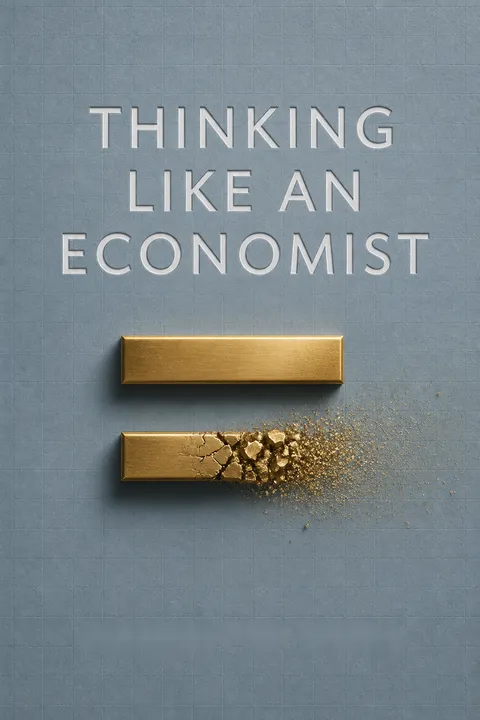
Thinking Like an Economist by Elizabeth Popp Berman explores how economic reasoning became dominant in US policymaking. Readers praise its thorough historical analysis and insights into the shift towards efficiency-focused approaches. Many found it eye-opening, noting how liberal economists played a key role in this transformation. While some critics found the writing dry and overly detailed, most reviewers appreciated the book's examination of how economic thinking has shaped policy debates and potentially limited alternative perspectives.
People Also Read







Glossary
Economic style of reasoning
Efficiency-centered policy thinkingBerman’s term for a broad approach to policy derived from microeconomics. It uses concepts such as incentives, markets, externalities, and efficiency, and often relies on quantification, models, and comparisons of costs and benefits. The approach presents itself as a neutral way to choose policy, but its emphasis on efficiency can compete with values such as equality, rights, and political participation.
Planning-Programming-Budgeting System
Goal-based budget analysisA federal budgeting and planning method introduced at the Department of Defense under Robert McNamara and extended across executive agencies by President Johnson in 1965. Agencies were asked to specify goals, identify programs that might achieve them, compare alternatives by cost and effectiveness, and use those comparisons in budgeting. Most agencies did not adopt it deeply, but the system helped establish lasting analytic offices and training programs.
Systems analysis
Structured comparison of alternativesA method developed at RAND for examining possible ways to meet a defined objective. Analysts identify alternatives, make assumptions explicit, estimate consequences, and compare options using chosen criteria, often cost-effectiveness. The method’s apparent rigor depends on prior choices about the objective and the measure of success. RAND’s defense work helped carry this approach into civilian policy and federal administration.
Kaldor-Hicks efficiency
Potential gains exceed lossesA criterion used to judge whether a policy produces a net improvement. A change qualifies if those who gain could, in theory, compensate those who lose and still remain better off. The compensation need not actually occur. This makes it possible to compare policies through aggregate benefits and costs, but it does not establish that the resulting distribution is fair.
Allocative efficiency
Resources follow valued demandAn economic measure of how well a market directs resources toward goods and services consumers value. In the book’s account, competitive markets are expected to promote allocative efficiency, while monopoly or unpriced pollution can distort prices and output. This standard became especially influential in market governance and antitrust, where it displaced broader goals such as limiting corporate power or protecting small businesses.
Consumer welfare standard
Efficiency-centered antitrust testThe dominant interpretation of antitrust that treats consumer welfare, commonly understood as allocative efficiency, as the principal legitimate goal of enforcement. Under this approach, corporate conduct is chiefly an antitrust concern when it threatens competition or raises prices. Berman traces how this standard narrowed antitrust’s earlier role in addressing concentrated corporate power and protecting smaller firms.
Negative income tax
Cash support below an income thresholdAn antipoverty proposal that provides money to households whose income falls below a specified level, with assistance generally declining as earnings rise. Economists in the Office of Economic Opportunity favored it as a comparatively direct and measurable way to reduce poverty. Its appeal contrasted with community action programs, which sought to increase poor residents’ political participation and influence over local services.
Managed competition
Regulated choice among health plansA healthcare proposal that uses government rules to organize competition among private health plans. Individuals choose among competing plans, while public policy structures the market and provides assistance to people with lower incomes. Alain Enthoven advanced this approach as a way to combine broad insurance coverage with incentives for consumers and providers to consider costs. It differs from a single universal public insurance system.
Download PDF
Download EPUB
.epub digital book format is ideal for reading ebooks on phones, tablets, and e-readers.








