

Key Takeaways
Redefine success around the life you can actually sustain
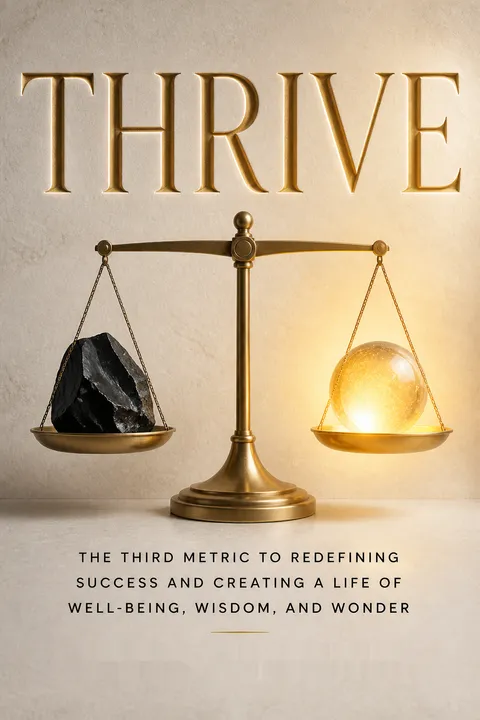
A costly wake-up call. In 2007, Arianna Huffington collapsed from exhaustion while building The Huffington Post. Money, visibility, and influence suggested success; the blood on her office floor suggested its price. She argues that money and power alone make an unstable measure of a good life, and proposes a Third Metric with four pillars: well-being, wisdom, wonder, and giving. Together, they ask whether achievement supports health, inner perspective, curiosity, and care for others.
A different scorecard. The framework does not reject ambition. It asks ambition to serve a fuller life. Huffington points out that people’s eulogies tend to celebrate love, generosity, and relationships, not promotions or inbox management. Her practical challenge is to judge success by the quality of life being built while it is being lived, rather than by professional markers alone.
What's striking is that this framework changes the question from how high someone climbs to what the climb is costing and creating. That resembles broader approaches to well-being that treat health, relationships, and agency as outcomes worth measuring alongside income. The four pillars also reinforce one another: rest can support judgment, reflection can deepen attention, and care for others can strengthen connection. Yet the ability to choose a less punishing path is uneven. A broader definition of success should also include fair wages, leave, and safe workplaces, not imply that personal habits alone can repair structural pressures.
Treat sleep as leadership infrastructure, not a reward for finishing
Rest improves the work. Huffington challenges the workplace boast that needing little sleep signals commitment. She links sleep loss to poorer judgment, attention, mood, empathy, and self-control, and notes that fatigue contributed to major industrial and transportation accidents. In a Stanford study described in the book, eleven basketball players extended their sleep toward ten hours nightly for five to seven weeks. Their three-point shooting rose 9.2 percent and free-throw performance rose 9 percent.
Make bedtime real. Huffington and Glamour editor Cindi Leive publicly tried prioritizing a full night’s sleep. They treated bedtime like an appointment, moved phones away from the bed, and recruited others to help them stick with it. The point is not that every person needs precisely the same number of hours. It is that sleep is part of the conditions for good performance, not leftover time after work is done.
The athletic example makes an abstract claim visible: when performance is measurable, recovery is easier to defend. The same logic applies to knowledge work, where fatigue can quietly degrade judgment without immediately stopping output. Rest is therefore not merely a private wellness preference; it is part of competent decision-making. Still, the burden should not fall solely on individuals setting bedtime alarms. Shift work, caregiving, long commutes, and unpredictable schedules can make adequate sleep difficult. Employers and institutions shape the conditions under which personal sleep practices are possible.
Change workplace rules that turn exhaustion into status
Burnout has a social setting. The book describes burnout not only as an individual problem but as a symptom of a culture that praises overwork and treats recovery as optional. Women may pay particular costs: the research cited reports nearly 40 percent higher heart-disease risk and 60 percent higher type 2 diabetes risk for women in highly stressful jobs. Women also leave demanding careers for reasons that include poor engagement and lack of enjoyment, not only childcare.
Redesign the job. Examples include project-based work that gives skilled people a defined outcome and deadline rather than requiring office presence, and predictable time off that protects employees from constant availability. Huffington also describes companies offering health benefits and wellness programs. Such measures can preserve talent and improve working conditions, while recognizing that a healthy workforce and a durable business are not opposing goals.
This section is strongest when it treats burnout as a design problem rather than a character flaw. Organizational rules determine whose time is protected, whose care responsibilities are accommodated, and which forms of commitment are rewarded. Flexible schedules and project-based roles can make work more accessible without treating ambition as inherently unhealthy. But wellness programs can become cosmetic if workloads remain excessive or employees fear penalties for using flexibility. The relevant test is not whether a company offers meditation; it is whether its expectations make recovery and nonwork life genuinely possible.
Take back attention before the feed spends your life
Connection can crowd out presence. The book notes that smartphone users check their devices roughly 150 times a day, while knowledge workers spend a substantial share of their time on email. Linda Stone’s term continuous partial attention describes being lightly tuned to many things without being fully present to any of them. Huffington also uses time famine for the persistent sense that there is never enough time, even as people fill their schedules with time-saving tools.
Create protected gaps. Turn off notifications, set periods for email rather than answering continuously, and keep devices away from meals or conversations. Workplaces can establish shared quiet periods or predictable evenings without email. Walking without a phone is another way to leave the stream of demands and notice surroundings. The aim is not to reject technology, but to decide when it serves attention instead of claiming it.
Attention is both a cognitive resource and a social signal. A device-free meal communicates that the people present deserve more than intermittent awareness, while a scheduled email window can reduce the switching costs of constant interruption. The book’s language of time famine also suggests that time is experienced, not merely counted: a short pause can feel expansive when it is chosen. Yet digital tools also support work, safety, and connection, especially for people separated from family or community. The useful distinction is not online versus offline, but deliberate use versus default availability.
Practice stillness so intuition can compete with incoming noise
Train attention gently. Huffington presents mindfulness as noticing present experience without condemning the mind for wandering. A simple practice is to follow the breath for a few moments and return to it when attention drifts. Meditation is not an attempt to force thoughts away. The book describes research associating regular practice with changes in attention, stress, and emotional well-being, and argues that even brief sessions can help people pause before reacting.
Listen, then test. Intuition is described as rapid judgment shaped by prior experience and subtle cues, not as magic. The book recounts a fire lieutenant who sensed danger and ordered firefighters out just before the floor collapsed, and nurses who recognized signs of infection before tests confirmed it. Quiet can make such signals easier to notice, especially when someone has relevant expertise.
The valuable connection here is between contemplative practice and skilled perception. A quieter mind may notice patterns that conscious reasoning has not yet assembled, much as an experienced clinician can recognize a familiar configuration before articulating each clue. That does not make every gut feeling reliable. Intuition can inherit prejudice, fear, or incomplete experience, particularly in unfamiliar settings. A sound practice is to treat a hunch as a prompt: pause, identify what may have triggered it, and gather evidence before making a consequential decision.
Use setbacks as material for growth, without pretending pain is good
Choose a response. Drawing on Stoic philosophy, Huffington distinguishes what people can control from what they cannot: events may be outside one’s power, while interpretation and response remain partly available. The book describes employees facing a major downsizing; those who adapted tended to show three attitudes, called the Three C attitudes: commitment to engage, control through purposeful action, and challenge by treating change as a chance to learn.
Practice perspective. Gratitude is one suggested way to interrupt spirals of fear or resentment. Christina Huffington, recovering from addiction, shared daily things she appreciated with friends. A simple daily list can direct attention toward what remains supportive, even during hardship. This is not a claim that every loss has a hidden benefit or that suffering should be welcomed. The practical lesson is to seek the next constructive response without denying how painful the situation is.
The distinction between acceptance and resignation matters. Acceptance can conserve energy for actions that remain possible; resignation gives up that agency. The Three C framework offers a compact way to examine whether a person is staying engaged, identifying a sphere of influence, and learning from disruption. Gratitude can also counter the mind’s tendency to give negative events disproportionate weight. But it should not be used to silence grief or explain away injustice. Some hardships require collective remedies, and emotional resilience is not proof that harmful conditions are acceptable.
Let wonder and mortality return ordinary moments to view
Attention makes the familiar vivid. Wonder, in this book, is the capacity to be moved by mystery and ordinary beauty. Huffington’s daughter spent two hours looking closely at a painting in London’s National Gallery and found the sustained attention unexpectedly absorbing. The example argues against treating art, nature, or daily life as material to document before it has been experienced.
Remember the limit. The book also treats mortality as a practical reminder of what deserves time. Stories of end-of-life conversations and Huffington’s mother’s wish to die at home encourage people to discuss their preferences before a crisis. Eulogies, she argues, tend to honor care and connection more than career accomplishments. Remembering death is not meant to make life grim; it can clarify what deserves presence now.
Wonder and mortality work as complementary corrections to distraction. Wonder expands the present by making ordinary things newly noticeable; mortality makes choices finite and therefore consequential. Together, they challenge the assumption that life can be postponed until a more convenient season. The painting exercise also shows that attention has a duration: meaning may emerge only after the first glance. Still, not everyone experiences art, spirituality, or death in the same way. Reflection should open possibilities, not impose a single religious interpretation or turn grief into a productivity tool.
Make giving a weekly habit, not a holiday performance
Care becomes real through action. Huffington describes volunteering with her five-year-old daughter at a center for children in need. The daughter saw another child celebrating a birthday with only a cookie and gave away her own presents. The episode illustrates how direct contact can make inequality concrete in a way that distant statistics often cannot. Giving need not mean donating money: it can involve time, professional skills, or small acts of attention.
Build a giving routine. The book cites research associating volunteering with greater well-being and lower depression, and it presents compassion as a skill that can be strengthened. Families can volunteer together, colleagues can serve in their communities, and professionals can offer expertise to organizations that need it. Such acts can create connection for both giver and recipient. They do not remove the need for public policy, but they make care part of ordinary life rather than an occasional response to a disaster.
The book’s strongest case for giving is not that altruism earns a reward, but that it changes the giver’s field of attention. Regular service makes other people less abstract and can turn concern into practical competence. That is especially important when digital exposure to distant suffering produces awareness without action. Still, volunteering should not be framed as a substitute for public services or fair economic arrangements. Nor should recipients be treated as instruments for a volunteer’s self-improvement. Good giving is responsive: it respects what people say they need and supports their agency.
Analysis
Thrive is part memoir, part workplace argument, and part practical guide. Its organizing idea is unusually clear: conventional success, measured through money and power, is incomplete unless joined by well-being, wisdom, wonder, and giving. The 2007 collapse gives this argument narrative force. The book begins not with an abstract critique of ambition, but with a body that has reached its limit while external markers appear to be accumulating. From there, Huffington moves between personal episodes, research, workplace examples, philosophy, and small daily practices.
The book is most persuasive when it connects individual experience to the systems that shape it. Sleep, attention, and recovery are not merely personal preferences when companies reward constant availability and treat exhaustion as proof of commitment. Its discussion of women leaving high-pressure careers is especially useful because it challenges the assumption that opting out is simply a childcare decision. The practical advice also has a memorable scale: brief breathing pauses, device-free time, walking, sleep routines, gratitude, and regular service are concrete entry points rather than an impossible demand to transform life overnight.
The argument has limits. The book presents a wide range of research, but some studies are small, correlational, or described in ways that can make complex health effects sound more settled than they are. Meditation and volunteering can support well-being, yet neither is a universal treatment or a substitute for clinical care. More broadly, a language of personal course correction can unintentionally place responsibility on people with little control over their schedules, income, or care burdens. The book partly addresses this through workplace reforms, but structural change deserves equal weight with individual practice.
Its lasting contribution is a richer definition of achievement, not a demand to abandon ambition. Work can matter deeply, but it should not consume the capacities that make work, relationships, and life meaningful. The four pillars function best as a recurring audit: what is this version of success doing to health, judgment, attention, and other people? That question makes the framework useful beyond any one career or spiritual tradition.
Review Summary
Thrive received mixed reviews, with ratings ranging from 1 to 5 stars. Many readers appreciated Huffington's personal anecdotes and research-backed advice on redefining success beyond money and power. The book's focus on well-being, wisdom, wonder, and giving resonated with some, while others found it repetitive or lacking in new insights. Critics noted the book's heavy reliance on quotes and scientific references, which some found overwhelming. Despite its flaws, many readers found value in the book's message about work-life balance and personal growth.
People Also Read









Glossary
Third Metric
A fuller measure of successHuffington’s framework for measuring success beyond money and power. It consists of four pillars: well-being, wisdom, wonder, and giving. The framework does not reject financial or professional achievement; it argues that these measures are incomplete unless a life also protects health, develops perspective, remains open to beauty and mystery, and contributes to others.
time famine
Feeling chronically short of timeA term used in the book for the persistent feeling that there is never enough time for what matters. It can arise even when people use time-saving tools, because saved minutes are often filled with more tasks. The contrasting idea is time affluence, the felt experience of having enough time or some margin in which to choose.
continuous partial attention
Divided attention across many inputsLinda Stone’s term for being partly attentive to multiple streams of information without giving any one of them full focus. In the book, it describes a common state of digitally connected life, where alerts and messages keep attention shifting. This pattern can interfere with concentration, presence in conversation, and awareness of one’s own thoughts and bodily signals.
iParadox
Technology obstructing inner wisdomHuffington’s label for the contradiction that smartphones and information tools can connect people to vast amounts of data while making it harder to access reflection, intuition, and direct human connection. The term captures the book’s warning that greater connectivity does not automatically produce greater understanding, presence, or wisdom.
Three C attitudes
A framework for resilient responseA set of attitudes associated in the book with adapting to major change: commitment, control, and challenge. Commitment means staying engaged rather than withdrawing. Control means identifying and acting on what remains within one’s influence. Challenge means treating disruption as an opportunity to learn or strengthen resilience, rather than only as a threat.
keystone habits
Habits that enable other changesA term from Charles Duhigg’s work that the book uses for habits that make other behavior changes easier. Instead of trying to reform every routine at once, a person identifies a high-leverage practice that can alter the conditions around other habits. Huffington gives sleep as her own example, saying that better rest made meditation and exercise easier to maintain.
HALT
A check for depleted resourcesAn acronym used in the book for hungry, angry, lonely, and tired. These states can weaken self-control and make unhelpful behavior more likely. HALT offers a quick diagnostic pause: before interpreting a difficult moment as a personal failure or making a consequential decision, check whether a basic physical or emotional need is being neglected.
managing compassionately
Leading with empathy and transparencyA leadership approach associated in the book with LinkedIn CEO Jeff Weiner. It involves communicating transparently and trying to understand the experiences and concerns behind another person’s position. Rather than treating disagreement as a contest to win, a manager uses questions and perspective-taking to make difficult exchanges more collaborative and constructive.
FAQ
What's Thrive about?
- Redefining Success: Thrive by Arianna Huffington redefines success beyond money and power, introducing the "Third Metric" which includes well-being, wisdom, wonder, and giving.
- Personal Journey: The book is inspired by Huffington's personal experience of collapsing from exhaustion, leading her to reassess her life and priorities.
- Cultural Critique: It critiques the glorification of overworking and burnout in modern work culture, advocating for a shift towards a more holistic view of success.
Why should I read Thrive?
- Practical Guidance: Thrive offers practical advice and daily practices to incorporate the Third Metric into your life, such as meditation and mindfulness.
- Health Benefits: The book links well-being to better health outcomes, showing how self-care can enhance productivity and creativity.
- Inspiration for Change: It serves as a motivational guide for those overwhelmed by modern life, encouraging a more fulfilling and connected way of living.
What are the key takeaways of Thrive?
- Four Pillars of Success: The book outlines well-being, wisdom, wonder, and giving as the four pillars of the Third Metric, promoting a balanced life.
- Importance of Sleep: Huffington emphasizes sleep as a critical component of success, enhancing creativity and decision-making.
- Mindfulness and Meditation: Advocates for mindfulness practices to reduce stress and improve focus, highlighting their simplicity and accessibility.
What is the Third Metric in Thrive?
- Beyond Money and Power: The Third Metric is a new measure of success that includes well-being, wisdom, wonder, and giving.
- Four Pillars Explained: Well-being focuses on health; wisdom on inner knowledge; wonder on life's beauty; and giving on compassion.
- Cultural Shift: Huffington argues for adopting the Third Metric to create a healthier work culture, especially important for women.
How does Thrive address the issue of burnout?
- Personal Experience: Huffington shares her own experience with burnout, which led to her collapse in 2007.
- Health Consequences: Discusses alarming statistics related to stress and burnout, particularly among women.
- Solutions Offered: Provides practical solutions like prioritizing sleep, practicing mindfulness, and setting work boundaries.
What specific methods does Thrive recommend for improving well-being?
- Daily Meditation: Encourages incorporating meditation into daily routines to reduce stress and enhance well-being.
- Mindfulness Techniques: Suggests techniques like deep breathing and being present to reconnect with oneself.
- Sleep Hygiene: Emphasizes good sleep habits, recommending calming bedtime routines and limiting screen time.
How does Thrive relate to women’s issues in the workplace?
- Higher Stakes for Women: Highlights that women face greater health risks due to workplace stress.
- Redefining Success for Women: Calls for women to redefine success on their own terms, embracing the Third Metric.
- Empowerment Through Change: Encourages women to advocate for healthier work environments and prioritize well-being.
What role does giving play in Thrive?
- Pillar of Giving: Emphasizes empathy and compassion as essential for a fulfilling life.
- Scientific Evidence: Cites research showing that helping others increases happiness and fulfillment.
- Community Impact: Encourages acts of service and community involvement to foster connection and purpose.
What is the significance of sleep in Thrive?
- Foundation of Well-Being: Sleep is crucial for well-being and success, enhancing creativity and decision-making.
- Cultural Attitudes: Critiques the glorification of sleeplessness, advocating for valuing rest and recovery.
- Practical Sleep Tips: Offers tips for improving sleep hygiene, like calming bedtime routines and limiting screen time.
How does Thrive suggest we redefine success?
- Beyond Traditional Metrics: Challenges conventional success definitions, advocating for well-being, wisdom, wonder, and giving.
- Personal Reflection: Encourages introspection on personal values and definitions of success.
- Cultural Shift: Calls for valuing well-being and connection over competition and materialism.
What are the best quotes from Thrive and what do they mean?
- “The price we pay...”: Warns about the consequences of neglecting self-care for traditional success.
- “You are your most important capital.”: Emphasizes prioritizing personal well-being over professional achievements.
- “Everything contains some special purpose...”: Encourages finding meaning in experiences, even adversity.
What practical steps can I take after reading Thrive?
- Implement Mindfulness: Incorporate mindfulness practices like meditation into your daily routine.
- Prioritize Sleep: Establish a calming bedtime routine and limit screen time to improve sleep quality.
- Engage in Giving: Find ways to give back to your community, enhancing your sense of purpose and connection.
About the Author
Other books by Arianna Huffington


Download PDF
Download EPUB
.epub digital book format is ideal for reading ebooks on phones, tablets, and e-readers.








