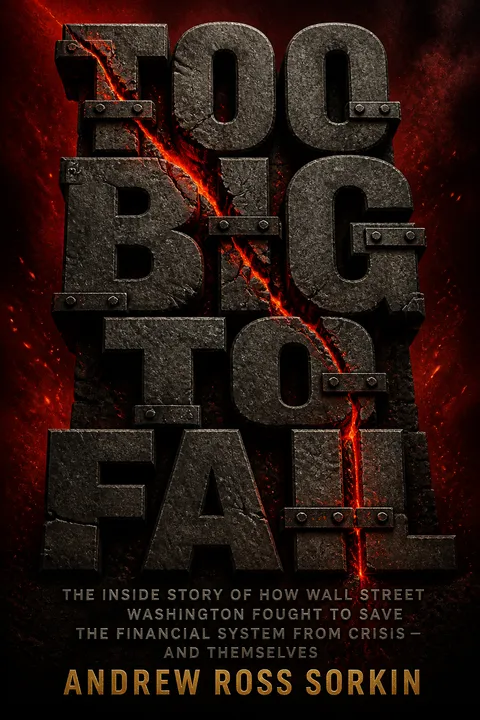


Key Takeaways
Treat the crisis as a network failure, not a collection of bad bets.
Risk traveled everywhere. At the 2007 peak, finance generated more than 40 percent of U.S. corporate profits. The system depended on mortgages being packaged, divided, and sold to investors around the world. Banks also bought these securities from one another, often without knowing the full chain of exposure. When housing prices fell, losses did not stay with the lenders who made the loans. They threatened firms linked through shared assets, counterparties, and short-term funding.
A web, not a row. Wall Street investment banks carried debt-to-capital ratios around 32 to 1. That leverage magnified profits during the boom, but left little room for error. The crisis was not simply a story of bad mortgages. It was a system in which one institution’s uncertainty could make every other institution suspect.
What's striking is how the book replaces the familiar image of a falling domino with a web whose strands are hidden from its participants. Network theory helps explain the danger: tightly connected systems can appear resilient until a shock crosses a threshold, then transmit failure at surprising speed. The same architecture can spread useful risk in calm conditions and amplify it in a panic. That distinction matters because diversification across owners does not guarantee diversification of exposure. If many institutions depend on the same collateral and counterparties, the system may be broadly exposed even when no single firm sees the whole picture.
When nobody can price an asset, liquidity can vanish before losses are known.
Uncertainty froze trading. The subprime mortgage market, worth about $2 trillion at its peak, began to unravel in 2007. Mortgages had been bundled into layered securities whose value depended on assumptions about defaults and housing prices. When those assumptions broke, buyers could not agree on what the securities were worth. BNP Paribas suspended withdrawals from three funds, explaining that parts of the U.S. securitization market could no longer be fairly valued.
A price is infrastructure. Without trustworthy prices, firms could not confidently sell assets, calculate their capital, or judge one another’s health. Some assets were valued through internal models rather than active markets, leaving investors to wonder whether reported figures reflected reality. The market did not need proof that every asset was worthless. It only needed to doubt the numbers.
The episode reveals a subtle distinction between insolvency and illiquidity. A firm may own assets that could retain value over time yet still be unable to sell them quickly at a defensible price. In a funding system that renews loans daily, that timing gap can be fatal. The deeper lesson applies beyond finance: measurement systems are part of an institution’s operating infrastructure, not mere accounting decoration. Still, market prices are not always wise in a panic. A forced sale can turn temporary fear into a permanent loss, so a rescue framework must distinguish genuine value from wishful valuation.
At 32-to-1 leverage, a rumor can become a survival crisis overnight.
Confidence funded Wall Street. Unlike deposit-taking banks, investment banks relied heavily on short-term borrowing, often renewed each day. Creditors and trading partners had to believe the firm would still be standing tomorrow. Once that confidence weakened, they demanded collateral, withdrew business, or stopped lending. The Bear Stearns collapse showed how quickly a run could develop. JP Morgan agreed to acquire Bear after the Federal Reserve offered a backstop for up to $29 billion in losses.
Fear became self-reinforcing. Lehman faced similar pressures months later. Its falling share price, rumors about trading partners, and demands for collateral made it look weaker, encouraging further withdrawals. CEO Jamie Dimon, who could see firms’ exposures through JP Morgan’s business, warned his staff to prepare for several major institutions to fail. In such a market, even a false rumor can trigger real cash demands.
The crisis resembles a bank run even when the institution is not a conventional bank. That is an important correction to the intuition that only depositors can stampede. Any creditor who can refuse to roll over funding can become a source of run risk. The feedback loop also resembles coordination failure: each participant protects itself rationally, yet their combined behavior can destroy the institution they fear. The nuance is that rumors were not the only cause. Lehman had real exposure and disputed valuations. Better communication might buy time, but it could not substitute for capital or credible accounting.
Promote dissent before a balance sheet makes the argument for you.
Loyalty narrowed judgment. Lehman CEO Dick Fuld and president Joe Gregory built a powerful, close-knit leadership circle. As the firm expanded into commercial real estate, mortgages, and leveraged lending, senior employees warned that its risks were growing faster than its safeguards. Michael Gelband and other fixed-income executives questioned the strategy. Yet the firm’s risk chief was often excluded from key discussions, and critics were treated as disloyal or insufficiently aggressive.
Expertise was optional. Gregory believed talented people could move across roles, even when they lacked relevant experience. The firm appointed Erin Callan CFO despite her limited background in treasury and accounting. Her confident public presentations briefly reassured markets, but confidence could not repair the underlying balance sheet. By June 2008, Lehman had reported a $2.8 billion quarterly loss and management dissent had become an internal revolt.
Lehman’s leadership problem was not simply that its executives made bad forecasts. It was that the organization weakened the channels through which forecasts could be challenged. Research on group decision-making often distinguishes psychological safety, the ability to raise inconvenient concerns, from mere collegiality. A loyal team can be cohesive and still be dangerously silent. At the same time, dissent alone does not guarantee sound judgment: a warning must be tested against evidence and translated into decisions. The practical implication is structural. Risk officers need access, authority, and a route to challenge senior leaders without having their careers depend on the leaders they question.
Create an orderly exit for giant firms before markets demand one.
Size was not the whole problem. Regulators feared that a large institution could not be liquidated quickly without disrupting payments, trades, and credit throughout the system. Commercial banks had established receivership processes, but investment banks did not. Treasury Secretary Henry Paulson had argued for authority to wind down failing broker-dealers, yet the government entered the crisis without a clear mechanism.
Improvisation had limits. Officials explored selling Lehman, splitting it into a healthy business and a troubled one, or converting it into a bank holding company. Barclays appeared willing to buy Lehman’s U.S. operations, but British regulators said the bank could not guarantee Lehman’s trades without shareholder approval. That approval could not be secured in time. Lehman filed for bankruptcy, exposing how national rules and cross-border operations could frustrate a rescue or an orderly failure.
The book’s most durable institutional insight is that failure planning belongs in the design of the system, not in the panic room. A credible resolution process can make it possible to impose losses on investors while keeping essential functions operating. That is different from promising that no large firm will fail. The difficulty is that legal powers cannot eliminate political conflict or cross-border dependencies. A domestic plan may still collide with foreign rules, as Barclays’ proposed deal did. Resolution plans therefore need to be tested across jurisdictions, not merely written as a reassuring document.
Set rescue rules consistently, or uncertainty becomes another source of contagion.
Each rescue changed expectations. The government helped arrange Bear Stearns’s sale, then allowed Lehman to fail, and soon after extended an $85 billion loan to AIG in exchange for warrants giving the government a 79.9 percent stake. Officials argued that each case had different facts and that Lehman lacked a viable buyer. Yet investors struggled to infer the rule. Was the government protecting creditors, preventing systemic collapse, or punishing shareholders?
Policy became a moving target. The inconsistency added to anxiety across markets already unsure which firms would receive help. It also sharpened the moral hazard debate: protect risk-takers and they may take more risk, but refuse aid and the damage may spread to workers, borrowers, and firms with no role in the original bets. The officials were improvising under pressure, but markets had to interpret each decision as policy.
This is a hard policy problem, not a simple morality play. A rescue can preserve payment and lending functions while still imposing severe losses on shareholders and executives. Conversely, letting a firm fail can appear principled while creating costs for people far removed from its decisions. Institutional legitimacy depends partly on explaining the distinction in advance. The challenge is that rules must leave room for judgment when the facts differ, yet too much discretion makes every decision look arbitrary. A robust framework would define protected functions, loss-bearing order, and emergency authority before a crisis arrives.
Taxpayer support needs legitimacy as well as financial logic.
The rescue was politically fragile. Treasury’s proposed $700 billion Troubled Asset Relief Program, or TARP, was initially rejected by the House, 228 votes to 205. Lawmakers objected to the cost, the lack of oversight, and the prospect of public money supporting Wall Street while households struggled. The bill passed days later after revisions, including stronger oversight and other concessions. Treasury ultimately shifted toward direct investments in banks, arguing that capital could restore confidence more quickly than buying hard-to-price assets.
Fairness shaped trust. Public anger intensified when AIG paid bonuses to employees after receiving government aid, and when Merrill Lynch’s bonus payments became public. These disputes made technical questions about compensation and deal terms central to whether citizens accepted intervention at all. A rescue could be financially defensible and still lose legitimacy if people believed insiders were protected while the public carried the risk.
Public legitimacy is not a communications afterthought. It affects whether governments can act at all, and whether their actions are trusted once announced. In democratic systems, perceived fairness is part of the policy mechanism because consent depends on who appears to bear the cost. Yet punitive rules can also backfire if they deter participation or delay stabilizing action. The task is to make accountability credible without turning emergency support into a symbolic punishment. Transparent terms, clear limits, and visible consequences for decision-makers can help bridge that tension.
Measure recovery by credit reaching the economy, not by a rescue announcement.
Relief did not mean repair. After TARP passed, markets continued to fall, and businesses and households still struggled to obtain credit. The original plan to purchase troubled assets was difficult to execute because there was no reliable way to price many of them. Treasury pivoted toward injecting capital directly into banks, while the Federal Reserve and FDIC introduced other supports. Each step aimed to keep the financial system functioning, but none could restore confidence instantly.
The real test was transmission. A stable financial institution matters because it finances mortgages, school costs, payrolls, and business investment. If public money props up banks but lending remains frozen, the central purpose has not been achieved. The book ends with an unresolved warning: firms and regulators may mistake survival for reform, allowing leverage and risk to return before the underlying incentives have changed.
The distinction between stabilizing institutions and restoring economic activity is crucial. Financial rescue is an intermediate mechanism, not the final outcome. A bank can report stronger capital and still avoid lending if uncertainty, weak demand, or damaged borrower finances remain. Evaluating policy only by market rallies or repayment of government funds therefore risks confusing balance-sheet repair with social recovery. The same principle applies to crisis management generally: success should be assessed by whether essential functions resume for the people who depend on them, not merely by whether the organization survives.
Analysis
Too Big to Fail is both a crisis chronicle and an account of institutional improvisation. Its narrative power comes from placing structural failures inside specific rooms, phone calls, and rivalries. The reader watches a system with extraordinary technical capacity confront a basic problem: no one can reliably price the assets, map all the exposures, or say in advance which institutions the government will protect. The result is not simply panic caused by bad mortgages. It is a legitimacy crisis in which private actors, regulators, and politicians each fear being left to absorb someone else’s losses.
The book’s strongest analytical thread is the interaction of leverage, opacity, and short-term funding. Each can be dangerous alone. Together, they make confidence a form of infrastructure. A firm can possess valuable long-term assets and still fail because it cannot meet immediate collateral demands. The narrative also shows how organizational culture shapes risk. Lehman’s problems were not invisible to every employee, but warnings had little influence when loyalty and status outweighed independent scrutiny.
The account is strongest at explaining decision pressure and weaker, by design, at settling every counterfactual. It cannot prove whether a different Lehman rescue would have prevented the wider collapse, or merely delayed it. The author’s sourcing note also matters: many conversations are reconstructed from participant recollection, sometimes years after events. That limitation does not erase the value of the scenes, but it counsels against treating every line of dialogue as a transcript.
The policy lesson is not that governments should always rescue large firms, nor that they should never do so. It is that emergency discretion becomes dangerous when it substitutes for resolution rules, credible supervision, and clear loss allocation. The people in the arena had to act without those tools. Their choices may have contained the crisis, but improvisation also amplified uncertainty and public distrust. The enduring question is whether survival buys time for reform, or merely restores the conditions that made rescue necessary.
Review Summary
Too Big to Fail chronicles the 2008 financial crisis, focusing on Lehman Brothers' collapse and the government's response. While praised for its detailed reporting and engaging narrative, some critics found it biased towards Wall Street and lacking in analysis of the crisis' causes. The book is seen as a valuable historical account but criticized for its focus on high-level executives and limited context. Readers appreciate its insights into decision-making during the crisis but note its complexity and occasional lack of explanation for financial concepts.
People Also Read







Glossary
Leverage
Debt amplifying investment exposureLeverage is the use of borrowed money to increase the size of an investment relative to a firm’s own capital. It can magnify profits when asset values rise, but it also magnifies losses when they fall. The book describes investment banks operating at debt-to-capital ratios near 32 to 1, leaving them acutely vulnerable to relatively small declines.
Securitization
Loans repackaged as securitiesSecuritization turns loans, such as mortgages, into securities that can be sold to investors. Banks bundle loans, divide the resulting claims into slices, and distribute them across markets. The process can make lending easier to fund, but it can also obscure who ultimately bears the risk and create dense connections among institutions.
collateralized debt obligations
Debt divided into rated slicesCollateralized debt obligations, or CDOs, are securities assembled from pools of debt, including mortgage-related assets. The pool is divided into tranches with different levels of priority and risk. Investors treated highly rated tranches as safe, but the underlying assets and the models used to value them could fail together, making the securities difficult to price or sell.
credit default swaps
Contracts protecting against defaultCredit default swaps, or CDS, are contracts that transfer the risk of a borrower or financial instrument defaulting. A buyer pays for protection, while the seller agrees to cover specified losses if a credit event occurs. In the crisis, AIG sold enormous volumes of this protection. Falling values and rating downgrades triggered demands for additional collateral, creating a severe cash strain.
repo
Short-term borrowing against securitiesA repurchase agreement, or repo, is a short-term loan secured by financial assets. A firm receives cash by temporarily transferring securities and agrees to buy them back later. Investment banks used repo markets to fund operations and trading. Because the loans were frequently renewed, lenders’ doubts could quickly become a liquidity crisis.
mark-to-market
Value assets at current pricesMark-to-market accounting records assets at an estimated current market value rather than simply at their purchase price. When active trading exists, the estimate can be grounded in observable prices. For illiquid assets, firms may rely on internal models, creating disputes about whether reported values reflect genuine market conditions or optimistic assumptions.
moral hazard
Protection encouraging greater riskMoral hazard is the possibility that people or firms take greater risks when they expect someone else to absorb the consequences. During the crisis, officials feared that rescuing financial institutions would teach creditors and executives to expect future government support. They also feared that refusing support could cause losses to spread beyond those who made the risky decisions.
Troubled Asset Relief Program
Federal financial rescue programThe Troubled Asset Relief Program, or TARP, was authorized in October 2008 with up to $700 billion to address the financial crisis. Initially presented as a program to purchase troubled assets, it shifted toward direct capital investments in banks. The program became a focal point for disputes over public money, oversight, executive compensation, and accountability.
Too big to fail
Failure threatens the wider systemThe phrase describes an institution whose collapse could disrupt the broader financial system because of its size, connections, or role in essential markets. The book emphasizes that the practical problem is often not size alone, but the difficulty of winding down a complex firm quickly without disrupting trades, payments, and credit.
FAQ
What's Too Big to Fail about?
- Chronicle of the 2008 Crisis: Too Big to Fail by Andrew Ross Sorkin provides a detailed account of the events leading up to the 2008 financial crisis, focusing on the actions of key players in Wall Street and Washington.
- Interconnectedness of Institutions: It highlights how the failure of one major financial institution could lead to a domino effect, threatening the entire financial system.
- Human Element: The narrative emphasizes the personal stories and decisions of influential figures, illustrating their struggles and motivations during a time of unprecedented economic turmoil.
Why should I read Too Big to Fail?
- In-depth Analysis: Andrew Ross Sorkin offers a comprehensive look at the financial crisis, making it a valuable resource for understanding the complexities of modern finance.
- Real-life Implications: The book provides insights into the consequences of financial mismanagement and the importance of regulatory oversight, relevant for both investors and policymakers.
- Engaging Narrative: Sorkin's storytelling approach makes the intricate details of the crisis accessible and engaging, appealing to both financial professionals and general readers.
What are the key takeaways of Too Big to Fail?
- Systemic Risk Awareness: The book underscores the concept of "too big to fail," illustrating how large financial institutions can pose risks to the entire economy.
- Importance of Transparency: It emphasizes the need for transparency in financial dealings and the dangers of complex financial products that can obscure true risk.
- Regulatory Challenges: The narrative highlights the challenges regulators face in managing and overseeing a rapidly evolving financial landscape.
What are the best quotes from Too Big to Fail and what do they mean?
- “Size, we are told, is not a crime.”: This quote reflects the central theme of the book, questioning the ethics of large financial institutions and their impact on the economy.
- “You are about to experience the most unbelievable week in America ever.”: This statement foreshadows the chaos and unprecedented events that would unfold during the financial crisis, emphasizing the gravity of the situation.
- “This is a matter of life and death.”: This quote illustrates the high stakes involved for both individuals and institutions during the crisis, highlighting the urgency of the decisions being made.
How does Too Big to Fail explain the concept of "too big to fail"?
- Definition of the Concept: The term "too big to fail" refers to financial institutions whose failure would have catastrophic consequences for the economy, leading to government intervention to prevent their collapse.
- Systemic Risk: The book illustrates how the interconnectedness of large financial institutions creates systemic risk, where the failure of one can lead to a domino effect impacting others.
- Government Bailouts: It discusses the moral hazard associated with the concept, as institutions may take excessive risks knowing they will be bailed out, ultimately leading to taxpayer burdens.
What role did AIG play in the financial crisis as described in Too Big to Fail?
- Insurance and Derivatives: AIG was heavily involved in writing credit default swaps, which insured against defaults on mortgage-backed securities, exposing it to massive liabilities as the housing market collapsed.
- Government Bailout: The book details how AIG required a government bailout to prevent its collapse, which was seen as necessary to stabilize the financial system due to its size and interconnectedness with other institutions.
- Impact on Taxpayers: AIG's bailout raised significant concerns about the use of taxpayer money to rescue a private company, highlighting the complexities of moral hazard in financial regulation.
How did the collapse of Lehman Brothers affect the financial system?
- Trigger for Panic: Lehman’s bankruptcy is portrayed as the catalyst for widespread panic in the financial markets, leading to a loss of confidence among investors.
- Cascading Failures: The book details how Lehman’s failure caused a domino effect, impacting other financial institutions and leading to a liquidity crisis.
- Regulatory Changes: The aftermath of Lehman’s collapse prompted significant regulatory changes aimed at preventing future crises, including reforms in banking practices and oversight.
How does Too Big to Fail address the concept of moral hazard?
- Definition of Moral Hazard: The book explains moral hazard as the tendency of institutions to take on excessive risks when they believe they will be rescued by the government.
- Examples in the Crisis: It provides examples, such as AIG and Lehman Brothers, where executives acted recklessly, believing that their firms were “too big to fail.”
- Consequences of Moral Hazard: The narrative discusses the broader implications of moral hazard for the financial system, including the potential for future crises if institutions do not face the consequences of their actions.
What specific methods did the government use to stabilize the financial system in Too Big to Fail?
- TARP Implementation: The Troubled Asset Relief Program (TARP) was established to purchase toxic assets from banks, providing them with much-needed liquidity. This method aimed to restore confidence in the financial system.
- Capital Injections: The government injected capital directly into banks, ensuring they had sufficient funds to operate. This approach was crucial for stabilizing institutions deemed "too big to fail."
- Guarantees on Deposits: The FDIC expanded its insurance coverage to reassure depositors and prevent bank runs. This measure aimed to maintain public confidence in the banking system.
How does Too Big to Fail depict the culture of Wall Street?
- Competitive Environment: The book illustrates the cutthroat nature of Wall Street, where firms are constantly vying for dominance and profits, often at the expense of ethical considerations.
- Risk-taking Mentality: It portrays a culture that encourages high-risk behavior, with executives often prioritizing short-term gains over long-term stability.
- Impact of Reputation: The narrative shows how reputation and public perception play crucial roles in the decisions made by financial institutions, especially during times of crisis.
What lessons can be learned from Too Big to Fail?
- Need for Regulation: The book emphasizes the importance of effective regulation to prevent excessive risk-taking by financial institutions.
- Transparency in Finance: It advocates for greater transparency in financial products and practices to ensure that investors and regulators can accurately assess risk.
- Preparedness for Crises: Sorkin highlights the necessity for both financial institutions and regulators to be prepared for potential crises, including having contingency plans in place.
What role did key figures like Hank Paulson and Timothy Geithner play in Too Big to Fail?
- Hank Paulson's Leadership: As Treasury Secretary, Paulson was at the forefront of the government's response to the crisis. His decisions and actions were critical in shaping the bailout strategies and interventions.
- Timothy Geithner's Influence: Geithner, as president of the New York Fed, played a key role in coordinating responses and negotiations with financial institutions. His insights and recommendations were influential in shaping the government's approach.
- Collaboration and Tension: The book depicts the collaboration and tension between Paulson and Geithner as they navigated the crisis. Their differing perspectives on intervention and regulation highlight the complexities of crisis management.
Download PDF
Download EPUB
.epub digital book format is ideal for reading ebooks on phones, tablets, and e-readers.








