

Key Takeaways
Treat spiritual truth as something to investigate, never something to inherit
A teacher refused the throne. In 1929, Krishnamurti dissolved the Order of the Star, which had been organized to prepare for his arrival as a World Teacher. Thousands had spent eighteen years awaiting him. He rejected the role, arguing that a spiritual organization can turn discovery into doctrine and a teacher into an authority to obey. Followers may gain belonging, but belonging is not freedom. He distinguished practical organizations, which can help people travel or coordinate, from groups claiming to lead the mind to truth.
The break was deliberate. Krishnamurti said that following even him would replace direct inquiry with dependence. The point was not to install a new, purer institution, but to question why people want someone else to guarantee their inner security.
What's striking is that the dramatic act was not simply a rejection of hierarchy. It was a test of whether an audience could hear a message without turning its messenger into proof. The challenge remains relevant wherever a community prizes personal inquiry but quietly rewards agreement with a founder. Still, institutions can protect vulnerable people and coordinate shared work. The useful distinction is not organization versus no organization, but practical cooperation versus claims of spiritual authority.
Face the fact before inventing an ideal to escape it
Ideals can postpone change. Krishnamurti argues that a mind that sees its own violence and then worships nonviolence may be avoiding the present fact. The ideal is built from the opposite of what is happening now, so the person can feel morally directed while remaining violent. The same pattern applies to envy, fear, or ambition: imagining a future self can distract from examining the motives shaping action today.
Look without an alibi. He urges observation without condemnation, justification, or escape. In his account, this is not passive acceptance. Seeing how a belief, family arrangement, or social convention works can reveal what needs to change. The book links this clear examination to suffering, which can expose conflict when it is no longer covered over by comforting explanations.
This argument usefully separates honest attention from self-improvement theater. A person can rehearse an admirable identity while leaving the behavior that contradicts it untouched. Yet ideals also help people name injustice and coordinate reform. The sharper question is whether an ideal serves as a practical guide or as a psychological shelter from evidence. Krishnamurti is strongest when he asks readers to test their motives, not when the critique is taken to mean that every future-oriented goal is evasive.
Observe anger without inventing an inner controller to fight it
The watcher belongs to the watched. Krishnamurti challenges the familiar idea that a separate inner self can manage emotions from a safe distance. The observer, he says, is made of the same memories and judgments that shape the anger, fear, or envy being observed. Treating the two as separate creates an inner contest: one part condemns, suppresses, or rationalizes another.
Attention changes the relation. Instead of asking how to eliminate anger, notice it as it arises, without defending or condemning it. Krishnamurti calls this “choiceless awareness,” observation without selecting only the feelings that seem acceptable. He argues that when the split between watcher and feeling drops away, the conflict sustaining the reaction can end. This does not mean acting out every impulse; it means seeing the impulse clearly before reacting.
The distinction reaches beyond ordinary self-monitoring. Metacognition often treats the mind as capable of stepping back and inspecting its own activity; Krishnamurti asks whether that step back is another mental activity shaped by the past. This can loosen shame and make emotional patterns easier to see. It also leaves a practical question: some emotions signal real danger or injustice and require action. Clear observation can inform that action, but it cannot substitute for judgment about consequences.
Use clock time, but stop postponing inner change until tomorrow
Not all time is the same. Krishnamurti distinguishes chronological time, needed to catch a train or learn a skill, from psychological time: the inward story that a person will become peaceful, honest, or free at some future point. He argues that the promise of gradual change can preserve the very pattern being changed. Someone who is violent today may keep acting violently while aspiring to a future state of nonviolence.
Meet the present pattern. The book asks readers to observe what is happening now rather than treating the present as merely a step toward a better self. Thought draws on memory to project the future, so psychological time can reinforce old reactions. Krishnamurti’s claim is that understanding may transform a response immediately, without a prescribed waiting period.
The distinction is powerful because it exposes procrastination disguised as personal development. It also echoes a practical difference between acquiring a technique over time and noticing a choice that can be made in the moment. The limitation is that psychological change is rarely uniform: insight may be immediate, while recovery, new skills, and altered circumstances can take sustained work. The idea is most useful as a warning against postponing honest recognition, not as a guarantee that every entrenched difficulty vanishes at once.
Build relationships without turning people into your emotional shelter
Dependence can hide inside affection. In one conversation, a successful, married passenger describes a persistent, unnamed fear. Krishnamurti traces it not to his job or family finances, but to his reliance on his wife to cover a deeper loneliness. The relationship offers comfort, yet the fear of losing that comfort can feed possessiveness, jealousy, and anxiety. The question is not whether people should care for each other, but whether care has become a demand for security.
Notice the pictures. Krishnamurti says partners often respond to accumulated images of each other: memories of past hurts, favors, arguments, and expectations. Meeting the image rather than the person keeps old conflicts active. His account of love is not possession or emotional bargaining, but a relationship in which both people can remain free.
The passage gives a memorable account of how reassurance can become a contract: stay as I need you to be, and I will feel safe. Contemporary attachment thinking adds an important nuance: dependable bonds can support exploration rather than prevent it. Reliance is not automatically possessiveness, and mutual care is not a failure of independence. The useful test is whether closeness permits each person to change, or whether it requires each to keep performing a role that protects the other from uncertainty.
Let pleasure end before memory turns delight into a demand
Thought can replay a moment. Krishnamurti describes pleasure as a process in which perception and sensation are followed by contact, desire, and thought’s wish to repeat what felt good. Seeing a beautiful landscape may be immediate delight. Recalling it and insisting on the same feeling tomorrow turns it into something to pursue. The pleasure becomes tied to comparison with a remembered experience, and disappointment follows when the new moment differs.
Do not confuse joy with its replay. The book does not demand that people reject ordinary enjoyment. It asks them to notice when memory begins directing attention toward repetition and possession. In Krishnamurti’s distinction, joy arrives without being summoned; thought can turn it into a project. Attention to that shift offers a way to enjoy an experience without making it a promise.
This is a precise account of how anticipation can crowd out experience. The mind does not merely remember pleasure; it uses memory to set expectations, compare outcomes, and keep desire active. That can clarify the difference between savoring and compulsive repetition. But memory also supports learning and meaningful continuity, so the target cannot be remembering as such. The more defensible insight is to notice when a past pleasure becomes a demand that the present reproduce it.
Stay with grief instead of converting loss into self-pity
Loss reveals what was relied upon. In a story about a man mourning his father, grief includes remorse over a strained relationship and the sudden feeling of being alone. Krishnamurti asks him to distinguish sorrow for the dead from the pain of losing a familiar bond. His inquiry suggests that grief may contain both love and self-pity, the distress of facing an emptiness previously covered by another person.
Do not rush toward an escape. The man wants to know how to get over his sorrow. Krishnamurti instead asks him to face it without comparison, explanation, or comforting belief. He does not present this as a formula for erasing loss. His emphasis is on experiencing grief directly rather than replacing it with a ready-made story about what it means.
The story asks a difficult but valuable question: what exactly hurts when someone dies? Naming loneliness or dependence can reveal dimensions of grief that sentimental language hides. Yet the distinction between mourning another and pitying oneself can be too neat. Grief is often relational, bodily, and socially shared, not merely a private failure to face emptiness. The passage works best as an invitation to examine a particular sorrow, not as a universal judgment about what bereaved people feel.
Treat the world’s divisions as habits reproduced in daily relationships
Society is made in relationship. Across the book, Krishnamurti links private habits of possession, ambition, and identification to public divisions such as class, nationalism, and religious conflict. The claim that “you are the world” means that people share recurring psychological patterns, not that every person has identical circumstances. A community organized around competing identities can reproduce conflict even when it replaces one political doctrine with another.
Question the small divisions. The book asks readers to examine how they relate to people, property, and ideas, rather than waiting for a perfect system to transform them. This is not a claim that social conditions do not matter. It is a warning that reforms can leave the motives behind division untouched, allowing old patterns to return under new names.
The argument makes social responsibility personal without reducing society to individual attitude alone. Identity can shape perception and solidarity, but institutions also distribute resources and power in ways that private insight cannot immediately correct. The strongest reading joins both scales: examine how ordinary relationships reproduce hierarchy, while still changing rules and material conditions. Otherwise, a call for inward revolution could unintentionally burden individuals with problems that also require collective political action.
Educate for attention, not merely for efficient conformity
Competence is not wholeness. Krishnamurti criticizes schooling that chiefly rewards memory, examinations, competition, and career preparation. Such education may produce skilled specialists who cannot examine the fears, ambitions, and social divisions shaping their lives. He argues for educating the whole person: intellectual capacity, emotional sensitivity, physical health, and awareness of relationships with people and nature.
Make safety different from dependence. In his educational vision, a student should feel secure enough to question, explore, and learn without being threatened into obedience. The teacher is not merely an authority delivering information, and parents should support the school’s broader purpose rather than demand only a respectable career. His account also distinguishes attention, open awareness, from concentration forced by reward, punishment, or comparison.
This vision usefully challenges the assumption that high achievement automatically produces mature judgment. A classroom can teach a subject while also shaping how students handle uncertainty, status, and disagreement. The emphasis on psychological safety is especially important: curiosity is difficult when mistakes threaten a student’s standing. Still, assessment and structured instruction have legitimate uses. The question is whether they serve learning or become the only measures of a person’s worth and potential.
Make meditation the quality of daily attention, not a ritual
Meditation begins in ordinary life. Krishnamurti rejects the idea that a posture, breathing routine, mantra, or control technique can deliver truth. He connects meditation instead to observing thought, emotion, and behavior as they occur, and to bringing order into daily relationships. In his view, a mind that is busy suppressing conflict or chasing a special experience is still caught in the activity it hopes to transcend.
Silence is not a trick. The book’s nature passages show attention directed toward a tree, birds, changing light, or the sounds of a landscape without immediately turning them into labels or possessions. Krishnamurti associates such undivided observation with silence and a sense of space. He treats the sacred as something that cannot be manufactured by belief, ritual, or expectation.
The account makes meditation less like a private performance and more like a way of meeting experience. Its connection between attention to nature and attention to human life also resists the idea that contemplation requires withdrawal from the world. A useful caution is that practices can help some people stabilize attention, even if they cannot guarantee insight. The distinction is between using a practice as support and mistaking the technique itself for the transformation it is meant to serve.
Analysis
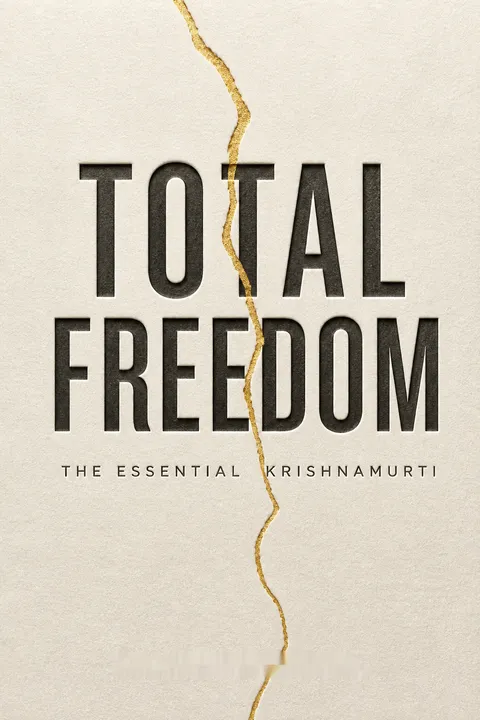
Total Freedom is an anthology rather than a conventional argument with a single unfolding proof. Its editors arrange six decades of talks, dialogues, and reflective writing around recurring questions: Who am I without inherited beliefs? Can conflict end without an inner battle? What does freedom mean if no authority can provide it? The collection’s narrative hinge is Krishnamurti’s 1929 dissolution of the Order of the Star. That public renunciation supplies the book’s governing method: distrust any answer that becomes a substitute for seeing.
The method is both the book’s strength and its difficulty. Krishnamurti repeatedly asks readers to attend to an emotion before labeling, judging, or managing it. His claim that the observer is not separate from what is observed gives this inquiry unusual force. It challenges the assumption that the self can stand outside its own conditioning and fix it like a machine. The same move links private distress to social life: identities, ideologies, and institutions are not abstractions alone, but patterns enacted in relationships.
The collection also presses a demanding conclusion: insight can be immediate, while gradual psychological self-improvement may perpetuate the problem it targets. That challenge can interrupt endless postponement. It can also be overstated. Some patterns are reinforced by trauma, material deprivation, social power, and learned behavior, conditions that may require sustained support and collective change. Direct attention need not exclude therapy, disciplined practice, or political action. The strongest reading treats Krishnamurti’s critique as a challenge to dependence and avoidance, not a ban on every method or institution.
His educational and ecological passages widen the argument. A life of attention includes how children are taught, how people treat one another, and whether nature is encountered as living presence or resource. The result is not a step-by-step system but a rigorous invitation to observe the machinery of one’s own thought. Readers seeking a program may find the refusal frustrating. Readers willing to question the wish for a program will find the book’s central experiment: look closely enough that the observer, the problem, and the act of seeing are no longer assumed to be separate.
Review Summary
Total Freedom by J. Krishnamurti receives predominantly positive reviews, praised for its thought-provoking insights on consciousness, freedom, and self-awareness. Readers appreciate Krishnamurti's direct approach and challenging ideas, though some find the content repetitive or difficult to grasp. The book is seen as a powerful tool for personal growth and understanding, encouraging readers to question beliefs and think critically. While most reviewers find it transformative, a few critics argue that Krishnamurti's ideas lack originality or practical application.
People Also Read










Glossary
Truth is a pathless land
No prescribed route to truthKrishnamurti’s central claim that truth cannot be reached through a prescribed religion, sect, teacher, ritual, or psychological system. It is not a denial that people can learn from one another. It rejects the idea that another person or institution can supply inner realization, and asks each person to examine experience directly.
Choiceless awareness
Observation without selectionA form of attention that observes thoughts, emotions, and surroundings without immediately choosing, condemning, justifying, or trying to change what appears. Krishnamurti presents it as different from forced concentration, which excludes distractions to pursue a chosen object. The aim is to see a reaction clearly, including the judgments brought to it.
The observer is the observed
Self and reaction are inseparableKrishnamurti’s claim that the self watching an emotion is not a separate entity outside it. The observer is shaped by memory, experience, and thought, just as the observed emotion is. Treating them as separate can create conflict through control or suppression. Seeing their connection is presented as a basis for clearer attention.
Psychological time
Inner becoming projected forwardThe inward movement of imagining that one will become better, calmer, or more fulfilled in the future. Krishnamurti distinguishes it from chronological time, which is necessary for practical life. He argues that psychological time can postpone direct understanding by keeping attention fixed on a future ideal instead of the present condition.
Content of consciousness
What shapes the mind’s experienceThe accumulated beliefs, memories, fears, desires, images, and cultural influences that make up a person’s familiar mental life. Krishnamurti argues that this content is not merely private: people across cultures share many forms of fear, sorrow, ambition, and conflict. Examining the content is central to his account of self-understanding.
Attention
Open, unforced observationA state of awareness that is not produced by coercion, reward, comparison, or narrowing the mind around a single chosen point. In Krishnamurti’s educational and meditative discussions, attention involves observing both the outer world and one’s own reactions. It differs from concentration when concentration means excluding other activity through effort.
FAQ
What's Total Freedom: The Essential Krishnamurti about?
- Exploration of Existence: The book delves into the nature of human existence, focusing on self-awareness and the dissolution of conditioning as paths to true freedom.
- Rejection of Authority: Krishnamurti emphasizes the importance of personal exploration over reliance on external authorities or ideologies.
- Pathless Truth: It presents the idea that "Truth is a pathless land," meaning there is no single path to truth; each person must discover their own understanding.
Why should I read Total Freedom: The Essential Krishnamurti?
- Timeless Wisdom: Krishnamurti's insights are relevant across cultures and eras, addressing universal human concerns.
- Encourages Self-Discovery: The book invites readers to embark on a journey of self-exploration, fostering a deeper understanding of their thoughts and emotions.
- Challenges Conventional Thinking: It provokes thought and inspires change by challenging assumptions about life, society, and spirituality.
What are the key takeaways of Total Freedom: The Essential Krishnamurti?
- Self-Awareness is Crucial: Understanding oneself is the foundation for true freedom, leading to liberation from societal conditioning.
- Illusion of Time: Psychological time affects our perception of life; true understanding transcends time.
- Freedom from Conditioning: Breaking free from societal and personal conditioning is essential for personal responsibility and transformation.
What are the best quotes from Total Freedom: The Essential Krishnamurti and what do they mean?
- “Truth is a pathless land.”: Emphasizes personal exploration over following established doctrines to discover truth.
- “The moment you follow someone you cease to follow Truth.”: Highlights the importance of personal exploration over blind adherence to authority.
- “When the mind is still, tranquil... there can be a regeneration.”: Suggests that clarity and insight arise from stillness rather than constant mental activity.
How does Krishnamurti define freedom in Total Freedom: The Essential Krishnamurti?
- Freedom from Fear: True freedom is the absence of fear, which is a major barrier to understanding oneself.
- Self-Liberation: Freedom is achieved through self-awareness and understanding, not granted by external circumstances.
- Beyond Ideals: Transcending societal ideals and conditioning is necessary for true understanding.
What role does fear play in Total Freedom: The Essential Krishnamurti?
- Fear as a Limiting Factor: Fear restricts human potential and understanding, perpetuating itself through avoidance.
- Fear and Self-Pity: Dwelling on fears leads to a cycle of sorrow; confronting fear directly is essential.
- Overcoming Fear: Observing fears without judgment can lead to liberation from their grip.
How does Krishnamurti view the relationship between the individual and society in Total Freedom: The Essential Krishnamurti?
- Interconnectedness: The individual and society are deeply interconnected; societal issues stem from individual actions.
- Responsibility of the Individual: Societal change begins with personal transformation and responsibility.
- Critique of Ideals: Reliance on collective ideals often leads to conflict; understanding society comes from understanding oneself.
What is the significance of self-awareness in Total Freedom: The Essential Krishnamurti?
- Foundation for Understanding: Self-awareness is essential for personal growth and understanding.
- Awareness of Conditioning: Recognizing one’s conditioning is the first step toward transformation.
- Path to Freedom: Self-awareness leads to freedom from fear and societal constraints.
How does Krishnamurti suggest we approach education in Total Freedom: The Essential Krishnamurti?
- Holistic Development: Education should foster total development, not just academic achievement.
- Freedom from Authority: Traditional education promotes conformity; independent thought is crucial.
- Encouraging Inquiry: Education should encourage inquiry and self-discovery rather than rote learning.
How does Total Freedom: The Essential Krishnamurti address the concept of love?
- Love Beyond Attachment: True love is free from possessiveness and desire.
- Love as Compassion: Love is a state of compassion that arises when one is free from fear and sorrow.
- Love Requires Freedom: Love flourishes in an environment of psychological freedom.
What is Krishnamurti's view on meditation in Total Freedom: The Essential Krishnamurti?
- Meditation as Awareness: True meditation is about cultivating awareness, not following a system.
- Silence and Attention: A quiet mind is necessary for genuine meditation and deeper observation.
- Freedom from Control: True meditation arises naturally from awareness, not forced practice.
How can one apply the teachings of Total Freedom: The Essential Krishnamurti in daily life?
- Practice Self-Inquiry: Regular self-inquiry helps understand thoughts, emotions, and conditioning.
- Cultivate Awareness: Develop awareness of reactions and responses in daily interactions.
- Embrace the Present Moment: Focus on living fully in the present, letting go of past conditioning and future expectations.
About the Author
Other books by J. Krishnamurti









Download PDF
Download EPUB
.epub digital book format is ideal for reading ebooks on phones, tablets, and e-readers.








