Key Takeaways
1. A Proud Nation's Ancient Ways and Sacred Lands
The Cherokees were often selected for distinction because they were inheritors of a dignity beyond their rather simple means and even referred to themselves as the “principal people.”
A unique culture. The Cherokees, calling themselves the "principal people," held a deep spiritual connection to their vast ancestral lands, believing them to be the center of the Earth. Their society was characterized by a strong clan system, where women held significant rights, including property ownership and the power to decide marriage and divorce. Their language was musical, their men were skilled hunters and fierce warriors, and their daily lives were interwoven with spiritual practices involving water, sun, and fire.
Harmony with nature. Cherokee life was deeply integrated with the natural world, guided by shamans who served as doctors, priests, and interpreters of the spirit world. Children were taught reverence for animals and the forest, learning to track, hunt, and live in balance with their environment. This traditional upbringing fostered a sense of dignity, self-reliance, and a unique identity that set them apart from their European neighbors.
Early observations. European observers, like naturalist William Bartram, noted the Cherokees' "grave and steady; dignified and circumspect in their deportment; rather slow and reserved in conversation; yet frank, cheerful and humane." Their hospitality was evident, though their men maintained an aloof independence, never bowing to others. This proud and self-sufficient culture, however, would soon face unprecedented challenges from the encroaching white settlers.
2. The Relentless Tide of White Expansion and Broken Promises
The whites were now an even greater threat than Indian tribes, whites settling on land sold by the Cherokees, then moving onto unsold land, a tide uncontrolled by their own governments, even uncontrollable, a people with land their single thought, knowing nothing as dear as land to own.
Unending land hunger. From the late 18th century, the Cherokees faced an relentless encroachment on their territory, driven by white settlers' insatiable desire for land. Despite numerous treaties with various governments—British, French, Spanish, and later the newly formed United States—guaranteeing their boundaries, these agreements were consistently violated. Settlers, often beyond the control of their own governments, pushed further into Cherokee lands, viewing the vast, unplowed wilderness as theirs for the taking.
Cycles of conflict. This constant pressure led to cycles of violence, with skirmishes, raids, and full-scale wars erupting between Cherokees and whites. The Cherokees, once formidable warriors who had conquered other tribes, found themselves in a losing battle against an ever-growing and technologically superior foe. Each conflict, often sparked by white aggression, invariably resulted in further land cessions, chipping away at their ancestral domain.
A legal quagmire. The situation was complicated by overlapping and contradictory claims from multiple entities:
- Thirteen newly independent states (e.g., Georgia claiming Alabama and Mississippi, North Carolina claiming land to the Pacific).
- The new American central government asserting jurisdiction over Indian affairs.
- Lingering influence of European powers (English, French, Spanish) in the Mississippi Valley.
- Numerous Indian tribes with their own claims.
This patchwork of authority made meaningful negotiation nearly impossible, as the Cherokees struggled to identify a single, trustworthy entity with whom to treat.
3. Internal Strife: Traditionalists Clash with Progressives
The two struggles of the Cherokees during Ridge’s long lifetime were their effort to protect their territory from the intrusion of white settlers and their attempt to adapt their culture in order to meet the appeals and pressures of the cultures of the white man.
A nation divided. As external pressures mounted, the Cherokee nation found itself increasingly divided internally. The primary struggle was between those who advocated for cultural adaptation to white ways—adopting farming, education, and a republican government—and those who clung fiercely to traditional customs, fearing that assimilation would lead to the loss of their identity. This division often fell along lines of mixed-blood versus full-blood Cherokees.
Rise of the progressives. Figures like Major Ridge, James Vann, and Charles Hicks, often of mixed heritage, emerged as leaders of the progressive faction. They embraced elements of white civilization:
- Large-scale farming with plows and cotton.
- Owning black slaves for labor.
- Building frame houses and establishing businesses like stores and ferries.
- Seeking education for their children in English.
They believed that by demonstrating "civilization," the Cherokees could secure their land rights and gain respect from the United States government.
Traditionalist resistance. Conversely, many full-blood Cherokees and shamans resisted these changes, viewing them as an erosion of their sacred ways. They saw white culture as corrupting, leading to vices like whiskey consumption and the abandonment of communal values. Shamans, in particular, warned against adopting white customs, attributing misfortunes like disease and land loss to the abandonment of ancient traditions. This internal conflict would ultimately weaken the nation's ability to present a united front against external threats.
4. The Dawn of Literacy and a New Cherokee Identity
Never in all the generations of all the Indians in America had any tribe had a way to write its language; and now, here and now, the Cherokees were prepared.
Sequoyah's genius. Amidst the turmoil, a remarkable innovation emerged from an unexpected source: Sequoyah (George Gist), a mixed-blood silversmith. Uneducated in English, Sequoyah spent years developing a written syllabary for the Cherokee language, a system of 86 characters representing each distinct sound. This monumental achievement allowed Cherokees to read and write in their native tongue, bridging the gap between oral tradition and written communication.
Literacy explosion. The syllabary was incredibly easy to learn, and within a few years, thousands of Cherokees became literate. This newfound literacy had a profound impact:
- Communication: Relatives could "talk at a distance" through letters.
- Education: It facilitated the spread of knowledge and the translation of texts.
- Cultural preservation: It provided a means to record Cherokee history, laws, and traditions.
- National pride: It became a powerful symbol of Cherokee intellectual capability and sovereignty.
The Cherokee Phoenix. The establishment of the Cherokee Phoenix newspaper in 1828, printed in both English and Cherokee using Sequoyah's syllabary, was a testament to this progress. Edited by Elias Boudinot, it became a vital tool for disseminating information, articulating Cherokee grievances, and fostering a sense of national identity. This intellectual flourishing, however, occurred precisely when external forces were most determined to dismantle the Cherokee nation.
5. Jackson's Unyielding Stance: Removal as Inevitable
“Build a fire under them. When it gets hot enough, they’ll move.”
A President's resolve. Andrew Jackson, a celebrated Indian fighter and hero of Horseshoe Bend and New Orleans, ascended to the presidency in 1828 with a clear and unyielding policy: the removal of all Indian tribes east of the Mississippi River. He viewed Indians as obstacles to national expansion and believed their "civilization" was impossible. His stance was rooted in a deep-seated conviction that white settlers had a right to the land and that Indians could not coexist within sovereign states.
Georgia's aggressive laws. Emboldened by Jackson's election, Georgia intensified its campaign to assert jurisdiction over Cherokee lands within its borders. The state passed a series of draconian laws designed to dismantle Cherokee sovereignty and force their emigration:
- Forbidding Indians from digging for gold on their own land.
- Denying Indians the right to testify in court against whites.
- Outlawing Cherokee council meetings and political assemblies.
- Imprisoning white missionaries who refused to swear allegiance to Georgia law.
These laws effectively stripped Cherokees of their rights and protections, creating an unbearable environment.
Supreme Court's impotence. The Cherokees, represented by attorney William Wirt, appealed to the U.S. Supreme Court. In Worcester v. Georgia (1832), Chief Justice John Marshall famously ruled that the Cherokee Nation was a "distinct community, occupying its own territory... in which the laws of Georgia can have no force." However, Jackson famously defied the ruling, stating, "John Marshall has made his decision; now let him enforce it." This executive refusal rendered the Supreme Court's decision powerless, leaving the Cherokees without federal protection against Georgia's aggression.
6. The Fateful Treaty of New Echota and Its Architects
He was heard to say, as he made an X, that he had signed his death warrant. He justified his action with the argument that an intelligent minority has a moral right and duty to save a blind and ignorant majority from inevitable ruin.
A desperate gamble. Faced with Jackson's unwavering resolve and Georgia's escalating aggression, a faction of Cherokee leaders, known as the Treaty Party, concluded that further resistance was futile. Led by Major Ridge, his son John Ridge, and his nephew Elias Boudinot, they believed the only path to survival for their people was to negotiate a removal treaty. They saw themselves as an "intelligent minority" making a painful but necessary decision to save their "blind and ignorant majority" from utter destruction.
The controversial treaty. In December 1835, this minority faction, without the consent of the majority of the Cherokee Nation or its Principal Chief John Ross, signed the Treaty of New Echota with the U.S. government. The treaty stipulated:
- Cession of all remaining Cherokee lands in the East for $5 million.
- Relocation to 13 million acres in the West, plus an additional 800,000 choice acres.
- Provisions for travel, subsistence, and compensation for lost property.
Major Ridge, upon signing, reportedly acknowledged it as his "death warrant," foreseeing the violent repercussions from those who would view it as an act of betrayal.
Ross's unwavering opposition. Principal Chief John Ross vehemently opposed the treaty, arguing it was fraudulent because it lacked the consent of the majority of the Cherokee people. He tirelessly lobbied Congress and President Jackson, presenting petitions with thousands of signatures, but his efforts were ultimately unsuccessful. Despite widespread public and missionary sympathy, Jackson's political pressure led to the treaty's ratification by the Senate by a single vote in May 1836, sealing the fate of the eastern Cherokees.
7. The Trail of Tears: A Journey of Unspeakable Suffering
Long time we travel on way to new land. People feel bad when they leave Old Nation. Womens cry and made sad wails. Children cry and many men cry, and all look sad like when friends die, but they say nothing and just put heads down and keep on go towards West.
Forced eviction. The Treaty of New Echota set a two-year deadline for voluntary removal, expiring in May 1838. When the vast majority of Cherokees refused to leave their homes, General Winfield Scott was dispatched with an army of 7,000 soldiers to forcibly round them up. Families were dragged from their homes at bayonet point, often with only minutes to gather meager possessions, while white looters immediately plundered their abandoned properties.
Confinement and disease. Thousands of Cherokees were confined in hastily constructed, unsanitary internment camps, where disease spread rapidly. The summer heat, poor sanitation, inadequate food, and lack of medical care led to widespread illness and death, particularly among the elderly and infants. Despite pleas from Cherokee leaders and some military officers, the initial forced removals by boat also proved deadly due to harsh conditions and disease.
The overland march. In the autumn of 1838, under a new agreement negotiated by John Ross, the remaining Cherokees began their forced overland march to the West, organized into thirteen detachments. This arduous journey, spanning nearly a thousand miles through harsh winter weather, became known as the "Trail of Tears."
- Conditions: Mud, rain, snow, inadequate clothing, scarce food, and contaminated water.
- Mortality: Dysentery, pneumonia, whooping cough, and pellagra ravaged the detachments.
- Loss: An estimated 4,000 Cherokees and their enslaved blacks died during the roundup, confinement, and march, leaving a trail of shallow graves across the landscape.
8. A Legacy of Resilience Amidst Profound Loss
The Trail of Tears—or, as Indians more often said, the Trail where they Wept—was a trail of sickness, with Indian sorcerers as doctors. Yes, and African voodoo doctors, too. The blacks’ guts, too, were extended and raw, their hearts broken. One must pity them. They and the Cherokees, the Choctaws and Creeks, the government officers and missionaries, all walking into history, which is owned by us all.
Rebuilding in the West. Despite the devastating losses, the Cherokees, both old settlers and new immigrants, began the arduous task of rebuilding their nation in the West (present-day Oklahoma). Leaders like Major Ridge and his family, who had arrived earlier, established new plantations and businesses, while John Ross eventually resumed his leadership, working to unify the fractured nation and secure their rights in their new homeland. The land proved fertile, and the Cherokees once again prospered, raising cattle, horses, and cultivating crops.
Enduring divisions and violence. The deep divisions caused by the removal, however, continued to fester. The assassinations of Major Ridge, John Ridge, and Elias Boudinot in 1839, carried out by Ross loyalists who viewed them as traitors, marked a tragic chapter of internal violence. These acts of revenge underscored the profound trauma and bitterness that permeated the Cherokee community, leading to years of political instability and further bloodshed.
A testament to survival. The story of the Trail of Tears is a complex narrative of cultural clash, political maneuvering, and immense human suffering. Yet, it is also a testament to the extraordinary resilience of the Cherokee people. Despite forced removal, internal strife, and the loss of thousands of lives, they preserved their identity, rebuilt their institutions, and continued their journey as a distinct nation, forever marked by the "Trail where they Wept."
Last updated:
Review Summary
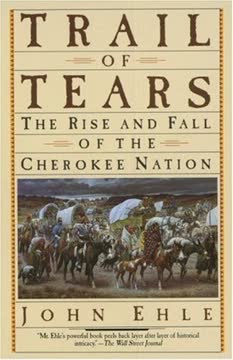
Trail of Tears by John Ehle receives mixed reviews averaging 4.12/5 stars. Readers praise its thorough research and emotional depth, documenting Cherokee history from colonization through forced removal. Many appreciate the complex portrayal of historical figures like Major Ridge and John Ross. Critics note the writing style varies inconsistently between historical documentation and literary narrative, making it difficult to read at times. Some reviewers feel it's too dense or relies heavily on white historical sources. Despite stylistic concerns, most consider it essential reading for understanding this shameful chapter in American history.
Similar Books