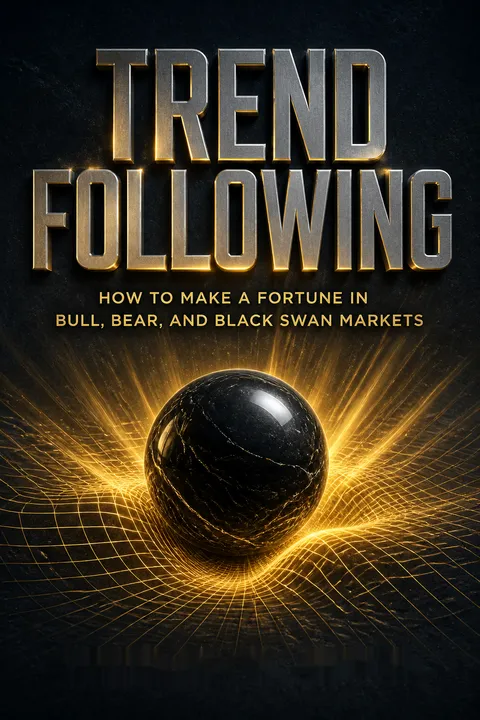


Key Takeaways
Follow price in motion instead of forecasting the next market turn.
React to what moves. Trend following means entering after prices begin moving persistently up or down, then staying until the movement reverses enough to trigger an exit. It does not try to call the exact bottom or top. A trend follower may buy a market after it has risen, or sell short after it has fallen, across stocks, currencies, bonds, and commodities. The method treats price as a practical signal of changing expectations, not as a clue to decode through news or economic forecasts.
The record’s hook. Covel reports that some trend managers gained roughly 5% to 40% in October 2008, when many conventional portfolios suffered steep losses. The claim illustrates the method’s potential in sharp moves, not a promise that it will profit in every crisis.
The appeal is methodological humility: instead of claiming to know why a market should move, the trader waits for evidence that it is moving. Prices combine many participants’ judgments, but they are not a perfect or instantaneous summary of information. The strategy can therefore be understood as acting on observed behavior while accepting uncertainty, rather than as proof that markets are irrational. Its essential test is not whether a trend story sounds persuasive, but whether a defined method can capture enough movement after costs.
Cap each loss before entry, because survival comes before prediction.
Plan the exit first. Trend followers expect to be wrong often enough that every trade needs an exit rule before money is committed. A stop-loss is a predetermined level at which a losing position is closed, limiting the damage if the market moves against the trade. The book’s central discipline is to accept small losses rather than wait for a market to vindicate a forecast. Without an exit plan, a manageable mistake can grow into a threat to the whole account.
Stops have limits. A price can gap past a stop, so an exit order cannot guarantee the exact loss. That is why risk control also depends on how large the position is. Dunn Capital described a system that allocated risk across markets and reduced exposure in more volatile ones, rather than treating every trade as equally safe.
This is a form of ruin prevention, a principle shared by engineering safety systems and insurance: contain the failure of one component before it becomes a system-wide failure. A stop is not a force field. Sudden gaps, thin liquidity, and execution costs can make realized losses larger than planned. The useful lesson is therefore broader than placing an order: position size, diversification, and the possibility of discontinuous prices must all fit the loss budget. A trader who survives can participate in the next opportunity.
Let rare long trends pay for the many small losses.
Protect the upside. Trend following often produces many modest losing trades while a smaller number of large winners generate much of the total return. Covel illustrates the arithmetic with a simple model: if 60% of trades lose 1% and 40% gain 2%, the gains outweigh the losses before costs. The specific percentages are illustrative, not a universal forecast. The practical implication is to avoid arbitrary profit targets that close a winning trade merely because it has reached a comfortable gain.
Stay for the middle. A trader will usually enter after a trend has begun and exit after it has weakened, missing its earliest and latest portions. That is deliberate. Trying to identify the perfect turning points can replace a repeatable process with guesswork, while cutting winners short can remove the few trades that compensate for repeated false starts.
This payoff pattern resembles venture investing, where a small number of outsized successes can support many failed experiments. The analogy also exposes the requirement: winners must be allowed to grow, and losses must remain bounded. A strategy that boasts a high win rate may still lose money if its occasional losses are enormous. Conversely, a low win rate is not inherently fatal. The distribution of gains and losses, after costs and across a sufficiently large sample, matters more than the emotional satisfaction of being right frequently.
Spread risk across markets because no one knows which will trend.
Widen the opportunity set. A trend follower does not need to become an expert in the crop outlook, politics, or corporate prospects of every market traded. The common input is price movement. Covel describes firms trading portfolios that span currencies, interest rates, stock indexes, energy, metals, and agricultural markets. One account of the AHL program listed more than 100 core markets across 36 exchanges, spreading exposure across different sectors and regions.
Diversification is not magic. Markets can move together, and trend-following managers may share similar exposures or signals. The book’s correlation comparisons show that different firms can experience similar gains and losses at similar times. Diversification broadens the chance of finding a trend, but it does not erase shared risks or guarantee that losses will offset one another.
The strategy treats diversification as a search advantage, not merely as a collection of asset labels. A broad universe increases the chance that some market is making a sustained move when others are stagnant. Yet correlations can rise precisely when investors most want diversification, and multiple managers may be different brands of the same underlying bet. Portfolio construction therefore deserves independent scrutiny: count exposures, identify common drivers, and distinguish more markets from genuinely different sources of risk.
Size positions by volatility, not by confidence or account size.
Budget the risk. Position sizing determines how much a trader buys or sells, and Covel treats it as central to the outcome, not a technical afterthought. If a market is more volatile, a risk-based system generally takes a smaller position; if it is less volatile, the position can be larger within preset limits. Seykota calls the portfolio’s total committed risk its heat. For example, risking 2% on each of five separate positions creates roughly 10% of portfolio heat before considering correlations or gaps.
Confidence is not a measure. A trader may feel certain about a market and still be wrong. A rule that ties size to account equity and estimated risk prevents excitement or conviction from quietly increasing exposure. As equity rises or falls, position sizes should be recalculated so the strategy does not accidentally become more aggressive after gains or losses.
Sizing converts a market opinion into a survivable financial exposure. This resembles dose control in medicine: the same treatment can be useful or dangerous depending on how much is administered and to whom. Volatility-based sizing is not a complete risk model, since correlations, liquidity, and abrupt price gaps matter too. Still, it makes the basic question explicit: how much can this position cost if the signal fails? That question is more useful than asking how persuasive the trade feels.
Know the recovery math before accepting a drawdown you cannot tolerate.
Losses compound asymmetrically. A drawdown is a decline from an account’s previous peak to a later low. If an account falls 50%, it needs a 100% gain just to return to its starting value. After an 80% loss, the required gain is 400%; after a 90% loss, it is 900%. Covel uses this arithmetic to explain why limiting losses matters and why investors should understand the depth and duration of historical declines before committing capital.
Stay within your capacity. Trend-following records can include long, uncomfortable losing stretches. Some clients in the book withdrew money near a drawdown’s low, shortly before the account recovered. That story is not evidence that every drawdown will recover. It shows why an investor’s risk tolerance, time horizon, and liquidity needs must match the strategy before the bad period arrives.
The recovery curve makes risk emotionally legible: percentage losses are not symmetric with percentage gains. It also shows why a tolerable strategy is one an investor can actually hold, not merely one that looks attractive in a chart. There is a crucial distinction between patience and denial. A drawdown may be ordinary variation within a sound process, or evidence that assumptions, execution, or the manager have failed. Monitoring predefined conditions helps separate the two.
Study crashes to find who had a plan, not just who gets blamed.
Follow the transfer. Covel revisits failures such as Barings Bank’s collapse and the near-failure of Long-Term Capital Management to ask who profited when large positions went wrong. In August 1998, LTCM lost about $1.9 billion; Covel reports that several established trend-following firms gained substantially during the surrounding market turmoil. The point is not that they predicted the crisis. Their systems were already responding to price movements across bonds, currencies, and other markets.
Understand the game. In exchange-traded futures, one trader’s gain is generally matched by another trader’s loss before fees. Participants may be trading for different reasons, including hedging, so they need not share the same goal. The useful question after a market failure is not merely who behaved badly, but what risk each participant accepted and whether a plan controlled it.
The zero-sum lens is powerful for tracing where trading gains and losses go, but it should not become a moral verdict. A hedger may willingly pay to reduce uncertainty, while a speculator accepts that risk in pursuit of profit. Their outcomes differ, yet both can receive value from the transaction. The lens is most useful when it corrects the habit of treating losses as money that simply vanished. It is less useful when it erases the economic purpose of transferring risk.
Test simple rules broadly, then execute without improvising.
Write the system down. A usable trading system must specify what to trade, how much to trade, when to enter, how to exit a losing position, and how to exit a winner. Covel favors rules that can be tested and followed consistently over discretionary decisions driven by news or mood. A sample system in the appendix used price breakouts, volatility-based sizing, and trailing exits across 15 markets. Its in-sample test reported a 21.02% compound annual return and a 23.05% maximum drawdown.
Interrogate the test. That example omitted commissions and slippage, and it was not validated on out-of-sample data. A strategy can look impressive after its rules have been tuned to past prices. Robustness requires checking different markets and parameter settings, including realistic execution costs, then comparing simulated results with actual trading.
Systematic rules help protect decisions from hindsight and momentary fear, much as a clinical protocol reduces variation in routine care. But automation can make a flawed idea execute more efficiently, not make it true. Backtests are especially vulnerable to overfitting, survivorship bias, and understated transaction costs. The appendix’s impressive results are useful as a worked example of how rules and risk controls fit together, not as evidence that the system should be copied or that future returns will resemble its history.
Treat a losing trade as information, not an injury to your ego.
Loss aversion distorts choices. Behavioral economist Daniel Kahneman’s prospect theory helps explain why people often cling to losing positions and take profits quickly on winners. In one experiment described by Covel, students who imagined losing a theater ticket were less willing to buy another than students who had lost the same amount of cash. The lost ticket felt like paying twice, even though the decision in either case was whether to spend money for the show.
Separate the trade from the self. Trend followers try to treat a loss as a cost of testing whether a market has begun a lasting move. They record decisions, follow exit rules, and avoid turning a trade into a referendum on intelligence. This is difficult because being wrong feels personal, but refusing to admit a mistake can make its financial consequences much larger.
The experiment reveals how people mentally label money and losses, even when the economic choice is equivalent. In trading, that mental accounting can become averaging down, refusing to sell, or changing rules after a setback. A written process creates distance between identity and outcome. It cannot eliminate emotion, nor should emotion be ignored; persistent distress may indicate that the position size or strategy is unsuitable. Good discipline includes noticing that signal rather than merely demanding more toughness.
Read long records as evidence, never as guarantees of future profits.
Use history carefully. Covel assembles decades of monthly records from named trend-following firms and contrasts them with major equity declines. The records show periods of strong gains alongside losing months, drawdowns, and years of weak performance. They support the case that trend following has produced substantial returns for some managers across varied markets. They do not establish that every manager, system, or investor will achieve those results.
Check the full bargain. Before allocating money, examine fees, leverage, liquidity, drawdowns, and how the record was constructed. The book’s appendix on stocks also demonstrates the importance of including delisted companies and adjusting for dividends when testing historical strategies. Past performance can reveal how a method behaved under previous conditions, but it cannot promise the next trend or protect against every failure.
The book’s strongest evidence is longitudinal: repeated results across managers and market episodes are more informative than a single lucky year. Yet historical records are not experiments with randomized controls. Manager selection, changing markets, leverage, fees, and publication choices can influence what readers see. A sound reading holds two ideas together: a persistent record deserves investigation, and no record abolishes uncertainty. The proper response is neither blind faith nor dismissal, but due diligence that asks what risks generated the returns.
Analysis
Covel’s central argument is both practical and deliberately narrow: markets change, and a trader cannot reliably forecast when a change will begin or end, so a system can react to price movement, limit losses, and remain exposed to the occasional large trend. The book’s narrative works by contrasting two kinds of market stories. One follows celebrated failures such as Barings and LTCM; the other asks who was positioned to profit when prices moved sharply. Profiles of Dunn, Henry, Seykota, and others make the approach human, while performance tables try to make it testable.
Its most useful contribution is not a secret entry signal. It is the combination of three disciplines: use observable price rather than elaborate explanations, size positions so mistakes are survivable, and permit winners to become much larger than losers. This combination explains why a low winning percentage can coexist with strong long-run results. It also explains why the approach feels uncomfortable: the trader must accept false starts, visible volatility, and delayed gratification without knowing which trade will matter most. The evidence needs careful handling. Historical manager records demonstrate that certain firms achieved exceptional results, but they are not controlled proof that trend following alone caused every return. Leverage, fees, market selection, capacity, and manager survival affect comparisons. Some figures are hypothetical or omit trading costs, and a strategy that worked across earlier regimes may weaken as markets and participants change. The book’s own discussion of drawdowns makes clear that a favorable long-run record can still be intolerable for an investor who needs cash or cannot withstand losses.
The most defensible conclusion is not that trend following always wins, but that it offers a coherent response to uncertainty. Its rules make a trader accountable to observable outcomes rather than persuasive forecasts. Its advantage, if present, depends on implementation, risk control, and the willingness to keep following the method through periods when its logic is hardest to endure.
Review Summary
Trend Following receives mixed reviews. Supporters praise its comprehensive overview of trend following strategies, psychological insights, and interviews with successful traders. Critics argue it lacks specific trading techniques and is overly repetitive. Many find the book informative but criticize its length and lack of practical "how-to" advice. Some reviewers appreciate the mindset and philosophy presented, while others expected more concrete trading systems. Overall, readers seem divided on whether the book provides valuable insights or is simply a long advertisement for trend following.
People Also Read







Glossary
Trend following
Price-responsive tradingA trading approach that enters after a market begins moving persistently upward or downward, then holds the position until a defined exit signal appears. It seeks to capture a substantial portion of a trend without predicting its exact start, end, or cause. The method can be applied across markets and commonly pairs trend signals with risk controls.
Absolute returns
Returns without a benchmarkAn investment objective focused on making positive returns across market conditions rather than matching or outperforming a specified index. In Covel’s account, trend followers generally seek profit from market movements in either direction, without maintaining a portfolio designed to resemble the S&P 500 or another benchmark. The objective does not mean returns are always positive.
Drawdown
Peak-to-trough account declineThe decline in an account’s value from a previous high to a subsequent low. A drawdown remains unresolved until the account rises above its earlier peak. Its percentage matters because recovering from a loss requires a larger gain: a 50% decline requires a 100% increase just to return to the starting level.
Portfolio heat
Total committed trade riskA measure of the combined risk budget assigned to open positions. Covel uses the term to describe the proportion of portfolio equity exposed if planned trade losses occur. For example, five positions each risking 2% represent about 10% heat before accounting for correlations, gaps, or execution differences. Traders may adjust heat to fit their risk tolerance.
Trading Tribe Process
Group emotional self-inquiryA process associated with Ed Seykota’s Trading Tribe, in which traders work together to notice and examine feelings that interfere with following a trading system. Rather than treating emotion as an error to suppress, participants observe their reactions and take responsibility for them. The intended benefit is greater self-awareness and less impulsive deviation from trading rules.
Capitalism Distribution
Uneven stock-return patternA term used in the book’s stock appendix for the highly uneven distribution of individual stock returns. In the studied U.S. stock universe from 1983 to 2006, a minority of stocks accounted for most aggregate gains, while many stocks underperformed or lost value. The pattern helps explain why index results can hide large differences among individual securities.
FAQ
What's Trend Following (Updated Edition) about?
- Trading Strategy Focus: The book delves into trend following, a strategy that aims to capture market trends, whether upward or downward, by focusing on price movements rather than predictions.
- Profiles of Success: It profiles successful trend followers like David Harding and Ed Seykota, offering insights into their philosophies and methods.
- Educational Resource: Serving as a guide for traders, it provides practical advice on risk management, decision-making, and the psychological aspects of trading.
Why should I read Trend Following (Updated Edition)?
- Timeless Principles: The book presents trading principles that remain relevant across market conditions, promising consistent profitability.
- Real-World Examples: It includes examples and performance data from successful traders, making the concepts actionable and relatable.
- Comprehensive Guide: The updated edition addresses recent market events, offering a thorough guide for traders of all levels.
What are the key takeaways of Trend Following (Updated Edition)?
- Cut Losses, Let Profits Run: This principle helps traders manage risk while maximizing gains by exiting losing trades quickly and staying in profitable ones.
- Embrace Volatility: Volatility is seen as a profit source, and understanding how to manage it is crucial for success in trend following.
- Discipline and Patience: Successful traders exhibit discipline and patience, waiting for the right conditions to enter trades.
What are the best quotes from Trend Following (Updated Edition) and what do they mean?
- “You can’t make money if you are not willing to lose.”: Highlights the necessity of risk-taking in trading, accepting losses as part of the process.
- “The market is never wrong.”: Encourages traders to trust market movements over personal biases or predictions.
- “Everybody gets what they want out of the market.”: Suggests that trading outcomes reflect traders' beliefs and behaviors, emphasizing self-awareness.
What is trend following as defined in Trend Following (Updated Edition)?
- Market Behavior Strategy: It seeks to capitalize on price momentum by buying assets trending upward and selling those trending downward.
- Reactive Approach: Unlike predictive strategies, it responds to market movements, allowing for objective trading.
- Focus on Price Action: Relies on historical price data to identify trends, helping traders make informed decisions.
How do successful trend followers manage risk according to Trend Following (Updated Edition)?
- Defined Risk Parameters: They establish clear risk parameters, often risking a small percentage of capital per trade.
- Use of Stop Losses: Implementing stop-loss orders limits potential losses, ensuring quick exits from losing trades.
- Diversification Across Markets: Diversifying investments across asset classes reduces exposure to single market volatility.
How does Trend Following (Updated Edition) address the concept of drawdowns?
- Inevitability of Drawdowns: Drawdowns are natural in trading, and understanding this helps traders prepare mentally.
- Recovery Strategies: Having a recovery strategy is crucial, as historical data shows trend followers often recover quickly.
- Psychological Impact: Coping with the stress of drawdowns requires a strong mental framework to endure and overcome them.
What is the zero-sum game in trading as described in Trend Following (Updated Edition)?
- Definition: A zero-sum game is where one trader's gain is another's loss, highlighting trading's competitive nature.
- Implications for Traders: Encourages responsibility for decisions, as gains and losses are directly linked to one's actions.
- Strategic Positioning: Awareness of opponents' strategies can help traders make informed decisions and improve success chances.
What are some effective strategies for trend following mentioned in Trend Following (Updated Edition)?
- Entry and Exit Signals: Clear signals based on price movements are crucial for entering and exiting trades.
- Position Sizing: Proper sizing manages risk, with small capital percentages risked per trade to avoid significant losses.
- Diversification Across Markets: Diversifying portfolios across markets captures trends in different sectors, increasing profitability chances.
How does Trend Following (Updated Edition) address human behavior in trading?
- Understanding Emotional Responses: Emotions like fear and greed impact decisions; recognizing and managing them is crucial.
- Behavioral Finance Insights: Concepts like "illusion of control" and "sunk costs" can lead to poor decisions; understanding biases aids rational choices.
- Curiosity and Learning: Maintaining curiosity and openness to learning helps traders adapt to market changes and improve decision-making.
How can I implement the strategies from Trend Following (Updated Edition) in my trading?
- Develop a Trading System: Create a system with clear rules for entry, exit, and risk management, guided by the book's principles.
- Practice Discipline: Stick to your plan, avoiding emotional decisions, and adhere to risk management rules.
- Continuously Learn and Adapt: Stay informed about market trends, review performance, and adjust strategies based on successes and failures.
What are the common misconceptions about trend following as outlined in Trend Following (Updated Edition)?
- It Only Works in Bull Markets: Trend following is effective in both bull and bear markets, not just rising ones.
- Requires Complex Analysis: The strategy is based on simple price movement principles, accessible to all traders.
- It’s Just Luck: Successful trend followers rely on systematic approaches, not chance, as evidenced by performance data.
About the Author


Download PDF
Download EPUB
.epub digital book format is ideal for reading ebooks on phones, tablets, and e-readers.








