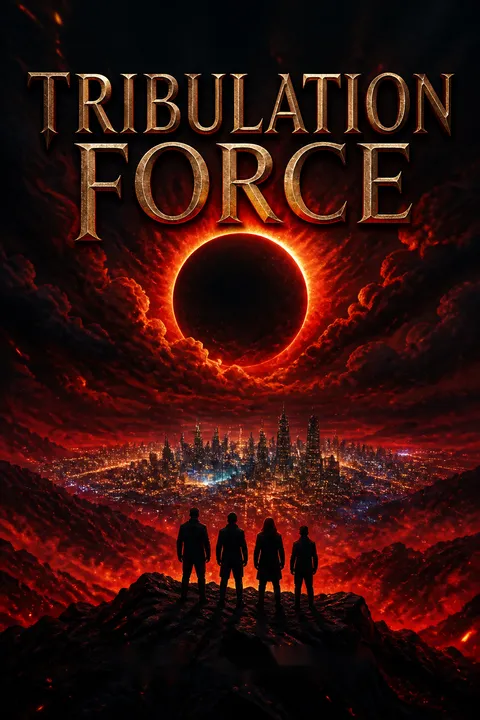


Plot Summary
Prologue
The first volume's catastrophe has left Rayford Steele and his daughter Chloe grieving the family they lost, while new believers Rayford, Chloe, pastor Bruce Barnes, and journalist Buck Williams have formed the Tribulation Force. They know Nicolae Carpathia, the charismatic new United Nations leader, is the Antichrist, though the public sees a peacemaker.
Buck alone remembers Carpathia murdering two men at the United Nations and rewriting witnesses' memories. The four friends prepare to resist him, even as Bruce warns that an agreement between Carpathia and Israel will begin the seven-year Tribulation.
The recap makes belief a consequence of catastrophic hindsight. The central characters were not prepared for the Rapture, so their new certainty carries shame as well as conviction. Their small group is an answer to a world that has lost both family and reliable public truth. Buck's unaltered memory establishes the novel's governing conflict: evidence alone cannot persuade people when power can alter what they believe they saw. The prologue also plants the treaty as a countdown mechanism, turning international diplomacy into an immediate spiritual and personal threat.
The Murder Everyone Forgot
On a Baltimore-to-Chicago flight, Captain Rayford Steele reads that billionaire Jonathan Stonagal supposedly shot himself and a British ambassador at a United Nations meeting.
Rayford knows the newspaper is repeating Carpathia's manufactured account: Buck Williams witnessed Carpathia kill both men, then watched him make the other witnesses accept a false memory. Buck's former boss, Steve Plank, and Carpathia's new assistant, Hattie Durham, were among those who forgot Buck had attended.
Now demoted and relocated to Chicago, Buck faces a hostile new bureau chief while trying to settle near the only friends he trusts. Rayford, meanwhile, is warned by his airline chief to stop discussing his faith at work, placing his new convictions in conflict with his career.
The novel opens with a split between public record and lived knowledge. Buck's certainty is not simply journalistic confidence; it is a fragile form of testimony in a society where even witnesses have been made unreliable to themselves. Rayford's workplace warning introduces a parallel pressure: truth has consequences even when it is spoken without institutional power. Both men have lost the protections their former identities offered. Buck's prestige cannot overcome his demotion, and Rayford's authority as captain cannot shield his beliefs from workplace discipline. The two conflicts establish resistance as a practical burden, not an abstract declaration.
A Shelter Beneath New Hope
At an emergency meeting, Bruce Barnes explains why the news from the United Nations alarms him. Carpathia is pushing worldwide disarmament, a common currency, a religious alliance, and a binding arrangement with Israel.
Bruce believes that treaty will start the seven-year Tribulation and bring the biblical judgments closer. His confidence is shadowed by grief: he admits that his earlier Christianity was hollow and that his family is gone, leaving him unable to bear the silence of home.
Rather than retreat into private study, he proposes nightly Bible classes and a concealed underground refuge beneath New Hope Village Church. Rayford, Chloe, and Buck agree to help build it, not as an escape from their mission but as a place to survive and regroup.
Bruce's leadership grows directly from his confession of failure. His past hypocrisy does not make him a detached authority; it gives urgency to his effort to prepare others. The shelter embodies that tension. It is not a denial of danger or a promise of safety, but a material expression of responsibility toward a vulnerable community. The four friends convert prophecy into tasks: study, construction, and mutual support. Their response also distinguishes courage from recklessness. Bruce argues that survival can serve resistance, while Rayford's initial instinct to reject retreat shows how easily bravery can become a performance of self-sacrifice.
The White Horse Sermon
At New Hope's crowded Sunday service, Bruce abandons his usual sermon routine to explain the first of Revelation's horsemen. He reads the white rider as a conqueror who wins through diplomacy and promises peace, then connects the prophecy to the coming treaty with Israel.
He warns that apparent stability will precede war, famine, disease, and death. Bruce never publicly accuses Carpathia, but listeners make the connection as they leave, asking whether the adored secretary-general could be the Antichrist.
Buck knows the answer from personal experience, yet keeps silent to protect the group's secret. Meanwhile, Chloe's hurt over Buck's sudden distance deepens, and he invites her to see his new apartment without understanding how his hesitation has unsettled her.
Bruce's sermon transforms prophecy from a private interpretive framework into a public act with political implications. By refusing to name Carpathia, he forces listeners to practice judgment rather than accept another authority's conclusion. The congregation's questions show how quickly charisma can be mistaken for moral legitimacy, especially when people are desperate for order. Buck's silence has a different function: he knows more than he can safely reveal, so restraint becomes a form of protection. Chloe's emotional disappointment runs alongside the sermon, grounding cosmic danger in ordinary vulnerability. The personal plot does not interrupt the apocalyptic one; it shows what people still risk losing.
Carpathia Calls Buck East
Buck learns from Steve Plank that Carpathia wants a private meeting and has arranged a first-class flight to New York under an alias. Buck worries the invitation is a test: Carpathia may want to discover whether his memory survived the mind control.
He also feels responsible for Hattie, whose career has become entwined with the secretary-general's, and asks Bruce whether he should try to warn her. Bruce cannot promise a safe approach, but Buck decides that avoiding Carpathia may look more suspicious than appearing in person.
He boards the plane, accepts the lavish treatment with unease, and rides to Manhattan with a silent bodyguard. In Chicago, Rayford begins his 757 recertification, unaware that a note from Hattie will complicate his own career decision.
Buck's decision is shaped by competing duties rather than simple appetite for a scoop. His professional instincts tell him to accept access to the world's most powerful figure; his new faith makes that access feel like proximity to mortal danger. Hattie's presence sharpens his guilt because his introduction helped bring her into Carpathia's orbit. Bruce's inability to offer certainty preserves the group's moral agency: faith does not remove the need to choose under incomplete information. The alias and silent bodyguard make hospitality feel coercive. Carpathia's power is expressed not only through threats but through an environment in which every convenience reminds Buck that he is being watched.
A Publisher's Golden Cage
At a private lunch with Israeli scientist Chaim Rosenzweig, Buck learns that Israel will trade access to Rosenzweig's crop-growing formula for Carpathia's promise of protection. Rosenzweig sees the deal as a path to peace; Buck recognizes how Carpathia has made himself indispensable.
At the United Nations, Carpathia privately acknowledges that Stonagal's estate is now his and offers Buck the presidency of a Chicago newspaper he plans to buy. The salary, staff, and promised editorial freedom are designed to satisfy Buck's ambitions while concealing a global media takeover.
Buck challenges the ethics of a United Nations leader owning news outlets, but Carpathia treats that objection as a solvable technicality. Buck leaves with privileged knowledge and no trust in the offer.
The offer turns Buck's professional identity into the instrument Carpathia most wants to capture. Rather than demand immediate obedience, Carpathia offers Buck the appearance of autonomy, a sophisticated temptation because it appeals to the reporter's own ambitions. Rosenzweig's bargain shows how fear can make submission seem prudent: Israel seeks security after surviving an invasion, and Carpathia converts that need into leverage. Buck's objection is not merely personal integrity. Independent reporting is a public safeguard, and ownership threatens the conditions under which truth can circulate. The chapter's central irony is that Carpathia can present control as freedom by promising not to interfere.
The President's Borrowed Jet
Rayford receives a note from Hattie pointing out that the new presidential aircraft is a Boeing 757, then faces a suspicious complaint accusing him of religious harassment during recertification.
He and chief pilot Earl Halliday discover that the supposed complainant and examiner's secretary do not appear to exist. Earl also tells Rayford he is a leading candidate to pilot Air Force One, a prestigious position Rayford initially resists because it would pull him from Chicago and New Hope.
Carpathia's influence soon becomes visible: President Fitzhugh lends him the new aircraft, and Rayford is asked to fly it to Israel. Hattie later admits that Carpathia wants Rayford as his pilot and has used anonymous gifts to Chloe to make Chicago feel less secure.
Rayford's recruitment is a study in how institutions can be bent without a direct order. A fictitious complaint, a presidential appointment, and a supposedly generous loan each appear separately plausible, but together they reveal a design. Rayford initially interprets the job through familiar measures of achievement, while his reluctance signals that his values have shifted since the disappearances. Hattie's role is psychologically revealing: she has become so dependent on Carpathia's account of events that manipulation feels to her like benevolent strategy. Her actions also expose the intimate scale of political power. Carpathia does not only claim states and media; he intervenes in a father's anxieties about his daughter.
Flowers, Lies, and a Porch
While Buck is in New York, Chloe sees Alice, a Global Weekly secretary, carrying boxes into his apartment and later hears Alice refer to a fiancé. Chloe assumes Buck is engaged, and anonymous flowers only deepen her humiliation.
The flowers are actually part of Hattie's attempt to unsettle the Steele family. When Buck returns, he finds Chloe angry and confused but does not understand why. Rayford quietly lets him come to the house, where Buck waits outside until Chloe finally admits him.
They discover that Alice is engaged to someone else and that Buck had lent her his keys to deliver office equipment. Buck apologizes for leaving Chloe uninformed; she owns her mistaken assumptions. Their reconciliation turns attraction into an honest courtship.
The misunderstanding is built from incomplete but credible evidence. Chloe sees Alice at Buck's apartment, hears the word fiancé, and fills the gap with the fear already created by Buck's mixed signals. Buck, in turn, assumes her hostility is arbitrary because he cannot see the information she has. The scene makes communication a moral practice: the couple repairs trust by stating what each knows and accepting responsibility for what each failed to clarify. Hattie's anonymous flowers show how political manipulation can exploit private insecurity, while Rayford's discreet intervention gives the young couple room to confront the problem themselves.
The World Takes One Name
Carpathia gathers religious leaders behind a new Global Community Faith, persuading them to treat distinct religions as parts of one tolerant system. Peter Cardinal Mathews emerges as its likely leader and a candidate for pope.
At the same time, the United Nations advances a single global currency and establishes the legal basis for acquiring newspapers, magazines, television, and radio. Buck resists Carpathia's publishing offer and trades assignments with religion editor Jim Borland so he can investigate the faith alliance, the temple plans, and the two preachers at Jerusalem's Wailing Wall.
Chloe accepts paid research work for Bruce, while Rayford agrees to fly Carpathia's delegation to Israel. The arrangements tighten around the group even as each member tries to serve a different kind of truth.
The global merger is the novel's most explicit image of coercion disguised as consensus. Religious leaders surrender differences in the name of peace; states accept disarmament in exchange for protection; media owners welcome capital while trusting Carpathia's assurances. These bargains show how authoritarian power can grow through willing cooperation, not only force. Buck's journalistic maneuvering offers a counter-model: he negotiates access while trying to preserve independent judgment. Chloe's research role gives her a different form of agency, grounded in teaching and preparation. Rayford's job places him closest to Carpathia's institutions. Their varied responses suggest that resistance depends on maintaining discernment inside systems that reward compliance.
Two Witnesses at the Wall
In Jerusalem, Buck persuades Rabbi Tsion Ben-Judah, a scholar studying the messianic prophecies, to bring him near the two preachers at the Wailing Wall. A gunman charges the men, but an unseen barrier throws him backward, and one witness sends fire from his mouth that consumes him.
The witnesses insist that listeners are safe and attackers are not. Ben-Judah takes Buck back that night, and the two preachers reenact Jesus' conversation with Nicodemus, speaking in languages their listeners understand.
Buck hears English, while Ben-Judah hears Hebrew; a recording captures neither the English translation nor their final words. The experience leaves the rabbi shaken and Buck certain the men are serving Christ, though Ben-Judah has not yet publicly reached that conclusion.
The Wailing Wall sequence shifts supernatural evidence from something Buck must defend to something he and Tsion experience together. The first attack establishes the witnesses' dangerous boundary: curiosity is permitted, violence is not. Their multilingual speech then transforms a crowd into many individual audiences, making revelation intimate even in public. The failed recording matters because it separates testimony from proof. Buck can report what he heard, but his device cannot preserve the decisive experience for others. Tsion's hesitation is not simple disbelief; it reflects the cost of revising an identity formed within a tradition that has rejected the claim he is now confronting.
The Covenant's Seven-Year Clock
On the day of the treaty signing, Buck speaks privately with President Gerald Fitzhugh, who confesses that Carpathia's influence is making him feel like a subordinate in his own government.
Yet at the ceremony, Fitzhugh appears transformed, praising Carpathia's disarmament plan and declaring the new aircraft a gift to the Global Community. Buck recognizes the same mind-altering force he witnessed at the United Nations. Israeli leaders and Carpathia then sign the agreement promising Israel protection, while the two witnesses condemn the pact from the Wall.
Rayford pilots the newly renamed Global Community One and watches the ceremony from the dignitaries' platform. The treaty makes Bruce's warning official: the seven-year Tribulation has begun.
The ceremony dramatizes power as a performance that can override private knowledge. Fitzhugh's earlier fear does not protect him from becoming Carpathia's public instrument; the change in his behavior shows how rapidly political judgment can be captured. The aircraft gift gives this submission a visible object, turning national authority into a possession that can be repainted and renamed. Rayford's presence in the cockpit places him inside the transfer, while Buck stands close enough to document it but cannot stop it. The treaty is therefore both diplomatic event and theological threshold. Its signature converts a predicted future into the characters' present.
The Rabbi Names Messiah
Aboard Global Community One, Buck and the other passengers watch Tsion Ben-Judah present three years of research on live international television. He traces the scriptural requirements for the Messiah, including lineage, birthplace, rejection, betrayal, death, and resurrection, then concludes that Jesus fulfilled them.
Tsion also reveals that he had accepted Jesus after wavering during the Rapture. Religious opponents try to shut down the broadcast, but he gets the central claim and contact information out before the screen goes dark.
Buck helps him escape the studio. Soon afterward, one of the witnesses calls to invite Tsion to address new believers in Jerusalem. Carpathia dismisses the conversion as insignificant, but Tsion's announcement gives Jewish seekers a public case for faith.
Tsion's televised conclusion reverses the earlier pattern of withheld knowledge. His scholarship, once a private investigation commissioned to identify a future Messiah, becomes a public admission that the awaited figure has already come. The broadcast makes intellectual rigor and spiritual conversion compatible: Tsion does not abandon research but follows its implications past the conclusion his community expects. His family bears the immediate cost, as his wife fears the social and political consequences of his declaration. Carpathia's dismissal reveals a strategic blind spot. He understands institutions and mass persuasion, but underestimates testimony that gives people a coherent alternative to his own claims.
Eighteen Months Under Carpathia
Eighteen months pass, and the first season of apparent peace has reshaped the world. Carpathia's headquarters rises at New Babylon, the global currency and media system tighten, and the new religion, now called Enigma Babylon One World Faith, brands belief in the Bible as final authority heretical.
Peter, formerly Cardinal Mathews, leads it as the new pope. Meanwhile, Bruce travels to seed house churches, Chloe researches and teaches, and the two witnesses draw huge crowds with Tsion's support. Their warnings against Israel's rebuilt temple anger both Carpathia and religious leaders.
Buck becomes publisher of Global Community Weekly, hiding his Christian allegiance while resisting propaganda where he can. Rayford remains Carpathia's pilot, though his uniform and work increasingly feel like service to an enemy.
The time jump measures how quickly emergency arrangements become permanent institutions. The Global Community no longer needs to present each change as temporary; its faith, press, and political hierarchy now reinforce one another. Against this institutional scale, the resistance is deliberately decentralized. Bruce's house churches and Chloe's teaching create networks that can survive the closure of formal spaces. Buck's position inside state media is compromised but not wholly passive, while Rayford's employment gives him access at a personal moral cost. The witnesses' conflict with the temple also complicates easy alliances: opposition to Carpathia does not mean agreement among all believers or religious communities.
Two Weddings, One Secret
As Buck and Chloe settle into married life in New York, Rayford and Amanda White find companionship after Amanda explains how Rayford's wife Irene helped bring her to faith. Rayford proposes, and the couples arrange a private double wedding with Bruce officiating.
Buck accepts work as publisher of the regime-owned magazine because it gives him a platform and a livelihood, though he continues to conceal his beliefs. Before the wedding, Fitzhugh warns Buck that Egypt, Britain, and American militia forces are preparing to challenge Carpathia.
At the same time, Carpathia reveals that Hattie is expecting his child and presents their relationship as a coming marriage. Chloe and Buck grieve that Hattie remains close to the man they know is evil, but cannot safely reach her.
Marriage here is not a retreat into domestic normality. The couples make commitments while knowing that geography, political danger, and the short horizon of the Tribulation may soon separate them. Rayford's relationship with Amanda also gives Irene's earlier faith a continuing effect: a private act of witness becomes part of a new family. Buck's job choice reflects a sharper compromise than his earlier refusal of Carpathia's offer. He enters controlled media to preserve access, while remaining aware that proximity can erode resistance. Hattie's pregnancy makes the group's concern more urgent, but their inability to intervene shows the limits of moral responsibility when disclosure could expose them all.
The Red Horse Arrives
During a planned reunion in Chicago, Rayford, Amanda, Buck, and Chloe learn that a coordinated militia assault has reduced Washington to ruins and that British and Egyptian forces have joined the uprising.
Carpathia's forces retaliate by destroying a former Nike base near Chicago, causing mass civilian casualties and blocking roads. The four friends are trying to reach Bruce, who has slipped into a coma after an illness, when traffic and emergency broadcasts expose the scale of the fighting.
Rayford uses his clearance to enter the wrecked hospital, where a nurse confirms Bruce is dead. Buck, Chloe, and Amanda wait with the car as Rayford returns alone. Their pastor, teacher, and closest spiritual guide is gone, and the foretold age of war has begun.
The ending makes global prophecy brutally local. News of attacks on capitals and airfields reaches the group through blocked roads, emergency broadcasts, and a ruined hospital beside their own route. The montage of international violence culminates not in a strategic victory but in Rayford's inability to save Bruce. His clearance opens the barrier to the wreckage, yet it cannot restore the person he came to find. The loss changes the Tribulation Force from a group sustained by its teacher into a smaller, less certain family. Ending at the first great wave of war preserves the novel's serial momentum, but the emotional consequence is complete: the community must continue without its guide.
Analysis
Tribulation Force turns political consolidation into a contest over who gets to define reality. Carpathia's most consequential power is not simply command of armies or money. It is his ability to make witnesses forget, presidents praise him, and religious leaders interpret submission as unity. In that environment, Buck's journalism becomes a moral problem: access can reveal the machinery of power, but access also invites the reporter to become part of it. His acceptance of a publishing role is therefore not a clean victory for resistance; it is a compromise whose value depends on whether he can preserve judgment inside a controlled institution.
The novel gives resistance several forms rather than one heroic model. Rayford's piloting places him close to Carpathia, Chloe's research prepares others to teach, Bruce builds churches and a shelter, and Buck gathers evidence. Their work is connected by their dependence on a shared community. The group's intimacy is not an escape from the crisis but the means by which each member can withstand it. Rayford's grief, Bruce's shame, Buck's responsibility for Hattie, and Chloe's uncertainty in love make spiritual commitment emotionally costly rather than effortless.
The plot's religious structure also drives its political sequence. The Israel treaty is not merely a diplomatic achievement; it starts the countdown Bruce has interpreted from Scripture. The witnesses make that interpretation visible, while Tsion's research gives it intellectual force for Jewish audiences. Yet the novel repeatedly shows that evidence cannot compel belief. Rosenzweig chooses security, Mathews chooses institutional reach, and Hattie chooses the world Carpathia offers. Their decisions make deception persuasive because it answers real needs.
The ending refuses a reassuring victory. War erupts, Bruce dies, and the surviving group loses its teacher at the moment the predicted violence arrives. The closing loss tests the premise that preparation can control outcomes. It cannot. What remains is not safety but responsibility: the characters must continue acting faithfully in a world whose institutions, memories, and homes are all under attack.
Review Summary
Tribulation Force, the second book in the Left Behind series, receives deeply divided reviews. Fans praise its suspenseful plot, biblical prophecy exploration, and character development, finding it compelling and faith-affirming. Critics condemn it for poor writing, misogynistic portrayals of female characters, passive protagonists, a jarring eighteen-month time jump, and problematic theology. Common complaints include the underdeveloped romance between Buck and Chloe, one-dimensional characters, heavy-handed Christian messaging, and disturbing worldviews regarding peace, unity, and other denominations. Many find it simultaneously entertaining and deeply flawed.
People Also Read

Characters
Rayford Steele
Disillusioned airline captainRayford is a veteran pilot and Chloe's father, a man trained to trust procedure, evidence, and control. The Rapture has shattered those habits by forcing him to reconsider his marriage, his parenting, and his former indifference to faith. He is emotionally guarded, often trying to solve grief through practical action, yet his bond with Chloe grows more candid and affectionate. His professional competence places him near political power, while his new convictions make that proximity morally uneasy. Rayford's central tension is between the security of a respected career and the obligations he believes God has placed before him.
Cameron Buck Williams
Reporter turned resistanceBuck, a celebrated international journalist, is observant, ambitious, and accustomed to gaining access through nerve and improvisation. His recent conversion makes him newly sensitive to moral compromises that once seemed routine, from eavesdropping to trading favors. He is the only witness who remembers Carpathia's murders, which gives him both crucial knowledge and acute vulnerability. Buck's attraction to Chloe develops alongside his growing sense of responsibility for Hattie and his commitment to honest reporting. He wants to expose power without becoming its instrument, but the changing media landscape forces him to reconsider what resistance can look like from inside a compromised institution.
Chloe Steele
Daughter finding convictionChloe is Rayford's young adult daughter, intellectually disciplined and initially skeptical of the faith her mother embraced. Grief over the family she has lost brings her closer to Rayford and gives her a new foundation for belief. She is direct, emotionally perceptive, and willing to challenge the men around her, especially when they confuse caution with wisdom. Her growing relationship with Buck asks her to balance romantic hope against the short, dangerous future Bruce describes. Chloe's research and teaching work show that she is not content merely to inherit someone else's certainty; she wants to understand the scriptural claims for herself and help others do the same.
Bruce Barnes
Repentant prophecy pastorBruce is a young pastor whose former profession of faith failed him at the moment of the Rapture. He carries shame for having misled himself and others, then channels that shame into intensive study and urgent evangelism. His grief for his wife and children leaves him lonely and physically depleted, but also gives him empathy for people who have lost their bearings. As teacher and organizer of the Tribulation Force, Bruce interprets prophecy while insisting that preparation requires practical work, including study groups and a hidden shelter. His mixture of humility, fervor, and exhaustion makes him a leader who knows his authority is earned through service rather than status.
Nicolae Carpathia
Charismatic global deceiverCarpathia is a Romanian politician whose rise to leadership seems effortless to the public. He is polished, attentive, and exceptionally skilled at making domination appear to be generosity. He offers people the thing they most want, then folds their need into his larger political design: security for Israel, opportunity for Buck, and prestige for Rayford. His calmness is as important as his ambition, because it encourages others to interpret coercion as reasoned leadership. To the Tribulation Force he is the enemy at the center of the coming crisis, but the world around them sees a persuasive architect of peace.
Hattie Durham
Aide in Carpathia's orbitHattie is a former flight attendant who becomes Carpathia's personal assistant. She is socially confident and drawn to the access, status, and excitement of her new position. Her history with Rayford gives her an intimate connection to the Steele family, while her introduction to Carpathia links her to Buck's sense of responsibility and guilt. Hattie can be playful and impulsive, but she also accepts Carpathia's explanations with striking ease. Her presence shows how proximity to power can reshape a person's self-image before that person fully understands the cost.
Tsion Ben-Judah
Scholar testing prophecyTsion Ben-Judah is an Orthodox Jewish scholar commissioned to examine the scriptural signs of the Messiah. He is disciplined, multilingual, and deeply invested in the integrity of his research. His humility sits beside formidable intellectual confidence, and he is cautious about revealing conclusions before he is ready to defend them. Buck's testimony and the encounter at the Wailing Wall bring his scholarship into direct contact with personal belief. Tsion represents a mind willing to follow evidence beyond inherited expectations, even when doing so threatens his standing and the safety of those he loves.
Amanda White
Believer seeking companionshipAmanda is a successful clothing executive who came to faith after years of resisting the people who tried to share it with her. She remembers Irene Steele's kindness as a turning point and seeks out Irene's family to explain that influence. Talkative, generous, and sometimes socially unfiltered, Amanda is also perceptive about people's needs and devoted to serving her church community. Her connection with Rayford grows from shared grief and shared faith. She brings warmth to a group whose members often respond to danger by becoming guarded or intensely analytical.
Chaim Rosenzweig
Israeli scientist and intermediaryChaim Rosenzweig is a celebrated Israeli botanist whose agricultural formula has transformed the country's fortunes. He is affectionate toward Buck, proud of his scientific achievement, and eager to see Israel protected from its neighbors. His desire for peace makes Carpathia's promises appealing, even when Buck recognizes their danger. Chaim's optimism is not stupidity; it grows from a history of vulnerability and a longing to secure a future for his people. His role shows how a reasonable search for safety can be recruited into a much larger political bargain.
Gerald Fitzhugh
President losing authorityFitzhugh is the president of the United States, an energetic and forceful politician who initially supports Carpathia's public program. In private, he is more wary and perceptive than his public gestures suggest. He recognizes that the new secretary-general is turning national cooperation into personal supremacy, yet he struggles to oppose a leader adored by the public. Fitzhugh's bluntness and temper contrast with Carpathia's polished composure. His position makes him both a witness to political capture and a potential source of information for those trying to understand what is happening.
Steve Plank
Journalist turned spokesmanSteve is Buck's former editor, an experienced journalist who leaves independent news work to become Carpathia's spokesman. He trusts Buck's talent but accepts Carpathia's account of the United Nations killings and gradually adopts the habits of his new political world. His transformation troubles Buck because it demonstrates that professional experience does not guarantee resistance to persuasion. Steve remains personally warm toward Buck, making their disagreement less simple than a contest between enemies. He embodies the danger of believing that proximity to power can be managed without changing one's judgment.
Peter Cardinal Mathews
Religious power brokerMathews is a prominent Catholic leader with political instincts and a clear sense of his own advancement. He participates in negotiations that merge religious institutions into a global faith and expects to gain a central leadership role. His confidence and charm help him navigate public ceremonies, but his interpretations of the disappearances reveal a theology willing to protect institutional authority over uncomfortable evidence. Mathews shows how religious office can become a route into political power when a charismatic leader offers the promise of unity.
Eli
Prophetic witness at the WallEli is one of two mysterious preachers who speak at Jerusalem's Wailing Wall. He warns the crowd about the coming Messiah and draws listeners by the force of his message rather than by amplification or spectacle. His composure during attacks contrasts with the violence of those who try to silence him. Eli insists that the witnesses' identities and origins will be disclosed in God's time, directing attention away from curiosity about himself and toward the testimony he delivers.
Moishe
Second witness at the WallMoishe shares the Wailing Wall ministry with Eli and participates in its warnings, public confrontations, and extraordinary signs. The two men act in concert, alternating their speech and refusing to entertain questions about their identities. Moishe's part in the encounter with Tsion makes the Christian message unavoidable for the scholar, though the witnesses do not pressure him to accept it. His presence helps turn Jerusalem into the novel's most visible site of conflict between religious expectation and Carpathia's political order.
Marc Feinberg
Advocate for the templeRabbi Marc Feinberg is an energetic advocate for rebuilding the Jewish temple on its historic site. He is willing to cooperate politically with people whose religious beliefs he does not share because he sees the temple's return as a long-delayed national and spiritual goal. His historical knowledge helps Buck understand the importance of the Temple Mount and the Dome of the Rock. Feinberg's priorities reveal how political compromise can seem acceptable when it promises to restore a cherished tradition.
Earl Halliday
Rayford's aviation mentorEarl is Rayford's longtime chief pilot and friend, a practical airline manager who respects Rayford's skill and wants him to advance. He also has personal ambitions tied to the prestigious presidential pilot position, making Rayford's possible appointment emotionally complicated for him. Earl tries to preserve their friendship while enforcing workplace expectations. His frustration with Rayford's new faith shows how sincere concern can coexist with reluctance to hear a message that challenges one's settled worldview.
Stanton Bailey
Global Weekly's powerful editorBailey is Buck's publisher, a blunt, demanding editor who recognizes Buck's exceptional talent even after the reporter's demotion. He continues to give Buck consequential assignments and defends his work when colleagues resent his success. Bailey's professional loyalty contrasts with the political forces trying to absorb the magazine. He is a figure from Buck's former life who still values independent reporting, even as the institution around him becomes increasingly vulnerable.
Verna Zee
Ambitious bureau chiefVerna is Buck's new Chicago bureau chief, a status-conscious editor who asserts authority over him after his demotion. Her friction with Buck turns his relocation into a daily professional irritation and exposes how easily workplace hierarchies can become personal contests.
Alice
Helpful newsroom secretaryAlice is a young Global Weekly secretary who treats Buck warmly despite Verna's watchful management. Her practical help with his equipment and apartment becomes the accidental source of Chloe's mistaken belief that Buck is engaged.
Nicholas Nick Edwards
Skeptical young pilotNick is Rayford's first officer, a capable younger pilot who rejects Rayford's religious interpretation of the disappearances. His discomfort provides an early measure of how unwelcome Rayford's new convictions are at work.
Irene Steele
Faithful wife and motherIrene is Rayford's wife and Chloe's mother, remembered through the influence she had on her family and on Amanda White. Her quiet devotion and concern for those she loved give Rayford a painful standard against which he judges his former conduct.
Raymie Steele
Rayford's young sonRaymie is Rayford and Irene's young son, remembered by his family through photographs, belongings, and the everyday details that survived the upheaval. His presence in memory keeps Rayford and Chloe's grief concrete.
Vernon Billings
Former senior pastorVernon Billings was New Hope's senior pastor before the disappearances. His teaching materials and church community help Bruce guide the people who remain, even though Billings himself is no longer part of their daily life.
Plot Devices
The Israel Covenant
Starts the prophecy clockThe treaty between Carpathia's Global Community and Israel is both a political bargain and the biblical signal Bruce has been watching for. Carpathia promises Israel protection in exchange for cooperation with disarmament and the wider global order. The agreement gives Rosenzweig hope that his nation can be safe, while Buck and Bruce understand it as a dangerous deception. Its signing changes the story's time scale: the seven-year Tribulation begins, and the characters' plans must be made against a defined horizon. The treaty binds personal choices, global politics, and prophetic expectation into one event.
Carpathia's Persuasion
Makes lies feel rememberedCarpathia's power operates through more than ordinary charm. At the United Nations, he makes witnesses accept a false memory of the murders and erase Buck's presence from their recollection. The same influence appears when President Fitzhugh behaves as a devoted supporter after privately expressing distrust. This device makes testimony unstable: people can sincerely report what Carpathia has made them believe. Buck's resistance is therefore valuable but isolating, and his survival depends on concealing how much he remembers. The effect also shows how political authority can invade private perception, turning public consensus into something manufactured rather than earned.
The Media Consolidation
Controls the public recordCarpathia uses the fortune inherited from Stonagal, along with new legal authority, to buy newspapers, magazines, broadcasters, and other communications outlets. His promise of editorial freedom makes the takeover appear benign, but Buck recognizes that centralized ownership can eliminate meaningful competition. The growing media network connects to the global currency, political structure, and new religion, giving Carpathia a means to frame events as well as govern them. Buck's role as publisher places him inside the system he distrusts. His challenge becomes finding ways to preserve factual reporting when the institutions responsible for distributing facts belong to the regime.
The Two Witnesses
Make prophecy publicly visibleEli and Moishe preach at the Wailing Wall, warning that Jesus is the Messiah and that Carpathia's peace is false. Their signs include an invisible barrier that stops an armed attacker and fire that consumes those who try to harm them. They also speak in languages understood by different listeners, allowing each person to hear the message directly. These events move prophecy out of Bruce's study and into the news, where Buck and Tsion can witness them. The witnesses draw believers while provoking hostility from Carpathia, the Israeli authorities, and religious leaders committed to other interpretations.
New Hope's Hidden Shelter
Turns belief into preparationBruce proposes an underground refuge beneath New Hope Village Church while the world still appears peaceful. The group plans a discreet construction process, concealing the shelter's purpose behind ordinary deliveries and a temporary water tank. It is linked to the church by a hidden passage and equipped to help the Tribulation Force evade immediate dangers. The shelter is not a permanent solution or a replacement for evangelism. It expresses Bruce's belief that faith requires practical care for others, and it foreshadows the movement toward house churches and decentralized survival as official religious institutions come under Carpathia's control.
Left Behind Series

About the Author



Download PDF
Download EPUB
.epub digital book format is ideal for reading ebooks on phones, tablets, and e-readers.








