

Key Takeaways
Build command judgment through study, not inherited military credentials
A steep learning curve. Lincoln entered the presidency with almost no military experience. His opponent, Jefferson Davis, had been a West Point graduate, a combat veteran, and secretary of war. Lincoln instead studied strategy intensely, questioned officers, and worked through problems until he understood their moving parts. His mind was deliberate, not instinctive, and he treated military command as a subject to master.
A wider command role. McPherson describes five linked duties: policy sets the war’s aims; national strategy mobilizes political, economic, diplomatic, and military resources; military strategy directs armed forces; operations organize campaigns; tactics guide battles. Lincoln took the greatest personal responsibility for policy and strategy, but sometimes had to reach into operations when commanders faltered.
What's striking is that Lincoln’s authority rests less on a claim to expertise than on a disciplined method for acquiring it. He reads, tests assumptions, and asks questions that expose whether a plan actually fits its purpose. That resembles organizational learning: leaders improve when they treat unfamiliar work as something to investigate rather than perform by confidence alone. Yet hands-on learning has a danger. A leader who fills every gap left by subordinates can weaken their authority and become a bottleneck. Lincoln’s example is strongest as a model of informed oversight, not permanent micromanagement.
Hold the fort, but make the attacker own the choice of war
A decision under pressure. In March 1861, Fort Sumter held about eighty Union soldiers inside Charleston Harbor. General Winfield Scott advised evacuation, while Lincoln feared that surrendering the fort would signal that secession could succeed. Reinforcing it by force risked driving more slave states into the Confederacy. Lincoln chose a narrower course: send food, not troops or weapons, and notify South Carolina.
A calculated signal. Confederate forces fired on the fort, beginning the war. The choice helped unite Northern opinion because the Confederacy appeared to initiate hostilities. Lincoln’s aim was not simply to avoid blame. If the fort received supplies without a fight, the crisis might cool; if attacked, the Union could defend its property with broader public backing. The plan preserved room for peace while refusing to concede national authority.
The episode shows how a limited action can clarify responsibility without eliminating risk. Lincoln did not control the Confederates’ response, but he designed a choice in which either outcome served a strategic purpose: continued restraint if they permitted supplies, or stronger Northern unity if they attacked. This is a form of signaling through conduct rather than rhetoric. The nuance is that the maneuver did not make war inevitable by itself. It made the Confederacy’s decision visible, while leaving Lincoln accountable for the consequences of choosing to hold the fort.
Keep political aims and battlefield strategy joined, not competing
War was political work. Lincoln’s central aim was preserving the United States as one republic. Achieving it required more than battlefield victories: he had to raise armies, maintain public support, keep foreign powers from recognizing the Confederacy, and hold border states such as Kentucky and Maryland. Military choices therefore had political effects, and political choices changed what armies could do.
Appointments served two purposes. Volunteer forces grew rapidly, and politicians, state leaders, and ethnic communities helped recruit them. Giving some of their leaders military commissions could bring useful support, though it sometimes placed weak commanders in important roles. Professional officers such as Halleck resented political influence, but Lincoln could not simply separate army command from the democratic coalition that supplied its soldiers. The war’s conduct and the survival of the government were interdependent.
The book resists the comforting idea that military decisions can be insulated from politics. In a volunteer war, legitimacy is a resource: citizens must accept recruitment, taxation, and sacrifice, while elected leaders remain answerable for how those resources are used. Lincoln’s appointments reveal the price of mobilization. Political inclusion can broaden participation, but it can also compromise competence. The useful question is not whether politics enters command, since it already does, but whether leaders can make its costs visible and prevent coalition-building from becoming a substitute for battlefield performance.
Use simultaneous pressure to turn superior numbers into advantage
A problem of geography. The Confederacy could shift troops along interior routes between threatened points, while Union armies approached from far-flung exterior lines. Lincoln saw that separate Union advances gave the smaller Confederate forces time to concentrate against each one. His answer was to threaten several positions at once, forcing the enemy to choose what to defend.
The idea in action. In January 1862, Lincoln explained this approach to Generals Halleck and Buell. Within weeks, Grant and naval forces captured Fort Henry and Fort Donelson while Buell threatened Confederate positions in Kentucky. The Confederates abandoned Bowling Green, Nashville, and Columbus, yet Grant captured Donelson as well. Lincoln called the principle “concentration in time”: coordinated pressure that uses a larger force across multiple fronts before an opponent can shift its strength.
This is a particularly clear example of strategic reasoning shaped by constraints. Lincoln did not need every Union army to win a separate contest of strength; he needed the Confederacy to face more simultaneous threats than its interior routes could comfortably absorb. The concept is useful beyond warfare wherever a larger organization must coordinate action across competing fronts. Its difficulty lies in execution: simultaneous plans require communication, supplies, and commanders willing to cooperate. A sound design can fail when the institution cannot make its separate parts move together.
Target the opposing army, not the city that symbolizes it
Richmond was not the whole war. General McClellan repeatedly delayed, arguing that the Union army needed more troops, equipment, or preparation. He often exaggerated Confederate strength. His Peninsula campaign brought him near Richmond, but during Lee’s Seven Days’ counteroffensive he retreated to the James River, despite having substantial forces available. Lincoln concluded that capturing a capital mattered less than destroying the army that could defend it.
The pattern repeated. After Antietam, McClellan let Lee’s battered army cross back into Virginia. After Gettysburg, Meade also failed to trap Lee when rising river water temporarily blocked the Confederate retreat. Lincoln objected to the Union army’s heavy baggage and its tendency to wait for perfect conditions. Supply was essential, but excessive preparation could give an enemy time to recover.
The distinction between a symbol and a source of power is central here. A capital can matter politically, but taking it does not necessarily end an opponent’s capacity to fight. Lincoln’s insistence on pursuing field armies reflects an outcome-oriented view of strategy: measure success by what the enemy can still do, not by the prominence of a place on the map. The caution is that an army cannot ignore logistics or terrain. Lincoln’s frustration sharpened his generals’ choices, but his preferred opportunities were not always as easy to exploit as they looked from Washington.
Back the commander who acts, even when critics demand a safer choice
Grant earned support through results. After Shiloh, newspapers and politicians attacked Grant with rumors of drunkenness and incompetence. Lincoln resisted calls to remove him. During the Vicksburg campaign, Grant’s early attempts failed, and critics again urged his dismissal. He then moved his army across the Mississippi, cut loose from its supply base, and won five battles in three weeks, trapping the Confederates in Vicksburg.
Judgment changed with evidence. Lincoln eventually made Grant general-in-chief in 1864 and left Meade in command of the Army of the Potomac, with Grant directing the broader strategy. He also elevated Sheridan and Thomas, whose campaigns helped defeat Confederate armies. The contrast is not that Lincoln always chose well: Frémont, McClernand, Banks, and others disappointed him. It is that he could revise his judgments and preserve a capable commander through criticism.
Lincoln’s support of Grant illustrates a distinction between accountability and reflexive blame. A commander can make poor attempts without being a poor choice, especially when the problem is difficult and the person adapts. The better test is whether performance changes as evidence accumulates. That said, loyalty must not become a shield against scrutiny. Lincoln sought information, including reports from Charles Dana, before deciding whether Grant remained worth backing. His example combines patience with monitoring, rather than offering an excuse to tolerate failure indefinitely.
Turn emancipation into military strength, then honor the promise
The war’s purpose changed. Lincoln began by emphasizing Union preservation, partly to keep border-state Unionists and Northern Democrats in the coalition. As enslaved people escaped to Union lines and the Confederacy relied on their labor, slavery became both a military resource and a target. The Emancipation Proclamation, issued after Antietam, declared freedom for enslaved people in areas still in rebellion and opened the Union army and navy to black recruits.
A promise became manpower. About two hundred thousand black soldiers and sailors served the Union. Their enlistment weakened the Confederacy while strengthening Union forces, and helped improve the Union’s standing abroad. Lincoln resisted exchanging prisoners on terms that discriminated against black soldiers, even as the refusal prolonged the suffering of captured Union men. He argued that the government could not ask black soldiers to fight for a freedom it would abandon when convenient.
Emancipation here is simultaneously a moral decision, a military measure, and a promise that changes the state’s obligations. Those dimensions reinforce one another: freedom gives the Union a stronger claim to black enlistment, and enlistment makes emancipation materially consequential. The prisoner exchange dispute exposes the cost of consistency. Preserving equal treatment meant leaving many white Union captives in brutal prisons. The episode resists easy moral accounting: a principled policy can impose immediate suffering, yet abandoning it would make the state’s promises to its soldiers unreliable.
Defend the republic without treating emergency power as limitless
Lincoln claimed exceptional authority. With Congress out of session after Fort Sumter, he called up troops, declared a blockade, spent money on military supplies, and suspended habeas corpus in areas threatened by rebellion. He argued that preserving the government sometimes required actions not clearly authorized by ordinary law. Congress later approved several early measures, and the Supreme Court upheld the blockade as a response to an existing state of war.
The boundary remained contested. Lincoln authorized arrests, including Maryland legislators suspected of aiding secession, though the government never publicly established evidence against them. He also permitted military trials of civilians. The Supreme Court later ruled such trials unconstitutional where ordinary courts were open. McPherson presents the preservation of the Union as the crisis behind Lincoln’s choices, without making every measure defensible simply because the crisis was real.
The tension is not between security and liberty as abstract ideals, but between urgent state survival and the danger that emergency measures become ordinary tools of government. Lincoln’s case for action rests on a severe premise: the Constitution cannot protect a nation that has ceased to function. Yet the Maryland arrests show how easily necessity can be asserted without adequate public proof. The lasting lesson is procedural as much as moral. Exceptional authority demands clear limits, evidence, and review, precisely because a leader may sincerely believe that the stakes justify almost anything.
Hold the war’s purpose through despair, because voters and soldiers decide endurance
The darkest point came in 1864. Heavy casualties, stalled campaigns, and Confederate raids made many Northerners believe the war had failed. Lincoln expected defeat in the election and faced pressure to negotiate. He refused to drop emancipation from the conditions for peace, arguing that the government could not recruit black soldiers under a promise of freedom and then discard that promise.
Victories changed the political arithmetic. Atlanta fell, Sheridan defeated Early in the Shenandoah Valley, Thomas crushed Hood at Nashville, and Sherman took Savannah after marching across Georgia. Lincoln won reelection; soldiers voted for him by a large margin. In 1865 he rejected any peace that would preserve Confederate independence or slavery. Richmond fell, Lee surrendered at Appomattox, and the Union survived, though Lincoln was assassinated days later.
The final stretch makes public endurance part of military capacity. A government can field armies only while enough citizens accept the aims, costs, and duration of the war. Lincoln’s refusal to trade away emancipation protected the credibility of the Union’s commitments, but it also carried electoral risk when battlefield news was grim. The sequence cautions against reading victory as inevitable. Atlanta and Sheridan’s campaigns altered public expectations at a decisive moment; without those changes, the same political strategy might have failed. Persistence mattered, but so did results that gave persistence a constituency.
Analysis
McPherson’s central achievement is to make Lincoln’s command of the Civil War an evolving practice rather than a hidden talent. Lincoln begins without professional military credentials, but acquires strategic fluency through study, direct observation, and repeated encounters with failure. The narrative’s recurring contrast is between his ability to connect political purpose to military action and generals who treat those domains as separable. That connection explains both his strength and his burden: when commanders delay, their military caution has political consequences that the president cannot delegate away.
The book also rejects a simple success story. Lincoln often chose the wrong commander, tolerated delay, misjudged operational opportunities, and sometimes acted on intelligence that proved false. His effectiveness lies less in avoiding error than in changing policy, command, and strategy as the evidence changes. Grant’s rise is the clearest example, but Lincoln’s management of emancipation shows the same adaptive quality on a larger scale. A war initially framed around restoring the Union became a struggle that destroyed slavery, recruited black soldiers, and transformed the nation’s political meaning.
That transformation makes the book’s moral and constitutional tensions inseparable from its military history. Lincoln’s emergency powers helped sustain the government, but some arrests and military trials exceeded defensible limits. The argument that preservation required extraordinary action is powerful, yet it cannot settle whether each action was necessary. Nor does military victory itself settle the consequences of the war. The narrative’s strongest implication is that command must be judged at once by its ends, its means, and the political community it leaves behind. Lincoln helped preserve the republic by changing it, but his record also warns that the language of necessity can endanger the liberties it claims to save.
Review Summary
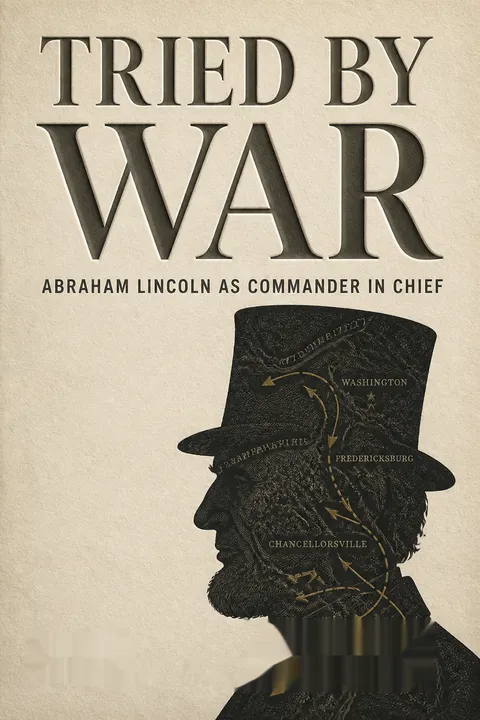
Tried by War is a well-researched but somewhat disappointing book focusing on Lincoln's role as Commander-in-Chief during the Civil War. While it provides insight into Lincoln's military decision-making and interactions with generals, many readers found it lacking in new information and analysis. Some praised its concise overview of the war from Lincoln's perspective, while others felt it strayed from its premise. The book's accessibility and McPherson's writing style were generally appreciated, but its depth and originality were questioned by more knowledgeable readers.
People Also Read


Glossary
Anaconda Plan
Confederate isolation strategyWinfield Scott’s proposed strategy for suppressing secession through a naval blockade and Union control of the Mississippi River. By sealing the Confederacy off from outside trade and dividing its territory, Scott hoped to compel surrender with less destruction than a major invasion. Lincoln considered the plan too passive as public pressure for offensive action grew.
concentration in time
Coordinated multi-front pressureLincoln’s strategic idea that Union forces should threaten several Confederate positions at once. The Confederacy could shift troops between fronts using interior routes, while the Union had greater numbers but operated from exterior lines. Simultaneous advances could force Confederate commanders to weaken one position to reinforce another, giving Union forces an opening.
contraband of war
Escaped enslaved people aiding Union forcesA label General Benjamin Butler applied to enslaved people who reached Union lines after working for Confederate forces. He argued that they could be treated as enemy property seized during war, rather than returned to their owners under the Fugitive Slave Law. The policy created an early route for the Union to employ escaped people and avoid restoring them to slavery.
hard war
War against Confederate resourcesA Union approach that moved beyond avoiding harm to Southern property and civilians. It treated resources sustaining the rebellion, including enslaved labor, food, transport, and military infrastructure, as legitimate targets for seizure or destruction. The approach gained support as conciliation failed and Confederate resistance continued, though its application varied across commanders and campaigns.
war power
Emergency executive authorityLincoln’s description of the authority he used as commander in chief to resist rebellion and preserve the United States. He invoked it to justify measures including calling troops into service, imposing a blockade, suspending habeas corpus, and issuing the Emancipation Proclamation. The Constitution does not use this exact phrase, and the scope of such authority remained contested.
10 percent plan
Wartime state restoration proposalLincoln’s 1863 plan for rebuilding loyal state governments in former Confederate states. When voters numbering at least 10 percent of a state’s 1860 electorate took an oath of allegiance and accepted emancipation, they could establish a state government eligible for presidential recognition. Lincoln presented it as a wartime measure to weaken the Confederacy and restore federal authority.
FAQ
What's Tried by War: Abraham Lincoln as Commander in Chief about?
- Lincoln's Leadership Focus: The book explores Abraham Lincoln's role as Commander in Chief during the Civil War, detailing his military strategies and decisions.
- Military and Politics: It emphasizes how Lincoln navigated the complexities of war while balancing political pressures and public opinion.
- Civil Liberties and War: The narrative discusses the tension between civil liberties and wartime measures, such as the suspension of habeas corpus.
Why should I read Tried by War: Abraham Lincoln as Commander in Chief?
- In-depth Historical Insight: The book provides a comprehensive analysis of Lincoln's presidency during a pivotal time in American history.
- Leadership Lessons: It offers valuable lessons on leadership, particularly in crisis situations, showcasing Lincoln's adaptability.
- Rich Documentation: Authored by renowned historian James M. McPherson, the book is well-researched with extensive primary sources.
What are the key takeaways of Tried by War: Abraham Lincoln as Commander in Chief?
- Strategic Decisions: Lincoln prioritized the destruction of the Confederate army, which was crucial for the Union's victory.
- Civil Liberties vs. Security: The book highlights the struggle between maintaining civil liberties and ensuring national security during wartime.
- Adaptability: Lincoln's ability to learn from his generals' failures and adapt his strategies is a significant aspect of his legacy.
What are the best quotes from Tried by War: Abraham Lincoln as Commander in Chief and what do they mean?
- "Destroy the rebel army...": This quote reflects Lincoln's primary military objective to restore the Union.
- "The judgments of the Lord...": It suggests Lincoln's belief in divine justice regarding the war's moral implications.
- "I will keep my faith...": This statement underscores Lincoln's commitment to emancipation and justice.
How does James M. McPherson portray Lincoln's military strategies in Tried by War?
- Hands-on Commander: Lincoln is depicted as deeply involved in military strategy and operations, often communicating directly with generals.
- Learning and Adapting: He learned from his generals and adapted his strategies, which was crucial for overcoming setbacks.
- Balancing Politics and Warfare: Lincoln's strategies were influenced by political considerations, balancing public opinion and military objectives.
What challenges did Lincoln face as Commander in Chief according to Tried by War?
- Limited Military Experience: Lincoln had to quickly learn military strategy and command, entering the presidency with little experience.
- Political Pressures: He faced intense political pressures from various factions, balancing demands while maintaining war support.
- Managing Generals: Lincoln struggled with generals who had differing strategies and competence levels, complicating military plans.
How did Lincoln's views on slavery evolve throughout Tried by War?
- Initial Caution: Lincoln initially focused on preserving the Union, cautious about addressing slavery to maintain support.
- Shift to Emancipation: As the war progressed, he recognized the necessity of emancipation to weaken the Confederacy.
- Emancipation Proclamation: This strategic war measure marked a significant turning point, aligning military objectives with moral imperatives.
What role did public opinion play in Lincoln's decisions as described in Tried by War?
- Influence on Strategy: Public opinion influenced Lincoln's military strategies and decisions, as he needed to maintain support.
- Political Calculations: He balanced demands from abolitionists and border-state Unionists, shaped by the political landscape.
- Response to Criticism: Lincoln was responsive to criticism, understanding that military failures could lead to political repercussions.
How did Lincoln's relationship with his generals evolve in Tried by War?
- Initial Deference: Lincoln initially deferred to his generals, believing in their expertise despite their shortcomings.
- Growing Frustration: His frustration grew with generals' reluctance to engage the enemy, leading to a more active role.
- Direct Intervention: Lincoln began directly intervening in military matters, becoming more assertive as Commander in Chief.
How does Tried by War address the theme of leadership in times of crisis?
- Lincoln's Resilience: The book portrays Lincoln as a resilient leader who adapted and learned from failures.
- Decision-Making Under Pressure: Lincoln made critical decisions under pressure, balancing military and political considerations.
- Legacy of Leadership: His leadership during the Civil War set a precedent for future presidents, impacting American political leadership.
What impact did the Emancipation Proclamation have on the Civil War according to Tried by War?
- Moral and Political Shift: It transformed the war into a moral crusade against slavery, galvanizing support for the Union.
- International Implications: The proclamation affected international relations, making it difficult for nations to recognize the Confederacy.
- Military Recruitment: It allowed for the recruitment of black soldiers, bolstering Union numbers and changing war dynamics.
How did Lincoln's leadership style influence the outcome of the Civil War?
- Decisive Leadership: Lincoln's decisive leadership was critical for the Union's success, demonstrated by appointing Grant as general-in-chief.
- Adaptability and Learning: His adaptability and willingness to learn from experiences allowed him to refine strategies.
- Emphasis on Unity: Lincoln's focus on national unity helped maintain support for the war effort, reinforcing the moral imperative of preserving the Union.
Download PDF
Download EPUB
.epub digital book format is ideal for reading ebooks on phones, tablets, and e-readers.








