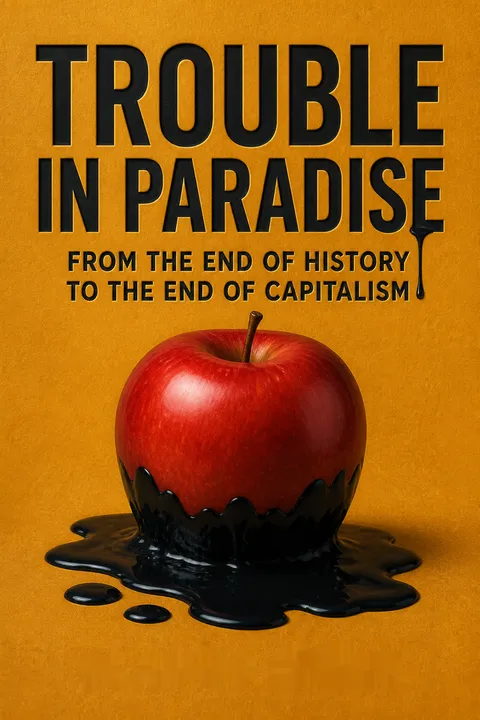


Key Takeaways
Judge prosperity by its casualties, not only by its growth.
Success has a shadow. The book opens by challenging the idea that rising wealth proves a society is healthy. South Korea appears as a technological and economic success, yet the account describes punishing work rhythms, isolation, precarious jobs, and a high suicide rate. Citing a 2013 report, it gives a rate of 28 suicides per 100,000 people, then the world’s highest. The point is not that material progress is unreal. It is that progress can deepen pressures and expectations faster than people can absorb them.
Growth creates new tensions. As living standards improve, people may acquire new expectations and become more alert to inequality. Revolt can follow rising hope, not only extreme deprivation. The question is therefore not simply whether life is getting better, but for whom, at what cost, and with what new forms of insecurity.
What's striking is the refusal to treat prosperity and suffering as competing descriptions. They can be produced by the same system: better technology and consumption alongside faster work, weaker security, and diminished social connection. This resembles the distinction in public health between average outcomes and their distribution. A rising average can conceal worsening conditions for particular groups. The caution is causal: the Korean example powerfully dramatizes the argument, but suicide rates have multiple social and personal causes. The case is best read as a warning against equating economic indicators with human flourishing, not as proof that growth alone causes despair.
Treat the excluded as products of capitalism, not outsiders to it.
Exclusion is systemic. Capitalism does not merely employ workers and leave a separate pool of unemployed people behind. Its drive for productivity can make workers unnecessary, while also producing people who are permanently or illegally employed, unemployable, or pushed into slums and precarious work. The book extends exploitation beyond the wage earner: people can be harmed by being denied access to productive work and social participation.
The global links matter. Eastern Congo can look like a remote zone of ethnic conflict, but local armed groups control mineral-rich territory through commercial relationships with foreign companies. Those minerals enter high-tech products. The apparent distance between consumer economies and excluded populations is misleading: exclusion and incorporation can be two sides of the same supply chain.
This account usefully challenges the habit of treating unemployment as an individual failure or a temporary gap in an otherwise healthy economy. It also makes supply chains politically visible: a polished device can depend on labor and extraction hidden from its buyer. The broader idea resembles structural accounts of poverty, where institutions shape who gets access to work, assets, and bargaining power. A necessary distinction remains: not every person outside formal employment experiences the same harm, and informal work can involve agency as well as exploitation. The framework is strongest when it reveals connections without making diverse lives interchangeable.
Read debt as a claim on future behavior, not just money.
Debt disciplines the future. Neoliberal policy recasts people as “entrepreneurs-of-the-self,” responsible for investing in their own education, housing, health, and retirement. When public guarantees shrink, loans and private insurance fill the gap. The borrower is formally free to choose, yet must manage risks without equal resources or power. Debt then shapes present conduct around the promise to repay.
Repayment can become control. The book points to Argentina’s early repayment of its IMF debt. Rather than simply celebrating repayment, the IMF worried that the country might use its new freedom to change policy. That reaction suggests that debt can serve institutional influence, not only financial return. A debtor’s failure may also be built into demands that are impossible to meet, as the author argues of austerity imposed on Greece.
The analysis connects household credit, employment appraisal, and sovereign lending through a shared mechanism: future obligations are used to organize present choices. This is a valuable counterweight to language that portrays debt as a neutral contract between equal parties. Yet the analogy has limits. A student loan, a mortgage, and a state bond differ in scale, law, and available remedies; debt can also fund useful investment. The sharpest question is not whether borrowing is inherently oppressive, but who sets the terms, who bears the downside, and whether repayment rules leave room for democratic choice.
Protect the shared conditions that make individual freedom usable.
Choice needs a foundation. The book argues that freedom is not just having options on paper. A person who can choose among health insurers but cannot afford care has a thin form of choice. Universal healthcare, public education, and reliable services can reduce the time and anxiety spent managing basic risks, making other choices more real.
Convenience can conceal control. Cloud services make digital tools feel personal and effortless, while data and decisions are handled in remote systems users cannot inspect. The more seamless the interface, the more hidden infrastructure may be coordinating it. The same tension appears in political rhetoric: people are told that insecurity gives them freedom to reinvent themselves, even when they have little control over the conditions forcing them to move from job to job.
This distinction anticipates a central concern in capability-based theories of freedom: rights matter most when people have the practical means to use them. It also clarifies why public provision need not oppose individual agency. A shared floor can expand the range of choices available to each person. The digital example adds a second lesson: convenience is not evidence of transparency. Still, public systems can be bureaucratic, intrusive, or poorly designed. The relevant comparison is not a perfect state against a perfect market, but which arrangements make people more capable of acting without transferring hidden risks onto them.
Look for the ignorance institutions produce, not just the lies they tell.
Power can be openly cynical. The book argues that ideology survives even when officials admit they care about money or influence. Cynicism can itself be a form of blindness: people may understand their immediate interests while missing how their actions reproduce a system they claim to oppose. The Party of Order in France, for example, mocked the republic while helping establish the property relations that made bourgeois republican rule possible.
Public memory is selective. Martin Luther King Jr. is often remembered through his dream of racial equality, while his campaigns against poverty and war are pushed aside. This is not simple forgetting. It is a socially useful narrowing of what his politics mean. Ideology works through omissions, habits, and institutions as well as false claims.
The idea connects naturally to agnotology, the study of how ignorance is made and maintained. Some facts are not hidden; they are rendered irrelevant, difficult to connect, or safe to remember only in a softened form. This explains why exposing hypocrisy does not automatically change minds. The evidence must also challenge the routines and categories that make the hypocrisy tolerable. The argument can, however, become too totalizing if every omission is treated as coordinated design. Institutional incentives often generate patterned silence without requiring a central conspirator.
Turn protest's first unity into a program for social justice.
The uprising is a beginning. In Egypt, people with sharply different aims united against Mubarak. After his fall, the army and the Muslim Brotherhood competed for power, while the diverse networks of workers, students, and other groups that had animated protest risked being sidelined. The book calls attention to the work after the shared enemy disappears: turning demands for democracy into changes in economic and social life.
Rights must reach daily life. Hegel’s “right of distress” gives a legal basis for survival when formal property rights conflict with a person’s life. The book extends this idea to poverty imposed on a whole class: denying people the means to live with dignity can itself be a wrong. Political freedom that leaves people trapped in poverty is incomplete.
The distinction between a coalition against a ruler and a movement capable of governing is crucial. Social movement research often finds that broad coalitions can mobilize quickly around a shared grievance but struggle to agree on institutions and distribution afterward. The book’s emphasis on social justice gives that transition a clear test: does political change alter people’s material security? The risk is that invoking a unified emancipatory goal can obscure disagreements among the people supposedly represented. Durable change needs both a demanding vision and procedures that let affected groups contest how it is interpreted.
Connect local struggles before nationalism turns neighbors into enemies.
Look past the loudest divide. Turkey’s 2013 Gezi protests began around a park threatened with commercial redevelopment, but expressed wider anger at privatization, authoritarianism, and the narrowing of public life. The book argues that market expansion and religious authority can reinforce one another rather than cancel each other out.
Solidarity can cross identity lines. In Bosnia, protesters from different ethnic communities waved Bosnian, Serbian, and Croatian flags together while demanding jobs and an end to corruption. Their common target was not another ethnic group, but the nationalist elites who claimed to protect them from one another. The book urges movements to build links across borders and identities, rather than let geopolitical rivalries absorb demands for dignity and material security.
This is a persuasive account of how political framing can either reveal or hide shared interests. A park, a job, or a public service is local, but conflicts over who controls it can connect to larger patterns of privatization and power. Cross-group solidarity also changes what a protest means: it refuses the assumption that identity determines political allegiance. Such alliances are difficult to sustain, however. Shared opposition does not erase unequal histories or conflicting needs. Solidarity becomes credible when it gives those differences room, rather than treating them as distractions from unity.
Use universal rights to remake identity, not restore an imagined past.
A wound can open possibilities. The book rejects the idea that liberation requires recovering an untouched pre-colonial identity. Colonialism violently disrupted societies, but the resulting rupture can also create space for new political identities. Frantz Fanon’s universalism matters here: solidarity need not be limited to one race or historical injury.
The imposed language can be repurposed. Some Dalit thinkers in India have treated English and the formal equality of law as resources against caste restrictions, rather than simply symbols of colonial domination. The point is not to praise colonial rule. It is that an inherited medium can be taken over and used to demand rights that existing traditions denied. Liberation may require transforming the tools and identities formed through historical violence, not pretending they can be cleanly erased.
The argument offers a useful alternative to two easy positions: celebrating a supposedly pure tradition, or treating Western universalism as politically innocent. It asks who can use a universal language, and whether its principles can be turned against the institutions that first imposed them. This resembles postcolonial accounts of strategic appropriation, where subordinated groups repurpose dominant forms. The danger is that rupture can be romanticized. Colonial violence does not become emancipatory simply because people later make something from it. The distinction between an enabling consequence and a moral justification is essential.
Treat communism as the question of who governs the commons.
The horizon is a problem. The book does not present Communism as a finished plan. It uses the “Communist hypothesis” to ask how shared resources should be governed: nature, knowledge, and the social conditions no one can build alone. This shifts attention from nostalgia for past regimes to the unresolved problem of collective control.
Exchange can be organized differently. Kojin Karatani distinguishes gift exchange, relations of domination and protection, and commodity exchange. He proposes a future return to gift exchange at a transformed level, not as charity but as reciprocal social organization. The author warns against assuming that abolishing market obstacles will release unlimited productivity. Piketty’s tax proposal and Sloterdijk’s voluntary giving differ, but both largely preserve the capitalist machinery and try to correct its distribution.
The strength of this framing is that it makes the commons concrete: the issue is not whether people are naturally generous, but how institutions organize access, contribution, and decision-making. Digital knowledge and ecological resources make the limits of private ownership especially visible. The caution is equally important. Gift exchange can create obligations, status hierarchies, and exclusions of its own; reciprocity is not automatically egalitarian. A serious alternative therefore needs more than goodwill. It needs durable rules for allocating resources and resolving conflict without recreating domination under a friendlier name.
Measure violence by the order it preserves as well as the blood it spills.
Spectacle hides structure. In The Dark Knight Rises, a popular uprising is portrayed through executions, disorder, and mob rule, while the economic arrangements that produced inequality remain largely offstage. The book argues that this contrast makes visible revolt seem uniquely violent and ordinary economic harm seem natural. Mark Twain’s comparison of revolutionary terror with the slow violence of hunger and deprivation makes the same challenge: count suffering beyond spectacular episodes.
Do not excuse political violence. The argument is not that revolutionary violence is harmless or automatically justified. It is that condemning it from outside a political project can miss why that project failed and why coercion became central to it. Any movement must be judged by its own aims and by the institutions its methods create.
This is a valuable corrective to moral accounting that notices a riot but not the daily coercion of poverty, insecure work, or state power. It also asks viewers to inspect how popular culture allocates sympathy: the billionaire philanthropist often appears more legitimate than the crowd demanding structural change. Yet expanding the definition of violence can blur distinctions that matter for victims and accountability. Physical assault, state repression, and economic deprivation are not identical. The comparison works best as an expansion of attention, not as a way to flatten different harms into one category.
Use leadership to awaken agency, then make its authority answerable.
Movements need more than spontaneity. The book doubts that leaderless, horizontal protest can sustain political change indefinitely. In the author’s account, people often need a figure who makes a difficult choice legible and helps them recognize their own shared aims. This leader does not simply claim to know what people want; a genuine political leader articulates a possibility people can decide to follow.
A right can challenge the rules. Hegel’s right of distress holds that a person facing a threat to life may claim necessities even against another’s property. The book extends the principle to people systematically denied dignified survival, linking the right to collective resistance. Leadership, on this view, should make agency possible, not replace it. The unresolved practical question is how a movement prevents a necessary authority from hardening into a new domination.
The section confronts a real organizational problem: decentralized groups can generate energy and insight, but decision-making and continuity become harder as movements grow. Leadership can coordinate action and clarify priorities, while the right of distress offers a principled limit on property claims that endanger survival. Neither point settles the institutional design question. Leaders need mechanisms of accountability, and emergency claims need public standards rather than unchecked discretion. The book is most useful here as a challenge to reflexive anti-hierarchy, not as a warrant for personal rule.
Analysis
Trouble in Paradise is a political diagnosis assembled from crises, films, jokes, protests, and philosophical arguments. Its governing claim is that capitalism can deliver real prosperity while making social life increasingly insecure, unequal, and difficult to understand as a shared world. The book’s strength lies in refusing comforting separations: growth from deprivation, consumer freedom from surveillance, democratic protest from economic power, or respectable finance from theft. Its examples repeatedly expose how what appears to be an isolated failure may be built into the system that claims to have caused it accidentally.
The book is also a theory of political perception. Debt turns social provision into private responsibility; cynicism can coexist with ideological blindness; protest can begin with a broad unity that dissolves once power changes hands. The proposed Communist horizon is therefore less a blueprint than a way to ask who controls common resources and whose suffering is made invisible. This allows the argument to take historical failures seriously without treating them as proof that alternatives are impossible.
Its method has costs. The dense psychoanalytic and Hegelian vocabulary can make very different cases appear as expressions of one underlying structure. The move from interpretation to political prescription is especially difficult: the demand for leadership and the willingness to discuss violence are not accompanied by a detailed account of safeguards, institutional design, or how competing groups should make binding decisions. Some of the book’s empirical examples also belong to the political moment of 2014 and should not be mistaken for current measurements or forecasts.
The result is best read as an unsettling interpretive map, not a policy manual. It teaches readers to ask what a system requires them not to see, and to test whether political victories change the distribution of power and the conditions of ordinary life. Its most durable challenge is to imagine emancipation without confusing a compelling rupture with a just settlement.
Review Summary
Trouble in Paradise receives mixed reviews. Many praise Žižek's provocative ideas and engaging style, finding his critique of capitalism thought-provoking. Readers appreciate his cultural references and humor. However, some find the book disjointed and difficult to follow, criticizing Žižek's tendency to ramble and lack of clear solutions. The book's analysis of global issues, including inequality and political extremism, is generally well-received. While some consider it a valuable contribution to contemporary philosophy, others find it frustratingly abstract and convoluted.
People Also Read





Glossary
Communist hypothesis
A horizon for shared controlA political framework, associated in the book with Alain Badiou, for diagnosing capitalism and imagining collective control of common resources. It is not a detailed institutional blueprint or a claim that past Communist regimes succeeded. The term names a continuing question about how people might organize shared life beyond capitalist ownership and competition.
cognitive mapping
A map of systemic relationsA way of connecting a person’s local experience to the larger economic and political structures that shape it. Without such a map, global capitalism can feel powerful yet meaningless, while unemployment, debt, or conflict appears as an isolated personal or local problem. The concept is associated in the book with Fredric Jameson and Alain Badiou.
entrepreneur-of-the-self
A person treated as personal capitalA neoliberal model of the individual as a small enterprise expected to invest in personal capacities, manage risks, and maintain future employability. Education, health, housing, and retirement become individual investment decisions rather than secure social rights. The book stresses the asymmetry: people are made responsible for risks they often lack the resources or power to control.
superego
A punishing, impossible commandA psychoanalytic concept that the book uses for an authority that demands the impossible and intensifies guilt when its demands are obeyed or breached. Unlike a straightforward moral guide, the superego can take perverse satisfaction in failure. In political life, austerity demands and individualized blame can make people feel guilty while leaving the structures producing their predicament untouched.
institutional Unconscious
Disavowed practices sustaining institutionsThe hidden or publicly disavowed practices that help an institution reproduce itself while contradicting its declared principles. The concept shifts attention from the private motives of individual members to the institution’s recurring patterns and silences. In the book’s account, exposing this underside can threaten membership because it challenges what the group treats as the basis of its solidarity.
modes of exchange
Forms organizing social exchangeKojin Karatani’s framework for interpreting social history through exchange rather than production alone. The book describes gift exchange, domination paired with protection, and commodity exchange, then a possible transformed return to gift exchange. Earlier forms do not simply disappear: elements of community and state power remain intertwined with capitalist markets.
right of distress
A survival claim against propertyHegel’s term for a claim that can arise when preserving life conflicts with another person’s property rights. The book emphasizes that this is presented as a right, not merely an appeal for mercy. It extends the idea to conditions in which a whole class is denied dignified survival, raising the question of whether resistance can challenge the legal order that sustains that deprivation.
Master
A figure clarifying collective actionA psychoanalytic and political term for an authority that gives a decision or shared project a form people can act upon. In the book’s emancipatory use, a true Master does not claim to know people’s interests better than they do; the figure helps them recognize and pursue a possibility they could not yet articulate. The concept remains risky because authority can become domination.
FAQ
What's Trouble in Paradise: From the End of History to the End of Capitalism about?
- Crisis of Capitalism: The book examines the ongoing crisis of capitalism, challenging the notion of the "End of History" and highlighting the need for a radical rethinking of social and economic structures.
- Cultural and Political Analysis: Žižek uses cultural references to illustrate the complexities of desire, power, and societal norms, drawing parallels between cinematic narratives and contemporary political struggles.
- Call for Emancipation: It advocates for a renewed commitment to radical emancipatory ideals, suggesting that true freedom and equality can only be achieved through collective action and a reimagining of societal values.
Why should I read Trouble in Paradise by Slavoj Žižek?
- Critical Perspective: Žižek offers a unique lens on contemporary issues, blending philosophy, psychoanalysis, and cultural critique to challenge readers' understanding of capitalism.
- Engaging Writing Style: The book is accessible yet thought-provoking, using humor and cultural references to keep readers engaged while exploring serious topics.
- Relevance to Current Events: Given ongoing global economic challenges, the book's analysis remains pertinent, encouraging critical thinking about power structures and potential for social change.
What are the key takeaways of Trouble in Paradise?
- Crisis of Capitalism: The book emphasizes that the current crisis is a fundamental challenge to the capitalist system, revealing its inherent contradictions.
- Role of Ideology: Žižek discusses how ideology shapes perceptions and behaviors, highlighting the importance of recognizing these influences for genuine social change.
- Emancipatory Potential: It advocates for a return to radical ideals of equality and solidarity, suggesting that true emancipation requires collective action and a commitment to social justice.
What are the best quotes from Trouble in Paradise and what do they mean?
- “What is the robbing of a bank compared to the founding of a bank?”: This quote challenges the morality of economic systems that prioritize profit over people, highlighting capitalism's hypocrisy.
- “The more you obey its demands, the more you are guilty.”: Reflecting the paradox of the superego, this statement illustrates how societal norms can trap individuals in a cycle of expectation and shame.
- “The crisis is not just the result of inadequate financial regulations, it expresses the intrinsic difficulty to make immaterial capital function like capital.”: This underscores capitalism's limitations in adapting to new economic realities, particularly in the digital age.
How does Slavoj Žižek connect cinema to his analysis in Trouble in Paradise?
- Cinematic Examples: Žižek frequently references films to illustrate philosophical arguments, using them as cultural touchstones to explain complex ideas.
- Cultural Critique: By examining films, he reveals how popular culture reflects and shapes societal values and ideologies, serving as a lens to understand contemporary life.
- Philosophical Insights: Cinema grounds theoretical discussions in relatable narratives, making abstract concepts more accessible and emphasizing the interplay between culture and ideology.
What is the role of ideology in Trouble in Paradise by Slavoj Žižek?
- Shaping Perceptions: Ideology plays a crucial role in shaping how individuals perceive their reality and their place within it, influencing beliefs, desires, and actions.
- Ideological Critique: The book encourages critical examination of governing ideologies, revealing complicity in one's own oppression and fostering genuine social change.
- Path to Emancipation: Understanding ideology allows individuals to challenge the status quo and work towards a more equitable society, essential for meaningful liberation.
How does Slavoj Žižek address the concept of debt in Trouble in Paradise?
- Debt as Control: Debt functions as a mechanism of control within capitalist societies, shaping individual identities and social relations.
- Psychological Implications: It can lead to feelings of guilt and inadequacy, reflecting broader societal pressures and expectations.
- Call for Change: Žižek urges a reevaluation of our relationship with debt, recognizing its role in perpetuating inequality and advocating for social justice.
What does Slavoj Žižek mean by "being-towards-debt" in Trouble in Paradise?
- Existential Framework: This term highlights the pervasive influence of debt on personal identity and social relations within a capitalist system.
- Cultural Critique: It critiques the normalization of debt as a way of life, suggesting it reflects deeper societal issues and can lead to hopelessness.
- Path to Liberation: Recognizing "being-towards-debt" implications allows individuals to challenge structures perpetuating indebtedness, crucial for achieving true freedom.
How does Trouble in Paradise relate to current global issues?
- Reflection of Economic Crises: The book's analysis resonates with contemporary global economic challenges, including rising inequality and financial instability.
- Social Movements: Žižek's call for radical change aligns with social movements advocating for justice and equality, providing a theoretical foundation for understanding and participation.
- Cultural Relevance: By connecting philosophical concepts to popular culture, Žižek makes his arguments accessible and relevant, fostering a deeper understanding of modern life's complexities.
How does Slavoj Žižek use the Mandela funeral interpreter incident in Trouble in Paradise?
- Symbol of Meaninglessness: The incident illustrates how political gestures can lack genuine meaning, highlighting the disconnect between appearance and reality in political discourse.
- Critique of Political Correctness: The interpreter's meaningless signs serve as a metaphor for performative political correctness, where actions appear virtuous without effecting real change.
- Reflection on Solidarity: It prompts reflection on solidarity's nature and how it can be co-opted or misrepresented in public life.
What does Slavoj Žižek mean by “the right of distress” in Trouble in Paradise?
- Hegelian Concept: This legal right allows individuals in extreme situations to act against property rights for survival, highlighting tension between individual needs and societal laws.
- Moral Justification: Žižek extends this right to oppressed classes, suggesting their rebellion against the system is legitimate.
- Call for Revolution: It serves as a foundation for advocating revolutionary action, emphasizing moral authority to reclaim dignity through resistance.
What is the significance of the “Master” figure in Trouble in Paradise by Slavoj Žižek?
- Need for Leadership: Žižek argues for a new type of Master to inspire collective action and guide social movements, contrasting with past leadership failures.
- Transference and Authority: The Master figure establishes authority and direction within movements, helping individuals transcend limitations and engage in meaningful action.
- Rejection of Cynicism: The book critiques contemporary distrust of authority, suggesting a healthy relationship with a Master can facilitate genuine political engagement and transformation.
About the Author



Download PDF
Download EPUB
.epub digital book format is ideal for reading ebooks on phones, tablets, and e-readers.








